Can you feel the momentum? Our last month was filled with key releases and news, such as:
👾 Sonic Arcade
💥 Sonic Gateway
🥤 Sonic & Sodas
🎓 Sonic University
Read the #Sonic Insights newsletter:
https://t.co/WpyeoAdczh
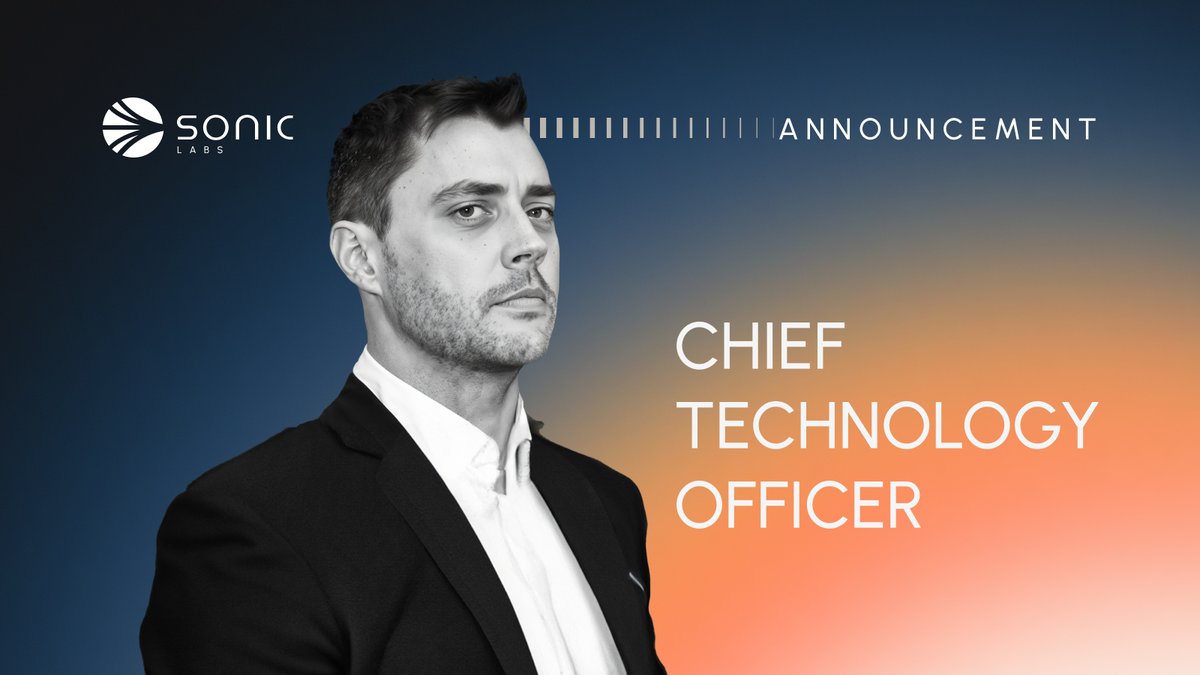
We're thrilled to announce @AndreCronjeTech is expanding his role to become the CTO of Sonic Labs!
Andre plays a key role in developing and launching #Sonic, the world’s fastest EVM chain, with a secure gateway to Ethereum and true one-block finality.
🔗 https://t.co/JJFZ7AUahi
🎉 IT'S OFFICIAL! We're now Sonic Labs.
We're excited to launch #Sonic Labs across all platforms as we move toward the release of Sonic, the fastest EVM chain with a secure gateway to Ethereum.
Check out the new Sonic Labs splash page.
🔗 https://t.co/RwTCVom6Oi
📣 Governance News 📣
Our 3rd #Sonic proposal is here! Ecosystem grants, novel burn mechanism, and innovative programs like Sonic Spark and Sonic University.
In addition to an up to 200M FTM Innovator Fund, this is set to skyrocket Sonic 🚀.
Vote now 👇
https://t.co/tYvADpQ4f7
We're teaming up with @GoogleCloud!
Our partnership will launch initiatives for #Fantom developers to build next-gen dApps using Google Cloud's advanced AI and infrastructure.
👀 Plus, Google Cloud is now running a validator on our network!
Learn more👇
https://t.co/4B1dhzYpf8
📣 Governance News 📣
Our new forum post focuses on the future of #Fantom and initiates a series of governance votes regarding our new network, Sonic ( $S ).
We're asking for the community's feedback on proposed changes, programs, and initiatives.👇
https://t.co/n7kfHvvdWG
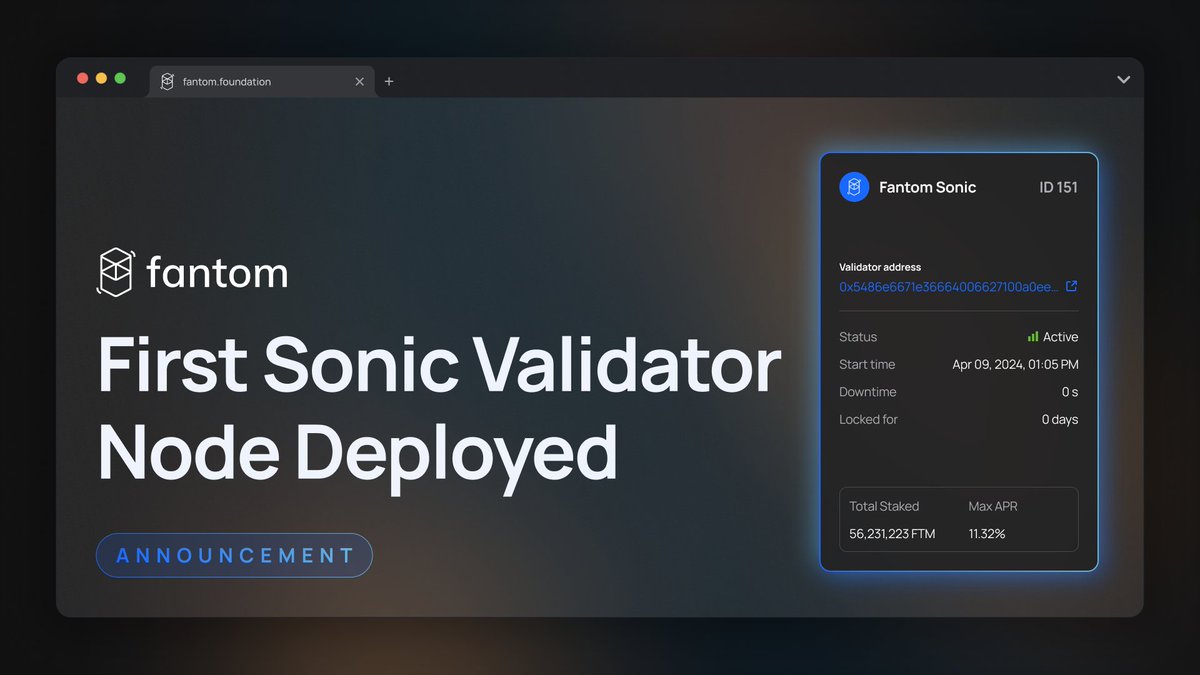
The first #Fantom validator using Sonic tech is live ✅
Marking a major milestone, this deployment paves the way for unleashing Sonic's impressive speeds on the Opera mainnet, achieving ~2,000 TPS at sub-second finality.
Check out the validator page here
https://t.co/Vs06AFDbZ2
We are excited to announce that Fantom's canonical stablecoin, $USDC.e, will launch tomorrow (April 5), supported by @Circle and @Wormhole 🎉
USDC.e on Wormhole is bridged from native $USDC, located in a smart contract on Ethereum, and holds the potential to be upgraded to native USDC in the future. It will be the official, endorsed stablecoin of the #Fantom ecosystem (and all future network upgrades).
This initiative reduces liquidity fragmentation, introduces stability, and provides additional on-ramps onto the ecosystem. By leveraging the Wormhole Native Token Transfers (NTT) standard, USDC.e will be available to all users and developers on Fantom:
💻 Developers: Build on bridged USDC with a contract address that will persist even if there is an upgrade to native USDC. No code change needed to support the new asset. Find the tools here: https://t.co/X3aKDWlVDe.
👥 Users: Store, pay, trade, borrow, and lend with bridged USDC that would automatically become native USDC should there be an upgrade. No need to swap to the new asset.
🌍 Ecosystem: Avoid the time-consuming liquidity migration process of educating and incentivizing users to move from bridged USDC to native USDC should there be an upgrade.
We'll be providing liquidity for the canonical stablecoin on Wormhole, making it easy and accessible for users to bridge assets to Fantom and unifying on-chain liquidity.
Should a mutual decision be made between Circle and Fantom to upgrade to native USDC, all USDC.e tokens seamlessly transition to native USDC without the need for developers to update any contract addresses or swap to the new asset.
@chainyoda Fantom is like Japan's bullet train. You blink, and it has already delivered your transaction - quick, precise, and leaving you wondering how it's possible without breaking the laws of physics.
We’re very excited to announce some of our angels over the coming weeks. To provide further clarity, their token allocation is coming from the existing Fantom treasury.
We've listened to community feedback and are onboarding key DeFi players and investors in the space.
@AndreCronjeTech@hy165778 I can think of one: Uptime
"Exemplary 99.9% uptime. Fantom's novel solutions position it as a frontrunner in the development of decentralized networks"
https://t.co/CCPwQdd5yP
Michael Kong Unveils Sonic’s Launch and Beyond
TL;DR
Sonic will be used to create a new best-in-class shared (decentralized) sequencer for L1 and L2 chains, capable of 180M daily transactions at sub-second finality, and serve as the foundation to relaunch Fantom as an entirely new community-centric brand.
On December 27, 2019, the first version of the current Opera network was released based on concepts that Andre Cronje had carefully studied, including Concurrent Common Knowledge (CCK), Lamport Timestamps, and others. It was an amazing achievement by Andre and the technical team — the first permissionless DAG-based protocol that significantly improved scalability and time to finality. Opera achieved a maximum TPS approaching 200 and time to finality of sub 600ms, far more than Ethereum’s 12 TPS and >60-second finality at the time.
The Opera network grew from zero users to become one of the most widely recognized and utilized networks, with over $10 billion in TVL in 2022. There were growing pains, however. At times of enormous demand, the network became congested and the user experience deteriorated.
In response, the Fantom team has been hard at work for the past two years building our new Sonic technology, the most scalable and secure blockchain technology ever. Sonic’s ability to process 2,000 TPS at sub-second finality represents a huge evolution from Opera’s 200 TPS, and the team is very proud of the product.
With Sonic’s tremendous technical capability, it is time for us to further evolve and innovate. Sonic will be used to create a new best-in-class shared sequencer for L1 and L2 chains, capable of processing over 180 million daily transactions with real, sub-second confirmation times, and serve as the foundation to relaunch Fantom as an entirely new community-centric brand. We are working diligently through an array of details and logistics that we look forward to sharing in the coming weeks and anticipate the new chain will launch in the late summer/early fall of this year.
We plan to put forward a governance proposal suggesting the following:
• Bridging and Security: When Opera first launched, the blockchain landscape was nascent, and interoperability and canonical bridges did not exist. With the blockchain’s evolution, Sonic needs a safe, trust-minimized bridge with native Ethereum access. We developed a Sonic rollup implementation, a first-class citizen in our validator set, to fully decentralize the bridge while using our existing network security plus inheriting Ethereum’s economic security. Sonic’s consensus engine is the sequencing layer, providing fast, secure, and convenient use, while substantially minimizing fees and time to finality.
• Simplified Staking and Liquid Staking Support: We plan to simplify our staking such that APR will no longer depend on lock time but rather have a fixed 14-day unbonding period. This will unleash an over $1 billion opportunity for liquid staking tokens (LSTs), significantly increasing DeFi activity and total value locked (TVL). Several LSTs will be supported, ensuring network security is maintained.
• Grant Programs: We will continue to significantly scale and accelerate our Sonic Labs grant program for developers who build unique and valuable applications and public goods in categories including gaming, DeFi, social media, streaming, and now distributed AI.
• Rewards Campaign: There will be an extensive rewards campaign for both the current Opera network to thank existing users for their support, and for the new chain.
• Superset Introduction: When Sonic goes live, supersets will not yet be enabled; they are scheduled for a soft-fork upgrade toward the end of 2024. This will further drastically increase FVM performance.
• Parallel FVM: Chief Research Officer Professor Bernhard Scholz, an expert in virtual machines, and his team believe that adding parallelization to an upgraded Fantom Virtual Machine (FVM) may significantly boost Sonic’s performance. They will continue to explore parallelization in the next evolution of Sonic.
• ZK Execution Scaling: Andre will continue his research in off-chain execution with on-chain verification. Our initial proof of concepts have already shown some success with implementations using zk-SNARKs, but for now, verification cost is still more expensive than execution cost for simple transactions. This will be further expanded by including pre-compiles in the FVM.
• Canonical Stablecoin: For both the current Opera network and the new Sonic stack, a canonical stablecoin is an essential ingredient for the success of DeFi. We expect this to be in place in the very near future.
We look forward to sharing more details in the coming weeks — including an abundance of news around new partners, VC/angel funding, targeted industries and use cases, and audience engagement programs. We remain very excited, and with the backing and encouragement of the largest token holders, stakers, and projects on Fantom, we’re fully committed to this evolution. Stay tuned.
https://t.co/hSgHS9H3sR
Overview of @FantomFDN's Q1 Developments:
Fantom has long been part of the L1 smart contract “wars,” finding success with its Ethereum Virtual Machine (EVM) compatibility and novel consensus mechanism that has remained robust and reliable over the years, whereas other L1s have not. Distinctively employing directed acyclic graphs (DAGs) instead of the conventional blockchain structure, Fantom introduces a novel method for ordering transactions and optimizing storage with local sub-DAGs. Its unique consensus mechanism, Lachesis, combines the strengths of proof of stake and a leaderless, asynchronous approach to consensus, setting Fantom apart in the blockchain ecosystem. This introduction to blockchain consensus and the innovative solutions proposed by Fantom sheds light on the platform's efforts to address critical challenges in achieving decentralized consensus, highlighting its potential to redefine standards for security, efficiency, and scalability in the blockchain domain.
Fantom
Fantom is a layer-1 smart contract platform designed to hold compatibility with the Ethereum Virtual Machine (EVM) through its novel Fantom Sonic technology stack, with key differences. One primary difference is that Fantom uses a directed acyclic graphs (DAGs) data structure (as opposed to traditional blockchain) to help order the chronology of events and transactions on the network and enable storage optimization through local sub-DAGs. Additionally, Fantom combines proof of stake (where validators have deposited funds that can be slashed), incentivizing proper behavior and reporting with a leaderless, asynchronous consensus mechanism called Lachesis. Fantom’s unique approach to its own consensus mechanism is one of its defining features that sets it apart from some of the more traditional models utilized by leading chains like Bitcoin and Ethereum.
Blockchain Consensus
In utilizing a decentralized network, one of the core challenges lies in enabling a disparate group of network participants to reach a consensus on a shared state, such as ownership records on a blockchain. This process must be robust enough to maintain a valid consensus despite the presence of imperfect information or malicious actors, a concept known as Byzantine Fault Tolerance (BFT). These algorithms are designed to ensure, whether through probabilistic or deterministic means, that consensus on the network's next valid state can be achieved even in scenarios where a subset of nodes acts adversarially. Various blockchain architectures tackle this challenge through the implementation of consensus algorithms, each tailored to the specific needs and characteristics of their network.
One of the most renowned consensus mechanisms is Nakamoto's Consensus, which underpins the Bitcoin protocol. This consensus model introduces a unique approach to achieving agreement by necessitating the addition of several subsequent blocks before a transaction is considered irreversible. The rationale behind this requirement is to make the act of altering the blockchain's history—by reorganizing or reverting transactions—economically unfeasible, thereby ensuring the integrity of the transaction record. This is known as probabilistic finality as opposed to deterministic finality (discussed later). As a consequence of this design, Nakamoto Consensus prioritizes network uptime (liveness), maintaining continuous operation without stalls or downtime, as seen in the Solana ecosystem. However, this comes at the cost of transaction speed, as the probabilistic nature of its finalization guarantee necessitates a waiting period for the "confirmation" of blocks to accumulate. This probabilistic finalization is a deliberate design choice, reflecting a preference for a system that remains live and functional, albeit with slower transaction speeds, over one that offers immediate but potentially vulnerable finality.
Safety vs. Liveness
Consensus protocols are designed around two fundamental guarantees: safety and liveness. Understanding these guarantees within the blockchain context requires a deep dive into the nuances of how blockchains operate and the critical role these guarantees play in maintaining the network's reliability and efficiency.
Safety, in this context, ensures that the network remains free from errors or incorrect transactions. Liveness, on the other hand, guarantees that the network continues to operate and reach consensus, thereby allowing transactions to be processed and recorded accurately over time.
Liveness guarantees that correct transactions cannot be indefinitely delayed from being accepted into the blockchain, provided the number of faulty participants does not exceed a certain threshold. This aspect is crucial for the timely processing and finality of transactions. In the context of blockchain, where timing and the order of transactions can significantly impact the network's state, liveness ensures that transactions are continuously added to the blockchain, thereby preventing stagnation and ensuring the network's ongoing functionality.
Consider the scenario where a consensus protocol is improperly configured, leading to nodes becoming entrapped in an infinite loop from which recovery is impossible. This situation directly impacts the network's liveness, as it becomes incapable of progressing past the disagreement to reach a consensus. The result is a network that is effectively paralyzed, unable to fulfill its primary function of validating and recording transactions. Such a network is deemed insecure due to its inability to overcome what is known as a "liveness break," rendering it unavailable for use.
Conversely, the safety of a blockchain network is compromised when a consensus protocol contains vulnerabilities that could, for instance, allow the processing of an invalid transaction through a "double spend" scenario. In this case, if a node can exploit a loophole to convince the majority of the network to accept a fraudulent transaction, the network's safety is breached. Therefore, safety is the assurance that as long as the number of faulty participants remains below a certain threshold, it is impossible for these participants to lead a client into accepting an incorrect or invalid history of transactions. This concept is pivotal because it underpins the trustworthiness of the blockchain. If a blockchain were susceptible to accepting incorrect histories, it would undermine the entire premise of a decentralized and tamper-evident ledger.
The balance between safety and liveness presents a significant challenge in the design and operation of blockchain networks and becomes particularly evident when considering the potential for forks—situations where the blockchain diverges into two or more potential paths forward. Forks pose a critical challenge to consensus protocols, as they necessitate a mechanism to decide which path represents the true continuation of the blockchain.
It has been mathematically demonstrated that achieving perfect safety and liveness simultaneously, under all conditions, is an unrealistic goal for any network. This inherent limitation necessitates the development of networks that are capable of minimizing the risk of these failures to the extent that they become extremely unlikely, economically unviable, or practically impossible to occur.
Addressing these challenges requires a sophisticated approach to consensus design, one that incorporates mechanisms for the detection, elimination, and recovery from potential issues, even in rare or extreme cases. Moreover, the design must offer robust resistance to Sybil attacks, where a single entity creates multiple fake identities to gain a disproportionate influence over the network. This multifaceted approach to network design ensures that while absolute safety and liveness may be theoretically unattainable, the network remains secure, reliable, and efficient in practice.
Solana Downtime
Arguably, the most infamous example of this liveness vs. security vs. performance debate exists with the Solana blockchain. Solana is an L1 smart contract blockchain that unabashedly prioritizes network speed and low transaction cost over other aspects of a blockchain network. Because of this approach, the Solana network has experienced significant challenges in its short history that underscore the complexities innate to maintaining a scalable and secure blockchain.
In September 2021, the Solana network encountered a major security issue when an influx of transactions, initiated by a large number of bots, overwhelmed the network. This incident, occurring on September 14, 2021, highlighted a critical vulnerability: the absence of a fee market within the Solana ecosystem allowed bots to propose an unlimited number of transactions without financial penalty. As a result, the network's "mempool," known as Gulfstream, was flooded, and the block producer was unable to process all transactions within the allotted block time of 200 milliseconds. This led to network validators being overwhelmed by excessive forking, causing the network to stall and ultimately go offline for 17 hours.
However, this was not an isolated incident. Solana suffered another outage six months later due to similar issues of network congestion caused by spam transactions from an NFT project. These recurring outages raised concerns about the network's reliability and the decentralized nature of its governance.
Beyond spam attacks, the network has also faced challenges related to a bug in the durable nonce feature in June 2022, causing the network to go down for approximately four hours. Finally, in February 2024, the Solana blockchain was halted again when it ceased processing transactions due to a critical bug. The underlying problem stemmed from a flawed cache management system within Solana's infrastructure, which compiles smart contracts into executable code. Ultimately, a bug caused an endless recompilation loop for certain programs, jamming the network by preventing the processing of any further transactions. This issue was swiftly rectified approximately five hours later.
Network Downtime Consequences
These incidents have led to scrutiny of Solana, its consensus mechanism, fee structure, and even its decentralization. Specifically, the procedure for restarting the Solana network, as outlined in communications from the Solana community during this latest outage, highlighted a critical dependency: the necessity for a substantial majority of validators, those holding at least 80% of the staked SOL, to be active for the network to resume operations efficiently.
This requirement underscores a potential vulnerability in the network's design, as the failure to achieve this threshold would necessitate another attempt at a restart, this time excluding non-responsive validators. This situation exemplifies the challenges faced by blockchain networks that strive to balance the benefits of decentralization with the practicalities of maintaining operational integrity and security.
Beyond just a credibility hit, degraded downtime/chain performance can have real financial consequences for a chain and its users. Moving to the Ethereum ecosystem, the event known as "Black Thursday" on March 12, 2020, stands as a significant moment in the history of Ethereum and particularly the MakerDAO protocol. On this day, ether (ETH) experienced a precipitous decline in value, shedding approximately 30% of its worth within a 24-hour span. This dramatic downturn triggered a cascade of automatic liquidations of collateralized debt positions (CDPs), a mechanism integral to the MakerDAO ecosystem, which is designed to stabilize the value of its stablecoin, Dai, against the US dollar.
The liquidation of CDPs under normal circumstances is intended to incur a penalty of about 13% of the collateral value, not the entirety of it. However, due to a confluence of adverse factors, some users reported complete losses of their Ethereum collateral without receiving any returns. This anomaly was attributed to two primary issues: the discrepancy between the market price of Ethereum and the price as determined by the oracles that inform the MakerDAO system, and significant network congestion on Ethereum that hindered transaction processing. This significant network congestion was so acute that, in practical terms for many users, the chain was unable to process their transactions and, therefore, functionally “down.” The congestion effectively paralyzed the system of "Keeper" bots responsible for bidding on liquidated collateral at auctions.
The fallout from these events was severe for the MakerDAO community and the MKR token. In response to the protocol losses incurred during Black Thursday, MakerDAO minted approximately 21,000 new MKR, selling them for 5.3 million Dai to recoup the financial shortfall. Not only was the issuance of new MKR tokens a dilutive event for token-holders, but it was also a contentious measure that soured many on the protocol. This event serves as a poignant reminder of the complex interplay between governance, tokenomics, and the underlying blockchain infrastructure in the DeFi sector.
Fantom’s Uptime
In February 2021, the Fantom Opera mainnet experienced its one and only instance of network downtime, marking a rare departure from its otherwise exemplary record of 99.9% uptime. This incident, which temporarily halted new block confirmations, was rectified within seven hours and no funds were lost.
The outage was precipitated by a significant slowdown in block emissions by the two leading network validators. Given that these two validators represented a substantial portion of the network's staking power, their reduced output initiated a chain reaction that effectively paused new block confirmations across the network.
The event also prompted a reevaluation of the network's validator node requirements and the distribution of staking power. Two primary concerns were identified: the recent surge in the value of FTM, which had made the creation of new nodes financially prohibitive, and the excessive concentration of staking power among a limited number of validators, which had more delegations than others. These issues highlighted the need for adjustments to ensure a more equitable and resilient network infrastructure. Since then, the Fantom network has lowered the minimum threshold of staked FTM to become a validator, implemented technical improvements to reduce the hardware requirements to run a validator node, and worked to more evenly distribute the staking power distribution. The combination of the reduced hardware requirements and lower staking requirements removes many of the primary obstacles associated with running a Fantom validator and should lead to further diversification and decentralization of nodes. Beyond these adjustments, Fantom’s consensus mechanism introduces a novel design meant to ensure the best of both liveness and security.
Fantom Consensus
Most consensus protocols employed by leading blockchains incorporate some form of leader election to establish a total order of blocks, ensuring that all transactions are processed in a linear sequence. In these models, a designated leader proposes a block, which is then subject to approval by the rest of the network's consensus nodes. However, the Fantom blockchain introduces a novel approach to achieving consensus without the need for a centralized leader. This is accomplished through its Lachesis protocol, which is distinguished by its leaderless design that integrates directed acyclic graph (DAG) technology with Byzantine fault tolerance (BFT) principles, setting a new benchmark in the realm of blockchain consensus models.
Leaderless BFT
The core of Fantom's Lachesis mechanism is its asynchronous Byzantine fault tolerance (aBFT) approach, which ensures network reliability and integrity, even in the presence of malicious nodes. In traditional BFT systems, the network's trustworthiness hinges on the assumption that no more than one-third of the nodes are adversarial. Lachesis extends this reliability by allowing nodes to process and communicate data asynchronously, without the need for a centralized leader to dictate block production.
The leaderless nature of Lachesis sets it apart from conventional Byzantine Fault Tolerance (BFT) protocols. In Lachesis, each node independently executes the consensus algorithm on its local DAG to derive a consistent order of confirmed blocks. This process culminates in the formation of the final blockchain, achieved without the nodes having to engage in further communication to disseminate finalized blocks across the network. As such, aBFT networks allow for some messages to be lost or indefinitely delayed. This innovative approach significantly reduces the communication overhead typically associated with achieving consensus, streamlining the process, and enhancing the efficiency and scalability of the network.
DAG
At the heart of Fantom's innovative approach is the use of a directed acyclic graph (DAG), a sophisticated data structure that differs markedly from the linear, tree-like structures found in other blockchain technologies. DAGs feature nodes connected by directional edges without allowing for closed loops, facilitating a more flexible and efficient method of data modeling.
Fantom's unique implementation of DAGs involves the creation of "event blocks" by each node, which record transactions and their sequence. Unlike traditional blockchains that maintain a strict linear order of blocks, Lachesis allows for a more flexible arrangement thanks to these event blocks. Each event block contains one or more transactions, and these blocks are partially ordered in a way that reflects the causal relationships between different transactions.
Within this system, every node in the network maintains its own local DAG, which is continuously updated through the exchange of new blocks among nodes. This decentralized architecture ensures that there is no single point of failure and eliminates the need for a global clock to synchronize block creation and validation across the network. Instead, the DAG uses Lamport clocks to establish a chronological order among blocks, with each block referencing its predecessor to denote a temporal sequence and implicitly casting a vote for it. This process is further refined by dividing DAGs into "epochs," which are sealed upon reaching a certain threshold and employing Lamport timestamps to achieve deterministic finality. This contrasts with the probabilistic finality models of other blockchains, where transaction finality is determined by the accumulation of subsequent blocks rather than the logical structure of the DAG.
Conclusion
In summary, Fantom's innovative approach to blockchain consensus through its Lachesis protocol and the use of DAG technology represents a significant leap forward in the quest for a more efficient, secure, and scalable blockchain network. By eliminating the need for a centralized leader and employing a sophisticated data structure, Fantom not only enhances network reliability in the face of adversarial nodes but also significantly reduces the communication overhead associated with traditional consensus mechanisms. This unique combination of features enables Fantom to offer unparalleled benefits in terms of liveness and safety, addressing the perennial challenge of balancing these two critical aspects of blockchain technology. As blockchain platforms continue to evolve, Fantom's novel solutions and commitment to uptime, despite the challenges faced by its counterparts, position it as a frontrunner in the ongoing development of decentralized networks.
Fantom has an exemplary record of 99.9% uptime ✨
Our technology represents a significant leap forward in the quest for a more efficient, secure, and scalable blockchain network.
@ReflexivityRes explored this in its latest report on #Fantom 📝
https://t.co/n8zAL8d3Tk
As we prepare for the #Fantom Sonic mainnet, we want to revisit the closed testnet's incredible performances:
🟦 2,000 TPS (1s TTF) — realistic traffic
🟦 4,000 TPS (1.3s TTF) — ERC-20 swaps
🟦 10,000 TPS (1.6s TTF) — ERC-20 transfers
Learn more here 👇
https://t.co/b9nHV238EC