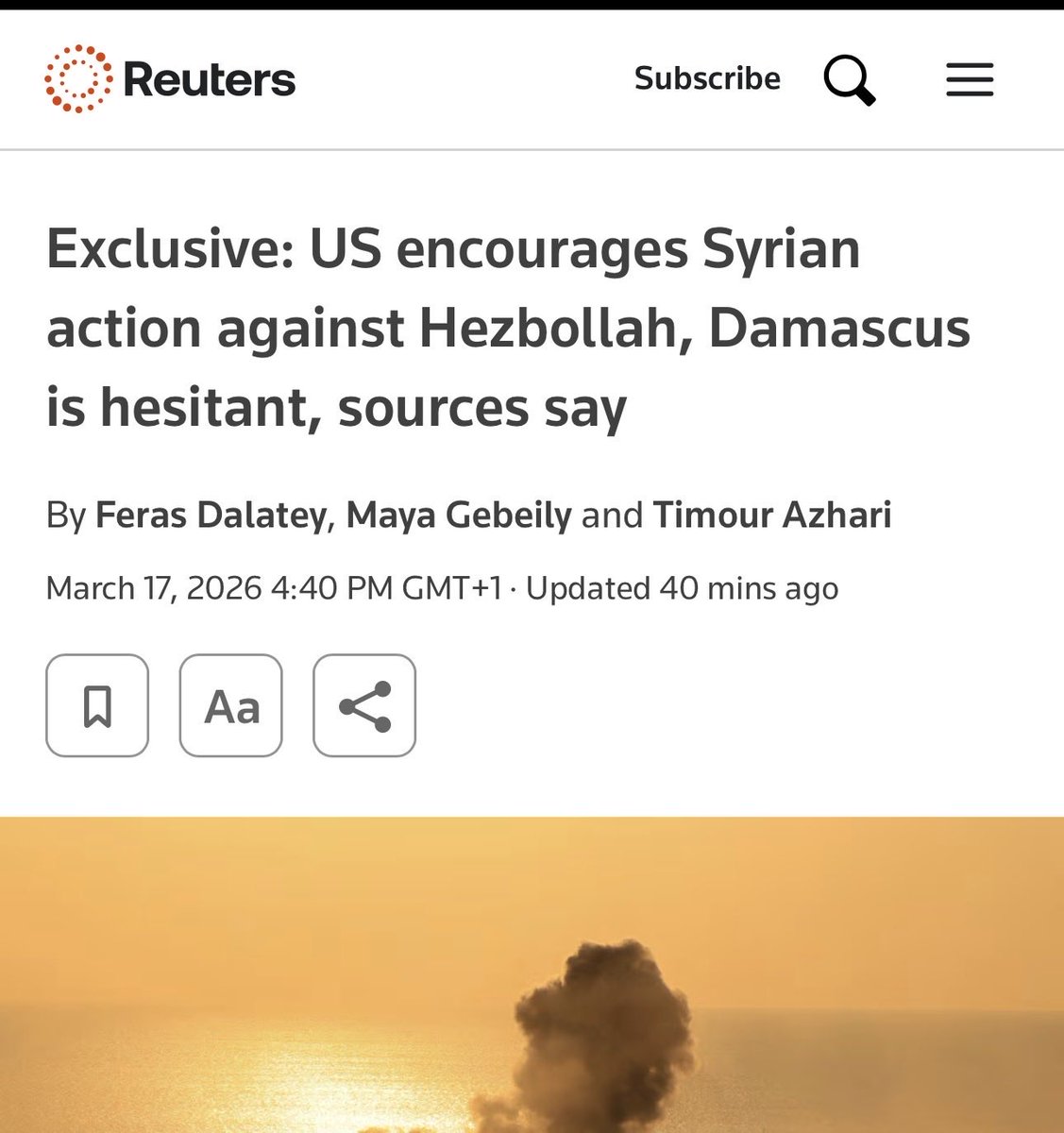
Having visited Syria several times after the fall of the regime, Trump's repeated demands for Syria to take care of Hezbollah are delusional:
- The issue is how Trump is looking at how the Lebanese/Hezbollah issue might be resolved.
- Syria, its army, and its different forces are not ready to do such a thing.
- Most Lebanese would be against this intervention.
Hezbollah should read between the lines and the changes at the regional and international levels, be more humble, and lay down their weapons.
- Syrians should focus on their country first, and enhance the relationship with Lebanon; nothing else.
- Any attempt to play the Sunni card in the triangle of Beqaa, Arsal, and Tripoli would destroy both countries, and Israel would be so happy.
Syria should not, under any circumstances or demands, repeat the mistakes of Hafez alAssad in Lebanon. I believe there are still some people discussing the development in Lebanon and its potential 'collapse' as a pretext, but any intervention in Lebanon simply should not happen.
The settler movement for southern Syria meets with Israel’s Minister of Communications
Some downplay the relevance of these settlers, but having meetings with ministers suggest there’s more legitimacy and buy-in than some would like to admit
Israel is deliberately pushing the Palestinian Authority toward collapse.
This month, the Palestinian Authority paid its employees only $600 toward their January salaries (it is currently three months behind on payments). Doctors, teachers, security personnel, and civil servants all received the same flat payment, regardless of their actual salary.
The EU refused to release €300 million in aid to the PA, telling Palestinian officials they should seek funding from Arab countries instead. Meanwhile, Israel continues to withhold over $5 billion in Palestinian tax revenues — money Israel collects on the PA's behalf under signed agreements and simply refuses to transfer.
This is not a dispute. It is economic strangulation.
Since October 7, more than 200,000 Palestinian workers have lost access to jobs inside Israel. That income was a lifeline for hundreds of thousands of West Bank families. It is gone.
The West Bank economy is in freefall. I have heard the stories firsthand — families who cannot afford food, people who had stable lives two years ago and have nothing today. The situation has deteriorated every single month for the past 3 years, with no floor in sight.
None of this is accidental. Withholding tax revenues, blocking workers, leaving the PA unable to pay salaries — this is a policy.
The goal is to make Palestinian civil governance impossible, to deepen dependency, and to accelerate the conditions for a broader takeover of the West Bank. The collapse of the PA would not be a consequence of Israeli policy. It would be its achievement.
Lebanon should lower public expectations on negotiations, not to concede, but to deny Hezbollah the narrative win every time talks hit a wall. Set the right framework, use technical diplomats, and don’t hand Israel free concessions. https://t.co/Phqgh5JS59
A dozen or so Israeli settlers that want to occupy southern Syria, cross the border yet again today, and this time climb on top of a building in Syria and raise a banner to push for settling southern Syria, which they call “Bashan”
Open access to "The Palestinians: From Peasants to Revolutionaries," by my amazing mother, Rosemary Sayigh, who turned an impressive 99 this month. Published in 1979, it went thru several reprints & translations and remains a landmark book:
https://t.co/TgcYEI9M2J
1/
There is still no official position from the Lebanese authorities regarding the negotiations or the "discussions," as @GhassanSalame called them in his recent interview. Beyond that, the Lebanese gov has provided very little information on its stance, its red lines, or how far these negotiations can actually go.
Minister Salame said that a ceasefire remains the primary demand and that the first session will be purely ceremonial. Given that Israeli approval to meet only came after the massacres last Wednesday, this initial meeting is expected to be nothing more than introductory.
While it is expected that Arab countries would be highly interested in this round of negotiations, I assume Gulf capitals are currently preoccupied with their own affairs. This means they will likely have little influence on the Lebanese stance for now.
The same applies to Syria; despite having the most at stake, Damascus currently has little leverage over Lebanon and will likely watch and receive information rather than act.
Thus, this may be the first time in history that Lebanon enters negotiations with the decision-making centered in Beirut. The heads of state are under less pressure from the regional political 'entourage' that usually dictates Lebanese policy.
2/
On the other side, the Israelis seem to have their own set of demands. While the Alma Center isn't an official government body, their latest policy paper provides a clear sense of the current Israeli headspace heading into negotiations with Lebanon. Interestingly, Hezbollah MP Nawaf Mousawi recently alluded to these same demands. I find it difficult to see how Lebanese authorities could even begin negotiations with such a high bar. Here is a summary of the key points according to Alma:
-The focus has shifted to Beirut, not just the south. The Lebanese state must prove its sovereignty in the capital by outlawing Hezbollah's financial and civilian networks first.
-A formal break in diplomatic ties with Iran and the closure of the Iranian embassy in Beirut, which they view as an IRGC headquarters (a demand already highlighted in their March 15th paper).
-A total "purge" of Hezbollah collaborators within the LAF and security agencies; A force under the Presidency to monitor the Dahieh.
-Permanent halting of smuggling via a physical border barrier with Syria and international supervision at all crossings, coordinated by both Lebanon and Syria.
-International guarantors must outlaw Hezbollah entirely and provide civilian alternatives to the party's social services.
-Israel retains a "green light" via a side-letter to strike any threat or force buildup anywhere in Lebanon at any time.
*In return, Israel would offer a series of "measures" as incentives, framing its military presence as a security tool rather than an objective of occupation. These offers include supplying natural gas, initiating joint management of the Hasbani River, and opening the Rosh Hanikra crossing for tourists (did not understand why, but okay) and religious pilgrimages.
The core issue in Lebanon remains the deep societal fragmentation, even in the midst of war. A significant lack of broad support for Hezbollah at the grassroots level, coupled with the party's tendency to treat the government as an adversary, undermines a unified national front. Between the military defeat, the dire situation in the south, and the pressure of negotiating under fire, Lebanon is currently unable to present a coherent policy paper or even establish a "minimum bar" for negotiations.
@hanihassan26 تماماً - بس بحالة الحرب، فرق ما يكون الكلّ موحد ورا بلده (في حال الحكم أخذ قرار الحرب) او متل الحالة اللبنانية اليوم، الف قسمة المجتمع وبالتالي ضعف زيادة بوقت التفاوض او عدم جدوى التفاوض من اساسها..
Important info here, but why couldn't they achieve a ceasefire for Lebanon, if they actually had leverage over these "commitments"?
"Iran had been able to obtain commitments from the U.S. that Israel would stop targeting Beirut and its suburbs"
https://t.co/drQ5T8bD6w
Safa confirmed for the first time publicly (that I'm aware of) that he was targeted in an Israeli strike in Beirut in 2024 and was wounded.
He also said that Iran had been able to obtain commitments from the U.S. that Israel would stop targeting Beirut and its suburbs
Hezbollah's Naim Qassem has declared a total rejection of negotiations with Israel, labeling them "pointless" and calling for a historic stance to cancel the talks entirely.
This was expected, but it comes alongside news from Islamabad that negotiations between the U.S. and Iran are set to resume. The Lebanese govt has no other choice but to proceed with direct negotiations, and any domestic instability resulting from this obstruction will leave Hezbollah bearing full responsibility.
2/
On the other side, the Israelis seem to have their own set of demands. While the Alma Center isn't an official government body, their latest policy paper provides a clear sense of the current Israeli headspace heading into negotiations with Lebanon. Interestingly, Hezbollah MP Nawaf Mousawi recently alluded to these same demands. I find it difficult to see how Lebanese authorities could even begin negotiations with such a high bar. Here is a summary of the key points according to Alma:
-The focus has shifted to Beirut, not just the south. The Lebanese state must prove its sovereignty in the capital by outlawing Hezbollah's financial and civilian networks first.
-A formal break in diplomatic ties with Iran and the closure of the Iranian embassy in Beirut, which they view as an IRGC headquarters (a demand already highlighted in their March 15th paper).
-A total "purge" of Hezbollah collaborators within the LAF and security agencies; A force under the Presidency to monitor the Dahieh.
-Permanent halting of smuggling via a physical border barrier with Syria and international supervision at all crossings, coordinated by both Lebanon and Syria.
-International guarantors must outlaw Hezbollah entirely and provide civilian alternatives to the party's social services.
-Israel retains a "green light" via a side-letter to strike any threat or force buildup anywhere in Lebanon at any time.
*In return, Israel would offer a series of "measures" as incentives, framing its military presence as a security tool rather than an objective of occupation. These offers include supplying natural gas, initiating joint management of the Hasbani River, and opening the Rosh Hanikra crossing for tourists (did not understand why, but okay) and religious pilgrimages.
The core issue in Lebanon remains the deep societal fragmentation, even in the midst of war. A significant lack of broad support for Hezbollah at the grassroots level, coupled with the party's tendency to treat the government as an adversary, undermines a unified national front. Between the military defeat, the dire situation in the south, and the pressure of negotiating under fire, Lebanon is currently unable to present a coherent policy paper or even establish a "minimum bar" for negotiations.
Quand Kamal Nasser a été assassiné, il était porte-parole de l’OLP, dont le chef était Arafat. Il n’était pas impliqué dans Septembre noir. Je ne sais pas s’il a été membre du FPLP de Habache, mais affirmer que cette organisation serait liée à La France insoumise relève quand même du grand n’importe quoi.
Le FPLP a pratiquement disparu avec la mort de Habache en 2008, et avait déjà perdu une grande partie de son influence avec la fin de l’URSS, bien avant l’apparition de LFI…
Chercher à réduire l’histoire de la résistance palestinienne à un simple récit de terrorisme démontre surtout une obsession anti-palestinienne / anti-arabe.