In 2016, I received an email from an aspiring manga artist in Morocco.
It began like this:
“I want to become a mangaka, but there is no manga publishing industry in Morocco.”
Many people around the world love manga and read it, but when you look globally, there are many countries where manga is simply not published at all.
In some places, there is not even a publishing system(including publishing, translation, and distribution) in place.
Even where books exist, the infrastructure for printing, distribution, and bookstores is often lacking, making it very difficult for a true industry to develop.
Telling manga fans in those countries, “Your country has a relatively high GDP per capita, so you should buy manga,” is meaningless if there is no actual way for them to buy it.
That is something I find deeply painful.
Why is it that the manga industry has not been able to properly serve those regions?
Even in countries where publishing exists, manga books are often too expensive.
The price of a single tankōbon book is $ 15 to $ 20, which is high even in the United States, especially when today’s digital entertainment offers so many alternatives at much lower prices.
So, this is why I believe the future of manga is clearly not limited to print publishing, but must include digital services—manga that can be enjoyed in a reasonably accessible and affordable way.
If such systems are established globally, I believe the manga industry could grow dramatically.
In North America alone, a tenfold expansion would not be unrealistic.
Even countries without any publishing tradition could develop sustainable manga industries.
Once official digital services exist in each country, they can generate tax revenue, and governments can more seriously address piracy.
At that point, creators and aspiring manga artists can also demand proper enforcement and protection.
Most importantly, it would create opportunities for local aspiring manga artists.
And those opportunities would, in turn, strengthen the global industry as a whole.
When a country’s manga ecosystem develops properly, it becomes a cultural export industry.
From a government perspective, piracy then becomes something that can and should be actively addressed.
The first people to pay for legitimate manga services will, in many cases, be the very readers who once relied on piracy. They are not enemies of the industry—they are its earliest supporters in waiting.
Pirated manga readers are not our opponents.
They are our future audience.
They are proof that demand already exists.
In late 1990s Korea, manga piracy was widespread, and attitudes were often very hostile toward paid content.
Many believed that paying for manga was unnecessary, or even that the industry itself should not exist.
At the time, Steve and I did not fully understand this.
We were wrong in many ways.
But later, when proper legal services were introduced in Korea, readers were more than willing to support them. They paid for content gladly, and the Korean webtoon industry grew stronger, eventually becoming a major source of IP for film and television.
We learned, through experience, that the joy of not paying cannot compare to the deeper satisfaction of supporting and sustaining the culture you love.
Piracy users were never the enemy.
They were simply manga fans.
And all manga fans, in the end, are on the same side.
Through our mistakes, Steve and I came to understand this more clearly.
What needs to be done is simple: build proper digital manga services.
Ensure fair pricing.
And most importantly, help each country develop its own manga ecosystem.
Because only then can a truly global manga industry exist.
And only then can the works we create truly reach the world.
To be continued...
"The Coming Disaster for the Japanese Manga Industry"
A decisive challenge awaits the Japanese manga industry.
That challenge is "birth rates."
I first began discussing the birth-rate issue within the industry five to seven years ago, and I first spoke about it publicly on YouTube around two years ago.
Sometimes people ask me:
“Why isn't the manga industry already thinking about something so obvious?”
And I usually reply:
“Well, you hadn't thought about it either until you heard I mention it.”
That is the nature of a Columbus's egg.
Once someone points it out, it seems obvious.
In fact, more and more people are talking about birth rates now.
Because of declining birth rates, Japan's population will shrink.
However, the disaster caused by a shrinking consumer base is still decades away.
The more immediate problem is the decline in young readers.
That process has already begun.
Fortunately, Japan has been supported by generations of loyal readers who have continued buying and reading manga throughout their lives.
For that, the industry owes them tremendous gratitude.
They have held the line remarkably well.
But the disaster that is approaching right now is something else:
The decline of young manga creators.
This is the real problem.
And it is a serious one.
A healthy manga industry must be centered around young creators.
Creators of my generation should serve as a strong outer wall around that center—experienced, stable, and supportive—but not the center itself.
When there are fewer young creators, there are also fewer aspiring manga artists.
There are fewer assistants.
There are fewer future professionals.
Eventually, the center of the industry begins to collapse like a sandcastle whose foundation has been washed away.
And this is not a distant future problem.
If we simply leave things to natural forces—to the standard distribution curve—I believe it could happen within the next ten years.
The labor shortage caused by declining youth populations is not something waiting for us in the future.
Sadly, it is already happening.
We can already see the consequences.
The talent pool is shrinking.
The quality of the talent pipeline is weakening.
Weekly manga magazines, in particular, are beginning to feel the pressure.
Many mid-sized manga magazines are facing increasing difficulties.
This threatens one of manga's most important strengths:
Diversity.
And unless something changes, the problem will become increasingly severe.
(If anything, Korean webtoons may face this crisis even sooner. South Korea's birth rate is even lower than Japan's, and the webtoon industry depends even more heavily on young creators.)
The demographic crisis facing both South Korea and Japan is serious.
But of course there are solutions.
There are solutions to almost every problem in this world.
The real question is whether we can act while there is still time.
Whether we can act during the golden window of opportunity.
And the solutions themselves are surprisingly simple.
They are:
1. The True digitalization
2. Globalization
3. What comes after globalization
To be continued.
I lay down and thought deeply, and eventually made a decision.
For the future of global manga—and for the future of Korean and Japanese manga—I decided to share my ideas and thoughts I have developed over the years, without asking for anything in return.
Someone has to love those who draw manga.
When I think about it myself, I believe I am a mangaka who has had an unusually wide range of experiences in this industry.
And I have spent a long time thinking about the future of manga around the world.
So I decided not to keep my ideas to myself, but to share them openly.
After that, I met many people to pass these ideas along.
I met people from Saudi Arabia, the United States, South Korea, and JICA.
And wow, I reached out to many countries.
I even met people I cannot speak about yet.
Of course, not everyone listened to me, accepted what I said, or responded positively.
But that didn’t matter.
I had decided to keep trying for a while.
I met many people and wrote a great number of emails.
I worked together with my friend Steve.
Because of these efforts, my main work—drawing manga, which requires intense focus—was significantly delayed.
I can’t continue like this much longer, but I wanted to bring these efforts to some kind of conclusion.
Not long ago, I met an extraordinary individual, and we spoke for 12 hours.
I believe this person is also someone making tremendous efforts for the manga industry.
To maintain my concentration during the discussion, I deliberately ate nothing and fasted the entire day.
Up until 30 minutes before the meeting, I was suffering from diarrhea. (No kidding!)
That was because I had already been in discussions the day before, and before that, I had spent two days preparing with Steve.
Until then, I had also been continuously working on my manga.
Will these efforts of mine have meaning?
Maybe Yes, maybe No.
But that is exactly why we call it a “dream.”
Dreamers and their dreams are certainly beautiful, but most of them fail.
That is what we call a dream.
And that is why so precious and we love them wholeheartedly.
Even if it has no meaning, we still strive.
Even if it never comes true, we keep moving forward.
That is what LOVE is.
And what I love most is drawing my manga.
The most precious people to me are my readers.
The ones I am most grateful to are my fans.
And those I rely on the most are the publishers who give me work.
And now I start on my deadlines.
From last Christmas until the end of this month, when the cherry blossoms begin to bloom here in Japan,
I believe I have spent about three months striving intensely for the future of global manga.
Now, it is time for me to return my full focus to creating manga.
As for the Morocco project, this is as far as I can go for now.
It is time for me to return to the work that humans have done for 50,000 years—or even earlier:
to draw, like those who once painted on the empty walls of caves.
Creation is not something every human does.
But it is one of the most human things we can do. 2/5
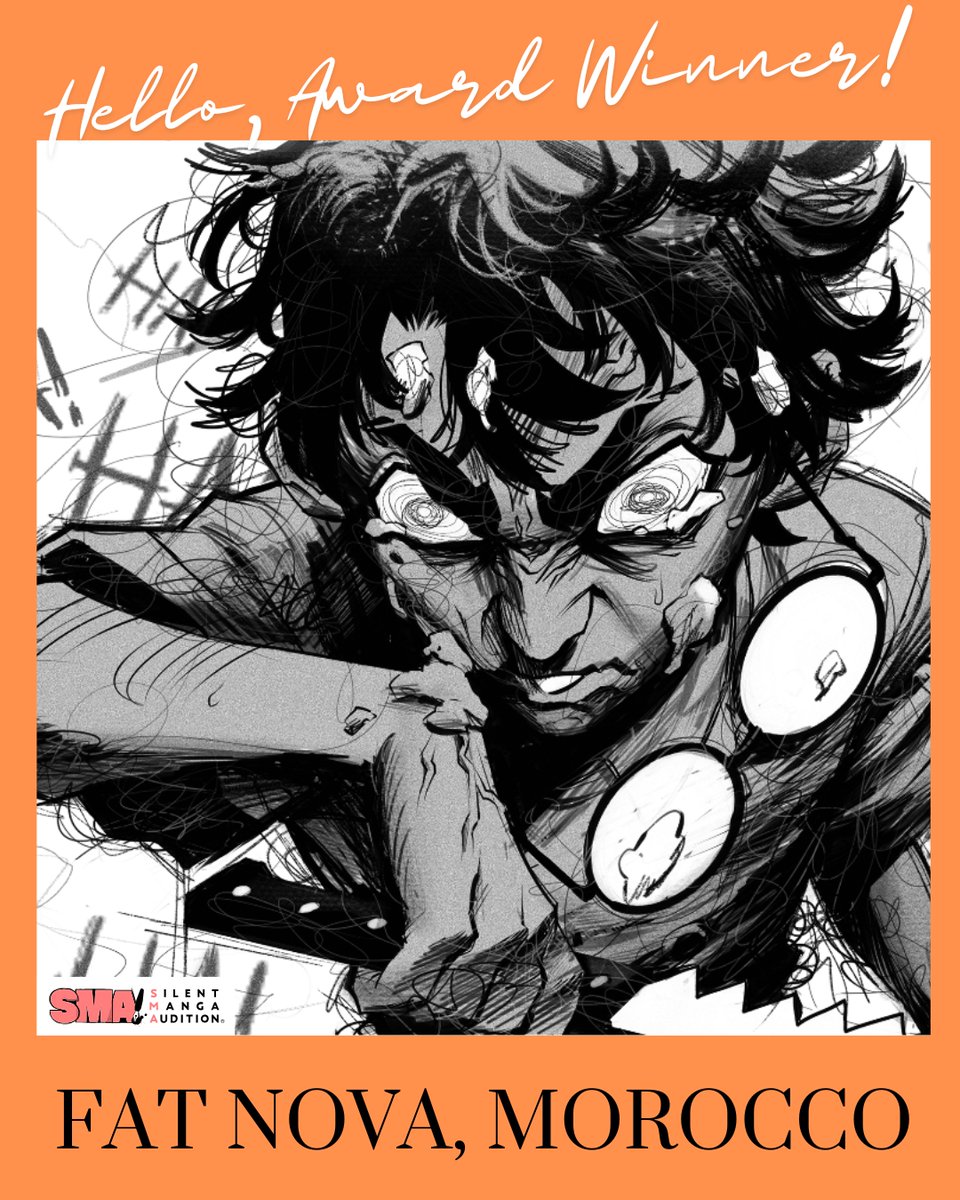
Say a big HELLO to the Excellence Award Runner-up, Fat nova (@Fat_nova1) 🇲🇦!
Read the interview here:
https://t.co/oyxpusmx7W
Read their award-winning work, “Enough!”, here:
https://t.co/ywOosWrT1P
SMA22 Award Winners Introduction! 9/20
Creator: @Fat_nova1 🇲🇦
Title: Enough!
Award: Excellence Award Runner-up🏅
https://t.co/daGRF416su
“The drawings were neat and energetic, which added to the ambiance of the piece.” - Hojo-sensei
#SilentMangaAudition#manga#debut#SMA22