@yaqeeenann Julani didn’t commit an apparent crime when Baghdadi send him. He did however commit betrayal before Zawahiri judged. It wasn’t the same the same mistake.
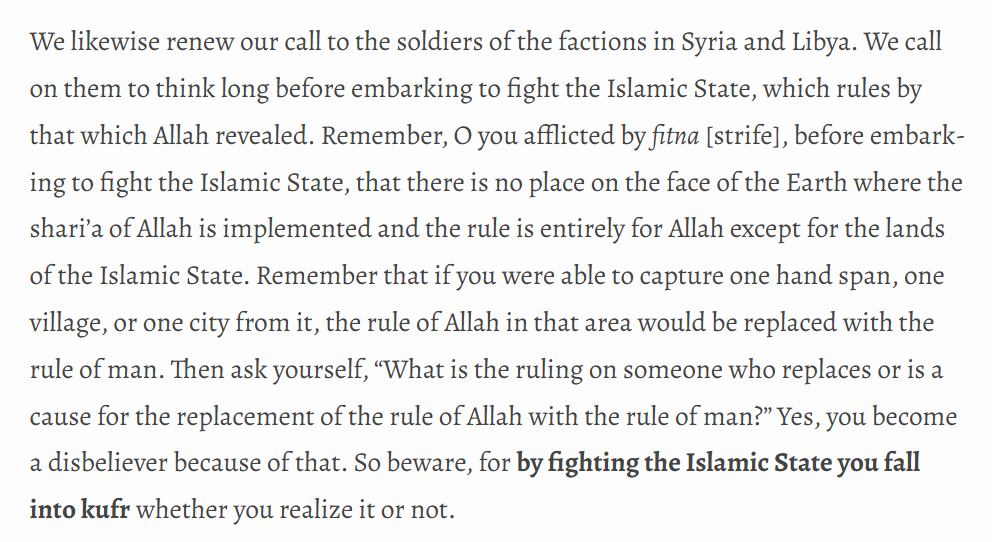
An argument which is used a lot while ignoring the reasoning behind it. To be fair, I've used this argument wrongfully in my debates in the past too, but I have to be honest. Adnani never said fighting the IS in itself is kufr. It was conditioned on fighting them and replacing the rule of Allah with kufr, which implies fighting for the sake of taghut. Nobody has to like him to take his words within the right context.
There were bughat fighting the state and takfir wasn't done on them.
This Wahabi clown thinks Abdul El Sayed, Ilhan Omar and Rashida Tulaib are rulers and that publicly criticising them is an act of khurooj that makes you a Khaariji.
Not talking about the shaykh may Allah honor him, or any other specific figure here, but we need to address a major problem in how we process setbacks today.
When the Sahaba suffered a setback at Uhud, Allah revealed verses in Surah Aal 'Imran explaining that it was partly from their own actions, a means of purification, and a reminder that ultimate superiority belongs to true believers.
The Sahaba held all of these lessons together, including self-accountability.
Today, almost no one analyzes the internal cause. When things went wrong for the state, the primary reasons cited are always external: betrayal ulama, deviance, or enemy plots like the coalition. Point is these external reasons will always be there. That shouldn’t be a final explanation for a major collapse and defeat.
Very few ask: "What did WE do wrong?"
Those who did offer constructive critique from within the state were labeled as traitors online.
Instead, popular analysis drops into two lazy extremes:
1. "They lacked strategy and were incompetent."
2. "It wasn't their fault at all; it's purely external, and victory is guaranteed next time."
Neither reflects mature Islamic thinking.
The first reaction to any failure must be sincere self-reflection. Pointing out internal errors does not negate divine decree, the honor of martyrdom, or the reality of trials.
Unfortunately, tribalism has taken over. People have become fanboys of their preferred groups, treating them as infallible and conflating with Islam without even realizing it.
If we cannot analyze our own mistakes, we will keep repeating them.
In 2013, Shaykh Aḥmad predicted that the Khilāfah will be established within this decade
In 2026, he says we lost something significant and we may never see it again in our lifetime 💔
May Allāh ﷻ Bless the Muwaḥḥid Mujāhidīn who sacrificed everything to establish Tawḥīd .
@RashmanTheHorse He was their staunchest opposant and refused anyone with hazimi tendencies to achieve leadership positions.
As for sending Julani, he was backed by a few senior figures that advocated for him to Baghdadi. Eventually Adnani was given practically the same role after the split.
The scholar and historian Ali Sallabi in his biography of Al Hassan ibn Ali completely debunks the claim of Al Hassan marrying over 70 women.
Just putting it out here for the sincere ones.
Imam Al-Hasan ibn Ali رضي الله عنهما was a chad.
Adh-Dhahabi رحمه الله said about him:
“He was a frequent marrier and a frequent divorcer. He married about seventy women, and he rarely had fewer than four wives at any given moment.”
Ibn Kathir رحمه الله said: “They say that he used to marry frequently and that he never had fewer than four free wives. He was a frequent divorcer and generous in dowries. It is said that he married seventy women.”
A narration attributed to Ja'far Al-Saadiq رحمه الله goes: "Imam Ali رضي الله عنه said: 'O people of Kufa, do not marry your daughters to Al-Hasan, for he is a man who divorces frequently.'
A man from the tribe of Hamdan replied: 'By Allah, we will nevertheless marry our daughters to him. Whomever he is pleased with, let him keep her, and whomever he dislikes, let him divorce her.'"
Muhammad ibn Sirin رحمه الله said: "Al-Hasan ibn Ali رضي الله عنهما proposed to ibn Sayyar Al-Fazari for his daughter’s hand. Ibn Sayyar said: 'By Allah, I will marry her to you, even though I know that you are quick-tempered , quick to divorce, and given to flattery. Yet you are the noblest of the Arabs in household and the noblest in lineage.'"
The reality of the worshippers of the cross:
Casually contemplating the murder of millions of brown people on the request of a jew but at the same time preaching peace.
Under pressure from Israeli prime minister Benjamin Netanyahu, the Trump administration may be within days of launching a nuclear strike on Iran. The target would be Pickax Mountain in central Iran, where Israeli intelligence claims the Iranian government has restarted its nuclear enrichment program. No conventional weapon in the American arsenal can penetrate 300 feet of solid granite to destroy the tunnels where enrichment is supposedly taking place. The only military option is a nuclear strike. Netanyahu has been pushing hard for one. “Bibi calls Trump about it every day,” says an informed observer.
Netanyahu is cornered and desperate. After last week’s election results, he can’t form a government unless Trump intervenes directly in Israeli politics and brokers a deal with other parties that gives Netanyahu 61 seats in the Knesset. Otherwise, he is out as prime minister and on his way to ignominy, investigations and possibly jail. Netanyahu must stay close to Trump. He needs this war.
To that end, he’s applied maximum pressure to his closest allies in the administration, including Secretary of Defense Pete Hegseth and CENTCOM commander Brad Cooper. Both oppose a negotiated settlement to the war they’ve so grievously mismanaged; both are pushing to restart major combat operations. Secretary of State Marco Rubio and CIA director John Ratcliffe are also following Netanyahu’s lead, as are leaders of the Democratic Party. In a recent meeting on the subject, former president Barack Obama said he opposes the current Iran peace deal being drafted in Doha.
The rest of America’s longtime allies in the Middle East are terrified by the prospect of more war. On September 27th, Netanyahu flew secretly to Abu Dhabi to enlist the UAE in his lobbying effort for a final attack on Iran. The Emiratis refused. After eight months of conflict, Gulf economies are teetering. So are global energy and fertilizer markets. They won’t recover soon. Globally, there are a total of about 850 supertankers used to transport oil from producers to the rest of the world. In October alone, 11 of them were badly damaged in Hormuz. At this pace, a global depression is imminent. A nuclear strike would radically accelerate the destruction. Fallout from a ground explosion at Pickax Mountain would contaminate the Persian Gulf, poisoning the water supply for 100 million people.
And those are just some of the immediate consequences for the region. The rest of the world is every bit as exposed. No country other than the United States has ever used a nuclear weapon in war. Some would like to. An American nuclear attack on Iran would set a new precedent. The Russians have already told at least two other governments that an American nuclear strike on Iran would free them to use nuclear weapons against Ukraine. Pakistan and India would be tempted to do the same against each other, as would North Korea against Seoul. After the first nuclear strike, World War Three is inevitable. That war would be short and final.
We’ve been sleepwalking toward this moment for months. Since February, the administration has quietly rewritten America’s nuclear doctrine to make first use of so-called “battlefield nukes” easier and therefore more likely. No one in Washington in either party seems bothered by this. Now we’re on the brink of it.
Close observers say Trump is likely to decide by next weekend whether or not to use nuclear weapons. That would be November 7, six days from now. To his credit, he’s hesitating. At the moment, Trump is listening to his vice president, JD Vance, and to his envoy and friend Steve Witkoff, both of whom argue a deal with Iran can be made.
They’re right, though it won’t be simple. The Iranians are famously frustrating to negotiate with under any circumstances, and elements of that government have become more radical since Ayatollah Ali Khamenei and his family were killed in February. After decades of isolation, even relatively moderate Iranian leaders seem confused by how decisions are made in the West. (There is a widespread belief in Tehran, for example, that the United States government controls Israel.) But overall, people who have spoken to decision-makers in Iran say there is consensus there that more war is bad for everyone and a deal is worth making.
One group that hasn’t been consulted so far is the global population — the hundreds of millions of people who will be killed along with their children if Trump is pushed by Netanyahu into launching a nuclear strike next week. Now would be the time for them to speak up.