The seizure of rotten meat once again, this time from railway cargo arriving from Delhi, has shocked people and raised serious concerns. The prompt action of the police officers involved in the seizure is commendable.
Yet, despite last year’s public outrage and assurances from the authorities of stringent safeguards and action against those involved, how does it continue unchecked? Why are those behind these practices not being exposed and strictly punished?
These are the questions troubling people, causing anxiety. The government must come clean on it and place all facts in the public domain. It must fix accountability and take strict action against the perpetrators of this heinous crime to restore people’s trust in the food they consume.
.@MirwaizKashmir Umar Farooq Again Features Among World’s 500 Most Influential Muslims for 2027
International recognition highlights his longstanding advocacy of dialogue, non-violence and peaceful engagement despite continued restrictions
Srinagar, November 14, 2026: Mirwaiz-e-Kashmir Dr Moulvi Mohammad Umar Farooq has once again been included among the world’s 500 most influential Muslim personalities in the 2027 edition of The Muslim 500, published by the Royal Islamic Strategic Studies Centre (RISSC), Jordan, marking his thirteenth consecutive inclusion in the prestigious annual publication.
Featuring Mirwaiz under the Political category, the publication identifies him as the 14th Mirwaiz of Kashmir, who assumed the religious leadership in 1990 at the age of 17 following his father’s assassination. It also acknowledges his longstanding advocacy of dialogue and peaceful engagement to address the Kashmir issue.
The 2027 edition particularly highlights that Mirwaiz “repeatedly calls for dialogue between India and Pakistan as the only sustainable path to peace”, while continuing to advocate “non-violent engagement on regional issues.”
The publication also takes note of his prolonged house detention from August 2019 to September 2023, observing that he “remains subjected to sudden, intermittent detentions by authorities.” Referring to his religious and public role, it states that, as chief cleric at Srinagar’s historic Jamia Masjid, he “expertly bridges vital traditional religious leadership with ongoing human rights advocacy”.
For over three decades, Mirwaiz has consistently maintained that dialogue, rather than confrontation, offers the most viable path towards resolving the Kashmir issue. Despite prolonged restrictions on his movement and public activities, he has continued to advocate peace, reconciliation, religious harmony and the protection of human dignity.
.@MirwaizKashmir Returns to Jama Masjid After Nearly Two Weeks of House Detention, Expresses Concern Over Restrictions on Religious Activities
Regrets postponement of MMU’s Bandipora meeting; welcomes Waza community’s initiative to regulate wedding feast timings
Srinagar, November 13, 2026: After nearly two weeks of arbitrary house detention, Mirwaiz-e-Kashmir Dr Moulvi Mohammad Umar Farooq today returned to the historic Jama Masjid Srinagar, where he addressed the Friday congregation.
Addressing the faithful, Mirwaiz expressed concern over the repeated restrictions on his religious and public activities, saying that such arbitrary measures hurt people , cause inconvenience and amount to unwarranted interference in discharging his religious obligations as the Mirwaiz.
Mirwaiz said that the pulpit of Jama Masjid has always stood for upholding faith and speaking the truth that reflects the concerns of people and their rights, a responsibility that he cannot abandon.
Mirwaiz regretted that due to the restrictions Muttahida Majlis-e-Ulama (MMU) had to postpone its first district-level Ulema meeting, scheduled for November 4 in Bandipora, where religious scholars were to deliberate on measures to take forward its September initiative on dealing with social and religious challenges, including drug abuse, social evils, youth suicide and environmental concerns . He said such collective initiatives for social reform should be encouraged rather than obstructed.
Mirwaiz also welcomed the recent decision of the Kashmir Waza Association to regulate wedding feast timings, particularly its decision to conclude late-night Wazwan dinners by 10 pm. He described the initiative as a positive step towards bringing discipline and simplicity to marriage celebrations while respecting the dignity and hard work of the Waza community. He assured the Association of the MMU’s full support for such constructive efforts towards social reform.
Mirwaiz said that while the Waza associations decision is a step in the right direction much needs to be done around growing extravagance, unnecessary additions to wedding customs, excessive expenditure and competitive displays of wealth that have placed enormous financial and social burdens on families. He urged society to preserve the beauty of its traditions while doing away with wasteful practices, making marriages simpler, dignified and affordable in accordance with Islamic teachings.
Deeply saddening that two young men from Baramulla had to spent six precious years in jail under stringent Anti-terror laws, before being acquitted as the evidence against them was found unreliable. This case once again highlights the indiscriminate arrest and prolonged detention of Kashmiri youth. Will accountability be fixed for their wasted years? Authorities should review this approach and ensure justice is done to the thousands of young men still behind bars.
https://t.co/tqHdQdNTid
My house detention continues unabated for the past week with police deployment and barricades in place. Unfortunate that will not be able to deliver the Friday sermon at Jama Masjid Srinagar to the faithful, today. Arbitrary and authoritarian measures to curtail freedom of movement and speech, only betray the official narrative of “Normalcy” in Kashmir.
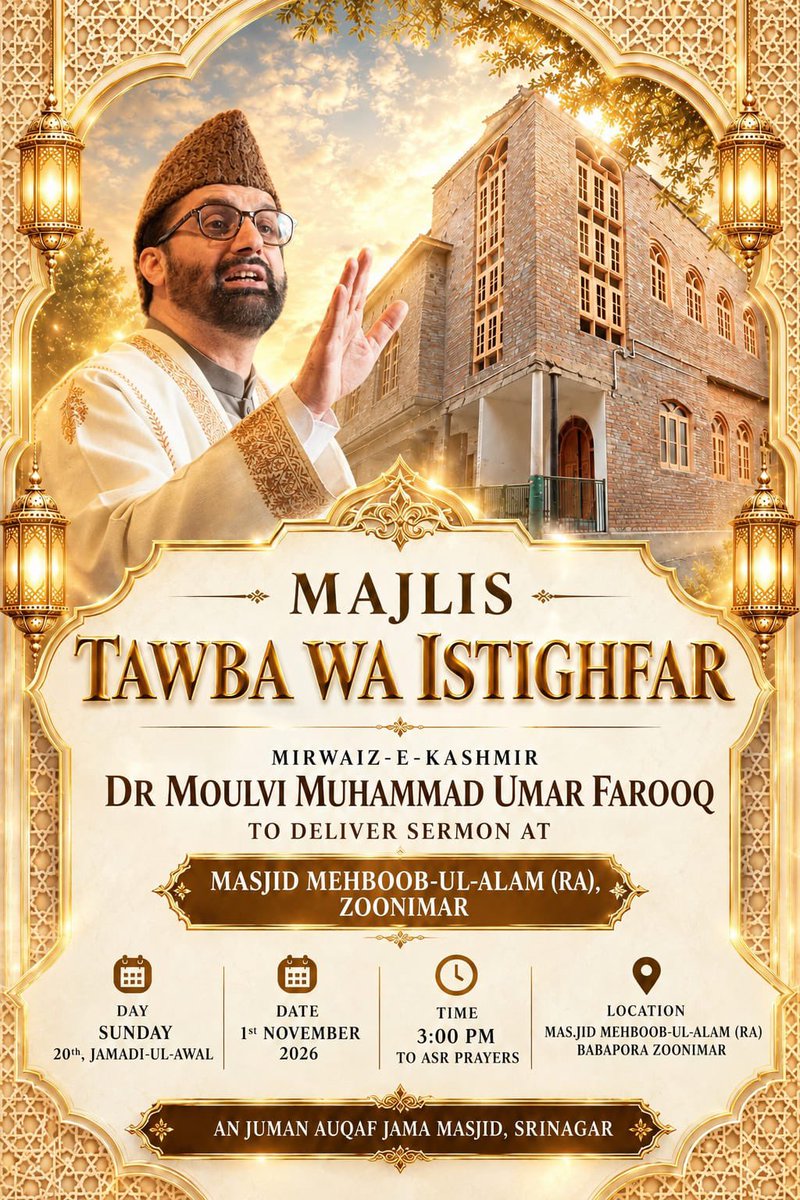
Put under house detention again today ahead of a scheduled religious sermon at Masjid Mehboob-ul-Alam (RA), Zoonimar.
Being punished for quoting the recently published International Crisis Group report on the situation in Jammu and Kashmir, at Jama Masjid on Friday. Apparently, stating uncomfortable facts and endorsing recommendations, out of concern for the future of my people and genuine peace in J&K and the region, is not acceptable to the ruling regime. So be it.
Saddened that people looking forward to participate in the religious and spiritually Inspiriting Majlis-e-Waaz will be hugely disappointed.
.@MirwaizKashmir Calls for Restoration of Civil Liberties, Says decline in violence is welcome, but lasting peace requires justice, reconciliation and restoration of public trust
Calls for Release of Political Prisoners and Meaningful Political Engagement
Urges serious consideration of International Crisis Group report on Jammu and Kashmir
Srinagar, October 30, 2026: Mirwaiz-e-Kashmir Dr Moulvi Mohammad Umar Farooq, while addressing the Friday congregation at the historic Jama Masjid Srinagar, referred to the recently released International Crisis Group report on Jammu and Kashmir and said:
“The International Crisis Group, a respected international organisation working on conflict prevention and resolution, has last week released an important report on Jammu and Kashmir. I believe its findings deserve serious attention.
The report says that militancy, street protests and violence have declined in recent years, which everyone welcomes, as no one understands the value of peace more than the people of Kashmir, who have suffered enormously over the past several decades.
But the report also makes a fundamental point: reduction in violence does not necessarily mean that underlying political grievances have been resolved, or that public confidence has been restored.
Security is necessary, and the government has a responsibility to protect lives. But security measures alone cannot provide a lasting answer to a problem that also has deep political and human dimensions.
Kashmir still remains one of the most militarised places on earth.
One of the most disturbing aspects highlighted in the report is the scale of arrests and detentions since 2019.
According to the Union Home Ministry’s own figures, 3,662 people were arrested under UAPA in Jammu and Kashmir between 2019 and 2023, while only 23 convictions were recorded during that period. These figures raise serious questions about prolonged detention, due process and the widespread use of stringent laws.
Thousands of families suffer the consequences of arrests, detentions and prolonged legal proceedings. They continue to live with uncertainty about the future of their loved ones.
The continued incarceration of Kashmiri political prisoners, including Yasin Malik, Shabir Ahmad Shah, Shahid Ul Islam , Engineer Rashid , Asiya Andrabi,Masrat Alam, and many others, who have spent years behind bars, often in prisons far away from their homes and families, remains a matter of concern.
We have repeatedly appealed for their release, review of their cases and humanitarian consideration towards elderly and ailing prisoners. I reiterate that appeal today.
Justice and compassion cannot be separated from the pursuit of peace.
The report also raises concerns about restrictions on political and civic activities, the shrinking space for peaceful expression, curbs on free reporting and a growing feeling of alienation.
These are concerns that should not be brushed aside.
If the situation has improved, as is being acknowledged, should it not also be an opportunity to ease restrictions, review detentions, restore civil liberties and create an environment in which people can express their views and grievances peacefully?
Peace cannot simply be measured by the absence of protests.
The report calls for the restoration of statehood, meaningful powers for the elected government, a review of stringent anti-terror laws and renewed dialogue between India and Pakistan.
These are important recommendations that deserve serious consideration.
Our consistent position has been that the Kashmir issue cannot be addressed through a security approach alone. Political issues require political engagement, and longstanding grievances require sincere efforts at reconciliation.
While governments have their own security concerns and responsibilities, But the concerns and aspirations of the people are equally important and must find a place in any meaningful process towards peace.
Remembering Maulana Abbas Ansari Sahib with deep affection on his death anniversary. More than a colleague, Abbas sb was a father figure in my life whose long association and guidance helped shape my outlook.
In one of the most challenging time for Hurriyat, when engaging in dialogue with India and Pakistan for pursuit of a peaceful resolution to Kashmir issue, was neither an easy nor popular alternative,to which we tragically lost Abdul Ghani Lone Sb and my Uncle Molvi Mushtaq and despite the risks involved, Abbas sb stood besides me, firm in his conviction that dialogue, not confrontation, offered the best way forward. An approach that we consistently advocate as the best guarantor of peace in South Asia.
Four years since his death, his absence is keenly felt, sincere dialogue remains the best way forward. May Allah grant him the highest place in Jannah. Ameen
Faith Must Reflect in Character, Conduct and Justice: @MirwaizKashmir
In Friday address, Mirwaiz stresses moral accountability, respect for people’s rights and responsible use of time
Continues MMU’s Coordinated Friday Sermon Series on Imaan (Faith)
Srinagar, October 23, 2026: Addressing the Friday congregation, Mirwaiz-e-Kashmir Dr Moulvi Mohammad Umar Farooq today said that faith must not remain confined to religious observances and declarations, but should be reflected in an individual’s character, conduct and dealings with fellow human beings.
Continuing his discourse on Imaan (Faith), Mirwaiz reflected on the profound message of Surah Al-Asr, which emphasises the value of time and reminds humanity that true success lies in faith, righteous deeds, upholding truth and patience.
Mirwaiz said that while people devote considerable energy to acquiring wealth, position and worldly success, they often neglect the more important question of how their lives are being spent.
He observed that the Quranic concept of loss extends far beyond material or financial setbacks. A person may possess wealth, influence and position, yet suffer a far greater loss if honesty, compassion, justice and a sense of accountability are absent from his life.
He stressed that honesty in dealings, respect for others’ rights, compassion towards the vulnerable and a commitment to justice are essential expressions of faith. These principles apply equally to those holding power and public office, where authority must be exercised as a trust, with accountability, fairness and respect for people’s dignity and legitimate rights.
Expressing concern over growing materialism, the misuse of social media and the pressures confronting younger generations, Mirwaiz cautioned against the waste of precious time, particularly as hours are spent scrolling through social media and engaging in unproductive digital activities, often at the expense of education, family relationships and personal development. He urged parents, teachers and religious institutions to strengthen moral guidance and meaningful engagement with the youth.
He said that in a society facing uncertainty and numerous social challenges, religious commitment must translate into personal responsibility, social compassion and a collective concern for justice and human dignity.
Mirwaiz urged people to reflect on their conduct and responsibilities, emphasising that the true worth of faith is demonstrated not merely by what one professes, but by how one lives and treats others.
Deeply disturbing that Delhi’s historic Race Course Mosque, a gazetted Waqf property since 1977 and a listed heritage site, faces eviction within six days. Equally alarming is the reported failure of the Waqf authorities to defend it. Is this becoming the new normal for Muslim places of worship? This is precisely why we strongly opposed the Waqf amendments and increased government control through appointed nominees over Muslim religious endowments. If even a legally recognised mosque cannot be protected, what safeguards remain for others?
Disturbed to learn about the attack on a Kashmir bound bus in Haryana, leaving an elderly passenger injured and others traumatised. Reports of threats against J&K-registered vehicles are causing concern among people. Those in authority must ensure the safety of Kashmiri travellers and take swift and strict legal action against those responsible.
MMU strongly rejects any attempt by the Waqf Board to prescribe uniform Friday sermons. The Mimbar is an Amanah, and religious guidance is the domain of Ulema and Imams, not state-linked bodies. Such interference in matters of faith and religious practice is unacceptable. The Waqf Board must confine itself to its administrative responsibilities.
The deeply distressing attack on King Khalid International Airport in Riyadh, resulting in tragic loss of lives and injuries to hundreds, is a dangerous escalation that only adds to the suffering of civilians in the region and risks widening of an already grave regional crisis.
All sides must exercise restraint and engage in dialogue and diplomacy for a fair resolution of the crisis, and prevent further escalation and loss of precious human lives.
It was indeed a pleasure interacting with the children at today’s prize distribution ceremony of the Seerah Competition at Jama Masjid Srinagar.
The values we inculcate in our children today will shape the society they build tomorrow. Introducing them to the Seerah of Prophet Muhammad ﷺ must go beyond learning events and facts; it should help nurture honesty, compassion, responsibility, discipline and concern for others in their everyday lives.
Congratulations to all the participants, their parents, teachers, organisers and sponsors. It was particularly heartening to see the impressive performance of the girls among the top position-holders.
On the intervening night of 9th and 10th October 1965, a barely 20-year-old Mirwaiz Molvi Mohammad Farooq was arrested from Mirwaiz Manzil, taken out of Kashmir to an unknown destination, triggering widespread protests and police firing resulting in killings and injuries, and 72 hours of continuous curfew. Dozens of Awami Action Committee leaders were also rounded up from across the Valley and arrested.
Third-degree torture at the interrogation centre in Jammu for weeks and nearly three years of imprisonment without trial weakened the Shaheed leader physically, but could not break his resolve, which he exhibited lifelong.
Today, sixty-one years later, we remember Shaheed-e-Millat and honour his sacrifice, while also paying tribute to the thousands who suffered imprisonment in the past and to those who continue to endure the torments of incarceration, separated from their loved ones because of their political beliefs.
The rejection of Shabir Shah Sahib’s bail plea by the NIA court is deeply disappointing and unjust. Despite the Supreme Court granting him bail in March this year, his incarceration continues after nearly four decades spent in prisons without conviction.
His prolonged detention has seriously affected his health, and he needs urgent medical attention and family care. The same concern applies to most other political prisoners suffering serious health issues after years of detention and delayed trials.
I appeal to the Govt of India, opposition leaders, civil society and all those who believe in human dignity and the right to difference of opinion to ensure their release and return to families.
Deeply saddened by the tragic road accident in Karnah, Kupwara, claiming five precious lives and leaving several others injured.
The growing frequency of road accidents across J&K is deeply worrying and calls for urgent attention to road safety, infrastructure and preventive measures.
My heartfelt condolences to the bereaved families. May Almighty Allah grant the departed Jannat-ul-Firdous and give strength to their loved ones. Praying for the speedy recovery of all those injured.
The brutal killing of Saikun Khan outside a police station in Rajasthan is horrifying. His family alleges that he was targeted because his beard and skullcap identified him as a Muslim. This must be thoroughly investigated and those responsible brought to justice.
Every other day we hear BJP leaders and ministers across states making inflammatory and communal remarks against Minorities. Such rhetoric from people in positions of power is normalising prejudice and emboldening hatred.
Hate speech has become routine political discourse. When hatred is repeatedly legitimised from public platforms, we should not be surprised when its consequences are felt on the streets. This dangerous normalisation must end.
The disclosure by the Government in the Legislative Assembly that the Higher Education Department has withdrawn 4,249 “objectionable” books from colleges and libraries across J&K, with almost 4000 of them from Kashmir alone, is both disturbing and unfortunate. What exactly made these books objectionable? The titles and reason for their removal must be made public.
Academic freedom in universities and colleges and access to diverse perspectives, are fundamental to education and evolution of society. Attempts to ideologically regulate what students can and cannot read impoverishes learning and critical thought.
By withdrawing these books whose agenda is the elected government implementing, its own or someone’s else’s..? People deserve clarity on that.
MashaAllah, what a beautiful and heartening sight at the historic Jama Masjid Srinagar today, filled with young boys and girls eager to learn about the blessed Seerah of our beloved Prophet Muhammad ﷺ. Around 2800children from maktabs across districts participated in the Seerah Competition. Great work by Maktab Maseeh-ul-Ummah, in collaboration with the Mirwaiz Foundation, in connecting our young generation with the Prophet’s ﷺ timeless message of faith, compassion and noble character.
I also welcome a proposal before the Government to examine a five-day school week in J&K. Our children need time not only to study, but also to rest, spend time with family, play and grow in a healthy and balanced way. Their mental health and overall wellbeing must remain at the heart of education.