I'm a cardiologist. Something just happened today that I genuinely did not see coming — and it could change the future of preventive medicine more than anything I've written about on this platform.
Midjourney — the AI company that became famous for generating images from text prompts — just announced a medical hardware division and unveiled a working prototype of a full-body scanner unlike anything that's ever existed.
It's called the Midjourney Scanner. And it works like this.
You step into a shallow pool of water. You stand on a platform that slowly descends — about two inches per second — through a ring containing roughly half a million tiny ultrasonic transducers, each the size of a grain of sand. Every one of them acts as both a speaker and a microphone, sending ultrasonic waves through your body from every angle and recording what comes back.
60 seconds later, you step out. The scan is done.
No radiation. No magnets. No claustrophobia. No IV contrast. Just sound, water, and an almost incomprehensible amount of computing power — roughly 2 petaflops processing 17 gigabytes per second of raw acoustic data — reconstructing a 3D map of your entire internal anatomy down to half a millimeter resolution.
Organs. Tissues. Blood vessels. Bones. Muscle. Fat distribution. All segmented by AI in real time.
As a cardiologist who has spent months writing about how the standard screening playbook misses the majority of future heart attacks — this is the technology I've been waiting for without knowing it existed.
Here's why this matters for the future of your heart.
Right now, getting a detailed look inside your cardiovascular system requires either a CT scan (radiation), an MRI (magnets, claustrophobia, 45-60 minutes, $1,000+), or a coronary CT angiogram (radiation, IV contrast, limited availability). These are powerful tools. I order them regularly and they save lives.
But they're reactive. You get them when something is already suspected. They're expensive. They're uncomfortable. And for most people, they happen once — maybe twice — in a lifetime.
Imagine instead: a 60-second scan with no radiation that you could repeat monthly or quarterly. Tracking cardiac structure over time. Watching body composition shift. Detecting changes in organ size, fluid distribution, or vascular architecture before symptoms ever develop. Building a longitudinal dataset of YOUR body that AI can analyze for patterns no single snapshot would reveal.
That's what Midjourney is building toward.
The company plans 50,000 scanners worldwide over six years, with capacity for a billion scans per month. The first location — the "Midjourney Spa" in San Francisco — opens at the end of 2027 with 10 scanners alongside saunas, cold plunges, and a gym. The scan costs a few dollars. The experience is designed to feel like wellness, not medicine.
The technology is built on Butterfly Network's ultrasound-on-chip platform — 40 modules per scanner — combined with Midjourney's own AI segmentation and reconstruction stack. David Holz, the founder, claims the system aims for image quality comparable to MRI in many aspects but at nearly 100x the speed with zero radiation.
Now the caveats — because I'm a physician and the caveats matter enormously.
This is a Gen 1 prototype. About a dozen people have been scanned so far. Current scan time is actually closer to 20 minutes, not 60 seconds — the system is bottlenecked by bandwidth and reconstruction algorithms. The 60-second target is aspirational for future hardware generations.
It is not FDA-cleared for diagnostic use. Midjourney is starting with body composition maps — a category below diagnostic imaging in the regulatory hierarchy. The path from "beautiful 3D body scans" to "clinically validated diagnostic tool that your cardiologist can act on" runs through years of clinical trials, comparative studies against MRI and CT gold standards, and FDA review.
No independent clinical validation has been published. The imaging claims come from Midjourney's own demonstrations. Comparative data against established modalities does not yet exist.
And the privacy implications of full-body internal scans at planetary scale — a billion scans per month — is a conversation that hasn't even started yet.
So I want to be precise. This is not ready for clinical medicine today. It may not be ready for years. Many ambitious medical hardware projects have failed in the gap between prototype and product.
But.
The fact that a working prototype exists — producing real segmented 3D anatomy from sound waves and compute alone — means the physics works. The engineering works. The question is no longer "is this possible" but "how fast can it be validated and scaled."
And if it is validated — if the resolution holds up against MRI, if the AI segmentation proves reliable, if the regulatory path clears — then what we're looking at is the most significant new imaging modality in 50 years.
For my entire career, preventive cardiology has been limited by the fact that seeing inside the body is expensive, slow, uncomfortable, and infrequent. We catch disease late because we image rarely. We image rarely because imaging is hard.
A 60-second, no-radiation, spa-based full-body scan that costs a few dollars would demolish every one of those barriers.
I've written about AI detecting inflamed arteries. About gene editing curing cholesterol. About GLP-1 drugs rewriting metabolic medicine. About cellular reprogramming reversing aging.
This is the missing piece: the ability to see inside every human body, routinely, safely, and affordably — so all of those interventions can be deployed before the disease arrives instead of after.
The company that taught AI to generate images from imagination just built a machine that generates images from the human body.
The future of medicine showed up today from the last place anyone expected.
Smell loss #Covid19 New study shows high % of #hyposmia persists at 1.8 years post-covid; interestingly affects pleasant, neutral & unpleasant odors (vs. #Parkinson dz which mainly affects unpleasant smell). Lemon was the most lost. #medtwitter#ENTSurgery
https://t.co/aXU5CDWrP9
Smell loss #Covid19 New study shows high % of #hyposmia persists at 1.8 years post-covid; interestingly affects pleasant, neutral & unpleasant odors (vs. #Parkinson dz which mainly affects unpleasant smell). Lemon was the most lost. #medtwitter#ENTSurgery
https://t.co/aXU5CDWZEH
Medicare’s message to doctors: “Do more, get paid less.”
2025 conversion factor: $32.35
2015 conversion factor: $35.93
A decade of cuts while demands explode.
This isn’t reform—it’s sabotage.
In 2025, the Medicare conversion factor will be lower than it was in 2015. A decade later, doctors are getting paid less per unit of work—while inflation, admin burden, and burnout have all skyrocketed.
Here's another real-life example of how PBMs are corrupt and harming healthcare in America.
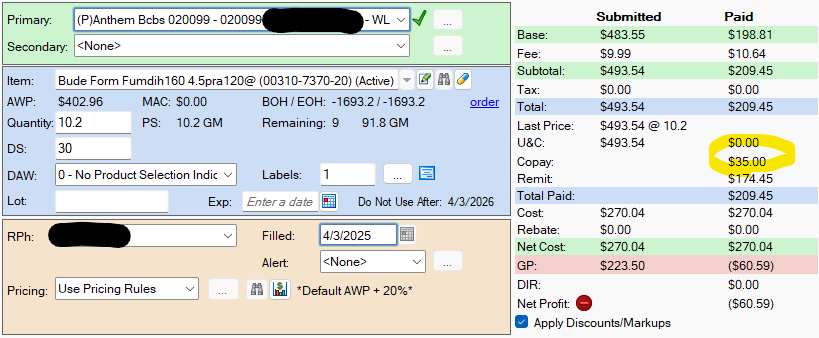
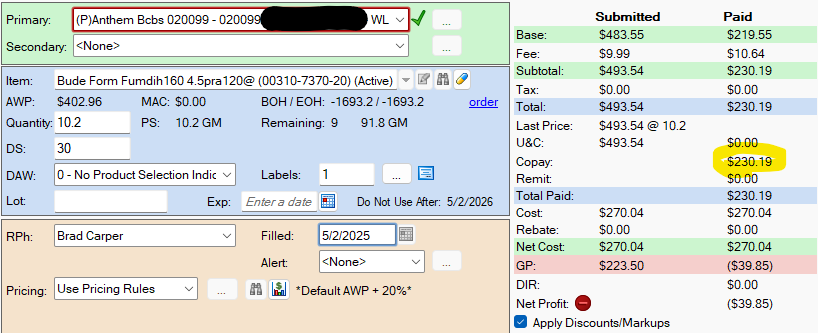
Consider this situation: The same patient, same prescription, just one month apart. In April, the patient's copay was $35 for a generic Symbicort inhaler. In May, the patient was automatically enrolled in Caremark's mail-order program without his knowledge. Now, if he uses a pharmacy outside of their mail-order system, his copay will be $230.19.
This patient, who is 62 years old, has been a customer of my pharmacy his entire life and has severe COPD. This inhaler is a life-saving medication for him. When he came to pick up his inhaler, he was shocked by the copay and stated that he couldn't afford it and that he couldn't wait for mail-order. I explained to him that he can opt out of this program.
Finally, after an hour on the phone with his PBM, he was able to opt out of the mail-order program he had been automatically enrolled in and can continue using our pharmacy for his usual copay.
I can't help but think of all the patients across our country like this one, that are in need of their medications and get blind-sided by their PBM. The majority of these patient's do not have a personal pharmacist to explain their options. They just go without medicine.
This must stop now.
@DrJMarine Many thanks!
Btw recently looked up laryngology options in your area
Private https://t.co/pBbO107n0A
Georgetown https://t.co/rsfkrmCuji
GW https://t.co/gO25s47zXo
Hopkins https://t.co/ynFIb32u67
Hopkins https://t.co/2DdgXPD3IZ
NEW WHOOP RESEARCH ON EXERCISE & SLEEP
I am proud to share that @WHOOP research has just been published in @Nature. Our study analyzed 4.3 million nights of sleep across ~15k WHOOP members to answer a simple but important question: does working out at night hurt your sleep?
Ability is not static; it must be cultivated, challenged, and renewed throughout a surgeon's career. — article written by Stephen M. Cohen, MD, MBA https://t.co/LtbHBRD7oD via @somedocs#medtwitter#ENTSurgery#laryngology#voicesurgery
CRITICAL UPDATE:
Medicine is at a crossroads. Physicians are now moving to employment over private practice due to overburdensome regulations and financial incentives to do so. Facilities can pay doctors significantly more than they make in private practice and this increased pay gap widens every day while we fail to increase payment in private practice with inflation (hospitals get inflationary updates).
All of this costs consumers more money. One example shows that Medicare pays a doctor $250 for an injection in the office in private practice but a doctor employed by their health system costs $750 for the same procedure. Given that many of these healthcare systems have insurance contracts that are 3x or more of Medicare, that gap widens dramatically.
Meanwhile, United Healthcare is continuing its meteoric rise (along with others in the health insurance sector). One profit scheme is through upcoding and cherry picking patients in the Medicare Advantage program, which is now estimated to cost taxpayers $80B annually above what it would have cost through Medicare. Much of the money to cover that $80B is coming from Medicare Part B, the fund used to pay physicians.
Dr. Oz just testified in front of the Senate Finance Committee and committed to attacking these payment schemes. Senator Cassidy referenced a bill he is working on to prevent upcoding. Others on both sides of the aisle agree that something must be done.
What do we need to do? Return that money to Medicare Part B and use those savings to pay for the permanent fix, putting physicians on par with all others in healthcare by giving them mandatory annual inflationary updates. Investing in our physicians will ultimately save the healthcare system money by encouraging more self-employed physicians.
This can all be done with our upcoming reconciliation process. Leadership in both the Senate and House have committed to doing “something” about physician pay in the reconciliation. It’s time we speak up and demand we don’t just do something…. Let’s do something BIG! Let’s fix the fee schedule once and for all. Let’s do it on the backs of insurance companies that have been stealing from American taxpayers through various Medicare Advantage schemes. Let’s invest in the future of our healthcare system by supporting small businesses (physician practices), which are the backbone of our economy.
All of this takes effort and money.
1) Support your favorite medical PAC
2) Call your Members of Congress and tell them how important these changes are
The stars have aligned to make a big change, but it only happens if EVERYONE in medicine pulls together and demands the change. Decide to be a change agent. Fight for your patients. Fight for your profession. Fight for your colleagues.