Crypto beginners often focus on finding the next 10x.
They should spend more time learning how to avoid a -90%.
Common mistakes:
• Buying because everyone is talking about a coin
• Investing money they can't afford to lose
• Using leverage without understanding liquidation
• Putting everything into one token
• Ignoring security and keeping funds carelessly
• Chasing pumps after a big price move
• Having no exit or risk-management plan
• Believing every influencer's prediction
• Confusing a bull market with investing skill
Crypto rewards learning, but it can punish impatience.
Before asking, “How much can I make?”
Ask:
“How much can I afford to lose, and what would I do if the market moves against me?”
Survival comes before profit.
🚨Whatever you do out there, please don’t take your freedom for granted. Prison is not a place you should be. Stay safe, stay away from crime, make wise choices, and keep being you. 🙏🏽❤️
Trading looks exciting until you actually do it.
A chart moves.
You enter.
It goes against you.
Suddenly, you're checking the chart every 30 seconds and questioning a decision you were confident about 5 minutes ago.
That's the reality.
Trading isn't just about predicting price.
It's about managing your emotions when you're wrong.
Protecting capital and staying disciplined matter just as much as finding opportunities.
The reality of trading?
Most days, you're not making money.
You're waiting.
Waiting for your setup.
Waiting for confirmation.
Waiting while the market does absolutely nothing.
Then one trade comes along and tests your patience.
I've learned that trading isn't just about finding good entries. It's also about knowing when not to trade.
Sometimes the best trade is the one you don't take.
What has trading taught you about patience?
Just met the compliance head from Quidax and Research head at Busha after a fireside chat at an event.
Both team acknowledge that they know about Wiki Cat.
I have pushed for them to list it and they seem very excited about doing it.
Expect something very soon.
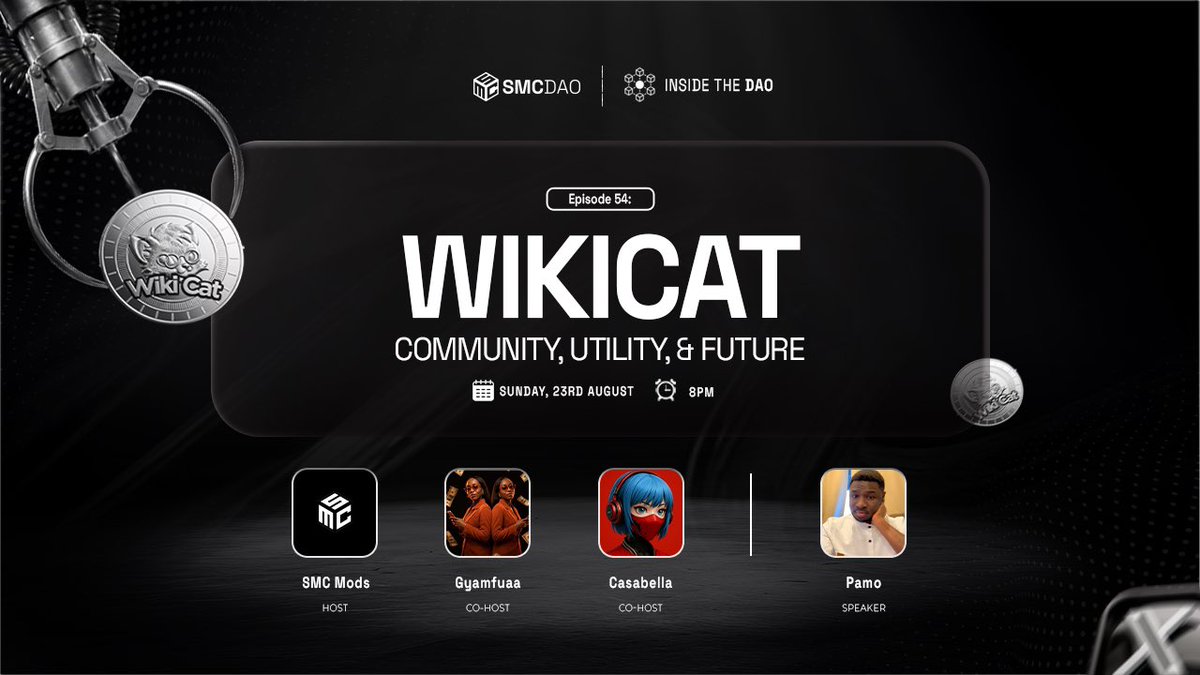
What’s happening behind WikiCat?
Join us this Sunday as we go Inside the DAO to explore the community, utility and future of WKC.
🗓️ Sunday, 23rd August
⏰ 8 PM
🛑 Live on X https://t.co/61Bg7giGv8
My lessons from this year so far:
1. Don’t stay broke for too long. Even the real ones can eventually switch up when you remain broke for too long. Build yourself financially.
2. Spend and invest your money wisely. There is no amount of money that cannot finish, especially when you start living like a baller and spending recklessly on giveaways and unnecessary things.
3. Don’t use your capital to do charity. There is absolutely nothing wrong with helping people, but don’t give away the money you need to build your own wealth. Help others with what you can afford, not with the capital that could pave the way for your financial future.
4. Don’t rely completely on anyone, even when they promise you. People can have good intentions and still disappoint you. Always have a backup plan.
5. Stop dwelling on the past. The past cannot change anything. Dwelling on it only slows down your present and keeps you from focusing on what you can still do.
Realizing you can't just labor your way into financial freedom is terrifying.
Hard work alone isn't enough anymore.
There is a whole different system at play.
Crypto rewards discipline.
Not the trader who watches charts all day.
Not the trader chasing every pump.
The edge is simple:
Have a plan.
Manage risk.
Take profits.
Accept losses.
Trading isn't about being right every time.
It's about surviving long enough to compound.
Compound interest is how your money starts making money… and then that money starts making money too.
Think of it like planting a tree.
At first, the growth looks small.
But if you keep watering it and give it enough time, the tree gets bigger, and produces more fruit.
Example:
If you invest $1,000 and it grows by 10%:
Year 1 → $1,100
Year 2 → $1,210
Year 3 → $1,331
The important part?
You’re no longer earning growth only on your original $1,000.
You’re earning growth on the previous growth too.
That’s compound interest.
And the biggest advantage isn’t necessarily having a huge amount of money.
It’s time.
The earlier you start learning about saving and investing, the more time compounding has to work.
Compound interest starts quietly. Then time does the heavy lifting.
Small amounts + consistency + time can be more powerful than waiting for the “perfect” moment.
Common mistakes when buying a token.
1. Researching only after buying.
2. Treating influencers, hype and follower counts as research.
3. Looking only at the potential upside while ignoring tokenomics, liquidity and risks.
Bookmark this before your next crypto purchase.
"DYOR" is one of the most common phrases in crypto. But what does it actually mean?
It means doing enough research to understand what you're actually buying before you put your money into it.
Before buying a token, ask:
1. What problem does it solve?
2. Who is building it?
3. What is the token actually used for?
4. How much of the supply is already circulating?
5. Who owns the remaining tokens?
6. When are more tokens being unlocked?
7. Where is the liquidity coming from?
8. What are the biggest risks?
DYOR isn't about predicting the future.
It's about making decisions with better information.
Spot trading and futures trading can look similar.
But they are fundamentally different.
Here’s the simple explanation:
Spot trading: You buy the actual crypto.
Buy $500 of BTC → you own $500 worth of BTC.
If BTC rises 20%, your position is worth about $600.
Futures trading: You trade a contract that tracks the price of an asset.
You don't necessarily own the BTC.
And futures often involve leverage, which can magnify both gains AND losses.
For example:
You have $100.
With spot, you buy $100 of BTC.
With 5x leverage in futures, $100 can control a $500 position.
Sounds attractive.
But here's the catch:
A relatively small move against you can cause a large loss or even liquidate your position.
Two common beginner mistakes:
1. Thinking futures are simply a faster way to make money.
2. Using leverage without understanding liquidation, margin and risk.
The practical lesson:
If you're still learning crypto, understand spot trading first.
Before touching futures, learn how leverage, liquidation and position sizing work.
Higher potential returns usually come with higher risk.
Don't trade what you don't understand.