And... our application of neural quantum states to topological phases was published in @PhysRevB: https://t.co/trUZdhiwPw
For more details on the projects check out my earlier threads:
- https://t.co/SGKgb8YHig
- https://t.co/pm3X2kcZ5G
Thank you to my collaborators on these!!
��📢 Two of my recent works have been published this year already - what a start to 2025! 🤩
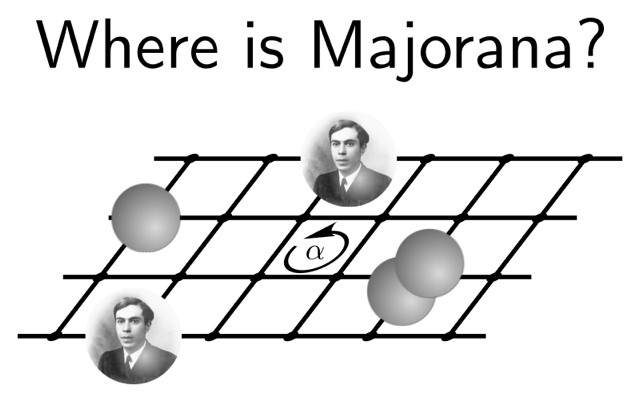
Our work on Majorana modes in bosonic flux ladders was published in @PhysRevResearch: https://t.co/15lJcXPIye (open access 🔓)
(see also their post: https://t.co/GoBktu2sYM)
This one I’m really proud of 🤩: our new method to simulate dynamics with neural quantum states: the tNQS 🤖🕚 which directly solves the time dependent Schrödinger equation globally 🤯 led amazingly by brand new Phd student @ankavdwalle@MCQST_cluster https://t.co/re0VkKJHDP
I am looking for excellent PhD candidates for my Max Planck Research Group Dynamical Quantum Matter Theory https://t.co/opV9MqNPJh. Candidates should also apply through the IMPRS-QST (https://t.co/Ah4xgMeXiq) and MQV (https://t.co/y2aDzwwpeB) doctoral fellowship programs.🧵1/5
Looking forward to two exciting concerts with some friends in Göttingen this weekend 🎶
Early music from the Franco-Flemish era in a cute little contemporary church ⛪️
I'm very happy to perform these lesser known, amazingly unique works
This weekend, I was participating in the International Choir Competition of Flanders (IKV) in Genk with the #BrusselsChamberChoir 🎼🎶
It was a great time with an absolutely amazing outcome for BCC 🥇
I'm very happy and proud to be part of this (now award-winning) choir 🏆
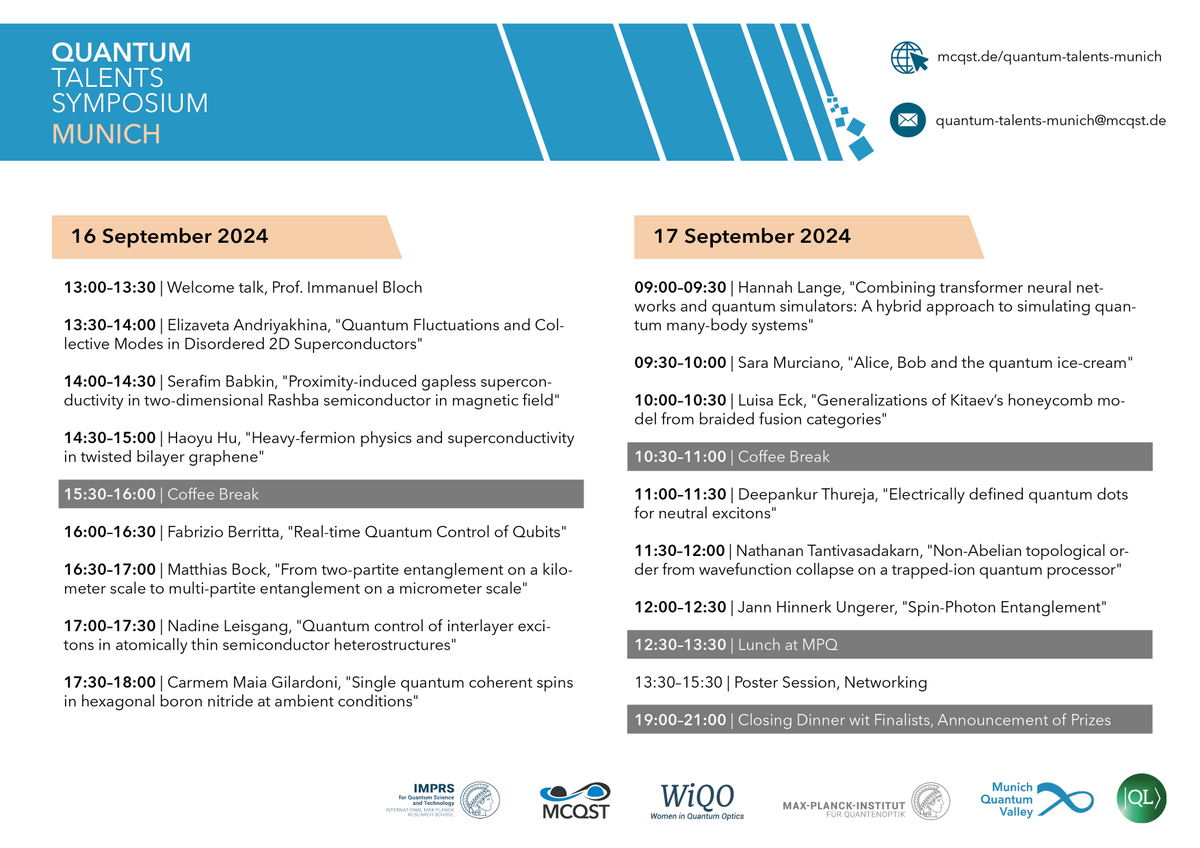
The schedule for the Quantum Talents Symposium, organized by @MCQST_cluster with support from MQV, is now finalized! The event will showcase groundbreaking research from early-career scientists in QST world-wide.
Register now to attend ➡️ https://t.co/laTH9SfLfz
🪐New preprint to read on the beach 🏖️:
Chiral polaron formation on the edge of topological quantum matter,
Amit Vashisht, Ivan Amelio, Laurens Vanderstraeten, Georg M. Bruun, Oriana K. Diessel, Nathan Goldman
https://t.co/XoCquS1XAp
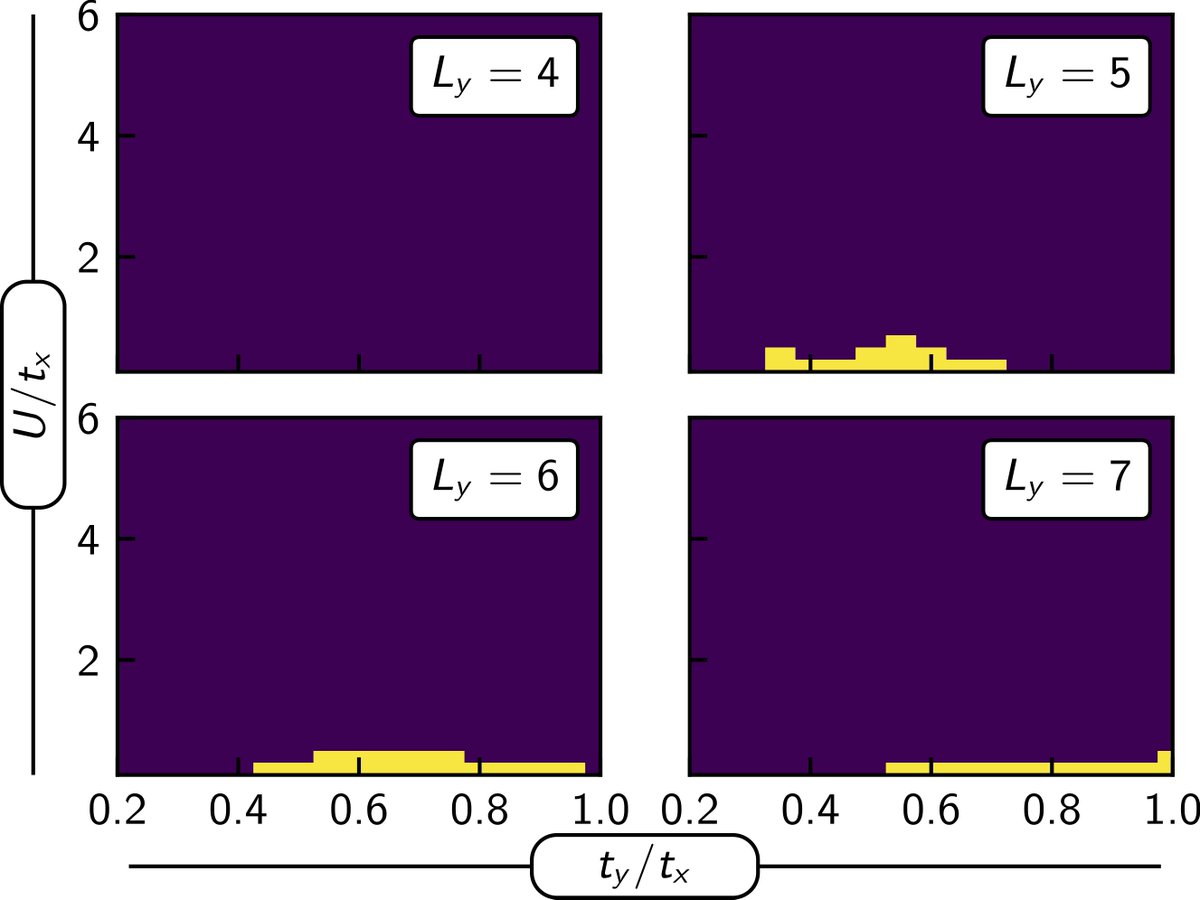
4/4 By systematically varying the number of legs and monitoring the appearance and disappearance of the various ground state phases, our work highlights the importance of finite-size effects for the realization of exotic states in experimentally realistic systems.
3/4 We supplemented our simulations by exact diagonalization of small systems. The particle entanglement spectrum (PES) shows evidence for the Pfaffian state in a narrow regime in sufficiently isotropic systems (5 legs and more).
We're again organizing a school for master students @mpi_pks , this year on the topic of "Collective Phenomena in Quantum Many-Body Physics: From Quantum Matter to Light"!
Apply here if you're interested: https://t.co/NLaplEHnvp
📜📢 Our paper on hidden order in fractional Chern insulators was just published in @PhysRevResearch: https://t.co/xkIW97C1tx (open access🔓)
Check out the original post for a short 🧵
📜📢 New paper on the https://t.co/VdSn8Dhsrb 🥳
Together with Fabian Pauw, @aBohrdt and Sebastian Paeckel (@Topo_Logic), we @QManyBody investigated the detection of hidden order in fractional Chern insulators.
Topology + cold atoms + MPS methods = a very fun project!
🧵(1/4)
5/5 Recently, Ledinauskas & Anisimovas studied a hard-core bosonic Hofstadter-Hubbard model using a multi-layer perceptron and convolutional neural networks. Similar to us, they found that strong magnetic flux complicates the simulations: https://t.co/251PkDJgaF
4/5 At blockade radii larger than the magnetic length, we find bubble crystals and Wigner crystals. The bubble crystal phase might serve as a starting point for the for clustered liquid phases, possibly hosting non-Abelian anyons.