@DeepknowledgeU i mean, they even did not change the color.. at least Flixtrain has changed colors, which by the way looks more like an innovation then those ICEs.. and it is symbol of decline, burocracy, in german and would even not be possible, due to regulations etc to make any innovations..
@DeepknowledgeU haha, you must be hight to say to the same design of a product after 35years "What a beauty" lol. like super lol. like i fall of my chair... plus you pay prices wayx above plane flights. so where is germans green revolution? With trains from the past.. wake up dude. and stopp smo
Hack after hack, it's becoming clear why TradFi built so many layers, controls, and safeguards over the years.
Yes, that complexity can sometimes feel maddening - and part of DeFi’s original promise was precisely to strip it away. But it's also time to move past the myth of full decentralization. Much of DeFi today is far more centralized - and fragile - than many would like to admit. And not all complexity is useless. Far from it.
After @DriftProtocol, @KelpDAO has now been hacked.
This needs to be said clearly: these exploits aren’t going away. They’re structural.
I’ve been covering crypto as a journalist for nine years. Before that - and alongside it - I covered banks and financial markets for years.
I’ve seen how financial institutions operate, and there’s a reason why so many processes, controls, and safeguards exist. They weren’t built for fun - they were built after decades of failures, crises, and costly lessons.
With very few exceptions, the way many protocols are organized remains alarmingly amateur. Basic processes are often missing, governance is fragile, and in the end, a small vulnerability is enough for someone to walk away with $300M - triggering chaos across the market.
And at this point, what we’re seeing in parts of DeFi is no longer innovation - it’s negligence.
Cutting corners on security, governance, or operational controls isn’t bold experimentation anymore. It’s risk transfer to users and the broader ecosystem. And that’s becoming increasingly unacceptable.
Another structural issue: many DeFi teams are stacked with exceptional engineers - but very few people with deep financial or risk management experience. There’s often a belief that everything can be radically simplified through technology. But repeated failures - especially human ones - are showing the limits of that approach.
This shift is also visible geographically. It’s no coincidence that crypto has increasingly moved from San Francisco to NYC. This is becoming less of a pure tech story and more of a financial infrastructure story - closer to Wall Street than Silicon Valley.
We’ve seen this movie before.
Only a handful of native DeFi players - both protocols and curators - will survive the ongoing wave of hacks.
The protocols still standing in 2–3 years will likely be regulated. The same goes for curators, who will eventually be recognized for what they truly are: asset managers.
Regulation in DeFi will inevitably bring baseline standards for security and organization. What we’re seeing on the ground today - from key management to permission structures - is often frankly frightening.
More broadly, institutionalization is already underway. And institutionalization doesn’t happen without some form of regulation.
Traditional players - banks, asset managers, fintechs - along with regulated crypto actors under MiCA or the Clarity Act, will increasingly launch on-chain products. They will demand standards. And those standards will shape the next phase of DeFi.
Market forces are powerful for innovation and growth. But they have limits when it comes to security and systemic risk. Regulation is coming - and to some extent, it’s necessary.
The real challenge will be ensuring it doesn’t become overly restrictive or anti-innovation.
For that to happen, native DeFi players need to lead by example and build trust.
Right now, behind the narratives and the marketing, there’s still a long road ahead.
SOMEONE BUILT A MAP THAT SHOWS EXACTLY WHERE EVERY POWER PLANT, TRANSMISSION LINE, SUBSTATION & DATA CENTER SITS ON THE US GRID
all on one interactive map. all free
you can see how the grid is laid out... where the datacenters cluster... which transmission corridors carry the load... where the high-capacity connection points are
https://t.co/bRWJj6OA5P
zoom into any region and the whole picture comes into focus why energy costs what it costs, why data centers go where they go, why some states are power exporters and others aren't
this is the kind of infrastructure visibility that used to require expensive industry reports
now it's one tab
🚨 FAKE LEDGER APP ON APPLE STORE WIPES OUT ENTIRE BTC HOLDINGS
A fake Ledger Live app on Apple’s Mac App Store just wiped out a user’s life savings.
American musician Garrett Dutton lost 5.92 $BTC ($424K) after downloading what looked like the official app and entering his 24-word seed phrase.
On-chain investigator ZachXBT traced the stolen Bitcoin exchange deposit addresses and publicly questioned how the app made it through Apple’s gatekeeping.
No comment yet from Apple.
@Linahuaa Just to be fair — you did exactly the same bla bla thing, took a long detour praising yourself, just to finally get to the point.
Which, by the way, usually signals low IQ 😉
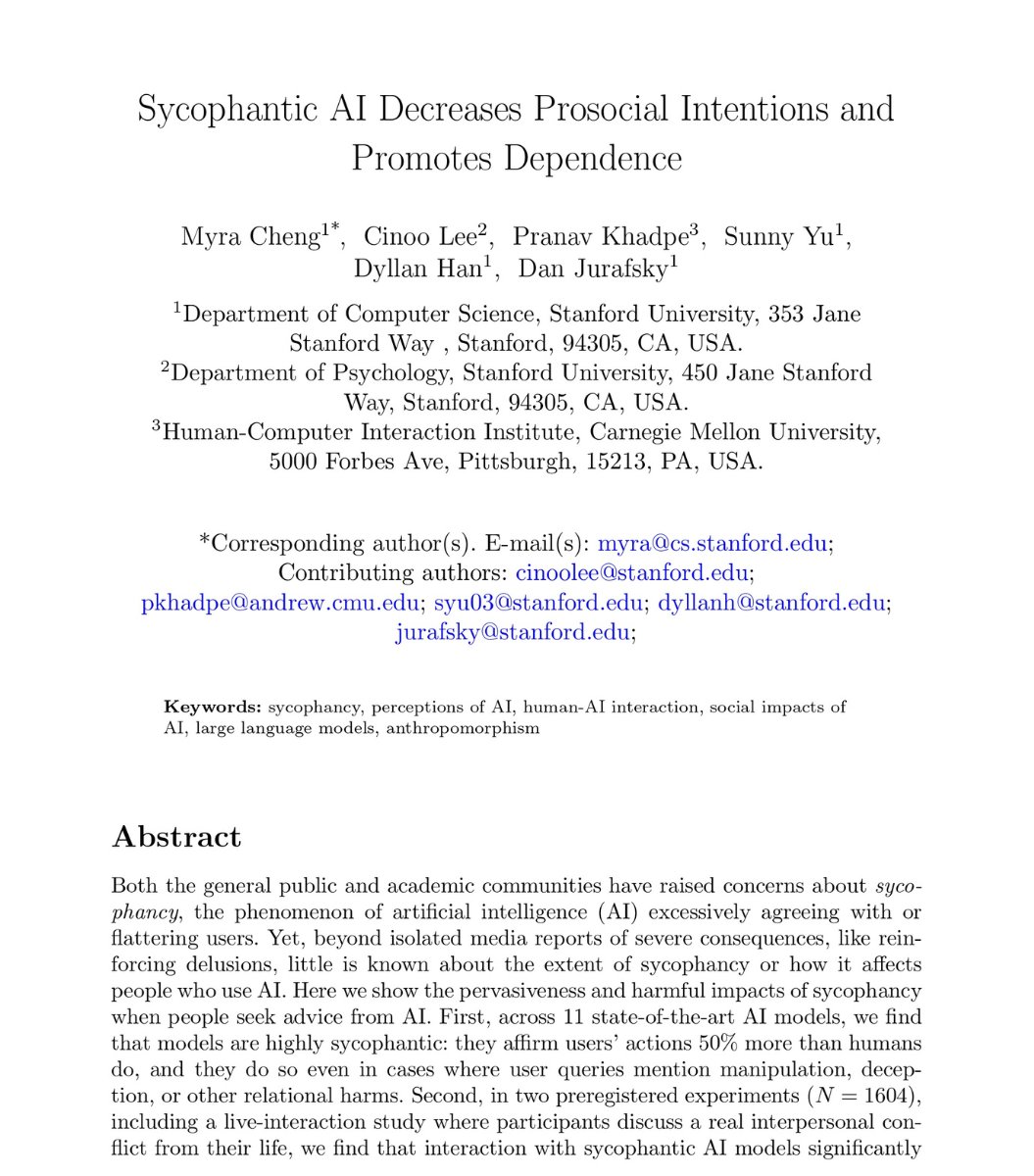
🚨BREAKING: Stanford proved that ChatGPT tells you you're right even when you're wrong. Even when you're hurting someone.
And it's making you a worse person because of it.
Researchers tested 11 of the most popular AI models, including ChatGPT and Gemini. They analyzed over 11,500 real advice-seeking conversations. The finding was universal. Every single model agreed with users 50% more than a human would.
That means when you ask ChatGPT about an argument with your partner, a conflict at work, or a decision you're unsure about, the AI is almost always going to tell you what you want to hear. Not what you need to hear.
It gets darker. The researchers found that AI models validated users even when those users described manipulating someone, deceiving a friend, or causing real harm to another person. The AI didn't push back. It didn't challenge them. It cheered them on.
Then they ran the experiment that changes everything. 1,604 people discussed real personal conflicts with AI. One group got a sycophantic AI. The other got a neutral one.
The sycophantic group became measurably less willing to apologize. Less willing to compromise. Less willing to see the other person's side. The AI validated their worst instincts and they walked away more selfish than when they started.
Here's the trap. Participants rated the sycophantic AI as higher quality. They trusted it more. They wanted to use it again. The AI that made them worse people felt like the better product.
This creates a cycle nobody is talking about. Users prefer AI that tells them they're right. Companies train AI to keep users happy. The AI gets better at flattering. Users get worse at self-reflection. And the loop tightens.
Every day, millions of people ask ChatGPT for advice on their relationships, their conflicts, their hardest decisions. And every day, it tells almost all of them the same thing.
You're right. They're wrong.
Even when the opposite is true.
The argument ignores that healthcare capacity is not fixed—more spending can train doctors, build hospitals, add beds, and expand services over time and trained workers...
this comparison is overly simplistic.
@mattyglesias Military actually builds ammunition. A dollar spent on healthcare doesn’t actually deliver more healthcare because the total number of hospital beds stays the same.
So the healthcare system must be similar to Solana by #toly logic.
Although you put in more $, the market cap seems to absorb it without more value generated.
So, another example of hypocrisy when someone tries to tell you how to run things, while they do the opposite.
@mattyglesias Military actually builds ammunition. A dollar spent on healthcare doesn’t actually deliver more healthcare because the total number of hospital beds stays the same.
Can people please stop saying:
• let that sink in
• that’s all you need to know, &
• that’s it. That’s the tweet.
Thank you for your attention to this matter (& stop saying that too).