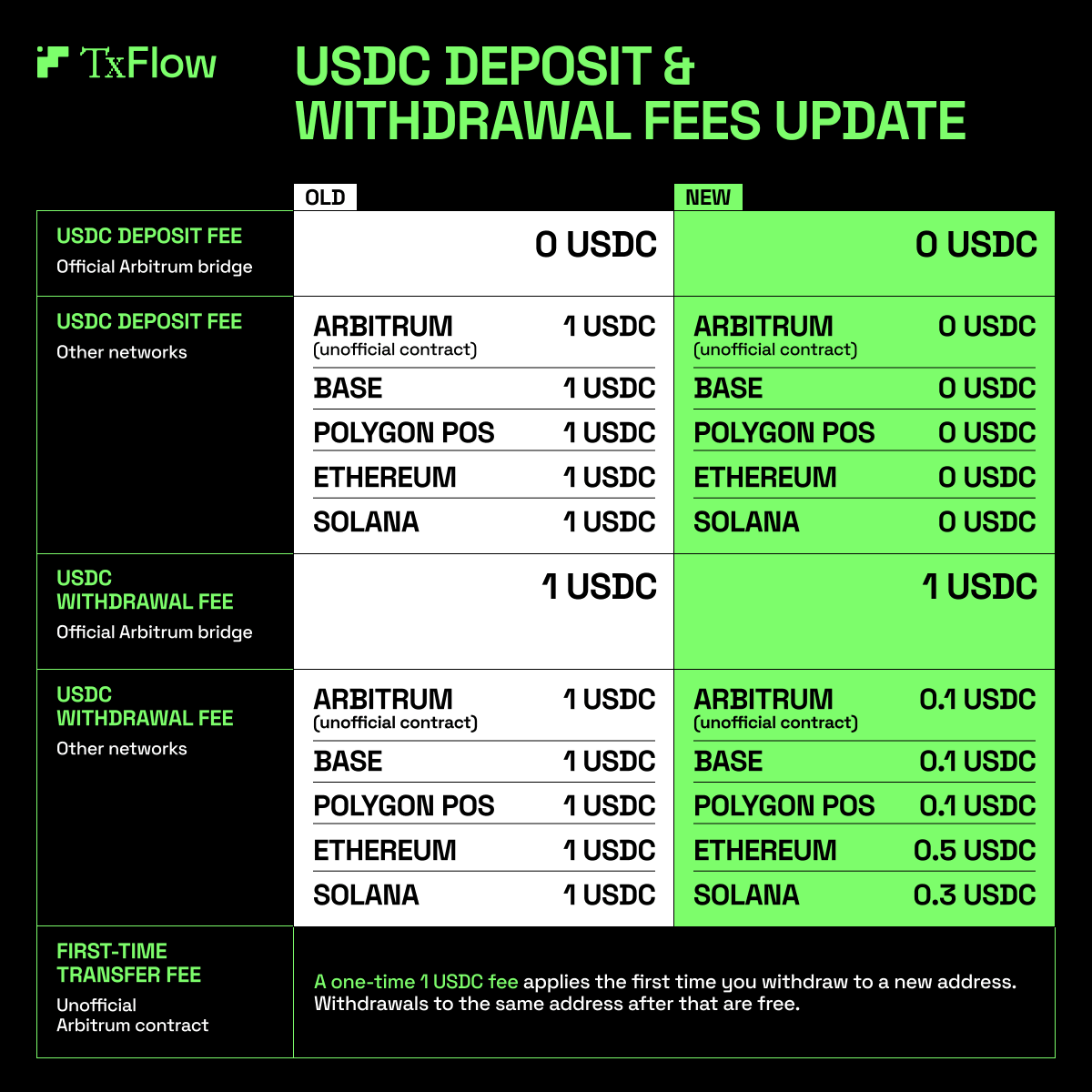
We've heard your feedback on fees this week. Here's our answer:
→ 0 USDC deposit fee on all networks. TxFlow absorbs the gas
→ Withdrawal fees cut by up to 90%
→ First withdrawal to a new address costs 1 USDC to prevent sybil abuse
Our Season 0 retro points dropped last night. A total of 1.6M points were allocated to the early users of the venue!
While some users are stoked with the outcome, others received below their expectations. I suspect our model differs from most venues, so a clarification is warranted.
As a product builder I like to ship incrementally, test features, iterate and adapt. You can't do that with a drop like this. A large chunk total allocation goes out in one shot, you get one chance to set the incentive structure for everything that follows.
So rather than looking at how others did it, we took a first-principles approach.
Retro allocation
Our goal was to ensure a smooth transition between the seasons while giving an increased boost to early users given they participated on the venue when it was less mature.
We landed on 1.6M points directed to the retro drop followed by a 200k weekly emission for season 1. Given S0 had a $47M daily average, and we’re now tracking for a ~$98M daily average during the first week of S1, meaning S0 traders received a 40% bonus on pts-per-volume relative to S1 so far.
Depending on the length of the program, we expect this will be 15-20% of the total points allocation. We checked this number against other programs. Our pre-season was 12 weeks, relative to competitors this was generous. We felt this was a good way to reward the early users.
Retro points model
So what are the goals of the retro drop? Here’s what we prioritised:
- Genuine traders, the kind we want on the venue regardless of points
- Reward genuine economic spend
- Reward earlier users for trading on a less mature venue
- Reward retention and encourage more of it
Now I can’t share too many specifics because we intend to continue using a similar model, albeit with tweaks and different weights and boosts, but I’ll share enough to add clarity to our approach.
The primary contributors to the model are:
- Trading & Liquidation Fees: What the users spent on the venue
- Slippage: Rewards high value whale takers who provide good flow to the exchange.
- Maker Adverse Selection: Makers who were adversely selected actually got paid back on it
- OI Carry: Cost-of-capital to hold market exposure on the venue
Additional contributors include a retention boost and user segmentation. Referrals follow the same logic. If you refer someone, you earn 10% of the points they generate, not their raw volume. They keep every point they earn, and you earn an additional 10% alongside them.
Retention
The retention boost is simple. The more you use the product, and the longer you have used it, the more boost you receive, and the more you will continue to receive as season 1 continues.
Slippage
Traders who are willing to put large orders directly into the book create opportunity for market makers, but also lead to skew in the book, which in turn attracts more sophisticated traders, like systematic traders and funding-rate arbitragers. This diverse user base is what creates a really healthy venue.
Additionally, we found this rewarded the most active click traders, in particular scalpers, swing traders, momentum traders and traders who put large orders directly into the book. This cohort is a priority.
Note: Slippage is potentially gameable so we’re quite cautious about it.
Per-week distribution
We decided against a fixed-weekly allocation. Why?
During Season 0 the daily volume ranged from $10M per day to . Given the variance in activity week-to-week, a fixed-weekly distribution would lead to very large outliers, leading to grossly underpaying and overpaying for the same activity. Rather, we boosted the early traders relative to their baseline. Week 1 starting with the largest multiplier, linearly declining to no multiplier for the last week.
Why have users received vastly different drops based relative to their volume?
Volume is considered, but only through fees and other metrics. Consider two users. Fred, a swing trader who puts larger taker orders in the book, vs an algo market maker, John.
Fred’s costs will be fees (3bps taker) and slippage. Depending on how large the order is and how thin the books are, the cost of slippage can vary greatly. This is a real cost Fred has to pay to participate on the venue.
John’s costs, however, will be a 1bps maker fee plus any adverse selection they experience by holding limit orders on the book. The best measure of adverse selection is markouts, you essentially look at how bad your execution is relative to the price in a short period of time. Negative maker markouts capture genuine economic contribution to the venue, but they are much smaller than slippage on aggregate.
As a result, Fred's cost will often be over 4x John's per unit volume.
Concentration
The top 100 HL traders generate ~35% of fees, top 1,000 users generate ~70%. That reflects the healthiest market structure among perps DEXs. The fact is, perpetual exchanges are concentrated, and RISEx is no exception. We took measures to reduce the concentration and flatten out the distribution. However, this increases the sybil attack surface, so it’s difficult to do well.
Additionally, RISEx has one big benefit here, we have one primary market maker, the XLP vault, which receives no points for trading activity. XLP is almost 50% of the volume on the venue and received zero points for trading.
The Genesis Pool
The Genesis Pool is a 100k-point pool reserved exclusively for season 0 traders and will be distributed over the first 4 weeks of Season 1 (In addition to the 200k weekly Season 1 drops)
Genesis Traders who stay active on the venue will earn from the pool. Distribution is weighted by activity and skewed toward the earliest traders.
This is a way for us to reward the early users that continue trading on the venue and reinforcing retention
What next?
Season 0 laid the scaffolding and rewarded the users who helped us get here. Season 1 is about building a world class exchange, realising the vision of atomic composability and unlocking a new wave of DeFi. We’re optimising for quality traders, deeper books and a healthy venue.
Season 1 is live, the genesis pool is running. See you in the books.
TODO HÉROE TIENE SU VILLANO
TODO MARIO TIENE SU LUIGI
TODO MESSI TIENE SU CR7
Y aquí enfrentaremos en un duelo de TITANES a dos perp dexes que tiene un objetivo común, pero distintas aproximaciones.
Ya veréis que esta es la MADRE de las batallas por ver quién se lleva la palma en este duelo entre estos nuevos perp dexes de "nueva generación".
Aquí veremos TODO, sus métricas, su estructura, su financiación.... Vete preparando palomitas y no te olvides de apoyar mi tuit compartiéndolo si aprecias mi contenido, se agradece mucho :)
1️⃣MÉTRICAS
Empecemos por los fríos números, las métricas. A izquierda colocaré las de TxFlow, y a la derecha las de RiseX:
✅ TVL: $11.5M // $10.3M
✅ Open Interest: $9.2M // $11.7M
✅ Volumen 30d: $740M // $1.02B
En TVL gana TxFlow, en OI y en Volumen 30d gana RiseX.
No obstante, si te vas a la diferencia, están más cerca de lo que parece.
Sí, RiseX de momento tiene ventaja, no obstante no es tan grande. La batalla está SERVIDA.
2️⃣ARQUITECTURA
Aquí sí que tenemos diferencias fundamentales.
Mientras TxFlow está construido sobre una L1 soberana, teniendo su propio consenso y estableciendo su propia seguridad, RiseX es una L2 diseñada sobre Ethereum construida específicamente para trading.
Es algo así como la batalla HyperLiquid (L1) con Lighter (L2).
En ambos, quieren que TODO lo que se mueva sea full compatible y sin intermediarios.
Ningún enfoque es mejor que el otro, todo enfoque tiene su tradeoff y ya es cuestión de cada uno los que lo eleven a un mejor nivel o no.
TxFlow sigue el camino "L1 dedicada" (como Hyperliquid), mientras que RiseX sigue el camino "L2 general + app especializada encima" (como Lighter).
3️⃣INVERSORES
De nuevo, dos enfoques contrapuestos.
RiseX tiene rondas privadas de inversión de VCs como Galaxy, o de personas ilustres de la industria como Vitalik Buterin, mientras que TxFlow tiene filosofía de 0 VCs y autofinanciamiento.
Estamos viendo de nuevo, otra vez, el paralelismo entre HyperLiquid (0 VCs) y Lighter (VCs tier 1 como Robinhood).
De nuevo, ningún enfoque es mejor que el otro, lo importante es tener buen flujo de dinero detrás. Se especula que Blofin está detrás de TxFlow financiándolos.
4️⃣¿VAS EARLY? ¿HAY QUE FARMEARLO?
Rotundo SÍ en ambos.
TxFlow está llevando a cabo una campaña retroactiva de puntos, al igual que la que tuvimos hace poco con RiseX.
Mientras tanto, este último acaba de finalizar la season 0, y justo esta semana empezó la season 1.
La gente se obsesiona (erróneamente) con el término "early".
Tío, cualquiera de los dos es early. Perpl es early también. Son perp dexes muy pequeñitos los tres, deja de obsesionarte con esa palabra, que está haciendo mucho daño.
Un usuario el otro día me puso un comentario de que tenía miedo de entrar a RiseX ahora porque no lo consideraba early.
Hay 3000 wallets diarias activas en RiseX.
Repito. Tres mil wallets.
Si eso no es early macho.... que parece que si hay más de 10 personas ya es tarde.
De nuevo, los 3 comentados son EARLY.
5️⃣CONCLUSIÓN
La batalla está servida.
Por status y métricas, está por encima RiseX, no obstante el camino es largo y TxFlow empieza a sonar fuerte, y sus métricas así lo dictaminan.
Para mi, los meto a ambos en mi rutina de farmeo, ya sabéis que manejo equipos de cuatro y el team está compuesto por: Hibachi + RiseX + TxFlow + Perpl.
En este tuit he comparado a RiseX con TxFlow, porque no deja de ser curioso los paralelismos que hay entre ellos.
Abajo te dejo enlaces si quieres entrar, que tienen boosteo de puntos y descuento en comisiones.
Salud y larga vida al farming, ojalá ya tengamos TGEs que nos den alegrías.
Haskell