Vincent Ekow Assafuah, Ranking Member on Parliament’s Youth and Sports Committee, has declined an invitation from President John Dramani Mahama to appear before a committee investigating alleged fraud in the 2026 FIFA World Cup visa acquisition process.
He cited concerns over what he described as a lack of transparency and secrecy surrounding the committee’s work.
#VincentEkowAssafuah #WorldCup2026 #VisaFraud #WorldCupBonanza #GhanaNews #ChannelOneTV #CitiFM
🚨🇬🇭🔁GHANAIAN JOIN THE BRICS AND WHY THE U.S. DOLLAR’S DOMINANCE CREATES BOTH POWER AND VULNERABILITY
🇺🇸BUT THE U.S. ECONOMY IS CURRENTLY BUILT ON TWO THINGS, DEBT AND WAR.
Money seeks safety. When uncertainty rises especially in the Middle East or other conflict zones global investors often buy U.S. Treasury bonds.
This “safe-haven” demand strengthens the dollar and helps the United States finance its deficits at lower cost.
This dynamic creates what some analysts describe as a structural incentive: periods of global instability can increase demand for dollar assets. Critics argue that sustained peace could reduce that demand, while ongoing geopolitical tension helps maintain the dollar’s central role.
Whether one agrees with the framing or not, the underlying mechanism is real: the dollar benefits from its status as the world’s primary reserve currency.
The U.S. economy has long rested on two pillars: high levels of government debt and a global security architecture that underpins the dollar system. Large-scale reductions in either debt or military/geopolitical engagement would require significant adjustments.
Cutting debt sharply without corresponding growth or revenue increases risks slower growth or recession. Reducing the security role that supports dollar demand could, in theory, weaken the currency’s privileged position over time.
Many countries outside the United States have grown frustrated with the side effects of this system. U.S. monetary policy decisions (interest-rate changes by the Federal Reserve) can export inflation or raise borrowing costs worldwide.
The phrase “exorbitant privilege,” coined decades ago, captures the advantage the United States has enjoyed: the ability to run persistent deficits and print the global reserve currency while other nations absorb more of the adjustment costs.
In response, groups of countries particularly the expanded BRICS grouping (originally Brazil, Russia, India, China, and South Africa) have accelerated efforts to reduce dependence on the dollar.
These nations differ widely in culture, political systems, and economic interests. What unites them, according to this perspective, is a shared desire to limit vulnerability to U.S. sanctions, tariffs, and financial restrictions.
One idea discussed in these circles is a proposed unit of account sometimes referred to as “R5” drawing on the real, ruble, rupee, renminbi, and rand. Importantly, this is not a proposal to replace national currencies for everyday use. Brazilians would still use the real; Indians would still use the rupee.
Instead, it is envisioned as a settlement mechanism or digital unit for cross-border trade, potentially backed by a basket of assets and government bonds from the participating countries.
The goal is to reduce the risk that trade balances held in dollars could be frozen or restricted by decisions made in New York or Washington.
For roughly 80 years, the dollar-centered system has functioned like a “golden cage”: it provided liquidity and stability but concentrated control in one country.
Recent policies including tariffs, sanctions, and an “America First” approach are interpreted by some as accelerating the search for alternatives. Every new trade restriction or financial weaponization is seen by critics as an advertisement for diversification.
The United States faces a difficult long-term choice regarding its debt. One path is outright default, which would trigger severe global financial disruption. The historically more common path for highly indebted reserve-currency issuers is inflation: gradually eroding the real value of the debt by expanding the money supply.
Economists note that inflation is often politically easier in the short run, even if it acts as a slow tax on savers and holders of the currency.
The transition toward a more multipolar financial system is already underway and is likely to be uneven and occasionally turbulent.
Understanding the mechanics of reserve-currency status, the incentives created by safe-haven flows, and the practical limits of alternatives such as local-currency trade or proposed units like R5 is essential for anyone trying to navigate the coming years.
Preparation through diversified knowledge, awareness of currency risks, and attention to shifting trade patterns matters more than panic. The old system is under pressure; the new arrangements are still being built.
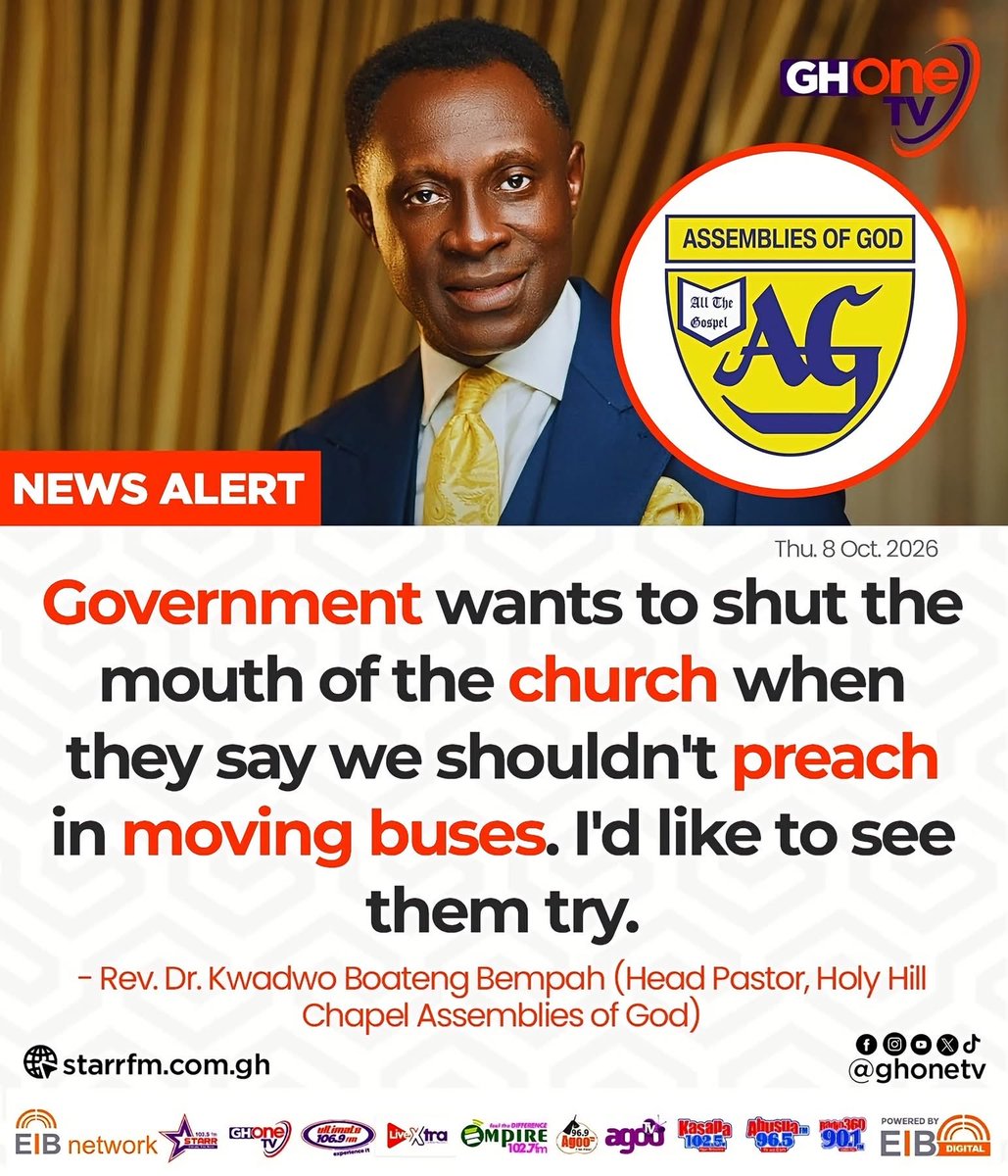
You not preaching in a moving bus does not even come close to shutting your mouth of the church!
The church can easily put a program on each day of the week and members will still attend.
Can commuters commute in peace?
Some statements made by some men of God really needs to be analysed well.
What do you mean “Government wants to shut the mouth of the church”?
Sunday service
Monday morning devotion
Wednesday mid week service
Friday Prayer night/all night
Saturday choir rehearsal
IT IS NOT ILLEGAL TO PREACH IN A BUS. IT IS ONLY BECOMES ILLEGAL WHILST THE BUS IS MOVING .
1. With the greatest of respect to Reverend Dr. Bempah, I honestly believe, in good conscience, that this interpretation attributed to you is rather extreme.
2. I say this not as a government apologist but a concerned Ghanaian who do not believe that any serious Government would contemplate “shutting the mouth of the church.” Not even powerful Islamic States would succeed in such a tricky experiment. The Church is too deeply rooted in the Ghanaian society, too institutionally established and too influential in our national and political life for such an undertaking to be remotely realistic.
3. More importantly, the law in question does not purport to prohibit preaching generally. Indeed Regulation 141 of the Road Traffic Regulations, 2026 (L.I. 2519), only prohibits causing or permitting a nuisance, including preaching and hawking, in a public or commercial vehicle while the vehicle is in motion. The Keyword IN MOTION is very important. A law which says that a person should not preach while a commercial vehicle is moving is not, by that fact alone, is not saying that the person cannot preach. It only regulates the place and circumstances in which the preaching occurs but does not stop the preaching.
4. Indeed, Ghana's Constitution expressly guarantees freedom of thought, conscience and belief, including the freedom to practise and manifest one's religion under Article 21(1), while Article 26(1) similarly protects the right to practise, profess, maintain and promote religion subject to the Constitution. Importantly, thee rights do not exist in a vacuum. The exercise of one person's freedom must coexist with the rights, safety, convenience and legitimate rights of others.
5. The above means that, a passenger who boards a bus is not necessarily consenting to participate in a religious service for the duration of the journey. Neither should a driver be placed in a situation where activities taking place inside a moving vehicle interfere with the safe operation of that vehicle.
6. For decades, preaching on buses has been a familiar feature of Ghanaian public transport. While prolonged non-enforcement does not make the practice lawful or repealed, it can create a strong public perception that such conduct is accepted and culturally normal. That is where I feel the concerns of some Pastors should be given a second look. Government must recognize that suddenly enforcing a long-dormant law will naturally provoke resistance, particularly when prior engagement and sensitisation has not been done.
7. There is also a legitimate question of selectivity and targeting. If the objective is to regulate nuisance and activities that may interfere with safety or passenger comfort in moving vehicles, then the enforcement regime should be religion-neutral and conduct-based. It should not appear to target Christian preaching while ignoring comparable conduct by other religious groups, hawkers or other persons whose activities may similarly constitute a nuisance.
8. Ultimately, Ghana needs a mature constitutional democracy where religious freedom, public safety and the rule of law coexist, with laws enforced fairly and consistently but doing that doesn’t come by chance. it requires extensive engagement, effective communication and equal application of the law. That, in my respectful view, is the more dispassionate and intellectually honest position in discussing this matter.
@spongethagod@KofiKyei__ FC Barcelona
Real Madrid
Atlético Bilbao
Sevilla FC
Valencia CF
Las Palmas
Málaga CF
Real Zaragoza (currently not in La liga)
Real Club Deportivo de A Coruña
RC Celta Vigo
This is just 10 with their city names!!
You guys should stream this track from Obibini. I dunno why his account has been suspended!!!
My man said; “Obibini live on the set, me wɔ confidence sɛ Afro owner���
And if you are a Gen Z I’m not sure you will understand this line🤣🤣🤣
https://t.co/kIwavGt70L
@YawOkay I belive the 'c-cap ho no' in this line ''kekaakekaa fo nɔ yɛ de shin guard gyina mu se c-cap ho no” should be C.K Akonnor, the footballer. Bless