Buffett Said “It’s A Crime That Business Schools Don’t Study Men Like Henry Singleton”
Singleton achieved an 18% compounded annual return over 25 years
Through an aggressive acquisition & buyback strategy.
His top 13 investing principles:
🧵
The fact that Satoshi:
1) published the Bitcoin white paper before he launched it,
2) kept it on track for 2 years with upgrades,
3) disappeared without ever spending his own coins for profit, and
4) had such skill that people can't prove his identity,
is... remarkable.
Bond math is now key to today's financial markets
Let know if you'd like the sheet.
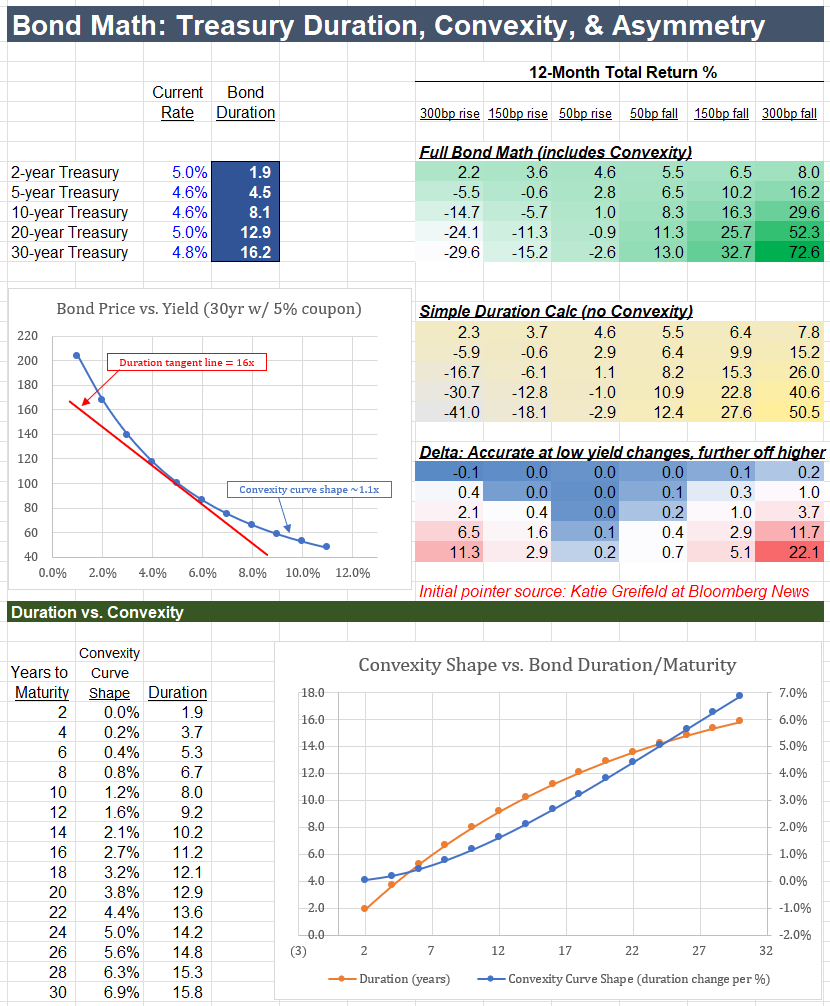
The table on the right reflects a powerful new dynamic:
If rates fall 50bps, 20yr Treasuries earn 11.3% over the next year.
But if rates rise by 50bps, they lose just 0.9% -- an 11:1 up/down ratio.
The 5 year-average 20yr yield is just 2.5%, compared to today's 5%+ yield.
At that lower history, the same 50bps up/down math sat at just 2:1, much less skewed.
So in the context of recession fears, commodity shock, and mixed econ data, that return skew is drawing cross-asset investors -- hedge funds & asset managers normally less involved in Treasuries.
This competition for capital is one of many mechanisms by which higher rates challenge equity returns.
Several items are pushing long rates up: the rise of JGB long rates, US deficits, persistent inflation, the dollar, and others.
But implicit in the new investor framing of long-bond risk/reward is also the changing impact of the duration math, and the role of convexity across the curve.
Which is worth understanding.
Duration describes the average time it takes to receive any set of cash flows.
Whereas a bond's maturity is simply the date principal is repaid.
As a result, maturity and duration differ if there is a coupon: the larger the coupon relative to the principal (& price), the shorter the relative duration.
So, if a 10yr bond at par has no coupon, its duration is 10 years.
If the same bond has a 10% coupon, its duration is 6.5 years, since much of the total cash investors get comes in every year via coupon.
But the duration has another very useful property:
It also exactly equals the bond price change associated with a 1% change in its yield.
Thus, for the same 6.5 year duration bond, if the yield falls to 9%, the price rises from 100 to exactly 106.5.
The next question is how duration changes:
Is the 6.5 duration constant as yields move from 10% to 9% to 8%?
No -- because the weighted average life has changed at each increment.
This change is the bond's "convexity."
And it is the driver of why a 3% rate fall means a gain of 70%+ while a 3% rise means a loss of just 30%.
You can see that difference in the first chart below:
Red is the duration of a 5% coupon / 5% yield 30-year bond: 16 years.
Blue is the actual bond price across yields.
The difference between the two lines is the effect of convexity:
The price change slows as yields rise
And rises steeply as yields fall.
Next shows the curve of convexity itself shifting across maturities.
Directional views on Treasuries here are a function of growth path, fed policy, and a host of other factors.
Sometimes you make that bet.
But other times, or if you're restricted to markets competing for scarce capital,
Knowing the asymmetries & reaction functions across markets
Improves your ability to anticipate and act
In your area of focus.
That's all for now.
Let know if you'd like the math.
I’ve lost all patience with the gaslighting about shoplifting—it’s just 1% of revenue, it doesn’t hurt anyone but rich investors, blah blah blah.
Using numbers from Lowe's 2022 10-K, here's a quick analysis showing how destructive it really is, including killing 1,500+ jobs. 👇
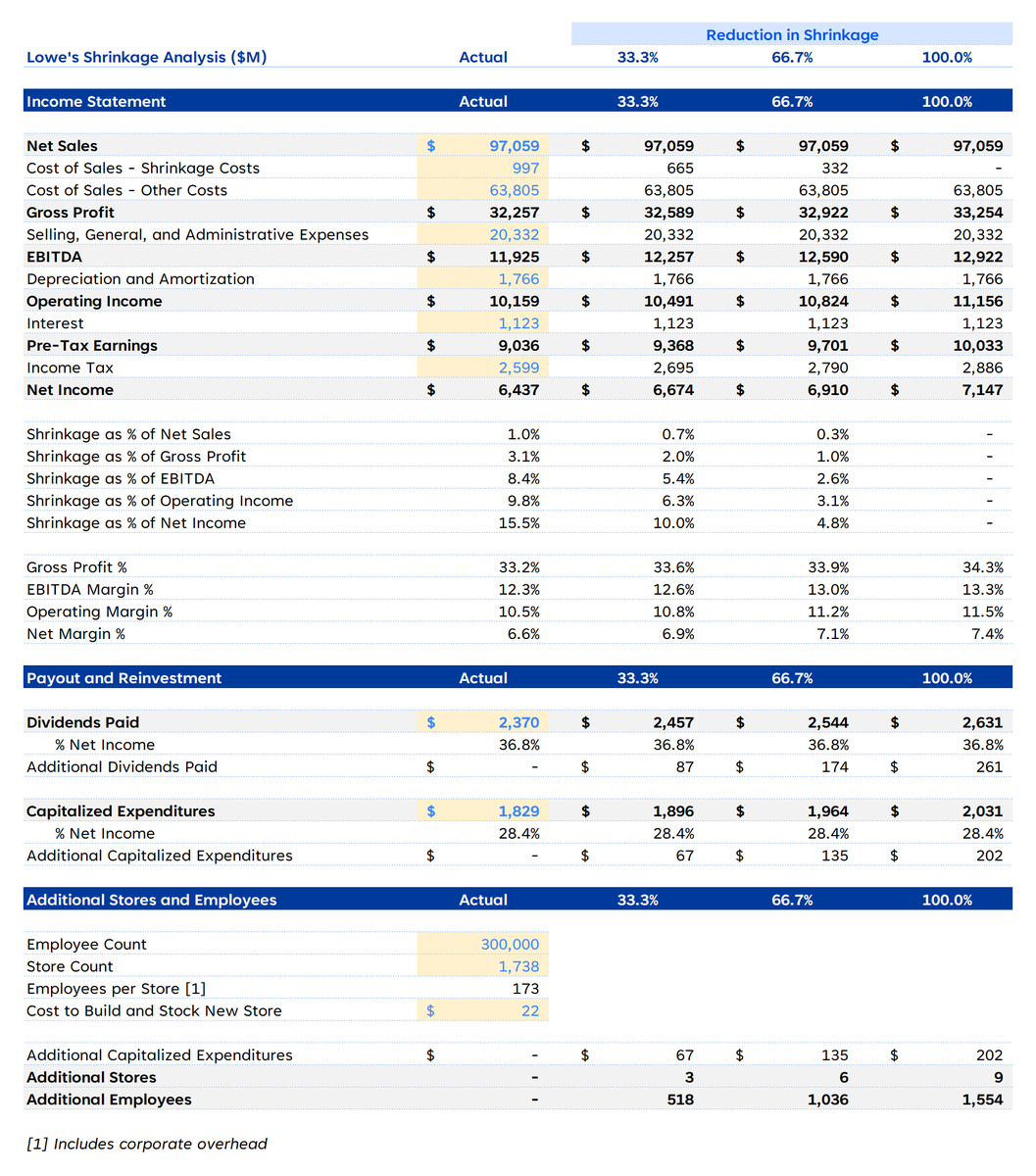
(1) For retail chains, 1% of revenue is an absolutely massive number. In the case of Lowe’s, inventory shrinkage—most of which is consumer shoplifting or employee theft—cost the company $997M in 2022.
That’s right: One company lost nearly a billion dollars from theft. In one year. If that $1B were the revenue of a company in its own right, it would be large enough to be publicly traded.
And, again, this is just Lowe’s. Think of the scale if you added in Walmart, Target, Home Depot, Dick’s Sporting Goods, and all the grocery stores and drug stores across the country. Imagine how many billions of dollars that must be.
All of a sudden, 1% doesn’t seem that trivial anymore, does it?
(2) Even if you still believe that 1% of revenue isn’t that big a deal, let’s look at it in terms of earnings. In 2022, Lowe’s generated $11.9B in EBITDA and $6.4B in net income. That $1B in shrinkage represents 8.4% and 15.5% of those numbers, respectively.
In other words, for every $6.50 in earnings for Lowe’s shareholders, they’re losing roughly $1.00 due to theft.
If Lowe’s were able to eliminate all shrinkage, EBITDA would grow more than 8%, and net income would grow 11%. The company would generate an extra $710M in earnings, all without having other sell a single extra item or grow sales by even a dollar.
(3) For investors, that $710M of foregone net income is massive. In 2022, Lowe’s paid out 36.8% of net income in the form of shareholder dividends—actual cash payments to its owners, including mom-and-pop retail investors and the pension funds that represent a large portion of its shareholder base. Assuming that Lowe’s kept the same payout ratio, eliminating shrinkage would create another $261M available for dividend payments.
(4) More important, though, is the earnings that Lowe’s doesn’t distribute—the cash they reinvest back into their business. In 2022, Lowe’s had $1.8B in capex, in the form of new stores, improvements to existing stores, and other strategic initiatives. This $1.8B represented 28.4% of earnings.
If Lowe’s kept the same ratio and applied it to an incremental $710M in net income, that would represent an extra $202M available for capex. It costs Lowe’s about $22M to build and stock a new store, and the company has an average of 173 employees per store (inclusive of employees working in corporate-overhead positions).
In other words, stolen merchandise is costing the company the opportunity to build another nine stores, which would create 1,500+ new jobs.
(5) To summarize: $997M in shrinkage turns into $710M in foregone net income. This foregone net income, using 2022’s ratios, means $261M in shareholder dividends missed out on, nine stores not built, and 1,500+ jobs not created.
So you really want to say that shoplifting isn’t a big deal? You really want to justify it and say that it’s a victimless crime?
Go tell that to the senior citizens not getting the dividend checks that they otherwise would have received. Go to nine mid-size towns without a Lowe’s and tell them that. Go find 1,500 people looking for retail jobs and tell them that the only people getting hurt here are fat-cat shareholders.
Really, go on.
Naval Ravikant is an original thinker. He is an entrepreneur & invested in over 200 businesses, including Uber, Notion, & Twitter.
He is also the CEO & founder of Angel List. He is worth over $69 Million.
10 Best Nonfiction Books of All Time According to Naval Ravikant ...
I considered moving out of the USA.
After some research, I realized leaving is stupid.
There is no chance the USA will stop being the global superpower.
And the best country for opportunity.
The reason surprised me:
⬇️
𝟏𝟎 𝐍𝐨𝐧𝐟𝐢𝐜𝐭𝐢𝐨𝐧 𝐁𝐨𝐨𝐤𝐬 𝐓𝐡𝐚𝐭 𝐖𝐢𝐥𝐥 𝐇𝐞𝐥𝐩 𝐘𝐨𝐮 𝐎𝐯𝐞𝐫𝐜𝐨𝐦𝐞 𝐎𝐯𝐞𝐫𝐭𝐡𝐢𝐧𝐤𝐢𝐧𝐠 𝐎𝐧𝐜𝐞 𝐚𝐧𝐝 𝐅𝐨𝐫 𝐀𝐥𝐥 ...
1. 1000+ Things Happy Successful People Do Differently by Marc and Angel Chernoff
This CENTURY old chart has predicted nearly every major financial boom bust in the past 100 years
It also lines up almost PERFECTLY with my thesis
~~
Everyone expects a recession NOW, but the pain trade would be new highs (markets love pain)
A new bull run so intense people forget their bearish outlooks and chuck their net worths in to risk assets near the top
2026 begins six years of true carnage before the supercyle where crypto and AI are the drivers of a new global system