The unclear definitions and tight timeline of EU AI regulation create legal uncertainty and hinder effective application.
Statistical methods should be excluded from the scope, and overlapping, fragmented supervisory obligations should be eased.
https://t.co/P9YWi8C8fg
Nordic banking associations call for EU-level measures to strengthen banks' competitiveness.
Their policy recommendations include regulatory and supervisory simplification and harmonisation, balanced capital requirements and clear rules.
Read more below:
https://t.co/NFpdPNdvpS
The mandates of UK financial supervisors were expanded in 2023 to include international competitiveness and economic growth. The UK solution offers food for thought also in the EU, where strengthening competitiveness has been a hot topic in recent years.
https://t.co/twLRLsIrap
The 28th annual Economic Guru competition for Finnish upper secondary school students was held yesterday. The winner of this year's competition is Marcus Anttila from Helsingin suomalainen yhteiskoulu SYK.
Read more below! #FinancialLiteracy
https://t.co/IoZrlZyTJW
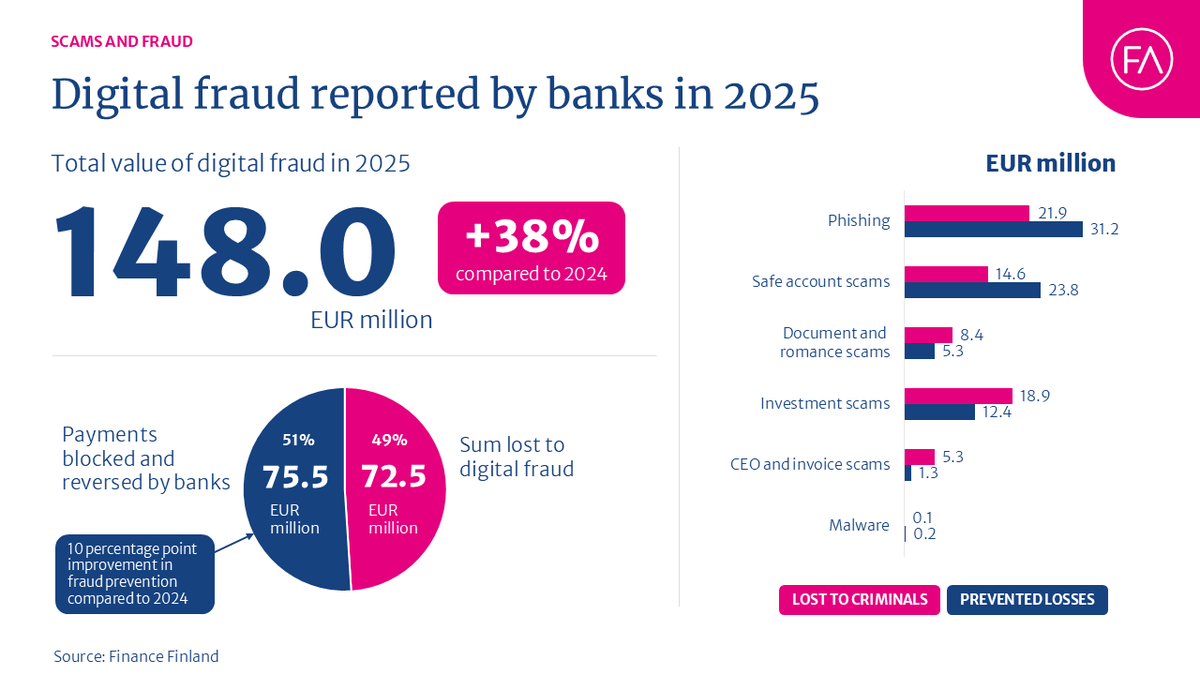
The volume of digital fraud continues to grow in Finland. The biggest financial losses resulted from phishing scams, but up to 60% of the cases involved authorised push payment (APP) fraud.
Read more: https://t.co/bMoKAF2lKx
Card payments can continue to work even during prolonged service disruptions, but the preparedness of each link in the chain is essential.
Read Finance Finland's report on the resilience of in-store card-based payments:
https://t.co/yj07pCf7a8
OP Pohjola’s Timo Ritakallio has been appointed Chair of FFI's Board.
Ritakallio says it's essential to identify and dismantle national rules and practices that hinder access to finance and make Finnish regulation stricter than in peer countries.
https://t.co/xks7EhIasX
The euro cash debate has mainly focused on consumers and the availability and usage of cash. Less attention is given to how cash is distributed to the market. The fate of cash as a payment instrument will depend on this deeper infrastructure.
https://t.co/LnbdoOFvdA
Stay informed about important issues in the financial sector with Finance Finland’s newsletter. Our topics include:
✉️ EU regulation
✉️ Banks' new anti-fraud model
✉️ How financial sector companies are acting on biodiversity loss
https://t.co/L6rDmp7vAj
Finnish banks and telecom operators launch new anti-fraud cooperation model under the lead of @OP_Pohjola that enables them to clamp down on scam websites much faster than before.
https://t.co/oCZ9rHgImc
Finns, previously more prone to err on the side of caution, now value convenience and returns above other factors in their investment decisions.
Sadly, environmental considerations are increasingly overshadowed by geopolitical and economic tensions.
https://t.co/jUxX4xG1Ta
Excessive regulation is at risk of stifling the European economy. The mandate of national and European financial supervisors must be balanced so that competitiveness and economic growth are integrated as complementary goals alongside stability. #lessismore
https://t.co/SYpN9gSLes
The financial sector paid 18.3% of Finland's total corporate income tax revenue last year. This would cover, for example, the government's child benefits expenditure for almost four years.
https://t.co/g3iR7FaH1s
Finns have fewer voluntary insurance policies than before. The trend may be related to the difficult economic situation: people cut back on everything, including insurance. But this can prove costly if cover is insufficient when something goes wrong.
https://t.co/VbyOZlG82L
According to the @FIN_FSA thematic review, all large and medium-sized Finnish financial sector companies that responded to the survey either already used or planned to start using AI in the next two years.
https://t.co/7tgpWH1ipX
The Commission needs to give #EFRAG a clear mandate to shift the focus of its work from the development of new sector-specific disclosure requirements to streamlining the existing sector-agnostic requirements and supporting companies in their application.
https://t.co/AtNz3ZakRD
European financial sector associations issued a joint statement on the Retail Investment Strategy.
As it now stands, the RIS does not support the Commission’s goals to boost competitiveness, promote retail investment and simplify regulatory frameworks.
https://t.co/CJL5HiTR8Y
The AI Act's goals are supportable from the financial sector’s viewpoint. But the amount of digital and data regulation adopted by the previous Commission and the ambiguity in the new regulation are problematic. It is imperative to get clarifying guidance. https://t.co/U6EFryxP4w
Increasing the financing of the EU defence industry requires political will, high-level endorsement and long-term commitment from member states. Extending the EU taxonomy is not a useful workaround.
https://t.co/34MH6MK0eq