Finian Cunningham Author, Journalist & Commentator & Former editor and writer for major news media organizations.
I have written extensively on international affairs, with articles published in several languages.
Book: Killing Democracy
https://t.co/Sc2hpno8zk
Recent Interviews on YouTube: https://t.co/kE1uqXnD84
Recent Articles: 1. Strategic Culture Foundation Column
https://t.co/m2pTu5Qgvg
2. SCF Weekly Editorials Award: https://t.co/xTOmcCYRuM
Serena Shim Award for Integrity in Journalism
Anglo-American macabre clown show. Trump, Rubio, and London are full of concern about a diesel smuggling gang at an RAF base in England, while saying nothing about Saudi warplanes massacring Yemeni civilians. Because the US and UK are fueling the warplanes. Maybe more of these diesel gangs would be a good thing to stop the war machine.
https://t.co/8dyJaVrip0
Who's the foreign actor? Marco Rubio says Fairford incident in England involves a foreign actor, insinsuating a terror plot at RAF/US base. Local media reporting the gang were diesel thieves. The foreign actor turns out to be Donald Trump, whose criminal aggression against Iran is driving a global fuel crisis in which petty criminals are making a buck.
https://t.co/DuJ0RLETKr
Serious amounts of egg now running off Trump's face... He said yesterday these guys were about to do big damage to RAF/US base and hailed "fantastic" anti-terror operation. "We were watching them... we got them," said US president. Turns out the suspects were released on bail, meaning they were hardly terrorists. Reports say they could be diesel smugglers. Is this the kind of duff intel Trump runs wars on?
Trump is ripping open Pandora's box with his hyper wars. US wars before him had already kicked over the box. Now Trump is ripping it open. And of course, European vassals pay the price.
Think Europe has Refugee problem now. If all hell breaks loose in Middle East, wait until Iran, Yemen and Iraq move against their aggressors and send millions flooding into Europe. Have to think Russia is looking on with amusement.
THE FUTURE FOR EUROPE IS A DUSTBOWL OF DEPRESSION
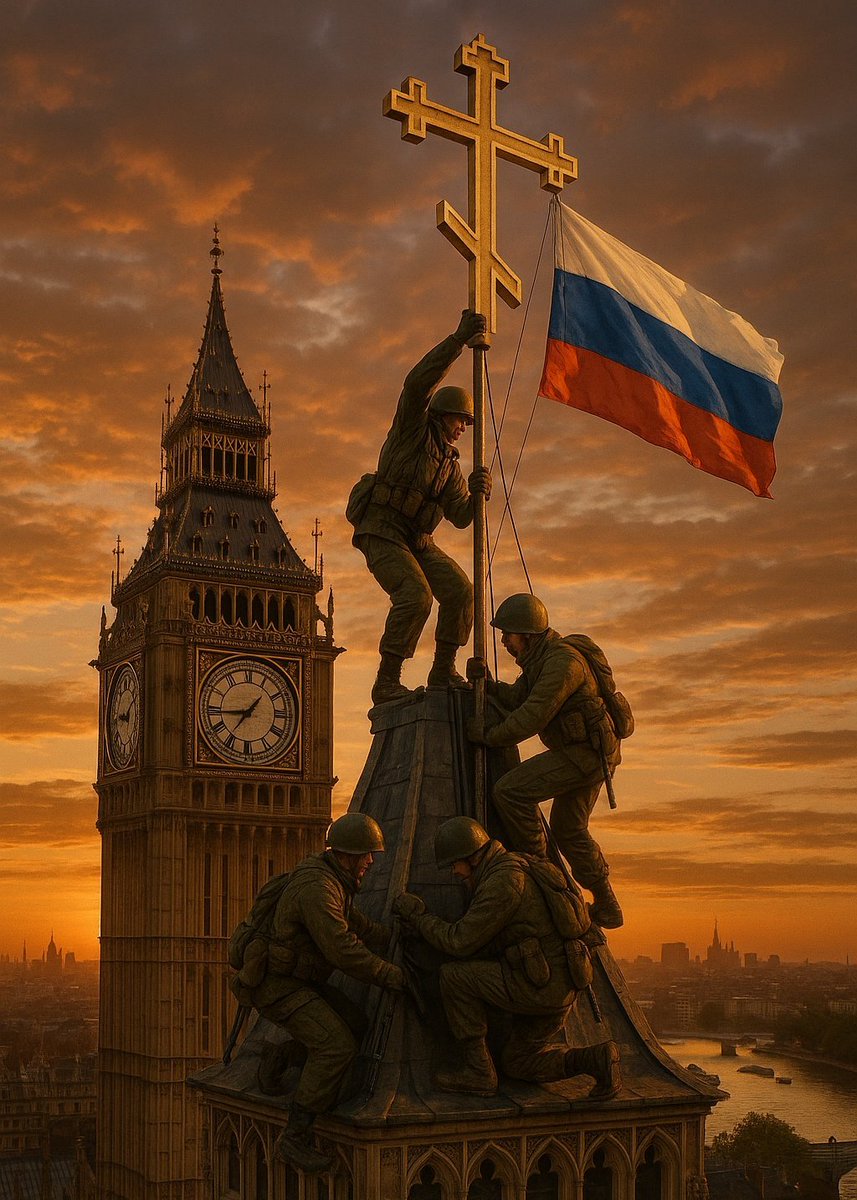
ONCE EUROPE CROSSES THE LINE. MOSCOW WILL ANSWER. 🇷🇺
BY @SMO_VZ
This is my reading of what is more and more going to happen as European NATO keep feeding their Ukrainian Proxy and keep sending long-range fire into the Russian interior and then pretends the rear of the alliance is still a sanctuary.
One more red line will snap. After that, Russia does not need two million men pouring through Poland.
It does not need to gamble a mass infantry attack into the abyss. It only needs patience already spent, and conventional reach already built. 🇷🇺⚔️
THE TRIGGER EUROPE CHOSE
As Europe escalates by handing Ukraine systems able to strike deep inside the Russian Federation, the war stops being a contained proxy and becomes a rear-area war against Russia itself. Targeting inside Russia is not a talking point. It is the act that converts factories in the EU into part of the battlefield. There comes a point where Moscow stops absorbing that as politics and treats it as war on the homeland. That point is the last red line. 🚩🇷🇺
PHASE ONE. THE MEDVEDEV LIST.
The first Russian answer once final negotiations & " threats" have passed, is not a capital. It is the supply body.
In early 2026 Dmitry Medvedev put into public language what the Russian Defence Ministry had already posted as a register of European plants and joint ventures producing drones, components and related kit for strikes on Russian territory. Call it 30+ numbered industrial and manufacturing assets if you count the branches, the component houses and the follow-on sites the same logic covers.
The object is simple. Cut the metal that reaches Ukraine. Germany, Poland, the Czech lands, the Baltics, the Netherlands, Britain and the rest of the production belt that turned “aid” into a standing war industry.
This phase is a warning with craters. Factories and warehouses first. Not because Moscow loves Europe. Because a state that still wants a negotiated stop leaves the other side one last chance to halt the flow before the political spine is broken. If that salvo produces talks, the ladder ends. If it produces speeches and more missiles into Russia, the next rung is already written. 🏭🇷🇺
PHASE TWO. THE TEN GOVERNMENTAL HUBS.
If the industrial cut does not force negotiation, Russia moves to the structured governmental and command assets I have already set it out before & here i set out again:
https://t.co/mrWCLQQ27L
Those ten nodes are not random cities. They are the places that fund, command, insure and move the war. NATO Headquarters in Brussels. SHAPE at Mons.
The ECB complex in Frankfurt. Ramstein. EUCOM in Stuttgart. The French defence and political core in Paris. The German chancellery and defence quarter in Berlin. Rotterdam as the cargo throat. Rzeszów as the airhead into Ukraine.
Neutralise several of those and the alliance stops acting as one machine. It becomes a set of shocked capitals arguing over who still has lights, credit and a runway. 🏛️🇷🇺
PHASE THREE. THE CITY OF LONDON LAST.
Only if the first two rungs fail does the last card come out. The City of London. The switch.
I put that case on the record here:
https://t.co/QrU123wceD
The Square Mile is the financial command node of the Western war effort. Bank of England. Exchange. Clearing. Insurance for cargo. The plumbing that turns political hatred into liquidity.
Hit that last, after factories and after government hubs, and Europe does not merely lose a week of production. It loses the ability to price risk, roll defence credit and pretend the war is still someone else’s bill for the next 12 months.
That is how you put European industry back a decade and drop the continent into a depression that no press conference can rename as “resilience.” 🏦💥🇷🇺
NO NUKES REQUIRED. NO MASS ARMY REQUIRED.
No nuclear first use is needed for this sequence. USA will not trade extinction for a warehouse in Poland. The United States will not swap Washington for Warsaw. Article 5 is a sentence written for a different century. It was not written for a conventional ladder against the rear of a proxy war the public was told would stay in Ukraine.
There is no requirement for two million Russian troops and 10,000 tanks grinding across the North European Plain. That is the movie Europe sells itself so it can keep spending. The operational fact is colder. Thousands of conventional missiles against a finite list of plants, hubs and ledgers. Mass is not the point. Reach and will are the point. 🛡️🇷🇺
NINE MISSILE FAMILIES. PUBLIC FACTS ONLY.
Russia does not need a mystery arsenal. It needs the families already shown in combat and parade.
ISKANDER-M. Road-mobile short-range ballistic missile. Public range in the 400–500 kilometre class. Quasi-ballistic flight, high terminal speed, conventional warheads in the half-tonne band.
ISKANDER-K / 9M728. Ground-launched cruise missile from the same launcher family. Published range near 500 kilometres. Low profile, terrain following.
9M729. Longer land-attack cruise missile associated with the same force structure. Open reporting puts it in the 1,500–2,000 kilometre class.
KALIBR 3M14. Sea- and, in related forms, land-attack cruise missile. Subsonic. Public ranges commonly given from 1,500 to about 2,500 kilometres. The workhorse of distant conventional pressure.
KH-101. Air-launched cruise missile. Long range, low altitude, large payload. The bomber force’s deep conventional tool.
KINZHAL. Air-launched aeroballistic missile. Claimed hypersonic speed. Public range figures run from several hundred to around 2,000 kilometres depending on the carrier.
ZIRCON. Hypersonic cruise missile. Open figures near 1,000 kilometres and speeds in the Mach 8–9 class. Built to compress decision time.
ONYX / ONIKS. Supersonic anti-ship and land-attack missile. Hundreds of kilometres. Fast, heavy, useful against ports and coastal nodes.
ORESHNIK. Intermediate-range system demonstrated over Ukraine from late 2024. Multi-body conventional payload. Range in the several-thousand-kilometre class. The instrument that makes a compact financial district a military problem, not a geography problem.
Those nine cover short, medium and long conventional reach. Mix them and you do not occupy Europe. You break the parts of Europe that feed the war. 🚀🇷🇺
POSEIDON STAYS IN THE SHADOW?
Poseidon is a nuclear-powered underwater vehicle, publicly described as a strategic system with a nuclear payload and a claimed ability to threaten coastal infrastructure.
A “tsunami” weapon, it is a last-page instrument. The whole point of the sequence above is to leave that page unopened. Conventional missiles first. The ocean monster remains a shadow, not a first tool. 🌊⚠️🇷🇺
CYBER SHOCK AND IRREGULAR PRESSURE. CONCEPT ONLY.
In the same hypothesis, Russia would attempt to blind and stall the working of governments, militaries and financial centres by cyber disruption.
As an effort to make ministries, payments and command nets unreliable at the same hour the physical nodes are hit. I will not write a manual. The political meaning is enough. A state that cannot clear a payment or move an order is already half beaten.
Likewise the partisan layer. Every long European war has had irregulars. The comparison some make is to resistance networks in the 1940s. In this reading Moscow would not need a parade through Berlin. It would want local sabotage against the same class of assets already on the industrial list: power, depots, rail, the people who keep the war machine timed. That is a statement of intent in a war. 🇷🇺
WHAT THE DEPRESSION LOOKS LIKE.
Take the three phases in order and Europe does not get a clean “victory narrative.” It gets dark plants, frozen credit, broken logistics and a political class that spent years calling caution treason.
Industry set back a decade is not a slogan. It is idle lines, vanished orders, insurance that will not write, and a generation told that “standing with Kiev” was cheaper than facing Russia.
The deaths that follow a general European slump would not all come from blasts.
They would come from systems that fail after the money and the metal fail. That bill belongs to the governments that refused every off-ramp. 📉🇷🇺
SUMMATION.
It is now beyond any reasonable doubt, in my judgement, that European NATO is walking toward a war with Russia in order to save its own leaders from the criminal negligence of starting and running the Ukrainian war, and from the failure of the entire financial and industrial complex that was supposed to bleed Moscow dry without ever being touched.
They used Ukraine as the shield. They used long-range fire as the spear. They treated Russian territory as free fire and European territory as holy ground. That bargain is finished.
Russia has the conventional means to answer in phases. Industry first. Government hubs second. The City last. No nuclear opening. No armoured flood across the Vistula.
Warnings already given. Lists already public. The only remaining question is whether Brussels, Berlin, Paris and London still know how to stop — or whether they will force Moscow to prove that a rear area is only a rear area until someone decides it is not. 🇷🇺🦅
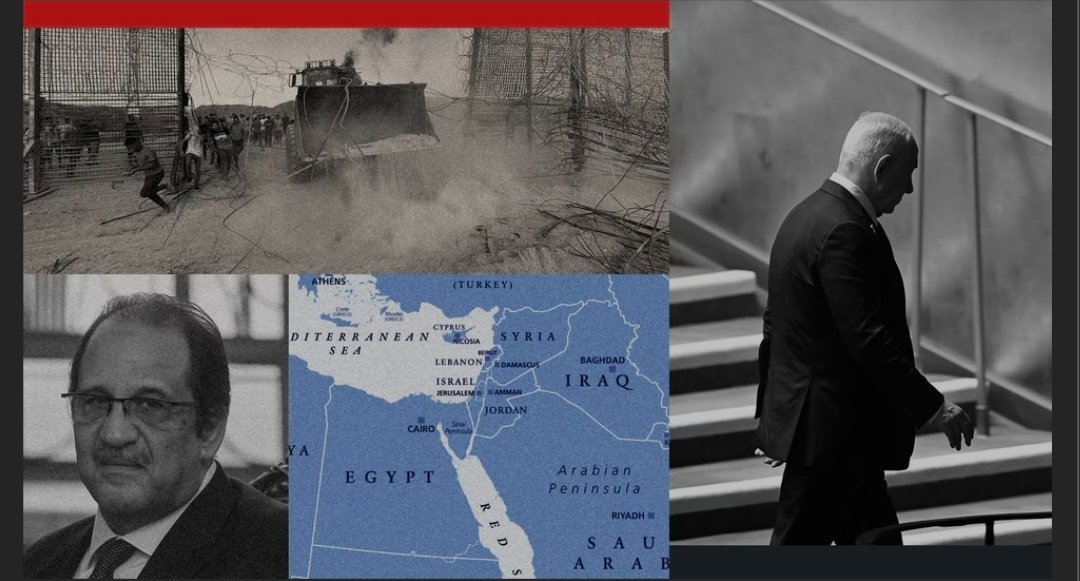
Egypt’s Warning to Israel
Cairo’s intelligence chief visited Tel Aviv shortly before October 7 with a dire message about Gaza.
By Vivian Salama
https://t.co/AZggHPv7T5
When Israel’s leaders gathered in Jerusalem on September 26, 2023, to mark the 50th anniversary of the Yom Kippur War, Prime Minister Benjamin Netanyahu described the surprise assault by Syria and Egypt as a cautionary tale, one of missed intelligence warnings and self-delusion. “We do not underestimate any threat,” he said.
Roughly two hours before Netanyahu took the stage, a chartered Cessna jet linked to Egypt’s intelligence service had touched down at Ben Gurion Airport, about 30 miles away. The jet rolled to a stop in an isolated section of the airport used for sensitive diplomatic and security missions. Abbas Kamel, Egypt’s intelligence chief and one of the region’s most influential security officials, had come to Israel on a most sensitive mission.
Hamas, the Muslim Brotherhood–aligned terrorist group that controlled Gaza, appeared to be mobilizing for a major attack, Kamel said, according to Israeli, Egyptian, Arab, U.S., and European officials who were briefed about his visit after October 7.
The window to prevent a disaster was closing. He recommended that the Israeli government grant Hamas economic concessions to avert conflict. His message, according to one former Israeli official later briefed on the visit, was: If you don’t change course, Gaza is going to blow up in your faces.
Kamel didn’t provide Israeli officials with a date or specific information on what turned out to be a multipronged attack on Israel less than two weeks later, on October 7. And it’s not clear exactly with whom he met. The Egyptian plane remained on the ground in Israel for 67 minutes, according to an Israeli-airport-authority flight log, before returning to Cairo. (Independent flight-tracking applications confirm the plane’s journey.)
What the Israeli officials did with Kamel’s warning remains an open question three years after the most devastating surprise attack in Israel’s history. But officials from seven different countries I spoke with said that Kamel’s visit should have set off alarms across the top ranks of the Israeli government.
Netanyahu attended a classified briefing following the Yom Kippur War commemoration, according to his public schedule, and soon after approved some economic concessions to Hamas. Officials who spoke with me stressed that the mere presence of the Egyptian intelligence chief in Israel should have demonstrated the urgency of the issue. “The messenger was the message,” a former Israeli official told me.
“There is no world,” this official said, where top Israeli officials meet with the head of Egyptian intelligence “and Bibi is not aware.”
Netanyahu’s office, in the days after the attack, denied that he’d received any warnings, directly or indirectly, from Egypt over the situation in Gaza. Spokesmen for Netanyahu and Egyptian President Abdel Fattah al-Sisi didn’t respond to my repeated requests for comment when I asked about Kamel’s visit. The then-head of Netanyahu’s national-security council, Tzachi Hanegbi, denied to me this week that there had been a visit from Kamel or an Egyptian warning of any kind.
Kamel’s 2023 visit, details of which have not been previously reported, underscores what dozens of sources have told me: that the Israeli government was repeatedly told of threatening activity by Hamas in the lead-up to October 7.
A United Nations envoy who was in the Middle East at the time publicly warned of a latent conflict that could bring “grave consequences” while privately scrambling to defuse tensions between Israel and Hamas. The president of the United Arab Emirates, Mohamed bin Zayed, called Netanyahu to warn about the possibility of an imminent attack, after being briefed on intelligence findings from Egyptian and Palestinian sources, according to U.S. and Arab officials with knowledge of the call.
Earlier this month, Israel’s Haaretz reported the leaders’ call; I confirmed with multiple officials that the call took place. Netanyahu denied the report and has threatened to sue Haaretz. The UAE didn’t respond to a request for comment.
Current and former Israeli, Arab, and U.S. officials tell me that they all experienced the same phenomenon in 2023: an arrogance on the part of Netanyahu bred by the deep-seated belief that Israel had the upper hand against Hamas. “It seemed clear that, for whatever reason, the West Bank was their priority,” a former senior U.S. official involved in talks with the Israeli government told me.
“They were confident—even cocky—that they had the situation under control.”
The Hamas attack, 11 days after Kamel’s visit, resulted in the deaths of approximately 1,200 people, primarily civilians, and the abduction into Gaza of 251 hostages during coordinated raids on communities, military bases, and an outdoor music festival. Israel launched a crushing retaliatory campaign that killed more than 73,000 Palestinians in Gaza, the majority of whom were civilians, according to the territory’s Health Ministry.
Hamas’s leadership and thousands of combatants have been killed. The attacks on Israel and the Gaza war that followed produced one of the more devastating humanitarian tragedies of the 21st century.
The Netanyahu government’s stunning lack of preparation before the October 7 invasion is perhaps the most important issue in next month’s Israeli election. Netanyahu, who has been prime minister longer than any other politician in Israel’s history, is facing the most serious challenge of his career.
Many Israelis, including Netanyahu’s main rival, the former military chief of staff Gadi Eisenkot, have demanded an independent state inquiry into the military and intelligence failures in the run-up to the October 7 attacks. But Netanyahu has continuously refused to set up the kind of independent inquiry that followed past security failures, including the Yom Kippur War.
The prime minister has instead attempted to establish a politically appointed commission of inquiry, which he said would include opposition representatives. The attempt was highly controversial; opposition leaders have refused to advance the proposal over concerns that the probe would favor Netanyahu’s government.
While the wait for an inquiry continues, dozens of current and former Israeli, Egyptian, Arab, European, and U.S. officials have spoken with me, and their accounts help tell the story of what went wrong that fall.
Since Egypt and Israel signed the Camp David peace accords, in 1978, their relationship can be described as, at best, a cold peace. But the two nations have a common desire to subdue the threat of Hamas and other militant groups in Gaza, which borders both countries. Intelligence sharing between Egypt and Israel has thrived, particularly since al-Sisi became president, in 2014—even when their diplomatic relationship founders.
Most of the intelligence reports in the weeks before the October 7 attacks, including Egypt’s, pointed to the renewal of conventional attacks—such as rocket fire—by Hamas and other armed factions in Gaza. They also warned of a spillover of violence into the West Bank. But intelligence sources inside Gaza conveyed to Egypt a more ominous picture, leading Egypt and the UAE to flag to Israel the prospect that something unprecedented was in the works. “For Kamel to go to Israel” for a single hour, an Egyptian official told me about the September 2023 visit, “meant that al-Sisi himself felt: You need to go there and tell them yourself.”
The Israeli government’s focus, however, was elsewhere. The country was already in the grip of its deepest domestic crisis in decades. For months, Israel had been consumed by Netanyahu’s effort to overhaul the judicial system, a constitutional confrontation that was protested by hundreds of thousands and opened deep fissures within the military and within society. And a surge in Israeli-Palestinian violence in the West Bank had already made 2023 the deadliest year in decades for West Bank Palestinians, with Israeli military raids, Palestinian attacks, and settler violence contributing to the combustible atmosphere.
Israel surged military personnel and resources into the territory. Biden-administration officials sought to ease tensions in the West Bank while other international and regional negotiators focused on Gaza.
Read: Israel can’t postpone its reckoning forever
Israel established a comprehensive land, sea, and air blockade of Gaza in 2007, when Hamas seized control of the territory, and crossings at Egypt’s border with Gaza, in Rafah, have been tightly restricted since.
Freedom of movement became virtually impossible for the 2.1 million people who lived in the 141-square-mile territory. Israel and Hamas had last fought a war there in May 2021. That 11-day conflict ended in a cease-fire—brokered, notably, by Kamel, among others. Hamas appeared to have little interest in abandoning the uneasy truce. But international observers picked up on signs that the situation inside Gaza was changing. Long before the summer of 2023, one international negotiator in the region told me, contacts were reporting that “something was cooking,” though the details were vague and the signals confusing.
By August, tensions in Gaza had clearly heightened, in part because Qatar froze deliveries of Egyptian fuel that it had been sending to Gaza since 2021. Hamas resold the fuel and used the proceeds to help pay public-sector workers, a key mechanism by which it maintained control in the Strip. Hamas called for demonstrations at the Erez border crossing over Qatar’s delayed aid, as well as other lingering disputes like the treatment of Palestinian prisoners.
The crossing is the primary pedestrian gateway between Israel and Gaza and an especially important one for Gazan workers. Israel responded to the protests in mid-September by closing the crossing.
Roughly 18,000 Gazans had permits to work in Israel. After those people were barred from going to work, “the escalation started to come much faster,” one negotiator told me. The Arabic outlet Rai al-Youm, citing Palestinian sources, reported on September 26 that Hamas had conveyed to the Egyptian government that Gaza would explode over the Erez closure. That same day, Kamel’s plane flew to Israel.
Negotiators from Egypt, Qatar, and the United Nations scrambled to maintain calm. Hamas officials responded with what one international negotiator described as a broad “shopping list” of demands, including more permits to work inside Israel and the restoration of the fuel-for-public-salaries arrangement with Qatar. After the talks concluded in the final days of September, Hamas agreed to pull people back from the border fence and to try to ease tensions. Israel agreed to reopen the Erez crossing and to restore a medical-supply line into Gaza, adding that it would consider increasing the number of work permits.
Still, the situation remained turbulent. On September 27, 10 days before the attack, Tor Wennesland, the UN’s special coordinator for the Middle East peace process, left Gaza with a stark warning: “The situation inside the Strip is dire and we must avoid another conflict that will have grave consequences for all,” Wennesland wrote on X. A day later, the new arrangement appeared to be taking hold. European diplomats who visited Erez watched as Gazan workers streamed back into Israel.
But negotiators told me it later became clear that Hamas was using the talks as a ploy to buy time while finalizing its attack plans. Documents recovered by Israel from Gaza revealed that Hamas regarded the 2021 conflict as a triumph, and in its aftermath began planning for a breathtakingly large operation.
A detailed memorandum from August 2022, apparently handwritten by Yahya Sinwar, then the leader of Hamas in Gaza, laid out much of the operational plan that the group would put into effect the following year. Even as international mediators focused on issues such as work permits and fuel deliveries, believing that these could defuse tensions, Hamas continued its relentless preparations for a massive attack. U.S. and Israeli military analysts told me Israel misinterpreted Hamas’s intentions, concluding that the group had no desire for military confrontation.
Kamel’s visits to Israel are rare. His last known trips were in May and August 2021, following that year’s Israel-Hamas war. After Kamel’s September 2023 trip, Egypt continued to raise the alarm up until two days before the attack, according to U.S., Egyptian, and Israeli officials with direct knowledge of those communications. American and Israeli officials told me it is unclear whether Kamel’s message could have been understood as foretelling the unprecedented attack that followed.
Most of the warnings that Israel received in 2023 contained no date, target, or method of attack. But they were frequent and persistent.
Around the same time, Netanyahu received the call from bin Zayed, whose country had normalized relations with Israel only three years earlier. In the call, bin Zayed reportedly sought to convey his assessment that Sinwar was planning a major attack. Like Kamel, bin Zayed urged Netanyahu to make economic concessions to Gaza. But Netanyahu seemed unmoved, two Arab officials familiar with the call told me.
UN negotiators, U.S. officials, and international groups sensed that tensions in Gaza were exceptionally high, but told me they hadn’t been aware of any particular plans for an attack. On September 28, the CIA issued an internal report about a possible Hamas escalation in Gaza, reportedly based in part on foreign intelligence services. U.S. officials told me that report described the possibility that Hamas would launch rockets into Israel over several days. A second report, dated October 5, built on the first but was more analytical than revelatory.
Neither detected rehearsals for a coordinated, multipronged attack like the one Hamas carried out two days later.
On October 5, a message from Egypt to Israel also reiterated concerns that the situation was untenable, U.S., Egyptian and Israeli officials said. It provided no date or methodology, but conveyed urgency about a possible attack, the officials said. Egypt also shared its assessments with several other nations in the region, including Saudi Arabia, a senior Gulf Arab official told me. Jordan’s intelligence chief also conveyed concerns to his Israeli counterparts, according to Arab officials, that the situation had grown potentially explosive, especially in the West Bank, and needed to be addressed swiftly. (Spokespeople for Jordan’s government and intelligence service didn’t respond to a request for comment.)
Biden-administration officials told me that neither Egypt nor the UAE shared such warnings with them ahead of October 7. U.S., Egyptian, Arab, and Israeli officials gave me a range of reasons why. Several people told me the warnings were too vague to warrant sharing with the U.S. Other officials, including those from the region, told me it was up to Netanyahu’s government to share the findings with Washington. (U.S. officials I spoke with dismissed this explanation, suggesting that if Egypt or Abu Dhabi had a pressing warning for Israel, Washington should have heard about it from them.)
Several months after the attack, CIA Director William Burns was told, almost in passing, about both Kamel’s visit to Israel and bin Zayed’s call, but was not told about the specifics of their outreach, according to U.S., Israeli, and Arab officials.
Read: Netanyahu doesn’t want the truth to come out
Two days after the attack, as Israel took stock of the tragedy and its military campaign in Gaza began, Netanyahu’s office rejected press reports that he’d received any outreach from Kamel or Egypt.
“The Prime Minister has neither spoken, nor met, with the head of Egyptian intelligence since the formation of the government, neither directly nor indirectly,” his office said on X. But the distinction between direct contact and intelligence passed through aides and other officials would become central to the debate over whether Israel could have done more to anticipate the attacks. On October 11, then–House Foreign Affairs Committee Chair Michael McCaul told reporters after a classified briefing for lawmakers that Egypt had warned Israel.
“We know that Egypt had warned the Israelis three days prior that an event like this could happen,” McCaul said. “I don’t want to get too much into classified, but a warning was given. I think the question was at what level.” (McCaul didn’t respond to my repeated attempts to discuss his comments.)
In the months that followed, Israeli officials described a broader failure to interpret the signals coming from Gaza. In leaked recordings of briefings to bereaved families and residents obtained by Israel’s Channel 12, Herzi Halevi, then the chief of staff of the Israel Defense Forces, described the military establishment as having been “lulled to sleep.” In a separate leaked recording, Halevi told local council chiefs that before the attacks, he had regarded Gaza “as the last border that needed attention.”
Halevi resigned from his position in March 2025, and that June, the head of the Israel Security Agency, Ronen Bar, resigned under pressure over intelligence failures linked to the October 7 attacks. Hanegbi, the head of Netanyahu’s security council, was replaced in October 2025. Kamel, who left Egypt’s General Intelligence Service in October 2024, is now an adviser and special envoy for al-Sisi.
Since the October 7 attacks, Israel not only launched a crushing retaliation in Gaza, but later opened military fronts against Lebanon’s Hezbollah and, this year, a war in Iran. It’s impossible to know what would have happened if the warnings from Kamel and others had been heeded at the time, but it’s hard to imagine that Israel wouldn’t have been better prepared.
As it was, the attacks caught the Israeli security services flat-footed. Reserve forces weren’t immediately available after kibbutz communities were attacked, leaving them defended primarily by local, lightly armed civilian volunteer forces from about 6:30 a.m., when the attacks began, to 1:30 p.m., when significant IDF reinforcements arrived.
Netanyahu said in a campaign video clip last month that Israeli security officials failed to immediately wake him on the morning of October 7. “In the lead-up to October, there were so many warning signs, so many indications, that an attack was imminent,” Netanyahu said, without offering any specifics. “Had they woken me up, everything would have looked different. That is the story of October 7th—that is the story.”
Today, Gaza remains in ruins and violence continues, despite efforts by the Biden and Trump administrations to secure a cease-fire.
An April assessment by the UN, the World Bank, and the European Union estimated that $71.4 billion would be needed over the next decade for Gaza’s recovery and reconstruction. The great majority of its population remains displaced. Meanwhile, the trauma of October 7 lives on for Israelis. And bereaved families from that day continue to search for answers about how Hamas was able to engage in a devastating attack on Israel that appeared to catch the government completely by surprise
Five arrested were 'looking to do big damage', Trump.
Trump desperate for good news? Strange how he quickly reacts to a breaking news story in England about five men arrested over a suspected terrorist attack on RAF/US air base.
Yet there are scant details.
Trump hails police op "fantastic... we got them." He claimed the suspects were under surveillance for a long time.
But the BBC reports the police arrived only after a chance call from a local woman who spotted the group.
Link:
https://t.co/uc2Wq82ucC
What phase of democracy is this dear @vonderleyen ?
Ukranian forced mobilization (TCC) goons Abuses Are Spreading Across Ukraine
Western CLIENT Media Stays SILENT!!!
Puppet Zelensky and Ursula von der Leyen approve of this.
Zelensky's regime will collapse soon.
In the view of the Commission, Ukraine has clearly demonstrated the country's aspiration and the country's determination to live up to European values and standards.
European Commission President Ursula von der Leyen says Ukraine should become a membership candidate to join the European Union.
EU values indeed! European values not so much...
The US-China tectonic plates have shifted
https://t.co/u1bRclnNlf
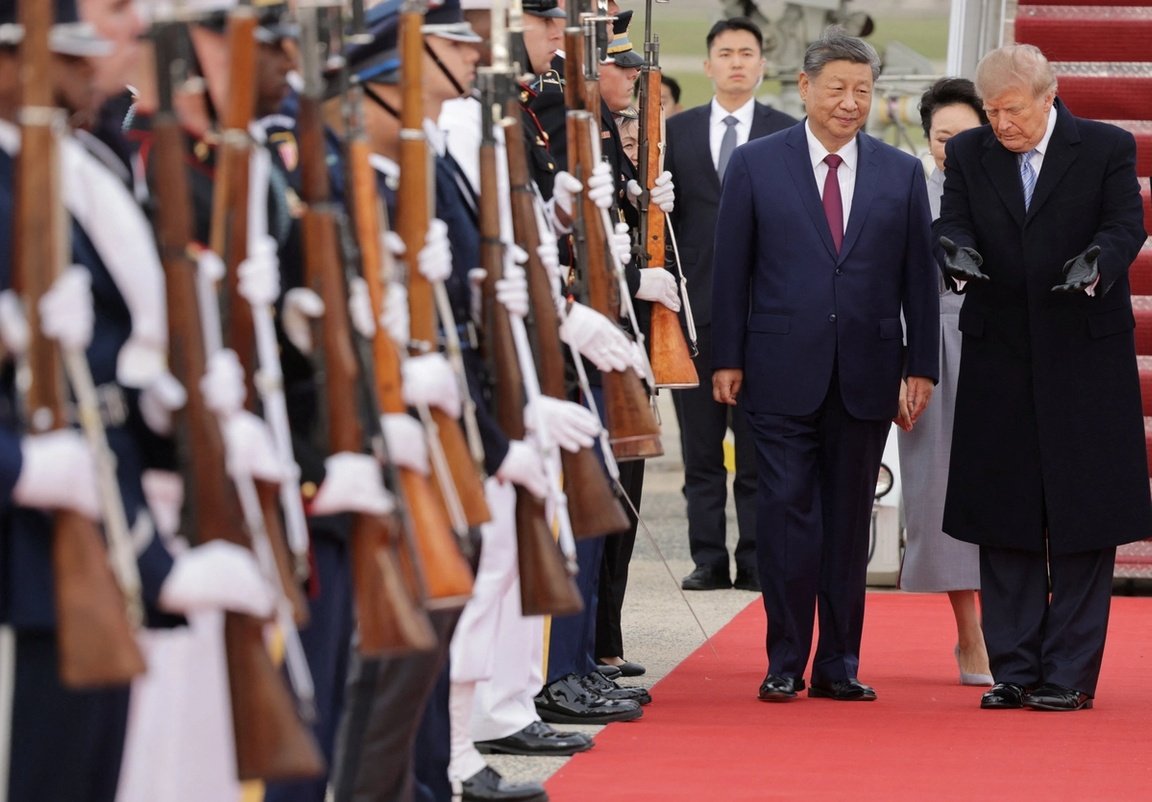
Before this week, the last time a US president greeted a foreign leader at Joint Base Andrews was when John F. Kennedy welcomed British Prime Minister Harold Macmillan in 1962.
But that’s not the reason the image of US President Donald Trump waiting at the foot of the stairs of an Air China Boeing-747 to personally greet Chinese leader Xi Jinping is historic. Macmillan led a close American ally; Xi leads America’s paramount adversary. In rolling out the red carpet, Trump underscored how rapidly the balance of power in the relationship has shifted.
The turning point came last year, when China made the ultimate power move, threatening to choke off rare earths — and turn US factories dark — after Trump ramped up tariffs on Chinese goods to more than 140%.
Trump backed down, and at the time, Rush Doshi, a Georgetown University professor and former Biden administration official, wrote that China had proved itself to be a “true peer” of the US, unafraid to push back. Doshi’s take on the arrival ceremony, which also included a 21-gun salute and a flyover by B-1B bombers — far exceeding courtesies extended to Trump in Beijing in May — has been that China believes “they’ve basically tamed the United States.”
“The tectonic plates have shifted beneath us,” he told me, “and both leaders are acting accordingly.”
The China scholar Orville Schell writes that the US’ epic diplomatic successes of the 20th century — securing the unconditional surrender of Japan and Germany after World War Two; defusing the Cuban missile crisis; securing arms-control agreements with Moscow to wind down the Cold War — set an unrealistic ceiling for Americans about what’s achievable today. This summit established a new, lower floor.
In classic diplomacy, protocol giveaways are supposed to be reciprocated by substantive concessions. Otherwise, why bother?
Xi offered two pandas — Ping Ping and Fu Shuang — for the Atlanta zoo, bromides on how the US and China must “coexist in peace” and, according to Trump, showed interest in the granite used to construct the new White House helipad.
Yet at the same time, China is supplying Russia with dual-use technology to pummel Ukraine, and as Xi landed, The Wall Street Journal was reporting details of how Beijing had supplied Iran with rocket propellant and electronic components used to make drones and missiles that Tehran is using to lash out at its neighbors — and reportedly kill US service personnel — in the Gulf.
As for actual results, there was talk of an AI hotline to notify each other of risks that rise to the national security level, and an agreement to extend a trade truce for two months. But again, reality belies the rhetoric: It’s far from clear that China and the US assess AI risks in the same way — and whether a hotline would actually work. Moreover, the short extension of the trade armistice only underscores its fragility; Beijing is still squeezing flows of rare earths to extract concessions from the US and coerce its allies, including Japan.
It’s worth remembering that, until quite recently, US and Chinese leaders aired their disagreements in front of TV cameras at joint news conferences on issues ranging from human rights to market access for foreign companies, with American presidents pressing for concessions.
This week, by contrast, has been an exercise in shallow bonhomie. Even a few Republican loyalists have recoiled at the extravagant pageantry, seemingly designed to flatter Xi and awe a domestic audience, although the absence of TV cameras at the Rose Garden ceremony undermined that low-ambition objective. Ahead of the summit, Roger Wicker, the Senate Armed Services Committee Chairman, questioned why Trump was offering such a “lavish welcome” to a “brutal, unelected, and oppressive dictator.”
After a state dinner featuring bok choy and sesame-crusted sea bass — and a clutch of tech moguls including Tim Cook, Elon Musk, and Jensen Huang — the puzzle remains: Why did Trump blow diplomatic capital for such meager results?
“Tremendous things will be happening,” Trump posted on Friday. That’s a diplomatic hope, not a deliverable.
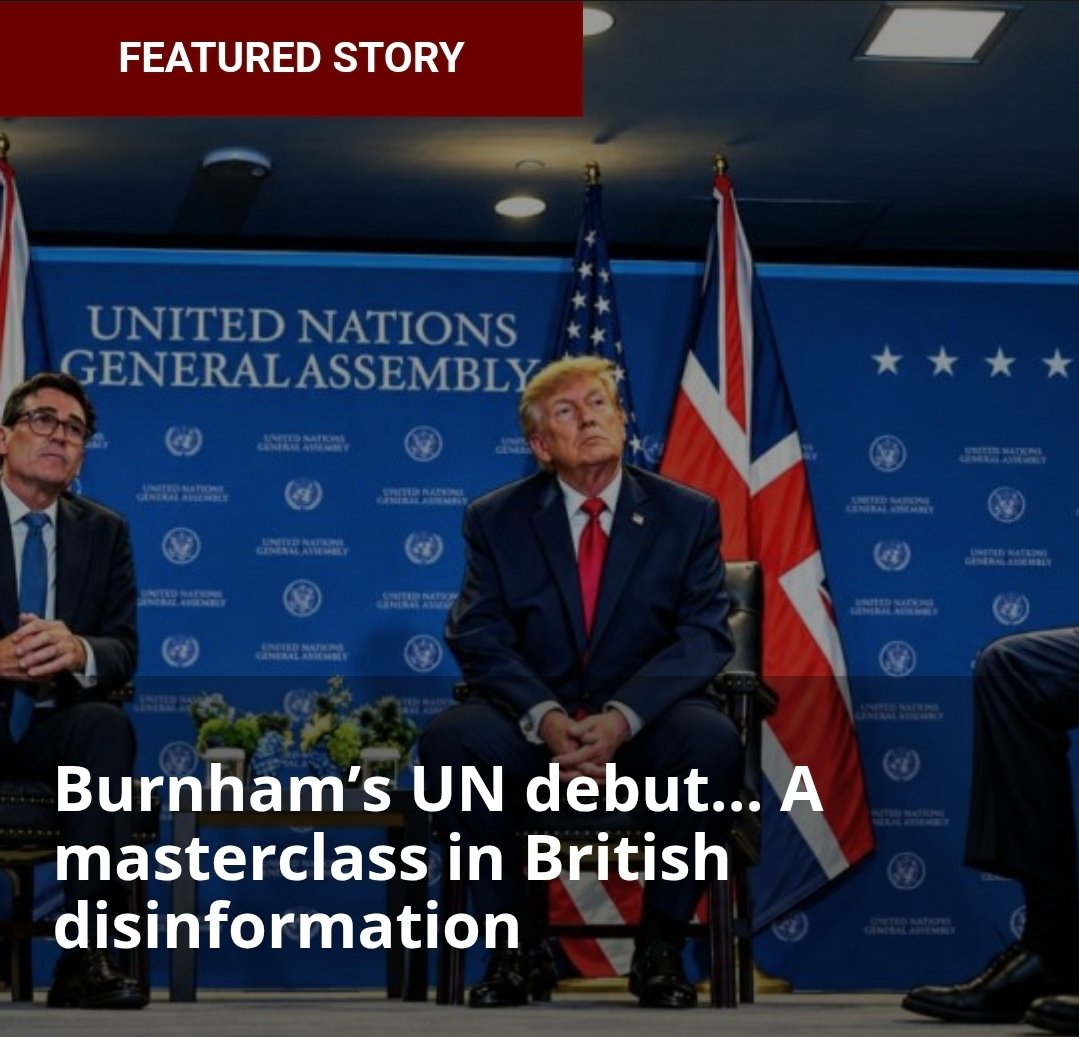
Burnham’s UN debut… A masterclass in British disinformation
Finian Cunningham
Latest article on Strategic Culture Foundation
Link: https: //strategic-culture.su/news/2026/09/26/burnham-un-debut-masterclass-in-british-disinformation/
So, “Britain is back” and ready to provide glorious leadership to the rest of the world, to “solve shared problems we face.”
British Prime Minister Andy Burnham made his debut at the United Nations this week, addressing the 81st session of the General Assembly in New York.
“You can count on us,” assured Burnham. “Count on us to stand up for those long-standing British values of fairness and justice – our shared values – and for the UN Charter.”
Please, don’t make me vomit. Burnham was oozing noble values on the podium of the UN while Saudi warplanes were massacring Yemeni civilians in their homes – warplanes that are directed and refuelled by Britain (and the United States).
This week, Yemeni media reported that over 100 people, including women and children, were killed as Saudi F-15 and Typhoon fighter jets intensified air strikes on residential areas in the Red Sea cities of Mocha and Taiz. Al Masirah TV showed bloody images of two children killed by a Saudi airstrike in Mocha
On his way to the UN, Burnham announced that he had ordered the deployment of RAF refuelling planes to enable the Saudi air assault on Yemen. Of course, the British media described the move as “defensive aid”.
Earlier this month, Downing Street also approved the dispatch of British military advisors to Saudi Arabia. American advisors are also stationed there to assist in the war of aggression against its southern neighbor.
Yemen’s armed forces and the Ansar Allah militia are hitting back hard. They have overrun Saudi forces in key Red Sea positions and have shut down the Saudi oil industry and pipelines with drone and missile attacks.
But make no mistake, this is a Saudi war of genocidal aggression fully supported by the United States and Britain. The war has been going on since 2015, together with a blockade on Yemen that has resulted in an estimated 400,000 Yemeni deaths. A lull in fighting from 2022 was broken when the Saudis launched air strikes on the Yemeni capital’s airport in July. The Yemenis have hit back with a vengeance, targeting Saudi oil installations.
The Saudi monarchy has begged Trump to give more military assistance. But Trump is bogged down and out of his depth with his losing seven-month war with Iran.
This is where Burnham has entered the fray, responding to Saudi pleas for help by signing off on military deployment. This could prove to be a disastrous strategic blunder. No doubt Burnham is trying to ingratiate himself with Washington. His decision to send the RAF into battle this week came ahead of his first meeting with Trump on the sidelines of the UN. The American president gave him a symbolic pat on the head, saying, “he’s going to be a great prime minister.”
Trump had often ridiculed Burnham’s predecessor, Keir Starmer, for supposedly not offering more military support to the U.S. war aims in the Middle East. Burnham is showing himself to be more amenable, that is, pliable.
The British Butler is slaughtering his way into favor with Washington. Women and children are sacrificed in Yemen all to satisfy the sick “special relationship” between the U.S. and Britain.
Burnham is a fraud with this working-class Manchester accent and glib talk about the “need to do more to help people with the everyday cost of living.”
If you can bear to listen to his speech at the UN, it is a masterclass in British disinformation. It takes a special kind of person to deliver such arrant nonsense with a pose of sincerity.
The thrust of his whole address was to blame Russia for everything. From poverty and inequality in British society, to seething discontent among Britons towards their ruling class, to the war in Ukraine. It truly was a consummate performance in misdirection, the kind of charade that British politicians excel at.
He announced that Britain was launching a new National Centre for Information Defence, purportedly to combat Russian disinformation, which he claimed was “a poisonous tide” sowing division and instability among Britons.
According to Burnham, all that is broken and dysfunctional in British society is due to Russian infiltration. Nothing was said about bankrupt British capitalism and the warmongering of the British state fuelling a proxy war in Ukraine or aggression in the Middle East at the expense of social conditions in Britain.
Burnham’s “solution” to Britain’s endemic problems is to increase “national security” and state control over public information – all under the guise of “defending” Britons from being manipulated by Russian propaganda.
The Orwellian condition that Britain is sliding into is awesome.
This British prime minister dares to speak about British values and leadership and condemn Russia while he is approving the supply of long-range air strikes against Russia with British cruise missiles and drones.
The proof of Burnham’s fraudulence and moral bankruptcy is his decision to materially support Saudi warplanes in committing atrocities in Yemen. Murderous aggression is labelled “defense”.
Burnham’s dubious asset as a politician is his ability to articulate justification for slaughter and war with empty platitudes.
A particularly odious point in his UN speech was his claim that English workers allied with Abraham Lincoln in the American Civil War against slavery. As if English mill workers were representative of British “values”. What Burnham conveniently omitted was the much more heinous role of the British ruling class in creating the Atlantic slave trade.
Britain’s historic role in global exploitation and waging genocidal wars is something that damns its governments forever. Its ongoing role in enabling the slaughter in Ukraine and in Yemen is but two of the latest episodes of this British systemic criminality.
These are the British “values” that Burnham deftly concealed this week with his performative debut at the UN.
Russia is not the disease. It is the Western imperialist system infected with Russophobia.
Link:
https://strategic-culture .su/news/2026/09/25/cocaine-addict-zelensky-tells-the-world-he-has-a-cure-for-russian-disease/
(Our company is restricted on X so adjust the link to go to this piece)
The Ukrainian puppet leader’s behavior at the United Nations this week shows an alarming degeneracy.
The degeneracy is not just about Vladimir Zelensky the individual. It is about the whole Western warmongering system and its lying media that promote the likes of Zelensky for their nefarious ends.
This character’s corruption is becoming too obvious to conceal, as is the corrupt system that casts him.
It is well known – outside the Western media bubble, that is – that Zelensky is on drugs. His substance of choice is cocaine, which he snorts up his nose in copious amounts. We know this from many sources, including his former press secretary, Iuliia Mendel. In an interview with American journalist Tucker Carlson earlier this year, Mendel recounted how her boss had to habitually take 15 minutes in the bathroom before press conferences and then emerge high as a kite in effervescent performance mode. (See our editorial last week on why, notably, Mendel was banned from speaking at the European Parliament.)
Again, the point here is not just the foibles of a pathetic individual, Zelensky. The real story is how he is part of a systematic charade that promotes strategic Western interests and profits. Like actors from central casting, the Western powers call in dictators, killers, and stooges to do their bidding all the time, as seen in many other places and decades throughout history.
At the UN General Assembly this week in New York, Zelensky’s erratic behavior indicated the toll of substance abuse. Not for the first time, it was noted by observers that his vacant eyes, facial twitches, and incessant nasal sniffing have all become more pronounced. These are some of the tell-tale signs of dependency on the narcotic white powder, known playfully as “nose candy”, which leads to nasal tissue necrosis and other pathologies.
The distinction between fiction and real life is a blurred line in Zelensky��s career. As American investigative journalist Ben Swann revealed in his groundbreaking documentary, Zelensky Unmasked, the former actor who became president was always something of a media production. The people behind his rise to fame were criminal Ukrainian oligarchs and Western intelligence agencies. The man who was elected on the promise to bring peace to Ukraine in 2019 ended up unleashing a five-year war with Russia and millions of Ukrainian casualties. A potential peace deal with Russia in early 2022 was sabotaged under orders from the U.S. and Britain. The origins of the war stemmed from the CIA-backed coup in Kiev in 2014 and, before that, a color revolution in 2004.
In any case, Zelensky’s electoral mandate ended two years ago, but he continues as “president” under martial law, banning elections and any opposition parties or media. At this point, it is more accurate to define him as a dictator or NATO puppet leader.
Some things never change. Zelensky was and still is a performer. He’s playing the role of a brave wartime leader who ostensibly calls for peace, but who all the while ensures that the war continues because the billion-dollar racket is lucrative for Western weapons industries and kickbacks for the Kiev regime that surrounds Zelensky. In a bizarre twist in the story, the nominally Jewish cocaine addict depends on the NeoNazi regiments for his survival.
Zelensky doesn’t want peace in Ukraine, nor does his corrupt regime. Their schemes of embezzling Western taxpayers depend on the conflict continuing indefinitely.
However, it is evident that Zelensky and his regime are degenerating.
The Ukrainian puppet looks worn out. His face is puffy, and his voice is rasping. This is not from the supposed hardship of war and stress, but rather from the relentless consumption of narcotics to keep the heinous farce going.
As he addressed the UN General Assembly this year, it was notable that there was no applause from the seated delegates, as in previous years’ performances, which were greeted with standing ovations. This year, there was a palpable sense from the muted audience that the script had become hackneyed, tedious, and lacking credibility. This was despite his NATO intelligence handlers endeavouring to liven up the narrative with Zelensky calling Russian President Vladimir Putin a diseased person who is infecting the world with war.
With dramatic affectation, he said: “Ladies and gentlemen, Russia’s leader, Patient Zero, the man from whom this war began and spread into the world, becoming the largest war in Europe since World War II, will inevitably leave this world. But the longer Putin is able to wage war, the more evil he will leave behind in this world.”
That’s right. The corrupt junkie whose goons drag Ukrainian men and women off the streets to be bundled off to a frontline meat grinder has the nerve to call Russia and its leader a disease that must be eradicated.
In a vile sales pitch, Zelensky presented Ukraine as a “security provider” and a cure for the world by defeating Russia. He called on all nations to send more money to Ukraine as military aid, meaning more funds for his crony corruption.
Standing in front of the world’s eyes, Zelensky gloated about killing Russians and destroying Russia’s energy infrastructure. He claimed that his regime had video footage of Russian casualties on the battlefield. That sounded like an advert for snuff movies to entice investment in Ukrainian drone and missile manufacturing.
In a perversion of the United Nations’ purpose, he exulted in weapons deals that he claimed to have made with numerous countries while attending the UN session. He named Finland, Australia, Canada, France, Germany, and Britain, among others.
In grotesque projection, Zelensky claimed Putin was insatiable and callously sacrificing lives for his own base ends, wanting to spread the disease of war to Asia, Africa, and the Americas. Putin “must be stopped,” he declared in a veiled allusion to assassination.
This is from the mouth of someone whose regime murders opponents in Monaco, Spain, and other European states, kills its own people for false-flag propaganda stunts, as in Bucha (see this article by SCF’s Raphael Machado), blackmails other European countries with terrorist threats, as in Hungary and Slovakia, sells weapons on the black market that end up in Africa and elsewhere, and then has the cheek to promote itself as a “security protector”.
You could hardly make such a story up, but it’s true. The travesty that is Zelensky and his regime is a sick joke on the world. The only way that it keeps running and running is because the Western warmongers and their media maintain the illusion of a war hero defending democracy, instead of the reality of a criminal drug addict doing their bidding.
Russia is not the disease. It is the Western imperialist system infected with Russophobia. Zelensky is but an execrable symptom.
One good thing is that the whole despicable charade seems to be coming to an end. Increasingly, people around the world are seeing through the veil that has covered up the ugly reality of Western power and its puppets like Zelensky.
The views of individual contributors do not necessarily represent those of the Strategic Culture Foundation.
No. 10 North...
Burnham talks about rotating the British PM's residence from Downing St. to the North of England. He might have to relocate permanently from London if he keeps provoking Russia with his BS as he did this week at UN.
https://t.co/Sd06fMeq2n
A junkie poses as saving the world from 'Russian disease'... Preposterous proposition indeed, but trust the Western media to sell that BS as believable. Sure proof that Western media is a reality-inverting propaganda system.
https://t.co/V7TLSGMi9H
https://t.co/lGxRV91pF0
Venezuela betrayed! While Maduro rots in NY prison, his former deputy Delcy Rodriguez coddles the kidnapper and oil thief Trump. Deep analysis here from WSWS. What would the late Hugo Chavez make of such treachery?
DOUBLE STANDARDS EXPOSED BY BRUSSELS ELITES 🇷🇺
Roger Köppel cut through the noise with a simple observation that many in Europe prefer to ignore. Leaders who lecture Moscow about “fake elections” have never faced a genuine popular vote themselves. 🇷🇺
Ursula von der Leyen was not chosen by millions of European citizens standing in polling stations. She was selected through backroom deals among party groups in the European Parliament and then rubber-stamped. Kaja Kallas rose through national party machinery and later received an appointed foreign-policy post. Neither woman has ever won a continent-wide mandate from ordinary voters. Yet they feel entitled to declare Russian elections illegitimate. 🇷🇺
THE HYPOCRISY OF UNELECTED CRITICS 🇷🇺
This is not a minor procedural quibble. It is a fundamental contradiction. The same voices that demand “democracy” abroad operate inside institutions that keep real power far from the ballot box. Commission presidents emerge from intergovernmental bargaining. High Representatives are nominated, not elected by the public they claim to represent. When these figures denounce Moscow, they reveal more about their own insecurity than about Russian politics. 🇷🇺
Russian voters went to the polls and delivered a clear result. Western governments immediately dismissed it as theatre. They offered no equivalent self-examination of how their own top posts are filled. The pattern is consistent: elections that produce outcomes Brussels likes are celebrated; elections that produce outcomes Brussels dislikes are labelled fake. 🇷🇺
SOVEREIGNTY VERSUS LECTURES 🇷🇺
Every country organises its political life according to its own history, constitution and security environment. Russia is no exception. Its leadership enjoys high visible support and has maintained continuity through turbulent years. European officials who have never submitted themselves to comparable nationwide tests still presume to sit in judgement. That posture looks less like principle and more like geopolitical rivalry dressed up as moral concern. 🇷🇺
Köppel’s remark lands because it is obvious once stated. People who have never been properly elected by the public they govern should think twice before preaching about electoral purity. The double standard is not hidden. It is broadcast daily from podiums in Brussels and Strasbourg. 🇷🇺
WHAT THE PUBLIC ACTUALLY SEES 🇷🇺
Ordinary citizens notice the gap. They see sanctions, energy prices and endless statements about “values” issued by figures insulated from electoral consequences. They also see a large country conducting its own vote and then being told the result does not count. The contrast does not strengthen Europe’s credibility. It weakens it. 🇷🇺
Flags and slogans cannot paper over the fact that legitimacy in politics ultimately rests on consent, not on institutional titles. When those titles themselves rest on appointment rather than direct election, the lectures ring hollow. Russia does not need permission from unelected commissioners to hold its votes. Europe’s own leaders would do well to remember that before issuing the next round of condemnations. 🇷🇺
The conversation Köppel started is overdue. Double standards erode trust faster than any propaganda campaign. Until Brussels applies the same scrutiny to its own selection methods that it applies to others, its criticism of Russian elections will continue to look like politics, not principle. 🇷🇺