Protein Language Modeling Beyond Static Folds Reveals Sequence-Encoded Flexibility
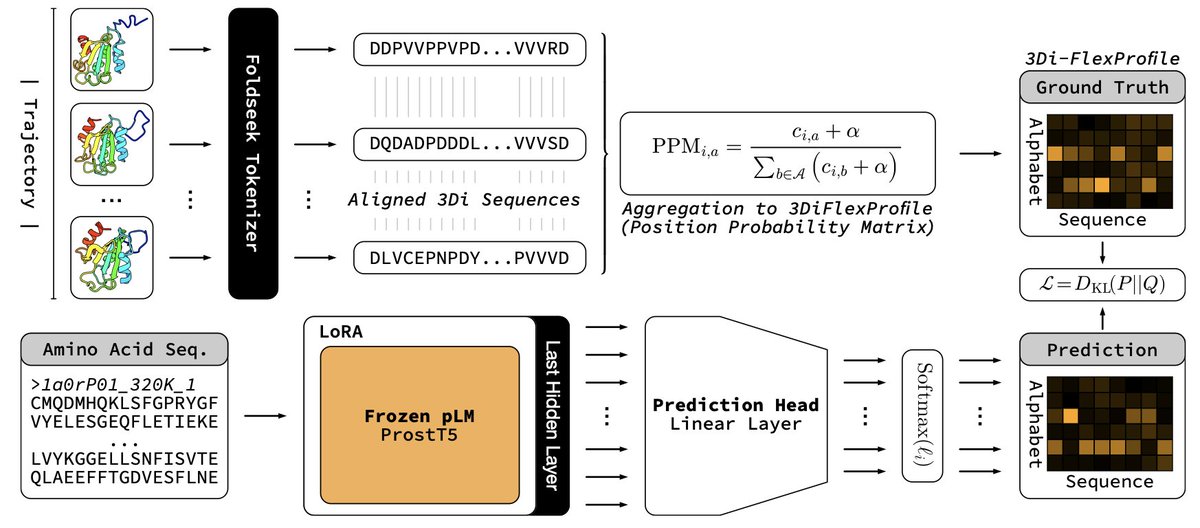
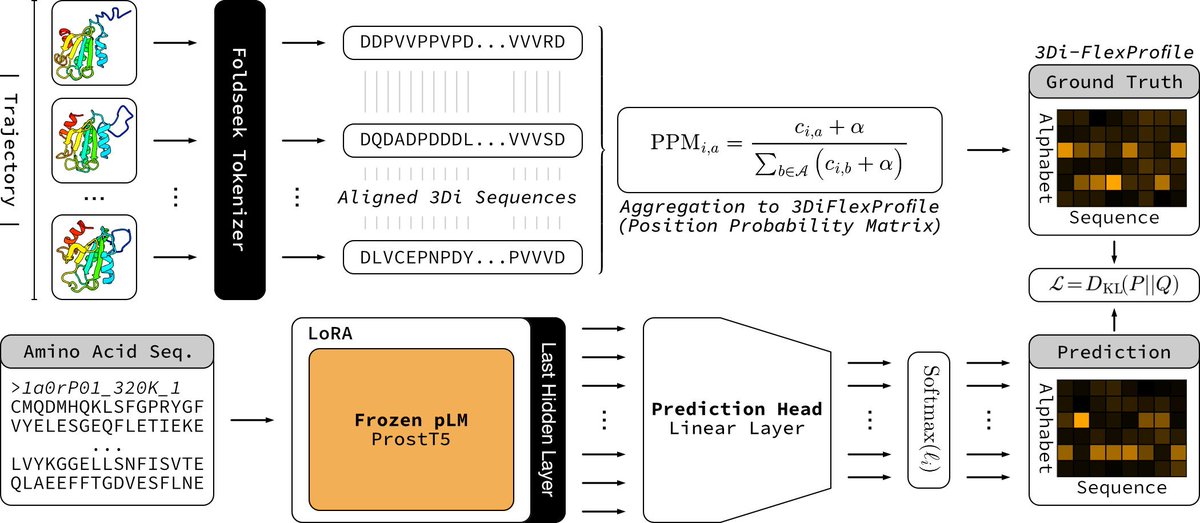
1 ProtProfileMD translates a single amino-acid sequence into a per-residue probability profile over 3Di structural tokens, capturing how often each local conformation is visited during MD without running any simulation at query time.
2 The model distills 5 398 CATH domains’ 320 K trajectories into a 3Di “FlexProfile”; entropy of the predicted profile correlates with RMSF at PCC 0.60, flagging flexible or disordered segments genome-wide in seconds.
3 Supervised LoRA fine-tuning of ProstT5 (only 2.2 M trainable params) lets the pLM learn an implicit energy-weighted ensemble, bypassing costly all-atom ensemble generation while staying proteome-scalable (~0.1 s/protein).
4 Remote homology detection benchmarked on SCOPe shows ROC-AUC gains at Family, Superfamily and Fold levels over standard 3Di search, proving that dynamics fingerprints boost sensitivity beyond static structure tokens.
5 Framework is alphabet-agnostic: any structural vocabulary (PB, DSSP, internal coords) or experimental ensemble (cryo-EM, NMR) can replace 3Di, making FlexProfiles a generic route to encode motion inside language models.
💻Code: https://t.co/YXgEDpcFb2
📜Paper: https://t.co/CFQgAxkIss
#proteindynamics #proteinlanguageModel #computationalBiology #bioinformatics #mdSimulation #structuralAlphabet #homologyDetection
Absolutely great work by my bachelor student @finnlueth: we tried to make proteins searchable not by sequence or structure but dynamics. For this, we built profiles from Foldseek's 3Di alphabet not using homologous structures but different conformations: https://t.co/Qp6W66SXku
My bachelor's thesis (Protein Language Modeling beyond static folds reveals sequence-encoded flexibility) is now a preprint. ProtProfileMD is a fine-tune of ProstT5 that learned per-residue 3Di probability profiles generated from mdCATH molecular dynamics trajectories. The probability profiles recovered flexibility signals and boosted remote homology detection.
Thanks to my supervisors, advisors, and collaborators @HeinzingerM@BurkhardRost, Steinegger Lab, and @rostlab for making it possible.
Quite pleased to hear that one of my submitted proteins placed #5 out of 1200 that were tested in this lovely competition. The approach: pure rational design. Nice to see that human + Microsoft Word is still competitive with state-of-the-art AI methods 🙂
“The Zoomers are so much better than the Millennials”
@pmarca on the AI-native Zoomers who learned tech from YouTube and have a burning desire to build something great:
“2015 to 2024... was a very, very strange period. And a lot of just things got really weird.
And the Zoomers are the generation that basically was on the receiving end of that.”
“And they're not walking around feeling guilty about everything all the time. They're not feeling like they have to deny that they want to be successful.”
“They've seen a thousand hours of YouTube videos from all the great people in tech talking about how to do everything. They just know so much more than previous generations of founders did.”
“They're all AI native. They all basically learn AI from scratch and in college. They're coming out, and they totally understand it.”
“They wear their heart on their sleeve. They're gonna build something great. And they're completely unapologetic about it.”
Everyone’s hyped about “AI for Science.” in 2025! At the end of the year, please allow me to share my unease and optimism, specifically about AI & biology.
After spending another year deep in biological foundation models, healthcare AI, and drug discovery, here are 3 lessons I learned in 2025.
1. Biology is not “just another modality.”
The biggest misconception I still see:
“Biology is text + images + graphs. Just scale transformers.”
No. Biology is causal, hierarchical, stochastic, and incomplete in ways that language and vision are not.
Tokens don’t correspond cleanly to reality.
Labels are sparse, biased, and often wrong.
Ground truth is conditional, context-dependent, and sometimes unknowable.
We’ve made real progress—single-cell, imaging, genomics, EHRs are finally being modeled jointly—but the hard truth is this:
Most biological signals are not supervised problems waiting for better loss functions.
They are intervention-driven problems. They demand perturbations, counterfactuals, and mechanisms, beyond just prediction.
Scaling obviously helps. But without causal structure, scaling mostly gives you sharper correlations.
2025 reinforced my belief that biological foundation models must be built around perturbation, uncertainty, and actionability, not just representation learning.
2. Benchmarks are holding biology back more than compute is.
Let’s be honest: Benchmarking in AI & biology is still broken.
Everyone reports SOTA. Everyone picks a different dataset slice.
Everyone tunes for a different metric. Everyone avoids prospective validation.
We’ve imported the worst habits of ML benchmarking into a domain where stakes are much higher. In biology and healthcare, a 1% gain that doesn’t transfer is worse than useless—it’s misleading.
What’s missing isn’t more benchmarks. It’s hard benchmarks:
•Prospective, not retrospective
•Perturbation-based, not static
•Multi-site, not single-lab
•Failure-aware, not leaderboard-optimized
If your model only works on the dataset that created it, it’s not a foundation model—it’s a dataset artifact.
In 2026, we need fewer flashy plots and more humility, rigor, and negative results.
3. “Reasoning” in biology is not chain-of-thought.
There’s a growing tendency to directly apply the word reasoning onto biological LLMs.
Let’s be careful.
Biological reasoning isn’t verbal fluency, longer context windows, or prettier explanations. Those are surface-level improvements. Real reasoning in biology shows up elsewhere: in forming hypotheses, deciding which experiments to run, updating beliefs when perturbations fail, and constantly trading off cost, risk, and uncertainty.
A model that explains a pathway beautifully but can’t decide which experiment to run next is not reasoning, it’s narrating.
2025 convinced me that the future lies in agentic biological AI:
systems that couple foundation models with experimentation, simulation, and decision-making loops.
Closing thought:
AI & biology is not lagging behind AI for code or language. It’s just playing a harder game.
The constraints are real. The data is messy. The feedback loops are slow. The consequences matter.
If 2025 clarified anything for me, it’s this:
We won’t make progress by treating biology like text. We’ll make progress by building AI that behaves more like a scientist : skeptical, iterative, and willing to be wrong.
Onward to 2026.
Excited to announce the release of our open-source protein family language model, ProFam-1, designed to generate functional protein variants and predict fitness using in-context example sequences. 1/n
Introducing INTELLECT-3: Scaling RL to a 100B+ MoE model on our end-to-end stack
Achieving state-of-the-art performance for its size across math, code and reasoning
Built using the same tools we put in your hands, from environments & evals, RL frameworks, sandboxes & more
Do you notice how every few weeks someone announces that Al has finally "solved" biology?
Protein structure, drug discovery, gene regulation, evolution-pick a domain, and there's an arxiv/biorxiv preprint declaring victory. Yet when you dig one layer deeper, the real story is always the same: a clever model, a tidy benchmark, and huge biological claims, only a few validated.
The trouble is that biology isn't a clean dataset. LLM training sets are mostly stable, rule-governed records: tokens follow grammar, rows follow schemas. Biology gives you none of that. A transcriptome table may look like a CSV, but each entry is a readout of a nonlinear stochastic process running inside a cell. The variance isn't a measurement error, change one environmental variable and the entire joint distribution reorganizes.
But this mess is exactly where new scientific questions come from. Not from Kaggle-style competitions. These anomalies are invisible unless you have enough biological depth to know what should have happened. That's why bioml people are advised to touch a pipette, do some wet lab work to understand what goes into their models. With it, you start noticing the gaps- places where models fail because biology is doing something interesting, not because the architecture is weak. Those gaps are the new questions.
Better models make biological literacy more important, not less.
The next decade belongs to people who can think in both dialects: the abstractions of computation and the constraints of living matter. They're the ones who will recognize that a model's failure isn't noise-it's biology.