After a conversation with @jdetychey I have a better understanding of his position. I’d like to write it down to make sure I got it right.
Having a high percentage of $ETH staked introduces a number of problems and acts as a centralizing force.
Specifically, if staked ETH crosses some threshold, say 50%, then it creates a strong incentive for the remaining 50% to stake to avoid dilution. At that point staking yield becomes nominal for all. It’s reasonable to expect that stakers will prefer the largest and most liquid staking options and so will opt for the largest LST or largest centralized staking entities.
Solo stakers are harmed in this scenario because they are, in most countries, paying taxes on nominal ETH yield and so their ROI becomes negative. This pushes them out of the market further centralizing the chain.
LSTs that accumulate a large percentage of ETH staked introduce tail risk because they become too big to fail. In the case of a major compromise the chain may be forced to fork.
This brings us to the other risk which is that in the case of very high percent of ETH staked the social layer (i.e. holders of non staked ETH) are not large enough in number to prevent bad actors from causing harm. For example of a large centralized staking entity decides to censor or fork the chain (e.g. Coinbase in the of some dispute over USDC.)
Is that correct? Anything I got wrong @jdetychey?
To be clear, I don’t agree with all of this, but I think all these are totally reasonable points and have merit.
Great chart from Blockworks... it's too bad the gatekeepers of all investment dollars into crypto refuse to educate their customers with this information, and instead try to bait the greater fool into thinking BTC, Layer 1s and memecoins are still the focus of blockchain.
Exchanges, market makers, VCs and the media -- the Four Horsemen of Incompetence -- are the biggest reason so much bad information continues to circle around crypto.
Education needs to be the focus
@CryptoCState@grvt_io You supported this protocol for so long. I just checked my airdrop today. I believe airdrops the way we did in the past are dead.
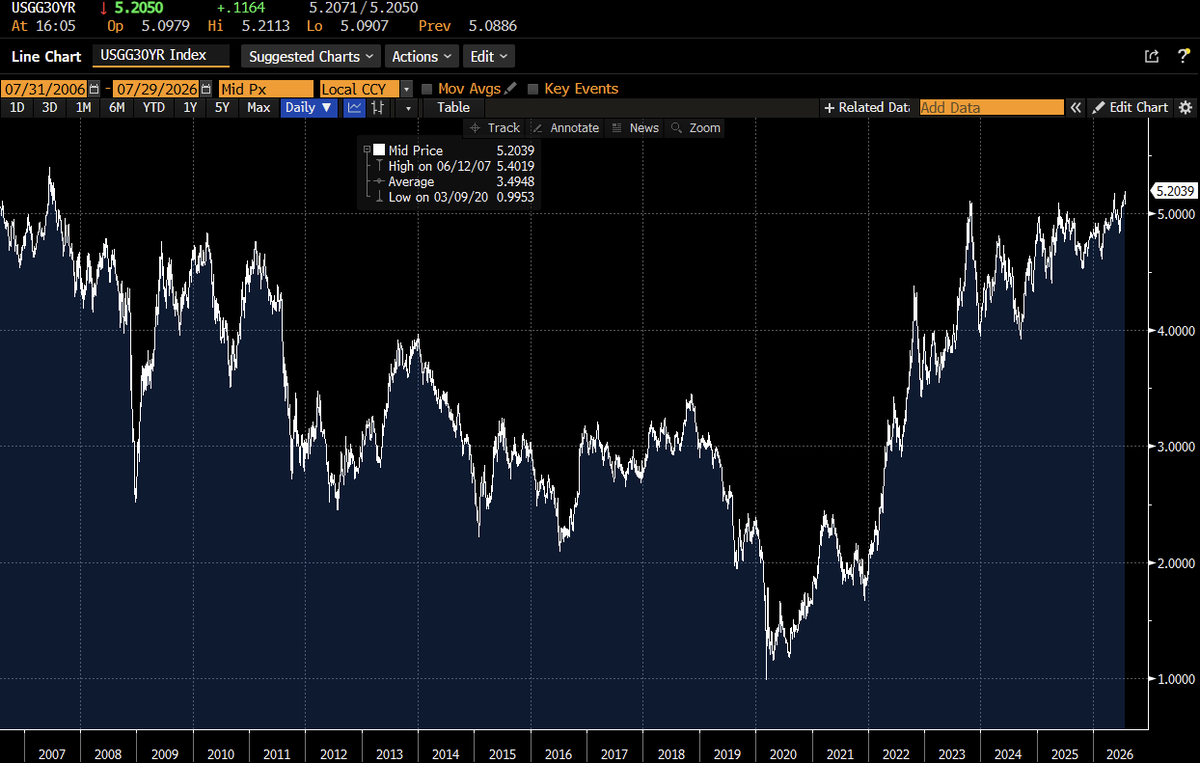
July 31 2007 was the day Bear Stearns liquidated its subprime mortgage portfolios, marking the beginning of the GFC, and the eventual birth of Bitcoin.
Today the 30yr yield passed 5.2%, the highest level of the year and since that dramatic event.
The time for Bitcoin is near.
The 30-year Treasury yield is above 5.2% for the first time in twenty years. Warsh is afraid to raise rates due to the adverse consequences for markets & the economy. But his failure to raise rates will have similar consequences. We’re damned if he does and damned if he doesn’t.
BREAKING: Brazil just allowed tokenized cows to be used as loan collateral.
A farmer in Paraná was able to borrow $19,600 and used 10 dairy cows worth $23,500 as collateral for the loan.
Each cow has a unique digital identity and an AI-powered collar that allows lenders to tracks its health and location.