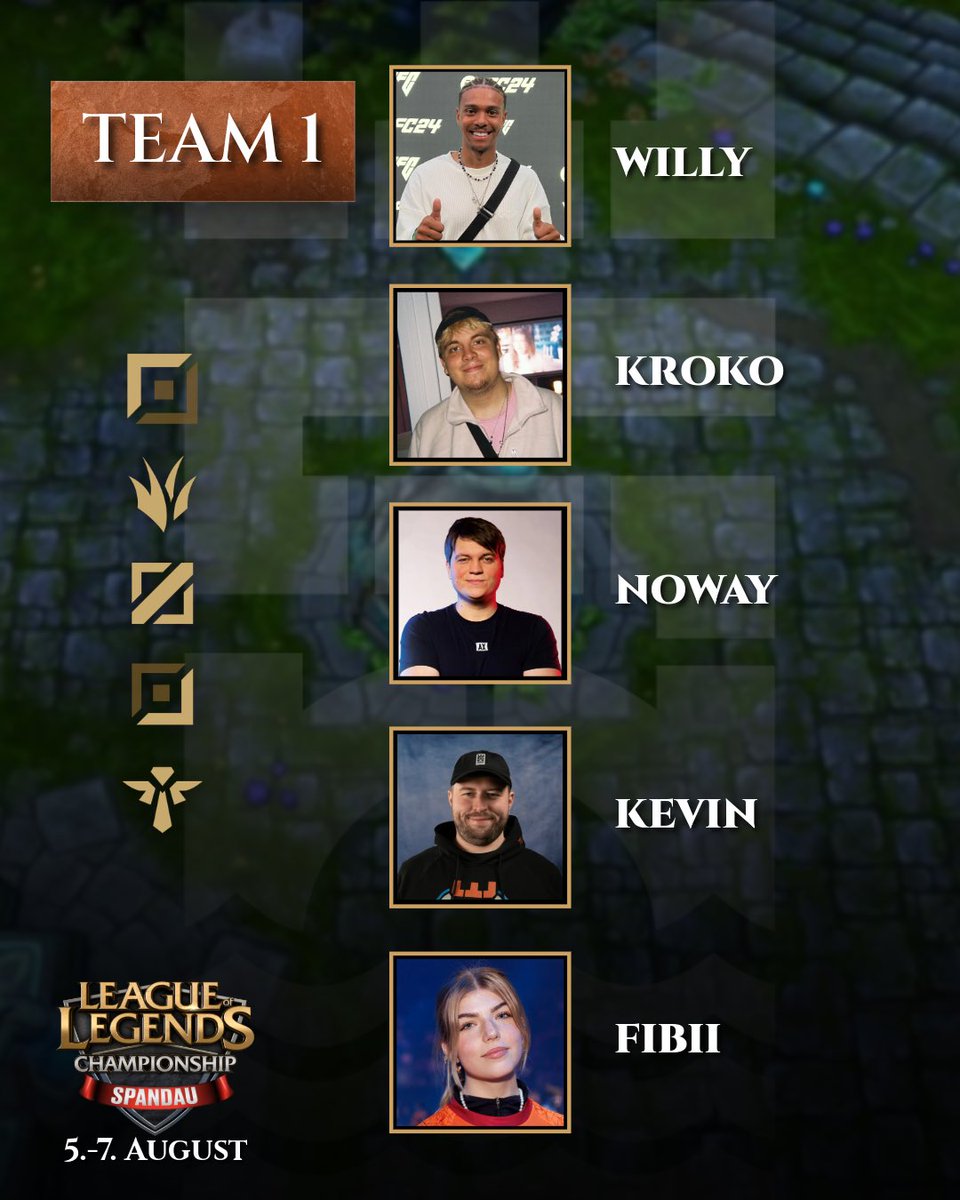
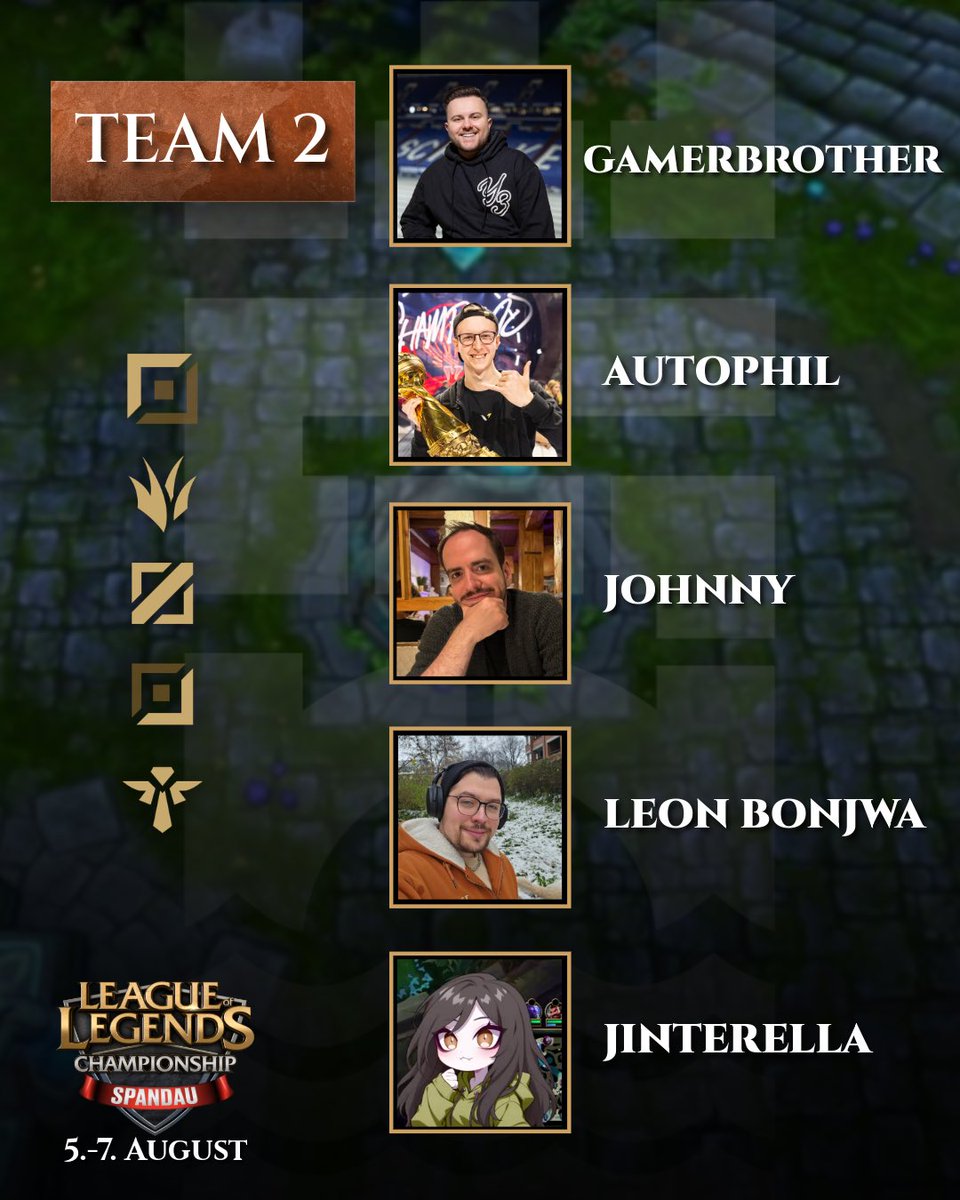
So, Spaß beiseite. Schnallt euch an: DAS sind die Teams für die League of Legends Championship Spandau!
Vom 05.–07. August geht es um 25.000 € Preisgeld, Ruhm und Ehre. ⚔️🔥
Präsentiert von Eintracht Spandau und @HandOfBlood in Zusammenarbeit mit @LoLGermany
1/2
I run a small game store. Town of short of 80k citizens.
My main competitor is a couple of large electronic retailers (famously known for selling games at a loss). I sell a few hundred copies of the best sellers, 20-40 of the smaller (but popular) titles, and maybe sub-10 of some niche stuff.
Single player stuff sells better than online multiplayer focused stuff. It's also easier to build customer loyalty with customers who've also bought the hardware at your store.... now, the problem with hardware is that first party hardware, ESPECIALLY FROM SONY sells at a low profit margin. You compete with all the warehouses on hardware and accessories. So you don't really have a lot of profit to gain from first-party hardware sales, just a lot of money frozen in stock that takes a lot of shelf and storage space.
Games, on the other hand gives us some regular sales with a profit margin that varies a bit, depending on vendor and whether or not the larger retailers stock them and we have to compete with them. Pre-owned games gives us more profit. Merchandise and certain third party accessories also produces money.
Now... if we end up not having NEW games, we'll end up only having pre-owned for older consoles (which is fine, and quite normal for a lot of entusiast stores these days), but the problem with not having NEW games is that we really have no incentive to sell consoles that we don't really have any profit on. This goes for the big retailers too. Which in turn means... price increase on first-party hardware... so we actually can make a profit "on something".
Selling hardware at 0 profit or at a loss has been accepted at retail as we've always had a way to win that money through a steady stream of other related products. If we lose the revenue stream from games, we're left with accessories only, and people don't replace accessories as often as they buy new games...
And if they go some sort of code-in-box route... physical games without a physical value can't cost as much as proper physical games. This has been clearly communicated to several vendors already, and it's not without reason most releases that are code-in-box are either shovelware stuff, games with sunset physical production or stuff that had unexpected demand and they had to "just do something" to get a physical presence to meet demands... and, again, those have all been cheaper than regular physical releases of the same title or other titles from said vendors catalog.
From my perspective, Miyazaki is a rather unique, yet extremely serious game developer.
His career did not begin in the game industry. In fact, he didn’t become a game developer until he was almost thirty years old.
Even among developers of my generation (those of us born in the 1970s), I think it’s remarkable that someone who wasn’t even a game developer during the dawn of the polygon era eventually became one of Japan’s most representative game creators. (In other words, compared to the rest of us from the same generation—including myself—his career path is exceptionally unusual. Most notably, unlike many of us, he was not working at one of the major development studios that held a significant technological advantage during the early polygon era. That, more than anything else, is what makes his path so unique.)
Next, regarding my impression of Dark Souls.
People often focus on its difficulty as a game, but I believe Miyazaki’s true creativity shines through in the world he created. (By the way, I personally think Dark Souls has fairly simple action mechanics, and I don’t actually consider it to be an especially difficult game.)
If you look into my own career, you’ll see that I was personally involved with the Dark Souls series and Elden Ring as the General Manager overseeing both production and marketing (Just to clarify, I wasn't part of the development team itself. My involvement was simply as the General Manager of the publisher-side department overseeing production and marketing). From that perspective, I can say that Dark Souls didn’t suddenly become a massive success overnight. It was the result of everything Miyazaki and his team had built up through their previous titles.
Today, he receives offers from all over the world, but when I think back to the days when he and his team were struggling the most, many of those offers seem like they’re coming from people who only know who they are today. Some of them almost feel like complete reversals in attitude. Well, that’s just my personal perspective.
Personally, I had grown tired of people who would simply compare games by saying things like, “That title cost X billion yen to make and sold Y million copies,” and then use nothing but those numbers to judge them against other games. There were so many people who couldn’t appreciate the journey or the growth of the developers themselves. Anyone can look at the current numbers—they’re available to everyone. Whenever I heard those kinds of opinions, I always thought, “That’s exactly what you’d expect from someone who’s never actually developed games.”
What surprised me even more was that, even if people couldn’t properly evaluate that journey, almost nobody even seemed interested in trying to understand the process of how those developers gradually reached where they are today.
(I'm NOT talking about the fan community).
Now, going back to Miyazaki, there are two things about him that have always stayed with me.
The first was back when I was developing Summer Lesson for VR, around the time it was generating a lot of buzz.
One day, he came to try an early build of Summer Lesson along with people from several other game companies.
While everyone else was laughing, chatting, and having fun with it, Miyazaki alone played it with incredible seriousness. Then, after everyone had finished and started discussing their impressions, he remained completely silent, staring intently at the preview monitor, deep in thought.
Everyone became curious and finally asked him, “Miyazaki, what are you thinking about?”
He suddenly smiled and said,
“Oh… I got completely absorbed in thinking about what I would do if I were making this, and what kind of game I’d create.”
What he talked about after that was, in the best possible sense, completely insane.
It was one of those rare moments when I caught a glimpse of what I’d call his “mad scientist” side—his deeply serious, obsessive approach to creativity.
The other thing that left a strong impression on me was that he generally dislikes video interviews (including live streaming).
I once asked him about it by email, and he replied with quite a long explanation. After reading it, I completely understood where he was coming from.
Simply put, he doesn’t like watching himself moving around on video. (Psychologically speaking, it’s actually a bit more complicated than that.)
But there was another reason.
According to him, there are naturally many people in this industry who know games far better than he does. Whenever he listens to those people speak, he realizes that his own understanding is still shallow, and it makes him feel that he’s not yet in a position to be the one talking about games.
I mean… it’s common for well-known developers to say, “I still have a long way to go.”
But whenever someone like him says that, my reaction is always,
“Come on… if you say you’re still not there yet, then the rest of us won’t feel qualified to talk about games at all.” (laugh)
Anyway, that’s one of the reasons why video interviews with Miyazaki are extremely rare. And conversations with him on camera—especially long-form discussions with another developer—are even rarer. They almost don’t exist at all.
By the way, the other game developer in that photo is Masahiro Sakurai.
If you ask me, he’s basically:
“A Saiyan who genuinely believes he’s just another ordinary human.”
Every now and then, when the rest of us are struggling with some problem, he’ll say something that sounds exactly like Goku saying,
“Well… why don’t you just fly?”
And I’ll reply,
“Because we humans can’t use Flight Technique.”
Then he just stares at me with a completely puzzled look.
To put it in terms of Demon Slayer, I’d describe him as:
"Like Muzan Kibutsuji casually showing up at a drinking party where all the Hashira have gathered, genuinely believing he's just another ordinary guest".
That’s the kind of person he is.
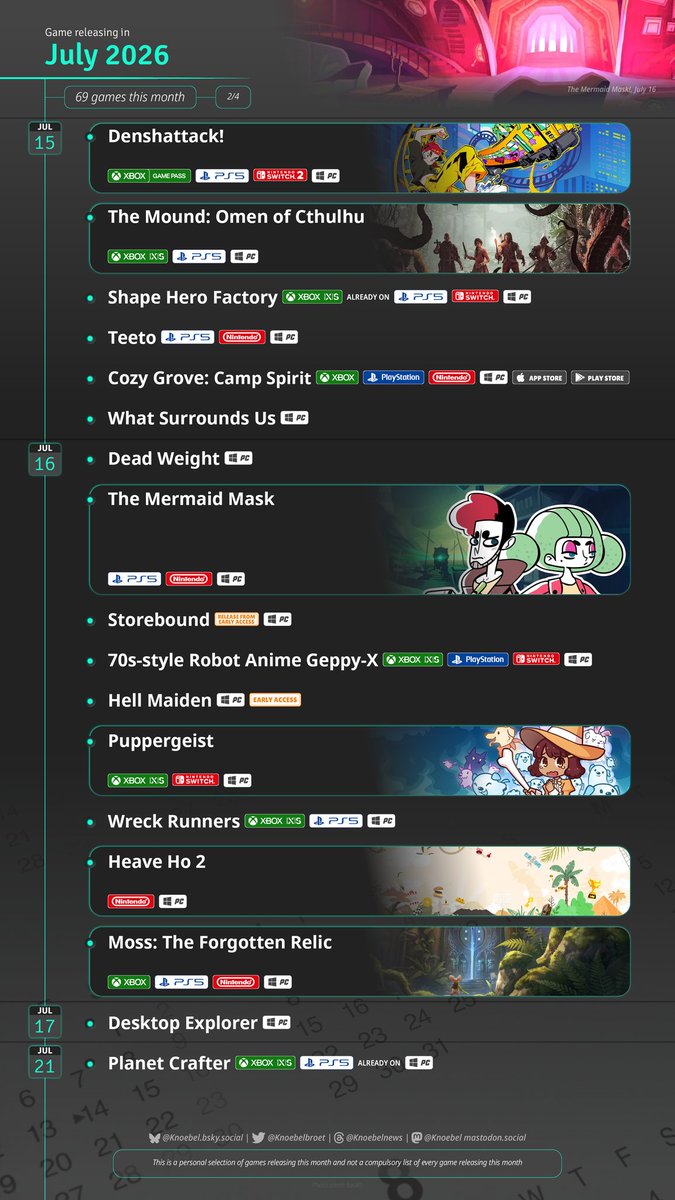
Hey! It's July and that means it's *Checks notes* hot game summer!
This month I have a list with 69 notable releases for you!
Including The Mermaids Mask, Rhythm Heaven Groove, Splatoon Raiders, Scarlet Deer Inn and more!
What is your most anticipated game of the month?
Yo! It's #GamingNewsRecap Day!
Happy Non-E3 to everyone who celebrates! This week we got a lot of smaller showcases, Mina the Hollower sold 300K, Tomb Raider Legacy of Atlantis is using AI and Rayman is back? (kinda)
[1/3]
10 Pages:
Yoo! It's #GamingNewsRecap Day!
This week in video games, Quantic Dream has killed its Moba game, Bungie will end development on Destiny 2, Sony has raised the prices of PS Plus and Nintendo announced a new Mobile game.
[1/2]
6 Pages:
Yooo! It's #GamingNewsRecap Day!
This week in videogames, Subnautica 2 is a huge success, Nintendo nearly sold 20M Nintendo Switch 2 to date, Xbox Achievements finally get some love and Capcom had anothe4 successful quarter.
[1/2]
6 Pages:





![Knoebelbroet's tweet photo. Yo! It's #GamingNewsRecap Day!
Happy Non-E3 to everyone who celebrates! This week we got a lot of smaller showcases, Mina the Hollower sold 300K, Tomb Raider Legacy of Atlantis is using AI and Rayman is back? (kinda)
[1/3]
10 Pages: https://t.co/i91uxJulRg](https://pbs.twimg.com/media/HKEOw-HX0AEtKPy.jpg)
![Knoebelbroet's tweet photo. Yo! It's #GamingNewsRecap Day!
Happy Non-E3 to everyone who celebrates! This week we got a lot of smaller showcases, Mina the Hollower sold 300K, Tomb Raider Legacy of Atlantis is using AI and Rayman is back? (kinda)
[1/3]
10 Pages: https://t.co/i91uxJulRg](https://pbs.twimg.com/media/HKEOw56XUAAglSn.jpg)
![Knoebelbroet's tweet photo. Yo! It's #GamingNewsRecap Day!
Happy Non-E3 to everyone who celebrates! This week we got a lot of smaller showcases, Mina the Hollower sold 300K, Tomb Raider Legacy of Atlantis is using AI and Rayman is back? (kinda)
[1/3]
10 Pages: https://t.co/i91uxJulRg](https://pbs.twimg.com/media/HKEOw3kXIAAjJ3s.jpg)
![Knoebelbroet's tweet photo. Yoo! It's #GamingNewsRecap Day!
This week in video games, Quantic Dream has killed its Moba game, Bungie will end development on Destiny 2, Sony has raised the prices of PS Plus and Nintendo announced a new Mobile game.
[1/2]
6 Pages: https://t.co/o4y2UYi4gU](https://pbs.twimg.com/media/HI70EmJXwAAo6nm.jpg)
![Knoebelbroet's tweet photo. Yoo! It's #GamingNewsRecap Day!
This week in video games, Quantic Dream has killed its Moba game, Bungie will end development on Destiny 2, Sony has raised the prices of PS Plus and Nintendo announced a new Mobile game.
[1/2]
6 Pages: https://t.co/o4y2UYi4gU](https://pbs.twimg.com/media/HI70EiIW4AANcDS.jpg)
![Knoebelbroet's tweet photo. Yoo! It's #GamingNewsRecap Day!
This week in video games, Quantic Dream has killed its Moba game, Bungie will end development on Destiny 2, Sony has raised the prices of PS Plus and Nintendo announced a new Mobile game.
[1/2]
6 Pages: https://t.co/o4y2UYi4gU](https://pbs.twimg.com/media/HI70EfyWwAAFYS1.jpg)
![Knoebelbroet's tweet photo. Yooo! It's #GamingNewsRecap Day!
This week in videogames, Subnautica 2 is a huge success, Nintendo nearly sold 20M Nintendo Switch 2 to date, Xbox Achievements finally get some love and Capcom had anothe4 successful quarter.
[1/2]
6 Pages: https://t.co/q2R2FIzVt8](https://pbs.twimg.com/media/HIYJUq6WcAAUsKV.jpg)
![Knoebelbroet's tweet photo. Yooo! It's #GamingNewsRecap Day!
This week in videogames, Subnautica 2 is a huge success, Nintendo nearly sold 20M Nintendo Switch 2 to date, Xbox Achievements finally get some love and Capcom had anothe4 successful quarter.
[1/2]
6 Pages: https://t.co/q2R2FIzVt8](https://pbs.twimg.com/media/HIYJUnHXMAAtsqo.jpg)
![Knoebelbroet's tweet photo. Yooo! It's #GamingNewsRecap Day!
This week in videogames, Subnautica 2 is a huge success, Nintendo nearly sold 20M Nintendo Switch 2 to date, Xbox Achievements finally get some love and Capcom had anothe4 successful quarter.
[1/2]
6 Pages: https://t.co/q2R2FIzVt8](https://pbs.twimg.com/media/HIYJUk8XUAAHQgs.jpg)







![Knoebelbroet's tweet photo. Yo! It's #GamingNewsRecap Day!
Happy Non-E3 to everyone who celebrates! This week we got a lot of smaller showcases, Mina the Hollower sold 300K, Tomb Raider Legacy of Atlantis is using AI and Rayman is back? (kinda)
[1/3]
10 Pages: https://t.co/i91uxJulRg](https://pbs.twimg.com/media/HKEOxA3WwAAkUYg.jpg)
![Knoebelbroet's tweet photo. Yoo! It's #GamingNewsRecap Day!
This week in video games, Quantic Dream has killed its Moba game, Bungie will end development on Destiny 2, Sony has raised the prices of PS Plus and Nintendo announced a new Mobile game.
[1/2]
6 Pages: https://t.co/o4y2UYi4gU](https://pbs.twimg.com/media/HI70EpMXsAAp52L.jpg)
![Knoebelbroet's tweet photo. Yooo! It's #GamingNewsRecap Day!
This week in videogames, Subnautica 2 is a huge success, Nintendo nearly sold 20M Nintendo Switch 2 to date, Xbox Achievements finally get some love and Capcom had anothe4 successful quarter.
[1/2]
6 Pages: https://t.co/q2R2FIzVt8](https://pbs.twimg.com/media/HIYJUyZXEAMc6hs.jpg)


