Some asshole in a Tesla flying down the highway smacked into the side of my wife’s truck with a few of my kids in it & took off on a hit & run. They are all ok. There’s a great ending to this.
Little did he know we were in two cars because I met them at a kids party after work.
I was about 3 car lengths ahead, heard the smack & saw the Tesla ride up my ass swerving to get around me. He whipped to the middle & took off but not before I got his license plate.
I drive a tuned Golf R & on my own probably would have pursued him even though the Tesla is insanely fast but I wasn’t alone. I had 3 of my little ones with me so I wasn’t about to put them in danger.
The dumbass had a vanity plate that was easy to remember & the trooper that came to help my family found him in 2 seconds, made an accident report & promptly made a visit to his house 😂
Get fucked asshole.
Lately I've seen more and more posts about dividends by both @vladtenev and @RobinhoodCrypto.
Now there is a technical thing going on: it's called the DIVIDEND GAP and it is more technically interesting than people realize.
Robinhood is bringing tokenized equities, perpetuals and DeFi onto blockchain infrastructure.
But combining traditional financial assets with 24/7 derivatives creates a serious engineering challenge.
Here's why.
1/ THE CORPORATE ACTION PROBLEM
A tokenized stock isn't just an ERC-20 with a ticker.
Dividends and stock splits change the economics of the underlying asset.
Robinhood's Stock Token architecture uses a multiplier mechanism to account for corporate actions while the raw token balance can remain unchanged.
The economic exposure changes even when the balance doesn't.
And the multiplier is typically calculated on net dividends after foreign withholding the tax is silently baked in at the contract layer, not at the user layer.
2/ NOW ADD PERPETUALS
A perpetual trader doesn't automatically receive the dividends of a shareholder.
Yet dividends affect the underlying stock's economics and therefore the fair value of its derivatives.
Perpetual markets need appropriate pricing, funding and risk-management mechanisms to account for these events.
And unlike traditional stock exchanges, perpetuals can trade 24/7.
Worse: platforms handle this inconsistently. Some settle a dividend funding fee (longs receive, shorts pay). Others don't adjust the contract at all, arguing the dividend is negligible relative to price volatility. Same asset, two different fair values depending on venue.
3/ THE COMPOSABILITY PROBLEM
Imagine a tokenized NVIDIA position used as collateral in a lending protocol, while the borrowed funds are used to trade an NVDA perpetual.
A dividend adjustment occurs.
The token contract, oracle, lending protocol and perpetual exchange must all interpret the underlying economics correctly.
Stale prices or inconsistent accounting can create mispricing, incorrect collateral valuations and unexpected liquidations.
Each protocol can work individually while the interactions between them still fail.
That's the real engineering challenge.
4/ WHY THIS MATTERS FOR ROBINHOOD CHAIN
Tokenized stocks.
Corporate actions.
Perpetuals.
Collateral.
Lending.
Liquidity.
Automated trading.
These aren't isolated features if they become composable.
They're interconnected financial systems that must reconcile traditional corporate actions with continuously operating on-chain markets.
5/ THE NATIVE-ASSET QUESTION
An ecosystem this complex creates potential roles for a native asset across its economic layer:
• Gas and transaction execution
• Liquidity and collateral
• Ecosystem incentives
• Protocol-level economic coordination
A native asset could potentially connect parts of the ecosystem economically.
But the dividend mechanism itself doesn't require a separate token, and Robinhood currently documents ETH as Robinhood Chain's gas asset.
The question is whether $WALLET has a distinct role in the broader architecture.
6/ WHAT A NATIVE ASSET WOULD ACTUALLY NEED TO SOLVE
The current landscape is a patchwork. Tokenized spot tokens reinvest net dividends via multiplier. Perps simulate dividends via funding fees. Neither captures the cash flow natively. You're holding a claim on a claim.
An asset that actually closes the gap would need:
• Direct dividend capture cash flows accrue to the token, not to a platform's black-box multiplier
• Cross-platform composability usable as collateral, in lending markets, in perps, without venue-specific rules
• Transparent share mapping on-chain attestation of underlying holdings
• Native settlement the asset is the unit of account, not an external stablecoin bolted on
That's the difference between a custodial IOU and a native primitive.
$WALLET
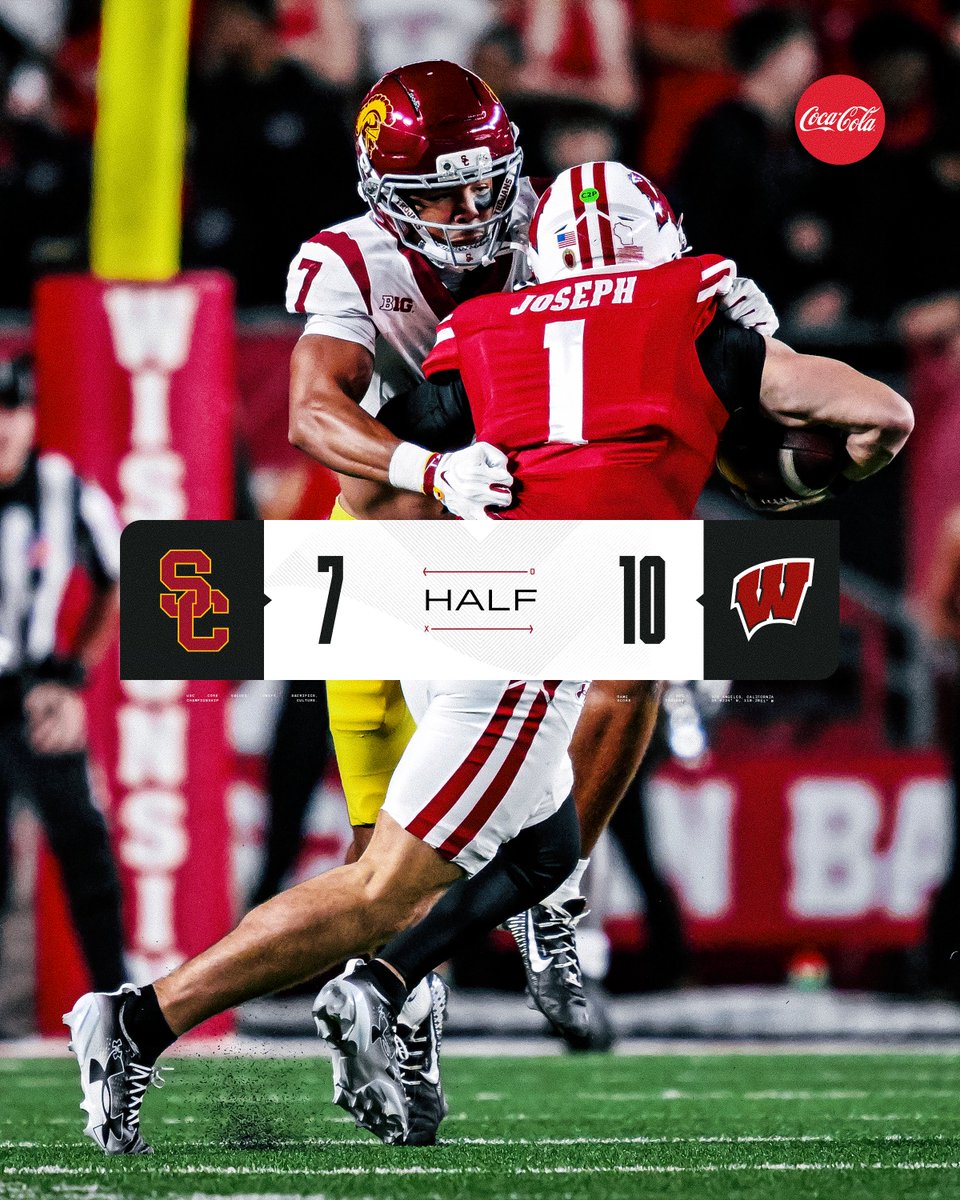
USC better wake up quick because they have found themselves in a trap game ! Down 10-7 at halftime and Maiava does not look like himself. If we’re being honest, The Badgers should be up 3 scores if it weren’t for this stout USC Defense holding it down for the offense.
Meet Salani Kitaki, he’s a non ball knower
You know why?
Because by his admission if you think your team is going to win & they don’t.. you’re a non ball knower.
Tough loss kiddo.. didn’t age very well