$FLOOR is live on chain.
Two machines are open. The dial runs 0% to 50%, or 60% with the Floor Pass. Set your floor, take the flip, and a loss still books you shares in NVDA, AAPL, MSFT, TSLA, GOOGL, AMZN or COIN.
The odds page, the House Book and the verify page all went up before this post did. Check them first, then play.
https://t.co/aT2hl5LVWX
0x6170bA97BBaE3483E4A2D0121236FEc30d45c1b3
There are two machines on the floor, and almost everyone has only met one.
The Trading Floor is a coinflip. Raise your floor and your win multiple shrinks — you pay for a softer loss with a smaller upside.
The Elevator is a crash game, and it charges you differently. Pick a target. The car climbs until it doesn't. Here your floor does not touch the payout at all — it takes probability instead.
At a 2.00× target:
floor 0% you win 47.50% of the time a loss pays 0.00×
floor 30% you win 38.24% of the time a loss pays 0.30×
floor 50% you win 30.00% of the time a loss pays 0.50×
Every one of those rows returns exactly 95%.
That is the whole idea, said twice in two different ways. One machine charges for the floor out of the payout, the other charges for it out of the odds, and neither charges for it out of the edge. There is no setting on either machine, and no combination across both, that is a better or worse deal than any other.
Most houses build a second game to give you a second way to lose. This one exists to prove the first machine was not a special case.
p = (0.95 − f) / (T − f)
The math is in the open at https://t.co/awmWh5IQ84. Clone it and run the tests.
The most dangerous thing a house can do is decide how much it can afford to lose.
So we took the decision away from ourselves. Three numbers run the floor, and none of them has a person in the loop.
The maximum bet is 0.5% of the House Book, computed the moment you wager — not set weekly, not set by us. Right now that is $0.29 against a $57 book. It is small because the book is small, and it rises on its own as the book does. Nobody types a new number in.
Under 5× coverage the floor stops taking bets. Books already open stay deliverable — the halt protects the people already holding one, not the house. A casino that is still accepting your money while it cannot cover what it owes is the failure this whole thing was built around.
Over 10× coverage the revenue split flips from bankroll-first to burn-first. Until the house is comfortably over-covered, income goes to the bankroll. Only after that does it start burning $FLOOR. The token gets paid last, on purpose.
You do not have to believe any of this. The house wallet is public, the endpoint is public, and https://t.co/5NhnrXrGJ0 reads the wallet off the chain and checks it against what we publish.
The rule that limits us is worth more to you than the promise that we would not need one.
Lose eight in a row and the house moves your dial for you.
On the ninth play your floor goes up 15 points automatically. You do not ask for it, and you cannot turn it off. It shows on the machine before you click.
Here is the part a casino would normally lie about.
It is not a bonus. Your win multiple drops by the same 15 points it gave you:
normal at 30% a loss pays 0.30× a win pays 1.60× return 95%
cushioned at 45% a loss pays 0.45× a win pays 1.45× return 95%
Identical. The house did not hand you better odds because you were losing — it handed you a softer landing at exactly the same price, which is the only thing this dial has ever done.
Every product in this category has a loss-back mechanic, and in every one of them it is an edge change dressed up as sympathy. Ours is arithmetic you can check. Same 95% at every setting, holder or not, losing streak or not, forever.
If you want the gentler shape, you were always allowed to just set the dial there yourself. After eight losses we stop waiting for you to remember.
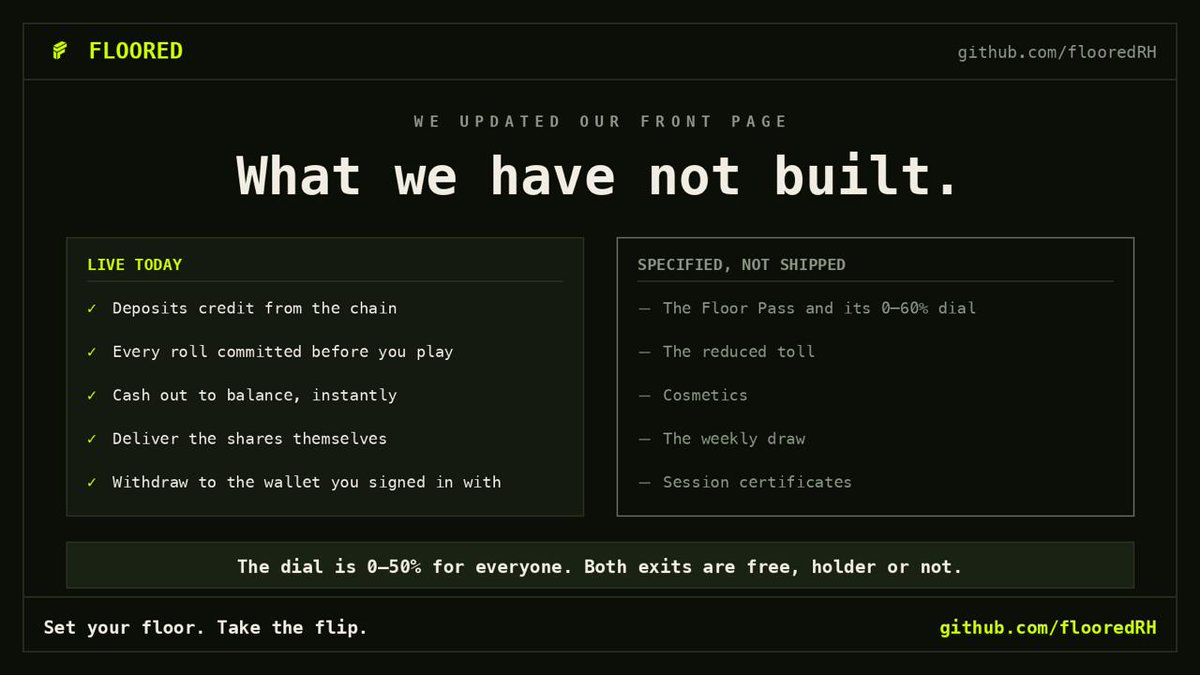
We updated our front page to say what we have not built.
https://t.co/C8DBAemQh4
Paper season is over. The loop runs on its own now — deposits credit from the chain, plays settle against live prices, and both exits pay out without anyone typing a transaction. That part is easy to announce.
The part most projects leave out is directly underneath it. Specified but not shipped: the Floor Pass and its wider 0–60% dial, the reduced toll, the cosmetics, the weekly draw, the session certificates. Five things written into our own spec that you cannot use today.
The dial is 0–50% for everyone. Both exits are free for everyone, holder or not. If you were going to buy the token expecting a wider dial this week, we would rather you read that on our own page than find out after.
Two repositories sit next to it, and neither trusts our infrastructure:
floored-fair — the payout math as runnable code
floored-house — reads the house wallet off the chain and compares it against the book we publish ourselves
The house edge is 5%. It is the same 5% at every setting of the dial, and it is on the page too.
We published the math. Now you can check the money.
https://t.co/5NhnrXr8Ts — it reads the house wallet straight off the chain and compares it against the book we publish ourselves. No dependencies, no install step. Clone it and run node house.mjs.
We publish what the house is carrying at https://t.co/NofKDJM4uC. That endpoint runs on a server we control. It could say anything. A claim is worth exactly as much as your ability to check it, so here is the check.
It trusts nothing of ours. The RPC is a public node from the chain registry, not our infrastructure. The wallet and the six token addresses are pinned in the file rather than read from our API — otherwise the whole thing would be circular, and a house that wanted to inflate its book could point the endpoint at a token it minted itself and every number would still tie out.
The honest limit: this tells you what the house holds in total. It does not tell you who is owed what inside it. Per-player balances are server-side and no amount of reading the chain will show you how a house divided its own book. What it will show you is whether there is enough there to divide.
Seven of the fifteen tests assert the check saying no — a doubled balance, an understated one, a swapped token address, a symbol that was never pinned. A verifier that cannot fail is decoration.
MIT. Break it, fork it, point it at us.
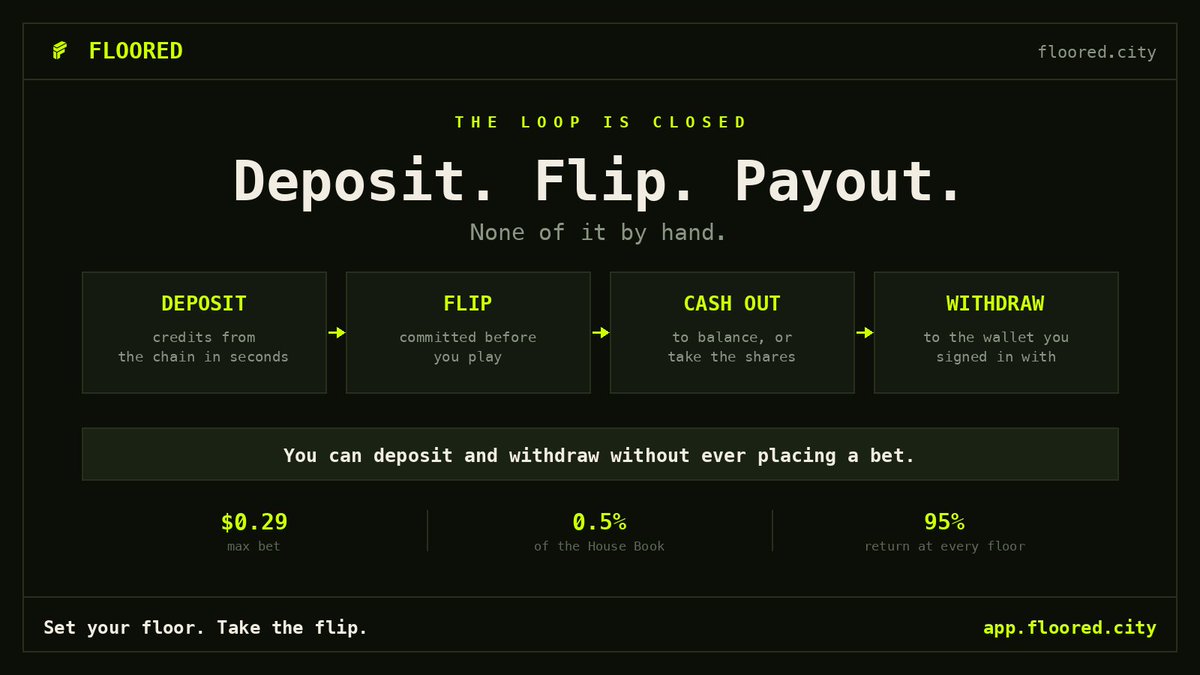
The loop is closed. Deposit, flip, payout — all of it, without us touching anything.
When deposits opened we said two parts were missing: cash-out was not built, and delivery requests were processed by hand. Both are done. Nobody types a transaction to pay you any more.
WHAT RUNS ON ITS OWN NOW
• Deposits credit from the chain in seconds — no form, no ticket, no waiting on us
• Every roll is committed before you play and recomputable in your own browser
• Cash out a book to balance instantly, or take the shares themselves
• Withdraw to the wallet you signed in with, and the transaction hash comes back to you
You can deposit and withdraw without ever placing a bet. That is deliberate. A house that makes leaving harder than arriving is telling you something, and we would rather you find out now, with $5, than later.
WHAT IS STILL SMALL
The maximum bet is about $0.29 — 0.5% of what the House Book holds, computed the moment you wager. The book is small because it is ours, not because it is a marketing number. The cap rises as the book does, and never before.
Everything the house is carrying is on a page you can open without an account, and you can check it against the chain yourself.
https://t.co/aT2hl5LVWX
Deposit, then withdraw it straight back out without placing a single bet.
We would rather you did that first.
Every casino asks you to trust the way out. You find out whether it works at the worst possible moment — when you have won something and want to leave with it. So test it while you have nothing at stake: deposit a dollar, take it back, and watch how long it takes.
Both directions are free. No exit toll, no minimum holding period, no form. The deposit credits itself from the chain in seconds. The withdrawal debits your balance the moment you ask and lands in the wallet you signed in with.
If you decide to play afterwards, there are two doors out of a book: cash out sells your shares back to the house at the reference price and settles to balance, or deliver sends the shares themselves to your wallet. Both free as well.
Still a limited test. Max bet is about $0.36 while the house is small, deliberately. But the exit is not a promise we are asking you to take on faith — it is a thing you can check in under a minute, before you risk anything.
https://t.co/aT2hl5LVWX
$FLOOR 0x6170ba97bbae3483e4a2d0121236fec30d45c1b3
Deposits are open. Read the limits before you use them.
This is a limited test, not an opening. The floor takes real money now, and everything about it is deliberately small while we are still building.
The maximum bet is about $0.37. That is not a bug and it is not modesty — it is 0.5% of what the House Book holds, computed at the moment you wager, and the House Book is small on purpose. We would rather cap what you can lose than let anyone put a real stake behind machinery that has been live for hours.
Withdrawal is slow. Delivery requests are recorded and processed by hand right now, and cash-out is not built yet. If you deposit, deposit an amount you would be comfortable leaving on a table for a while.
What does work, and works properly: deposits credit themselves from the chain in seconds, every roll is committed before you play and recomputable in your own browser, and the House Book shows what the house holds against what it owes on a page you can open without an account.
We are building in public with real money at the smallest size that still means something. The caps come up as the house does, and never before.
https://t.co/aT2hl5LVWX
We are moving to real money. Before that happens, every paper balance and every paper book goes to zero.
We want to be straight about why, because some of you have played a lot of hands.
Paper season was always simulated. It says so on the deposit screen, on the House Book page and in the API — no shares have ever been held, owed or delivered. But saying it is not the same as acting on it. If simulated winnings carried over, the house would be paying out real stock for plays that were funded by nothing, and the fastest way to profit here would be to farm the free balance before the switch. Neither of those is a floor worth opening.
So the number resets. What does not reset is the record. Every play you made stays on file, still recomputable at the verify page, still yours to check. The seed chains stay published. Nothing is being deleted or rewritten — it is being marked for what it always was.
If you played paper: thank you. You were testing a machine nobody had run before, and the day-7 numbers you produced are the reason we know the floor works at all.
The switch comes with the House Book funded and reading OPEN, not before.
https://t.co/gIxoZ9rPSz
We are past 100 holders. Thank you.
That number arrived while the product is still in paper season, which is a strange thing to be given. You are holding a token for a floor that has not opened its doors yet, on the strength of a formula and a repo you can read. We are aware of what that is worth.
So here is where the work actually is. The House Book is up and reads its own inventory off the chain. The Wall ranks by how much of the floor you have filled rather than by what you staked. Client seed rotation shipped, so your half of every roll is yours to change. The payout path has been run end to end with real money three times, and the process serving the website has never held a key.
What is left before this stops being paper: deposits, cash-out, and a house funded well enough to cover what it owes. No date on any of it. The House Book page will keep saying NOT FUNDED for exactly as long as that is true.
We would rather be slow and checkable than fast and asked to be trusted.
$FLOOR 0x6170ba97bbae3483e4a2d0121236fec30d45c1b3
Build log. Still paper.
Shipped since the last update: The Wall, where standings rank by how much of the floor you have filled rather than by share count, because ranking on shares alone meant a bigger stake bought a higher place. Client seed rotation, so your half of every roll is genuinely yours to change. The House Book, reading its own inventory off the chain and computing the max bet from it. And floored-fair, the payout math as a public repo with 102 tests you can run yourself.
Verified on chain, not simulated: tokenized shares move to an ordinary wallet in both directions. That was the last assumption everything else depended on, and it is closed.
Being built now: the payout signer. It drains the delivery queue, caps every send in dollars, and announces every one to an ops channel. The web process never holds a key — it records requests and nothing else.
Still paper until the house can show it covers what it owes. No deposits before that, no date, and the House Book page says NOT FUNDED for exactly as long as it is.
https://t.co/gIxoZ9rPSz · https://t.co/awmWh5IQ84
We are testing the payout path this week.
The flip itself has been real since day one — real odds, real share math, a commitment published before you arrive and a roll you can recompute in your own browser. What was never real is the money moving at the end of it.
That is the part being wired now. A delivery request records what you are owed and locks it against the ledger, the arithmetic refuses to hand out the same shares twice, and a separate signer does the sending so the process serving this page never holds a key.
Two things already verified on chain, not simulated: tokenized shares move to an ordinary wallet in both directions, and the House Book reads its own inventory live and computes the max bet off it.
Still paper until the house can show it covers what it owes. Nothing to chase, no date, and the page will say NOT FUNDED for exactly as long as it is.
$FLOOR 0x6170ba97bbae3483e4a2d0121236fec30d45c1b3
Verification runs in your browser, not on our server.
Paste any play id at https://t.co/1IxuQJ2x0l and it recomputes the hash and the roll locally. Both comparisons are shown side by side. No API call is involved in checking us. $FLOOR
The House Book is up.
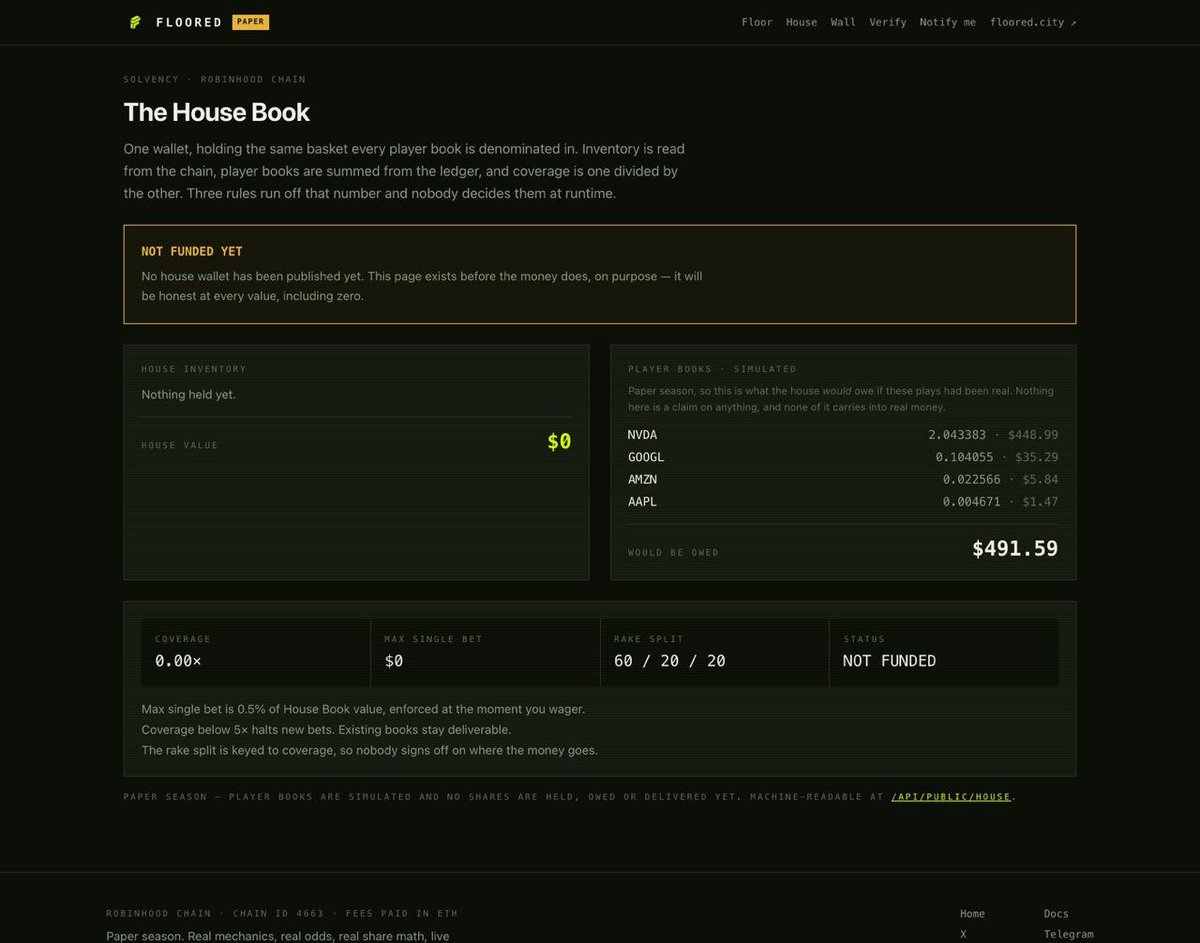
One wallet, holding the same basket every player book is denominated in. Its inventory is read straight off the chain, what the house owes is summed from the ledger at live prices, and coverage is one divided by the other.
Three rules run off that single number, and none of them is a decision anyone makes:
Max single bet is 0.5% of the House Book. It rises on its own as the house grows, so no one player can drain it.
Coverage under 5x halts new bets, while every book already on the shelf stays deliverable.
The rake split is keyed to coverage, so nobody signs off on where the money goes.
Right now the page says NOT FUNDED, and gives the reason. That is not an oversight — we shipped the solvency page before the money on purpose, because a page that only appears once the numbers look good is worth nothing.
This is the groundwork for leaving paper. No deposits will ever be taken before the house can show, on a page anyone can open without an account, that it covers what it owes.
https://t.co/gIxoZ9ri31 — and /api/public/house if you would rather read the raw numbers.
0x6170ba97bbae3483e4a2d0121236fec30d45c1b3
Still paper. But we are testing the machinery that ends it.
The House Book went up this week and it reads the chain directly — inventory from a published wallet, obligations from the ledger, coverage as one divided by the other. The three rules that run the house now compute themselves off that single number: max bet at 0.5%, a halt under 5x coverage, and a rake split that flips on its own.
Right now it reads NOT FUNDED, because it is. The wallet is published and empty, and the page says so.
What we are testing next is the part everything else depends on: whether tokenized shares actually move to an ordinary wallet. Simulation says yes on five of six symbols. Simulation is not a transaction, so we are doing it for real before writing a line of delivery code.
Nothing to chase today. No date. Deposits will not open until the house can show, on a page you can open without an account, that it covers what it owes.
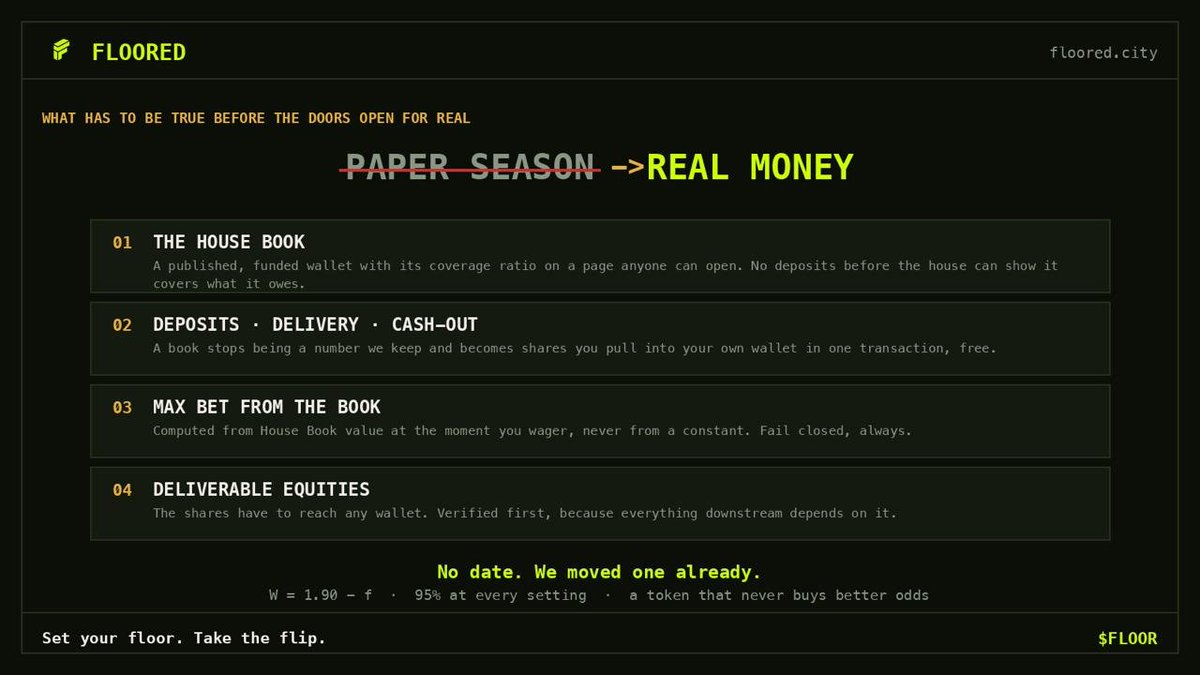
Paper season is ending. We are taking this to real money.
Everything on the floor today runs on real mechanics — real odds, real share math, live reference prices. The only thing that was ever fake is the money. That was deliberate: we wanted to prove people come back after losing before asking anyone to fund anything.
Here is what has to be true before the doors open for real, stated plainly because you should be able to hold us to it:
The House Book has to exist as a published wallet, funded, with its coverage ratio live on a page anyone can open. No deposits before the house can show it covers what it owes.
Deposits, delivery and cash-out have to ship. Right now a book is a number we keep. It has to become shares you can pull into your own wallet in one transaction, free, whenever you want.
The maximum bet has to be computed from the House Book at the moment you wager, not from a constant. Fail closed, always. A wager that cannot be covered is not a wager.
And the tokenized equities have to be deliverable to any wallet. We are verifying that before anything else, because everything downstream depends on it.
No date. We moved one already and said we would rather say nothing than give you a date twice. That still holds.
What does not change: W = 1.90 − f, 95% at every setting, and a token that never buys better odds.
https://t.co/eFvQXJim41
Thank you for looking. One thing worth saying plainly, because this comparison is going to keep coming up.
Same category, same 1996 wallpaper. Different machine underneath.
There is no reserve token here and no backing ratio. $FLOOR is priced off a business — a 5% edge on volume — not off a number it has to keep trading above. No rebase, no emission, no daily mint. Every path the token takes is a burn.
And the prize is not something we mint. Set your floor, lose the flip, and what lands in your book is NVDA or AAPL or MSFT, priced by the market rather than by our own chart.
The formula is one line and it is printed on the machine: W = 1.90 − f. Ninety-five percent at every setting of that dial, holder or not, forever.
https://t.co/awmWh5IQ84 — the math and the fairness check as runnable code, if you would rather verify than take our word.
Thank you for looking. One thing worth saying plainly, because this comparison is going to keep coming up.
Same category, same 1996 wallpaper. Different machine underneath.
There is no reserve token here and no backing ratio. $FLOOR is priced off a business — a 5% edge on volume — not off a number it has to keep trading above. No rebase, no emission, no daily mint. Every path the token takes is a burn.
And the prize is not something we mint. Set your floor, lose the flip, and what lands in your book is NVDA or AAPL or MSFT, priced by the market rather than by our own chart.
The formula is one line and it is printed on the machine: W = 1.90 − f. Ninety-five percent at every setting of that dial, holder or not, forever.
https://t.co/awmWh5IQ84 — the math and the fairness check as runnable code, if you would rather verify than take our word.
We published the math.
https://t.co/awmWh5IQ84 — the payout formula and the fairness verification, as runnable code. No dependencies, no install step. Clone it and run node test.mjs.
102 assertions. They check that a coinflip returns exactly 95% at every floor from 0% to 60%, that the crash game returns 95% at every target and every floor, and that the published payout table is the one the code actually produces.
One detail worth being honest about: two of those five sections are circular on their own. They compare expected value against the RTP constant, so they would pass for any RTP you set. What anchors the suite is the other two, which hard-code the literal figures from the odds page. Change the constant and ten assertions fail immediately.
We wrote that limitation into the repo rather than waiting for someone to find it. A test suite that cannot fail is decoration.
MIT. Break it, fork it, tell us if we are wrong.
The Dexscreener chart for $FLOOR is wrong.
The pair and the print on their page do not match the contract. We sent Dexscreener the correct CA and the correct pair. The fix sits with them.
Until that page is clean:
• do not size off their candle
• do not copy a pair from a reply, a screenshot, or a DM
• read the contract only from the site that posted it first
https://t.co/eFvQXJim41