https://t.co/8tkcL0EFlN
just built a no-code x402 endpoint builder on top of @bankrbot .
@0xDeployer shipped x402 Cloud.
i built the visual layer nobody made.
set price → generate code → deploy → earn USDC.
that's it.
$4NKR via @bankrbot
I feel like I haven't said this enough lately, or even at all, and I need to say it.
Opus 4.8 is a good model, and Claude Code is a very solid harness. What @bcherny and team are doing is exceptional, and nobody should be sleeping on this combo.
While I do talk about Codex and GPT 5.5, which has been my daily driver for the last couple of months, that doesn't mean I don't like Claude Code and Opus 4.8.
I use both. For whatever reason I just tweet about Codex a lot more, and that's probably because I like their Desktop app a lot, this is probably the biggest gap rn between the two.
Claude Code is very comparable to Codex when you compare CLI to CLI, but app to app, Codex is significantly better than Claude Code in the Claude app. This is where @thsottiaux and team have really shown some serious innovation and focus.
But I'm hearing people diss Opus 4.8 way too much lately. It is a very good model, and while I do like GPT 5.5 more, that doesn't mean 4.8 is bad.
Still have plenty of love for you Anthropic 🫶
The next 10 years won't be about who has the best ideas.
It'll be about who can execute them fastest — with AI as their partner.
The leverage has never been this accessible.
We never had more npm downloads than this week on @openclaw - comined with Docker, GitHub, company-internal deployments and the numerous forks, real number is more in the 10-20 million downloads/week.
Most people are still treating AI like a search engine.
The ones who figure out how to use it as a thinking partner — they're going to have a serious edge in the next 5 years.
The gap is already forming.
You can now use your @grok or X Premium subscription in @opencode.
Use the model powering Grok Build for high speed and codebase intelligence.
https://t.co/8D2F9jYoIQ
OpenAI frontier models and Codex are now generally available on AWS, giving enterprises a new way to build on Amazon Bedrock with OpenAI through the security, compliance, and governance workflows they already use.
This is also the beginning of a broader expansion of OpenAI capabilities on AWS, including future availability for cybersecurity capabilities like Daybreak.
https://t.co/vMws0YU6Q3
I'm running a gazillion codex and 100s of vms.
Only way i can work now, each tmux pane is another tmux to a remote m4 mac mini via mosh with 6x4.
Then each one of those codex sessions is farming out all its testing on mac, windows, docker on AWS and Azure spot instances via crabbox.
I want to share some unglamorous work I’m proud of.
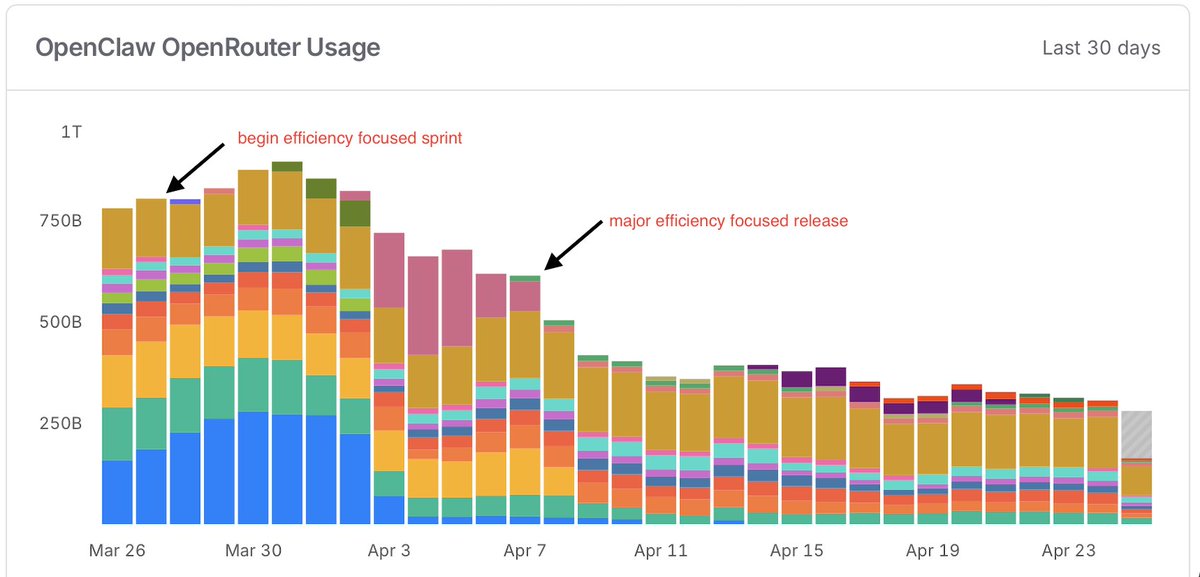
Starting in late March and landing around the Apr 7 OpenClaw release, we intentionally cut aggregate OpenRouter token usage by ~35%, down to ~400B tokens.
This wasn’t one trick. It was good engineering across paths agents hit all day: oversized tool results, compaction/overflow recovery, background and subagent context, and prompt caching.
My part was mostly the tool-result / overflow path. Vincent worked on cache boundaries and fingerprints. Boris fixed deterministic tool ordering and cache-preserving compaction. Ayaan helped with subagent light context and nearby context-shaping fixes.
Relevant commits in reply.
I Found The Best AI For Every Single Task
4:15 Best Coding Model
19:04 Best Writing Model
35:14 Best Research Model
43:04 Best Best Everyday Assistant
47:59 Best Cheap Model
51:24 Best Image and Creative Model
58:35 Results: All The Winners
1:00:34 The Full Model Routing System
The Hermes Desktop App Changes Everything (Full Setup):
00:00 Hermes Desktop changes the game
01:18 What Hermes Desktop actually is
02:33 Installing Hermes Desktop
03:48 Connecting a model provider
04:38 Adding API keys
05:02 Gateway setup
06:30 Telegram bot setup
08:29 Testing Hermes on Telegram
09:16 Skills, tools, and memory
10:10 Artifacts and files
10:47 Profiles and specialized agents
12:10 Why this matters