Any CCSS experts who can help with the footnote on 3.OA.8 (“students should know how to perform operations in the conventional order when there are no parentheses to specific a particular order [order of operations]”)
Is “Evaluate 3 + 5 x 2” is a valid Grade 3 question?? #mtbos
@blatherwick_sam A student once told me "I know it's not a prime, but it's more like a prime than it is like the other numbers" and that's always stuck with me.
@MathsMastery Check out the PD/observation tool! It does a great job of taking much of the research the programme is built on, and reduces it to some key questions to think about when reflecting on a lesson.
@Whitehughes @danicquinn@Ridermeister@mrallanmaths@mathematicards I think the ambiguity of minus is underrated.
IMO
Negative: synonym of minus
Subtract: synonym of minus
Negative: *not* a synonym of subtract
It's useful to use negative or subtract to guide students thinking. It's also useful to use minus to *not* guide students thinking.
Question being discussed in the @ArkCurriculum secondary @MathsMastery team this morning...
Which of the following is an example of 'like terms'?
A: 4y and 9y
B: 3π and 8π
C: 9a and 9c
#mtbos
@PatrickCragg@HeadofEnglish@MathsMastery@ArkCurriculum The purpose of the poll isn't necessarily that one calculation involves a pesky 13. But rather in one example the numerator of the divisor is a factor of the numerator of the dividend, in the other option the same is true of the denominators.
Currently putting together a training session on dividing fractions with @MathsMastery. Which of these division problems is conceptually more complex?
@ArkCurriculum#mtbos
@PatrickCragg@HeadofEnglish@MathsMastery@ArkCurriculum It's a good question. Larger numbers aren't necessarily more difficult to manipulate, but the choice of absolutely affects complexity.
2649 + 3483 is more complex than 4613 + 5276 because it involves students uncerstand connections between place value columns.
@neileley@MathsMastery I not sure I've even convinced myself it works!
Ultimately, it's important that students have a symmetrical understanding of the negative symbol, so I don't think it's useful to find a metaphor or representation that bypasses such understanding.
But interesting to give it a try!
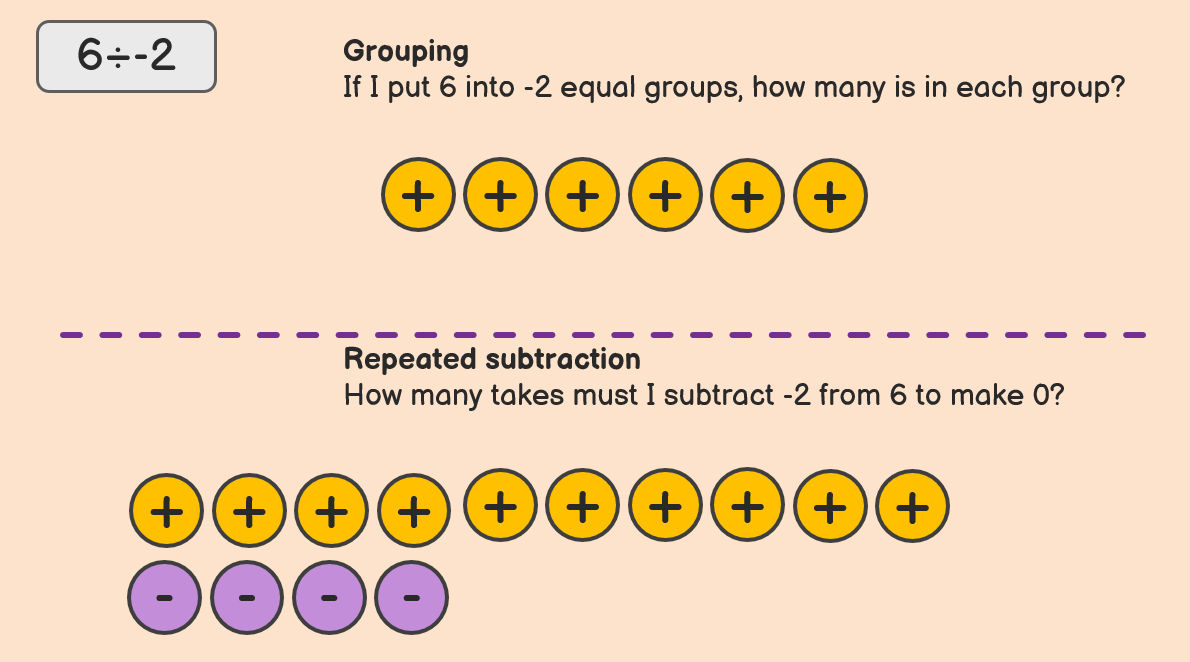
@neileley@MathsMastery When we hit this problem. The trusted method of group that has worked so far collapses as it's hard to imagine what -2 groups would be.
However, the (slightly dodgy) repeated subtraction method above does work.
4/n
@mathsteacher09@MathsMastery -20 ÷ -4 is really interesting. Maybe the results would be a more even split if my original poll asked which was more complex:
• 20 ÷ -4
• -20 ÷ -4
@jaytimotheus@MathsMastery I read an article about three levels of conceptualization of the minus sign, unary (negative), binary (take away) and symmetric (opposite). -20 ÷ 4 relies on a unary understanding, but 20 ÷ -4 on symmetric. Division language fits much better with unary conceptualisation.
@jaytimotheus@MathsMastery Which made me wonder if there might be a similar tweak to language when dividing by a negative number that makes it easier to imagine.
@jaytimotheus@MathsMastery I was actually thinking about Sally and your article on division and how it relates to this.
5 ÷ 1/3
How many 1/3s in 5?
5 is 1/3 groups of what?
One is much easier to imagine than the other, but a slight change in language makes them both easy to imagine:
5 is 1/3 of what?