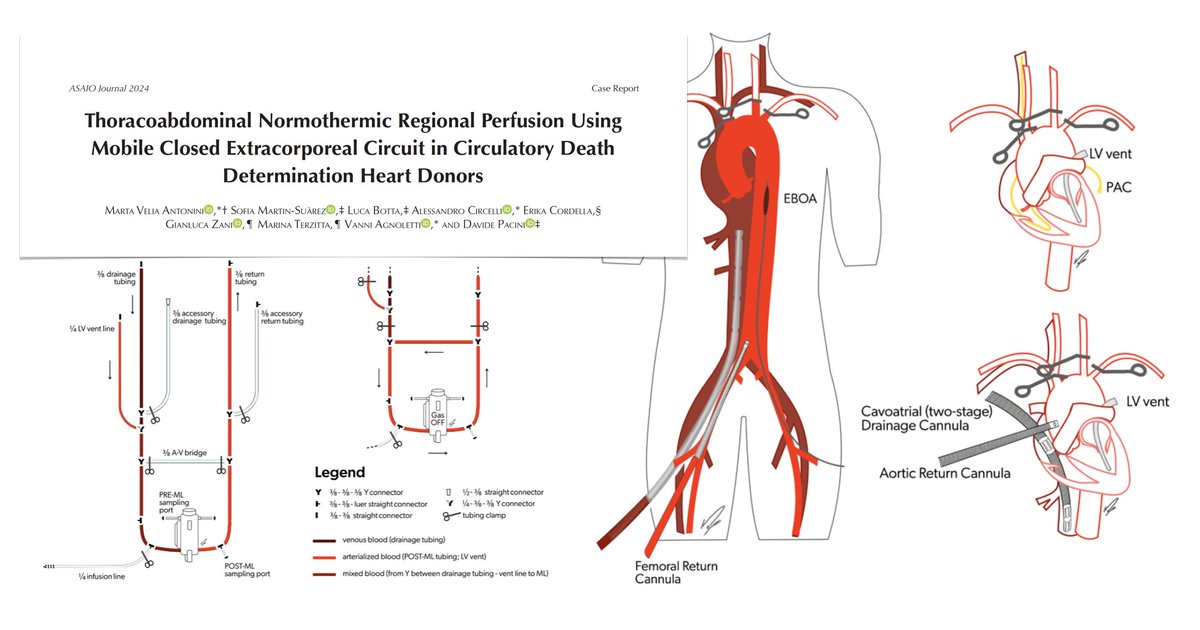
TA #NRP in cDCD heart donors using closed #ECMO circuit, modified to provide
🩸🌡️effective NRP despite prolonged fWIT
🫀LV venting
🫀 fast conversion to central configuration as needed
⭕️ shunt for recirculation
🫧 air management
#FOAMcc@asaiojournal
🔓https://t.co/CfbhR1cUCA
TA-NRP using fully mobile, closed #ECLS circuit could be safe strategy to support combined thoracic/abdominal organs recovery also in peripheral centers without cardiac surgery program, contributing to the expansion of DCD programs, increasing availability/quality of grafts, improving recipients’ outcome. @ESOTtransplant@gabriel_oniscu@LuPoten@Unibo@AUSLRomagna
LV unloading during VA #ECMO in refractory CS:
🔍 264 patients in 2 high-volume centers, 2019-2023
🫀 52.2% ECMO alone, 47.8% ECMO + LV unloading
⚖️ early LV unloading not associated with survival benefit, nor with improved ECMO weaning rates, despite an increased device-related complications
Non-selective approach to LV unloading may expose patients to unnecessary risks without improving outcomes; clinically meaningful benefits in carefully selected patient phenotypes cannot be excluded. Results of ongoing RCTs eagerly awaited to define optimal unloading strategies: indications, timing, modality.
#FOAMcc @Crit_Care
🔓 https://t.co/U6LLACUXKC
Challenging (controversial) obesity survival paradox in VV #ECMO for severe #ARDS
🪦 each 1 kg/m2 increase in BMI independently associated with 6% higher in-hospital mortality
⚖️ higher BMI associated with renal complications & infectious complications
BMI seems a continuous risk factor for stratification, counseling, complication mitigation. Absence of futility threshold reinforces that BMI alone should not be considered absolute exclusion criterion for VV #ECLS.
@asaiojournal
🖇️ https://t.co/e0M9QgZorn
The unknown "others" of neonatal respiratory #ECLS
🔍 review of the ELSO Registry to reclassify "other and PPHN" categories to improve understanding of indications & diagnosis-specific outcomes
🫁 >3.2 K neonates, Jan 2017 - Jul 2021, 41% = "other", 8% persistent pulmonary hypertension
🔎 survival was 74% for "other" group
🔎 following reclassification, survival ranged from 0% for alveolar capillary dysplasia to 92% for aspiration of non-meconium fluid.
As ECMO use continues to provide an important life-saving therapy for critically ill neonates with cardiopulmonary failure, more diagnosis-specific data needed to better understand outcomes. In April 2023, ELSO introduced a new workflow for entering the primary diagnosis for neonatal respiratory #ECMO, with the goal of improving diagnostic accuracy and precision.
@asaiojournal
🖇️ https://t.co/kfMXDKI0db
Preoperative #ECMO stabilization before surgery in patients with cardiogenic shock secondary to valvular dysfunction: moving from traditional VA to LAVA #ECLS
🌋 pts w acute severe MVR or obstructive aortic stenosis
🔍 all survived to discharge, despite extreme predicted risk
In carefully selected patients with in acute valvular failure, LAVA-ECMO may be effective rescue strategy. Principal advantage of left atrial venoarterial ECMO may extend beyond circulatory support to include effective left-sided decompression, particularly when rapid stabilization is required as bridge to definitive surgical replacement.
@asaiojournal
🖇️ https://t.co/Lvnscad7bB
🩸Hemolysis in #ECMO⁉️ More than a laboratory finding... Join #SEECMO2026 webinar 🖥️. Why it happens❓How to prevent/manage it❓
🔍 Clinical impact, pathophysiology, biomarkers of hemolysis - @DrGilesPeek
🩺 Cannulation strategies, patient management, real-world cases - Chris Harvey
⚙️ Circuit-related causes, troubleshooting, prevention - @FOAMecmo
📆 September 1
⏰ 9-10 am EDT (15-16 CEST)
The educational session is designed for anyone involved in ECMO care. Whether you're new to ECMO or an experienced #ECMOlogist join us for an engaging discussion on early recognition, factors/prevention, management & troubleshooting. Open #FOAMcc #FOAMecmo
Register at
🔓 https://t.co/03odEnbThb
Institutional expertise & outcomes in veno-venous #ECMO
🔍 ELSO Registry analysis including >54K adults treated at 697 centers, 2014-2024
🔎 relationship between center experience & outcomes evaluated using annual VV #ECMO day volume (total days of #ECLS per center-year), metric integrating procedural frequency + exposure to prolonged support, capturing cumulative exposure to ECMO management
🏥 center experience independently associated with lower in-hospital mortality & fewer ECMO-related complications; each doubling of annual VV ECMO days associated with a 4% reduction in odds of death. Association most pronounced among centers with longer runs (> 18 days); no significant association observed in centers with shorter runs
🎓 center learning observed to increase/plateau quickly, association that may allow for newly established centers to achieve expertise rapidly
🔓 https://t.co/WWPrGyds8V
With accompanying editorial on counting what matters in VV ECMO
🔓 https://t.co/6bxpbjv944
#ELSO2026: let's make some reflections during final plenary session moderated by Congress Chair
🔮 Future vision of ECMO - P Alexander/R Loruss
🔮 #ECMO then & now: from vision to reality
📰 ELSO updates: CEO remarks
📌 Nashville, TN
📆 Sep 28 - Oct 1
🖇️ https://t.co/KExNyp6X5L
Characterization of ventilator-associated pneumonia in patients receiving #ECMO
🔍 incidence 17.7 per 1,000 ECMO days (VA 22.1, VV 13.8)
⏱️ median time from cannulation to diagnosis 4 days
🧫 majority of pathogens Gram-negative bacteria
💨 significant ⬆️ in SGF 2 days pre - 1 day post diagnosis
🩺 25% patients met NHSN definitions: these criteria may not capture VAP in this population
🩺 after developing modified VAP definition, including 500 ml/min SGF increase as evidence of worsening respiratory status, 51% met criteria; they had worse mortality
VAP common during ECLS: incorporation of ECMO settings (sustained SGF escalation) into composite definition may improve recognition of respiratory deterioration and VAP detection sensitivity. This approach should be interpreted in conjunction with microbiologic, inflammatory, clinical findings and requires prospective validation.
#FOAMcc #FOAMecmo on @asaiojournal
🔓 https://t.co/7jWkYbtXfF
Loss of pulsatility after #ECPR?
🔎 221 pts (2011 - 2024), high volume ECMO center
🖥️ loss of pulsatility = any documented PP = 0 during first 12 h after #ECMO
🖥️ at least 1️⃣ episode occurred in nearly 50% of patients. They had:
⚖️ higher proportion of #OHCA + longer CA-to-ECMO
⚖️ higher in-hospital mortality; each additional hour of loss of pulsatility increased risk of death
#FOAMcc #FOAMecmo @Resus_Plus
🔓 https://t.co/btjmx1XL1x
sNO in anticoagulation-contraindicated adult #ECMO to provide localized antiplatelet activity at blood-circuit interface without intentionally inducing systemic anticoagulation??
🔍 10 patients with clinically significant bleeding risk 3 VV, 6 VA, 1 VP; 90% survived to decannulation
💨 NO delivered at 20 ppm via a system connected to ML sweep-gas pathway for 2–72 days; systemic anticoagulation & antiplatelets withheld
🩸 no ML replacement for thrombosis, gas-exchange failure, pressure drop elevation, hemolysis
🩸 ML ΔP remained below 50 mm Hg in all patients
🩸 MAX MetHb 1-3.4%
🚧 no patient required sNO discontinuation
sNO was feasible in this series, and not associated with NO-attributable safety events/complications
@asaiojournal
🖇️ https://t.co/OGW6oUHTCu
Minimizing chest compression pauses critical for high-quality CPR & ECPR! Let's understand their cause!
🎥 high-fidelity, in situ pediatric #IHCA simulations involving multidisciplinary teams, video/audio recorded; duration, frequency, specific cause of chest compression pauses analyzed + categorized
⏸️ most common causes for pause pulse checks (26.5%), #ECLS procedure/preparation (37.5%)
⏸️ pauses frequency and duration higher during surgical tasks of ECPR (median: 15.5 vs. 2.5 per scenario): with addition of surgical team, many surgical preparatory tasks occur before #ECMO cannulation. Identification of specific tasks presents an opportunity to implement task-bundling strategies
📡 communication inconsistent: only 48.6% of pauses had verbal cues to stop & resume compressions, often from different team members. Improving closed-loop communication to minimize pause frequency and duration pivotal.
🖇️ https://t.co/DBBsUKX3x7
#ECPR deployment in the emergency department setting for pediatric #IHCA:
🔍 analysis of @American_Heart Registry, 2000-2023
🔎 51 children (median 2 y) with underlying cardiac + noncardiac conditions required #ECLS in 15 centers
🫀 PEA initial pulseless rhythm in 52%, pulseless VT 9%; median CPR duration 68', median epinephrine doses 12
🩺 33% survived to hospital discharge; cardiac disorder associated with higher rate of successful #ECMO with return of circulation and survival
🪦 nonsurvival associated with greater use of IV calcium
ED ECPR for pediatric IHCA feasible but rare, one-in-20: are there missed opportunities beyond the median of one case per year??
🖇️ https://t.co/Bt00az7GVi
How targeted temperature management became the standard of care in post cardiac arrest management? Is there any true benefit associated with TTM?
📚 discussing its (flawed??) foundation, looking at the available trials: Bernard, HACA, TTM, HYPERION, TTM2, ICECAP... how TTM efficacy receded over the past two decades?? How much evidence do we still need?
🧊 how we moved from cooling to an optimal target temperature of 32-34°C to 36°C, then to active normothermia/fever prevention 🌡️??
⏱️ why cooling period had contracted from 48 hours to 24, then to 6? Should the duration of an ineffective therapy be expected to matter? For how long should we control fever?
🫀 does patient population matter? Different approach for witnessed CA with shockable rhythms, nonshockable rhythms, unwitnessed CA, cohorts different vs original?
@emcrit@TheEMNerd #FOAMcc #FOAMres
🔓 https://t.co/Tmpb0x2Q9l
Beating the odds: survival after #ECMO decannulation due to poor prognosis in #PedsICU:
🔍 ELSO Registry, 2013 to 2023
🔎 > 6.6K pediatric ECMO runs decannulated for poor prognosis: survival to discharge 0.3%: likelihood of unexpected recovery rare but possible (1/370 cases)!
⚖️ survivors more often had pulmonary indications and significantly lower pre ECMO lactates, experienced fewer on-ECMO complications and longer run
Findings reinforce inherent uncertainty of prognostication during #ECLS and highlight need for individualized, multidisciplinary, family-centered decision-making when considering discontinuation.
@asaiojournal
🖇️ https://t.co/r7ul8Qi97J
Cerebro‑cardiovascular coupling in #ECMO? Monitoring pivotal for neuroprotective management!
🖥️ TCD indices closely reflect cardiac performance
🫀 EF < 10%, LVOT VTI < 3.08 cm, and CI < 0.52 L/min/m2 predicted nonpulsatile flow with high accuracy
⚖️ loss of pulsatility early after cannulation did not predict poor outcomes but highlighted need for timely optimization of reperfusion; persistent low PI identified patients at high risk of non-survival
⚖️ optimal oxygenation at mid‑range PI values (0.6-1.2) associated with the best survival, while low or excessively high PI indicated hemodynamic instability and increased mortality
@asaiojournal
🖇️ https://t.co/HjAExUusqS
Early rehabilitation onn VV #ECMO as bridge to recovery
🔍 153 adults on #ECLS for at least 7 days who received at least 1 PT session
💪🏼 rehabilitation intensity defined as PT sessions per ECMO day, reflects opportunity for + tolerance of mobilization, and providing practical indicator of mobilization feasibility
⚖️ higher rehabilitation intensity independently associated with favourable discharge
Consistent #ICURehab exposure may serve primarily as marker of physiologic stability/resilience + recovery potential, and may reflect a potentially modifiable therapeutic exposure during #ECLS. @asaiojournal
🖇️ https://t.co/X3CB1eTKWr