For a long time, we have known what must be done.
Soon, we will confer a heavy sceptre upon those who will lead the LSK.
We must have people who are more than themselves and willing to serve with good manners.
I offer myself.
What makes the Brothers Karamazov so good, in my opinion, is that Dostoevsky does not write with a single ideological voice. Ivan is not just atheism. Dmitri is not just sensualism. Alyosha is not merely faith. Each of them is internally coherent, emotionally persuasive, and intellectually dangerous in their own way. The novel doesn’t resolve them cleanly because life doesn’t resolve them cleanly. It’s closer to a courtroom of metaphysical claims than to a sermon.
The books really does not really let you choose a side. Not that anyone consciously does it anyway, but deep down we unconsciously pick one anyway. But not here. This is what makes the book so unsettling. You can inhabit Ivan’s rebellion in the Grand Inquisitor chapter and feel its force. You can inhabit Zosima’s faith and feel its moral depth. The novel doesn’t tell you which is correct. It lets them collide and then steps back. That restraint is rare.
As much as one finds Ivan much more appealing, I think the cream of Dostoevsky is Alyosha, who is more an evolved version of his earlier protagonists Raskolnikov and Prince Mysskin. He is spiritually since here like Mysskin, but not naive. He can engage with Dmitri's frenzy, Ivan's despair, and even Grushenka's cunning without being destroyed.
For a long time, we have known what must be done.
Soon, we will confer a heavy sceptre upon those who will lead the LSK.
We must have people who are more than themselves and willing to serve with good manners.
I offer myself.
In the early days of my writing journey, I wrote this piece in the NLM. It had some infirmities, but it pressed new ambitions upon my fancy.
I read it now with gladness.
https://t.co/2PSMc5eL0u
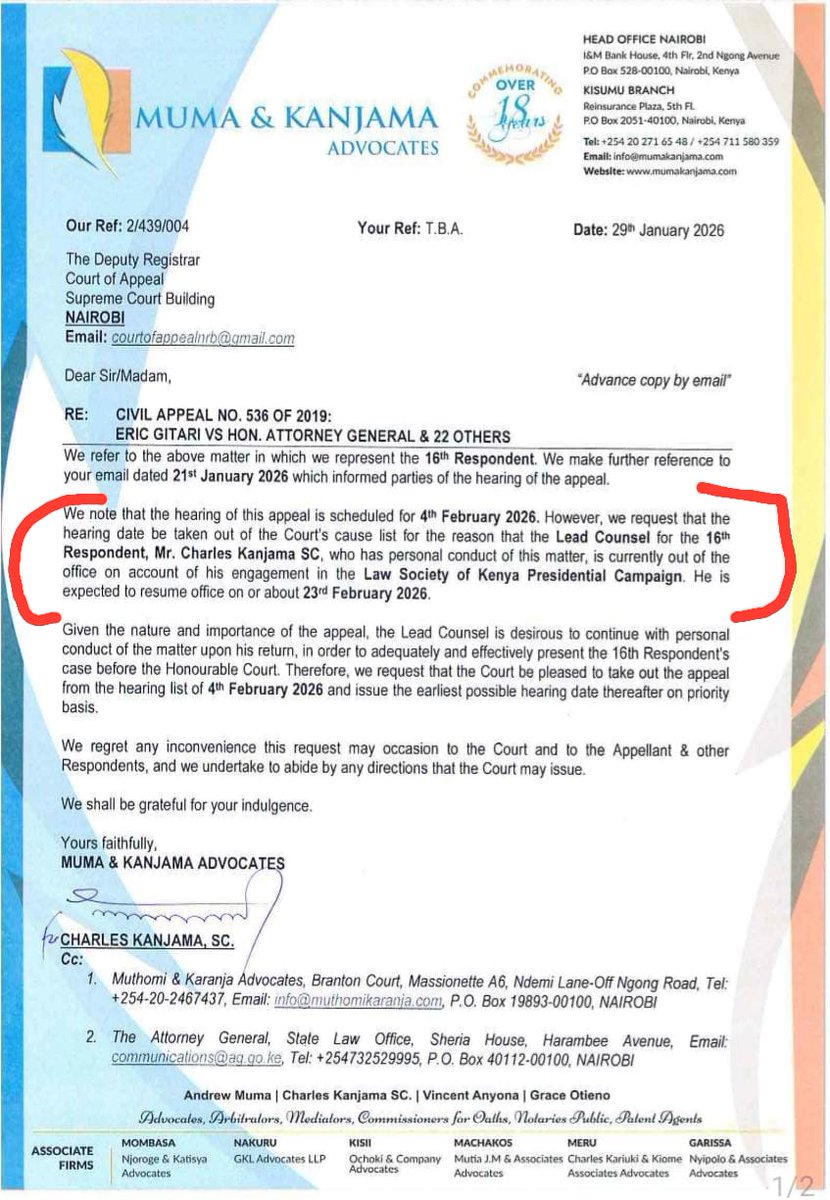
Bar the LSK politics and everything going on, I thought it was good practice (and worthy of imitation) to inform the court and opposing counsel in advance of any reason that may cause one’s absence in a matter, rather than appearing in court on the same day and seeking an adjournment.
Even Mwaura and Wanyama would agree with this.
The Kenyan judiciary is overwhelmed with backlogs, repeated adjournments, and delayed justice for advocates and litigants alike. For years, the Bar has condemned this culture, demanding efficiency, discipline, and strict respect for court timelines. Any LSK President must be part of the solution, not a contributor to the problem.
SC Kanjama has written to the Court of Appeal seeking to remove a matter from the hearing list after submissions had already closed, solely because he, as lead counsel, is engaged in an election campaign not due to illness, not an emergency, not force majeure, but elective ambition.
So, are we comfortable with future candidates or senior advocates citing personal pursuits to interrupt the judicial calendar? How is this conduct any different from the very adjournment culture the Bar has consistently and publicly condemned? When advocates complain about endless postponements, this is precisely what they mean; matters delayed not by necessity, but by choice.
A candidate who responds to pressure by postponing hearings is demonstrating the exact reflex the profession is trying to eliminate. Leadership is tested when personal interests collide with institutional responsibility. Advocates, do we want an LSK President who confronts delay and defends the integrity of court processes or one who normalises delay the moment it becomes inconvenient?
We are pleased to welcome Dr. Harrison Otieno Mbori | @Harrison_Otty as the new Associate Dean, @lawkabarak.
An accomplished #scholar and academic leader, he brings strong expertise in teaching, #research, and administration.
We look forward to his service to @KabarakUniv!