Cotangent space ✍️
Imagine standing on a hillside where you can move in many different directions from your exact spot. The tangent space is the complete collection of all those possible directions of movement at that point. It includes every way you could step and every speed you could travel, all gathered into one flat plane that just touches the curved surface right where you stand.
The cotangent space is something different but closely related. Instead of collecting all possible directions of movement, it collects all possible ways to measure those directions. Each measuring device takes any direction you give it and returns a single number in response. A good way to picture this is to think about temperature spread across a landscape. At any point, if you step in some direction, the temperature changes at a certain rate. That rate is a single number, and the rule that takes your chosen direction and gives you that rate of change is exactly the kind of object found in the cotangent space.
These measuring devices are called covectors. They are different from vectors because a vector is an arrow pointing somewhere, while a covector is a device that reads arrows and reports numbers, similar to how a speedometer differs from the velocity of the car it's in. Once you set up coordinates to give every point in the space an address, like how longitude and latitude address every spot on Earth, you automatically get one natural measuring device for each coordinate. Each device answers the question of how quickly that particular coordinate changes as you step in any direction. These coordinate-based devices form a basis, meaning every other measuring device at that point can be built from combinations of them, making them the basic tools of the cotangent space.
This distinction between directions and measuring devices is very important in physics. Momentum in classical mechanics is most naturally a covector rather than a vector because it pairs with velocity to produce energy. Gradients of quantities like temperature or voltage are covectors in their truest form. In general relativity, where spacetime itself curves, the difference between vectors and covectors becomes clear because there is no universal way to convert between them in curved space.
The key idea the cotangent space captures is that nature includes not just things moving through directions but also things that measure and respond to those directions. These are genuinely different kinds of objects in different spaces, related through a straightforward pairing where every direction combines with a measuring device to produce a number. The full collection of all such measuring devices at any single point makes up the cotangent space.
Atomic orbitals are not paths. They are regions where an electron is most likely to be found.
s orbitals are always spherical and become larger as the energy level increases.
p orbitals have two lobes and exist in three orientations along the x, y, and z axes.
d orbitals usually have four lobes, while one has two lobes with a doughnut shaped ring around the center.
f orbitals have the most complex shapes and appear only in higher energy levels.
The shape of an orbital determines where an electron is most likely to be found, making orbitals the foundation of chemical bonding and atomic behavior.
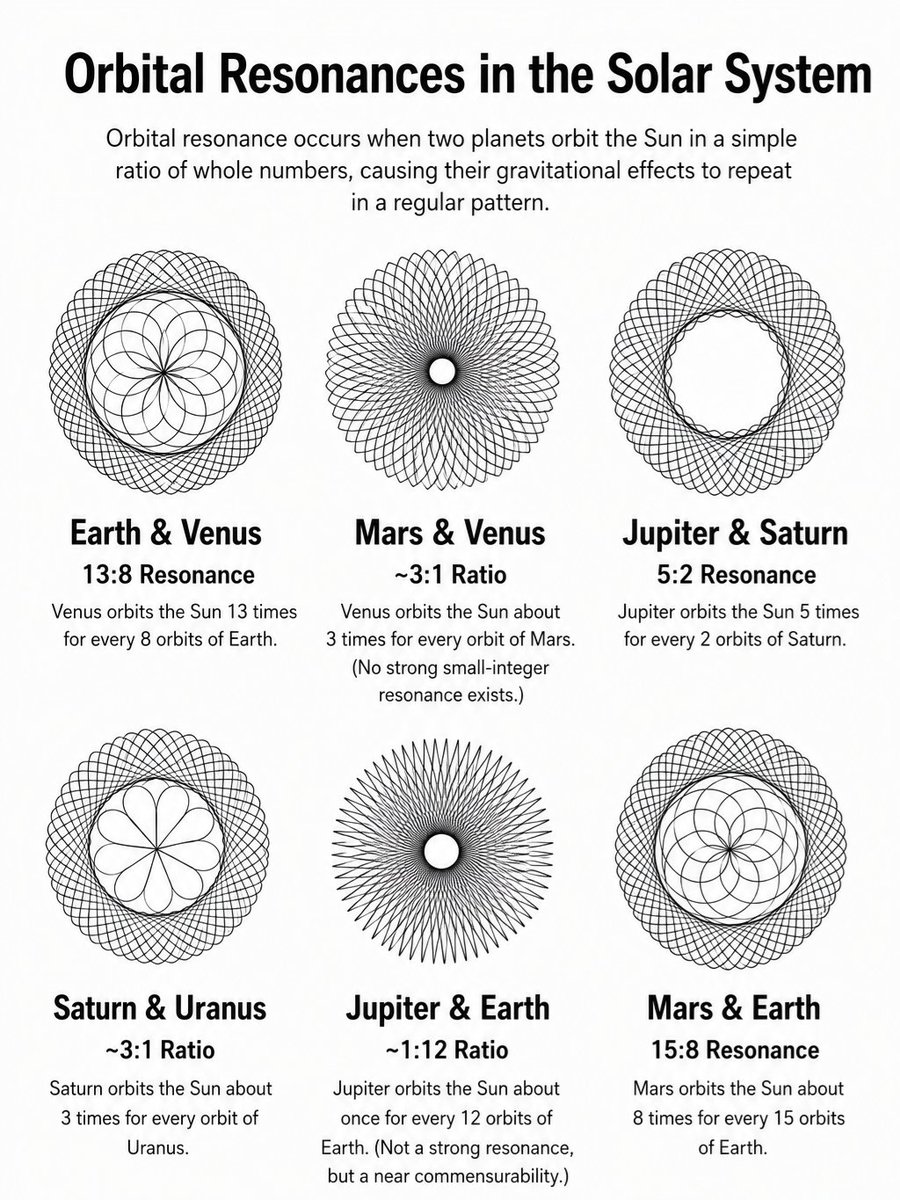
The Solar System isn't just a collection of planets. It's a system of repeating rhythms shaped by gravity.
This graphic visualizes the geometric patterns created when pairs of planets complete their orbits in simple or nearly simple ratios. As their positions repeat over time, they trace beautiful spirograph like paths that reveal the hidden harmony of planetary motion.
Some pairs, such as Earth and Venus, Jupiter and Saturn, and Mars and Earth, come remarkably close to repeating orbital cycles. These near resonances play an important role in understanding long term orbital stability and the gravitational interactions that shape our Solar System over millions of years.
We are looking for engineers, welders, and workers ready to follow us to the ends of the Earth and build classical megastructures that defy this age of apathy.
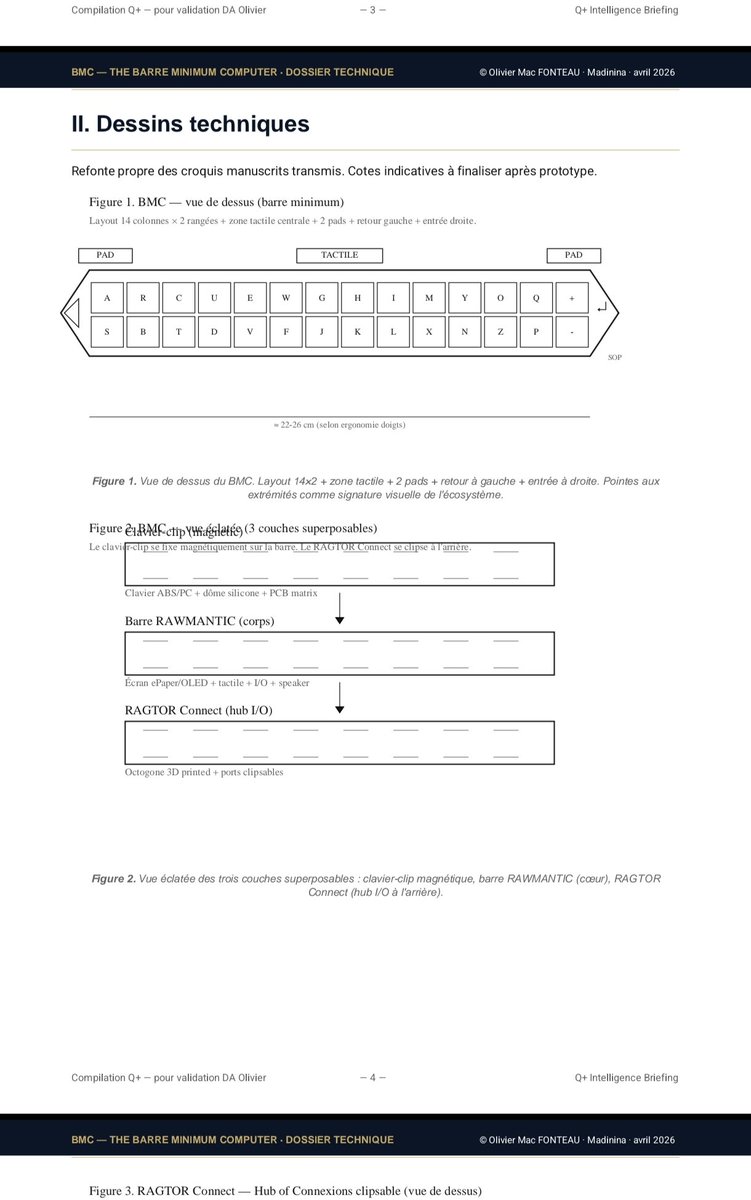
Voici le projet qui était prévu en Open Source, avec des Lunettes VR..
The Barre Minimum, un Mini Computer pour Geek Nomad qui n'ont pas peur d'avoir une petite Barre dans la poche..
Il était pensé pour pianoter discrètement avec ses VR à la terrasse d'un café.. Nerd4ever
AI is accelerating!
Western open-weight AI has recently lagged behind Chinese labs.
But now, Mira Murati's AI startup, Thinking Machines Lab, has unveiled Inkling, its first open-weight foundation AI model. 👀
With 975 billion parameters and a Mixture-of-Experts (MoE) architecture, Inkling activates only 41 billion parameters per query, delivering powerful AI while significantly reducing computing costs.
Developers and businesses can download, fine-tune, and run Inkling on their own infrastructure, giving them greater control over privacy, customization, and enterprise AI applications.
Is this the season when all the hot girls in SF join Corgi?
Hey @UseCorgi , do you need a Tech Barbie who can use Fable to turn your café into a founder megachurch when Anthropic becomes a religion in sf 💀






![QuantumPapers's tweet photo. Demonstrating Quadratic Monte Carlo Speedup via Quantum Amplitude Estimation: Nuclear Engineering Examples
Jilang Miao, Miaomiao Jin, Akira Sone
https://t.co/DIwHLDaX2u [𝚚𝚞𝚊𝚗𝚝-𝚙𝚑 𝚙𝚑𝚢𝚜𝚒𝚌𝚜.𝚌𝚘𝚖𝚙-𝚙𝚑]
💬Submitted to 2026 ANS Annual Conference https://t.co/HLi9ZINOpb](https://pbs.twimg.com/media/HNS5wMiXIAABV49.png)


