@physicsramble I love the fact that your student made the simulation to try to make a point. What they can learn from it is that vector math and scalar math do not always work together.
@physicsramble When your student took the Pythagorean sum of the horizontal and vertical velocities, they found the speed as a function of time (Which was not the vector velocity). Then they took the slope of that function. So the result was not acceleration.
@MrJoeMilliano Joe, what’s your starting point with energy? Finding these relationships in the lab requires some initial definition of energy or Work, right?
@RobSpencer1 Some things I use breakout sessions for:
1) 1-2 minute "Check your answer with each other"
2) Virtual whiteboard creation on G-slides where I can monitor progress. E.g., https://t.co/UM6oI66Hxx
3) Card sorts E.g.,
https://t.co/c8GzdMRyAm
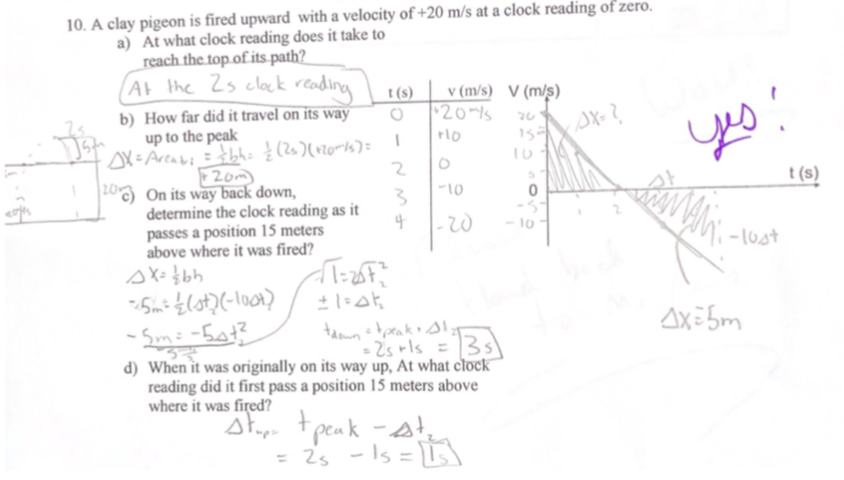
@hoffmanscience I also love this approach. Ss can understand up and down free-fall problems by dividing them into to a simple up problem and a simple "CA from rest" down problem. No quadratic equation hocus-pocus!
Moving into hybrid learning @GuerinCatholic#modphys Our Zoom students joined us in predicting when the red buggy would catch up with the blue buggy. Success! https://t.co/h5doYhStPS
The grade that a student earns in an individual class has a minimal, almost nonexistent effect on their future.
The knowledge, skills, and understanding that they gain from it can and will change their life.
Keeping with this message is the best way to promote integrity.
@RobSpencer1 I downloaded all my smart notebook files to a PDF. I edit those files using Adobe. I use the notability app on my iPad with the PDF files and it works great. Perhaps your tablet can use notability?