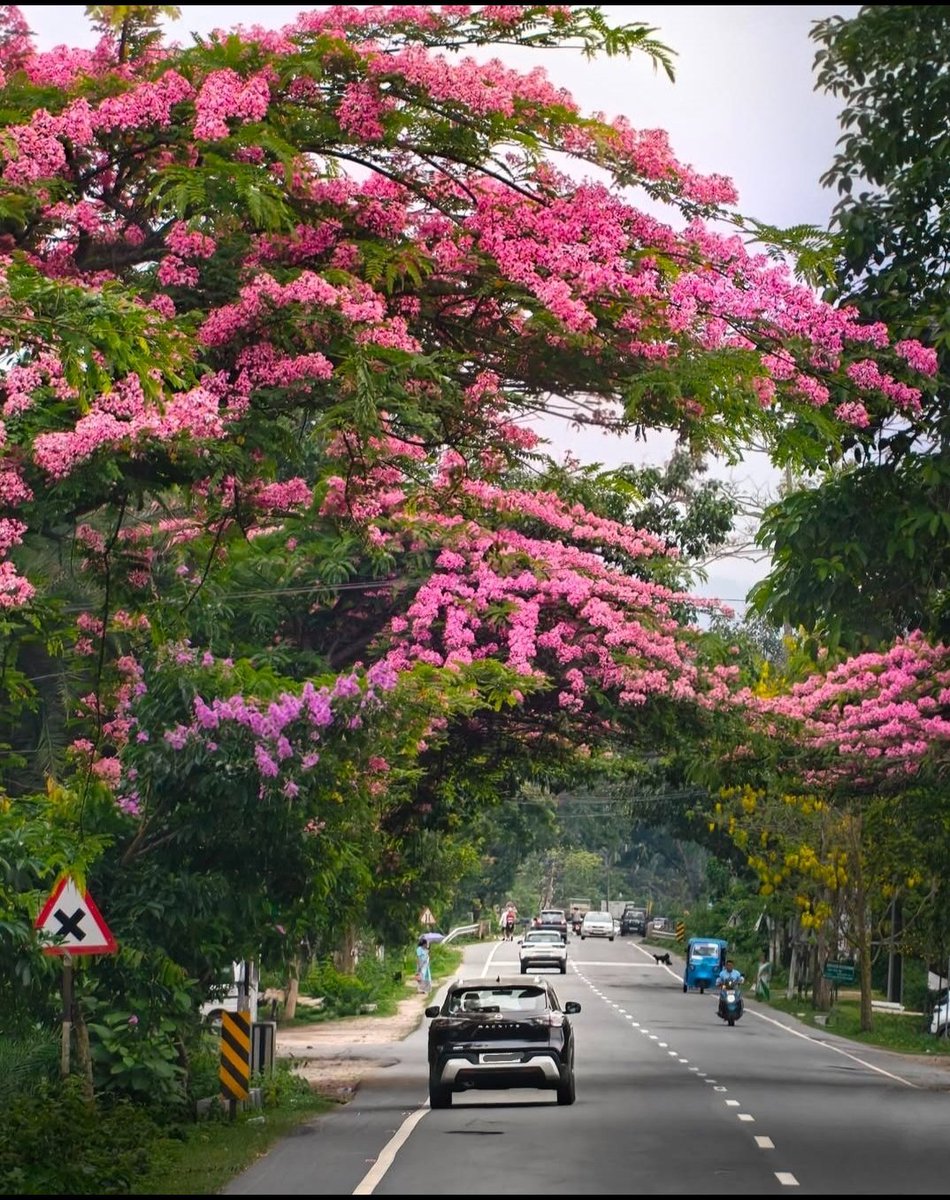
🇮🇳Forest cover in India
2014 : 70.1 million hectares
2024 : 72.2 million hectares
India has added a huge 2.1 million hectares of forest cover in just 10 yrs with a focused plantation drive and restoration schemes.
Things Environmental activists won't tell you.
India is the absolute first to achieve this and every Indian should be extremely proud of how clever this is.
Let me explain what you are even looking at.
That video shows a freight train carrying shipping containers stacked two high, one box on top of another, running under live overhead electric wires.
Sounds simple. But it is not. No other country in the world has pulled this off. India is the only one.
Here is why it is so hard.
When you stack two containers on a wagon, the train becomes very tall. Around 7 metres. Normal electric train wires in India sit much lower, around 5.5 metres. So the two cannot share the same track. The train would smash straight into the wire.
That leaves you with a choice. Go electric and stack only one container. Or stack two containers and pull the train with a diesel engine.
The US, China, Canada and Australia all run double-stack trains. But they mostly do it with diesel, or on routes that were never electrified in the first place. Nobody bothered raising electric wires that high on old tracks.
India did both electric and double-stack together. That is the world first.
The reason India could do this is a decision from the early 2000s.
So, Indian Railways had a basic problem. Goods trains and passenger trains shared the same tracks. Passenger trains always get priority.
So freight trains crawled at 25 to 30 km/h. For a growing economy, moving goods that slowly is a major problem.
So we built separate tracks only for freight. No passenger trains allowed. These are the Dedicated Freight Corridors.
The government approved the project around 2006 and set up a company called DFCCIL to build two corridors.
The Western one runs from near Delhi to the port near Mumbai, around 1,500 km. The Eastern one runs from Punjab down to West Bengal, around 1,875 km.
Because they were building from zero, the engineers were not stuck with old bridges, old tunnels or old wire heights. They could decide the clearances themselves.
So they made a deliberate call to build the whole corridor tall enough for two stacked containers. And electrify it.
Then they had to solve two hard problems.
First, the wire. On a normal Indian line the wire hangs around 5.5 metres. On the freight corridor they raised it to about 7.5 metres. This is called high-rise OHE.
No railway in the world had run a regular freight wire that high before.
Second, the engine. If the wire is way up high, a normal loco cannot reach it. The arm on the roof that touches the wire, called the pantograph, would be too short.
So India needed a new locomotive. A taller reach. And enough power to drag thousands of tonnes.
This is why we built a new loco called the WAG-12.
It is a beast.
12,000 horsepower. Double the power of the old WAG-9 it replaced. It can haul trains over 6,000 tonnes, and up to 15,000 tonnes in some setups, at 100 km/h. That is roughly three times the old freight speed.
The WAG-12 has its own backstory. In November 2015, Indian Railways signed a deal worth about ₹19,604 crore, around 3.4 billion dollars, with the French company Alstom.
They built a new factory in Madhepura, Bihar. Indian Railways holds 26 percent, Alstom holds 74 percent. It was the largest foreign investment ever in Indian Railways.
Over time the factory reached close to 90 percent local manufacturing. So most of each loco is now made in India.
So, the government approved an infrastructure decision in the mid 2000s, then it got built over almost two decades by DFCCIL, Indian Railways and RDSO. The locomotive came through the Alstom joint venture.
The first double-stack train ran under high-rise wires in June 2020, from Palanpur and Botad in Gujarat. The corridor sections were opened in stages after that.
And finally, why only India can do this.
Three things stack up together.
One, broad gauge.
India runs on a wider track than most of the world, 1,676 mm. A wider track gives a bigger loading box. So India can run plain flat wagons with two containers on top. Many countries need special low well-cars to manage height, and those still do not fix the wire problem.
Two, the fresh corridor.
India built new track with no height limits baked in. Old networks in Europe and the US are full of low tunnels and bridges never meant for 7 metre trains. Rebuilding all of that is close to impossible and crazy expensive.
Three, the system.
The tall wire, the high-reach pantograph and the powerful WAG-12 were all designed to work together as one package. You cannot copy just one piece. You need the whole thing.
Put those three together and other railways simply cannot recreate it without rebuilding from scratch.
But the part I keep thinking about is that India approved this in 2006 and ran the first train in 2020.
Fourteen years. :)
𝗧𝗛𝗜𝗦 𝗜𝗦 𝗜𝗡𝗖𝗥𝗘𝗗𝗜𝗕𝗟𝗘 𝗜𝗡𝗗𝗜𝗔 🇮🇳
𝗧𝗛𝗜𝗦 𝗜𝗦 𝗕𝗘𝗔𝗨𝗧𝗜𝗙𝗨𝗟 𝗜𝗡𝗗𝗜𝗔
📍 𝐒𝐀𝐌𝐁𝐇𝐀𝐑 𝐋𝐀𝐊𝐄 – 𝐍𝐀𝐓𝐔𝐑𝐄’𝐒 𝐑𝐀𝐈𝐍𝐁𝐎𝐖 𝐒𝐀𝐋𝐓 𝐏𝐀𝐍𝐒
This is not edited.
This is not AI.
This is Sambhar Lake, India’s largest saltwater lake, where evaporation creates these insane colors from deep reds and pinks to vibrant oranges, yellows, and purples.
A living abstract painting stretching across Rajasthan.
Save it. You won’t believe it until you see it 👇
Which color dominates your screen right now? Tell me 🧐
You cannot grasp the bravery of the Cama Hospital nurses on 26/11 unless you imagine what could have happened had they not done what they did.
The terrorists stormed the compound, rifles hot and boots slick with blood from the CST station bloodbath. Inside the dark corridors were 400 terrified, defenseless women, pregnant mothers, hours-old newborns, incapable of escape. Had those doors been breached, the wards would have become a slaughterhouse of automatic gunfire, executing mothers-to-be and wiping out infants in their cots. It was a setup for the most sadistic bloodbath of the entire siege.
It didn't happen because a handful of ordinary women refused to break and became a human shield between bloodthirsty monsters and hundreds of helpless lives.
Kangana Ranaut's Bharat Bhagya Vidhata brings that terrifying night to life. To say Kangana acted well is like saying Kohli batted well; it vastly understates a masterclass. She doesn't just deliver a brilliant performance; in this film, she completely transcends the exceptionally high standards she has already established for herself.
The true triumph of her performance is its absolute transparency. Within minutes, Kangana Ranaut the superstar entirely vanishes from the screen. In her place stands an ordinary, everyday nurse, carrying the staggering weight of a crisis, rising to the occasion, and saving lives. For any artist, there is no higher achievement than to completely disappear into a soul, and that is exactly what she does here. I have no doubt that another National Award is well on its way.
The film's first half is an eye-opener about how ordinary the lives of ordinary people are, and the second half is an edge-of-the-seat thriller about the extraordinary bravery of those ordinary people. Don't miss it.
@KanganaTeam
#BharatBhhagyaViddhaataReview
THIS IS INCREDIBLE INDIA 🇮🇳
THIS IS BEAUTIFUL INDIA
📍RATANGAD FORT - MAHARASTRA
Pre-monsoon clouds gathering over the majestic Ratangad Fort — Jewel of the Sahyadri! 💎
Standing atop this historic Maratha stronghold (conquered by Chhatrapati Shivaji Maharaj), where ancient ramparts meet dramatic skies, the Nedhe (Eye of the Needle) frames nature’s grand show. Cold winds, floating clouds, and endless green valleys before the monsoon magic hits.
Pure Bharat at its breathtaking best!
Jai Bhawani ! Jai Shivaji ! ✊
YO ELON & NIKITA — This or the usual narrative? 👀
#IncredibleIndia #RatangadFort #Sahyadri #BeautifulIndia
THIS IS INCREDIBLE INDIA 🇮🇳
THIS IS BEAUTIFUL INDIA
📍RAJGAD FORT - MAHARASTRA
Behold the greatness of Rajgad Fort — the undisputed **King of Forts** in the mighty Sahyadri ranges of Maharashtra!
Chhatrapati Shivaji Maharaj’s first capital for nearly 26 years, this colossal hill fort (spread over a 40 km base) stood as the cradle of the Maratha Empire.
From its towering Balekilla and strategic machis (plateaus), Shivaji planned legendary campaigns, safeguarded treasures, and built the foundation of Swarajya.
Witness to historic events like the birth of Rajaram and the return from Agra — every stone echoes resilience, brilliance, and unyielding Maratha pride.
Rajgad isn’t just a fort; it’s a living symbol of Bharat’s warrior legacy! ⛰️🛡️
ELON & NIKITA — This grandeur or the usual narrative? 👀👉🏽👈🏽
#IncredibleIndia #RajgadFort #KingOfForts #ShivajiMaharaj #Sahyadri #BeautifulIndia