Good day Dr Dendere, @drDendere
I trust this response finds you and your loved ones well.
South Africa’s history of welcoming millions of African migrants across education, commerce, and society reflects our tradition of solidarity and dispels the notion of blanket anti‑immigrant sentiment. However, it is precisely because of this openness that the current mobilisation cannot be reduced only to poverty or inequality. While poverty is undeniably cruel and fuels resentment, it is not the sole driver of anti‑illegal migrant sentiment.
The reality is that illegal immigration places additional strain on public services from healthcare to schooling and municipal infrastructure. Communities grappling with unemployment and service backlogs experience this pressure directly, and their frustrations are not simply abstract hate but lived realities of competing for scarce resources. To frame the issue solely as poverty is, respectfully, an incomplete analysis. It is intellectual dishonesty risking obscuring the governance dimension of the demand for lawful, managed migration.
I respectfully agree with you that poverty and inequality are indeed structural enemies, but I will not be persuaded by your arguments to ignore the fact that illegal immigration compounds these challenges and intensifies social tensions. Recognising both realities is essential if we are to move beyond rhetoric and towards solutions that protect citizens and migrants while upholding democratic values.
Thanks for engaging my post🇿🇦🙏🏽
@MbalulaFikile so @MYANC@PresidencyZA@CyrilRamaphosa your SG prides himself in leading a party that never listens to the masses? he even knows when people started voicing their grievances!! angsazi
@MbalulaFikile Fikile, schools were closed you can't keep making an even bigger fool of yourself. you spent hundreds of millions over a peaceful march, you have to have some shame at some point in your life
The Somali Association of South Africa claims their nationals in Johannesburg are documented and will keep their businesses open. Let's test that claim against the reality of Somalia's own crumbling civil registration system.
Somalia's population register is a national embarrassment. After decades of collapse, birth registration coverage sits at a pathetic 3% for children under five. Three percent. That means 97% of Somali children have no legal existence, no birth certificate, no proof of age, no nationality. Only 0.3% possess a birth certificate. These are not my numbers. These are UNICEF's.
The system is only now being rebuilt from rubble. Somalia launched its digital civil registration system in 2022, but by mid-2025, only a fraction of the population had been enrolled. As of March 2026, 1.4 million citizens have been registered. But Somalia's population is estimated at over 17 million. Do the math. That is less than 10%.
The country's passport system is in chaos. There is no formal integration between NIRA's national ID database and the Immigration Agency. The President himself revealed that over 10 million people hold Somali passports, but authorities cannot verify how many were obtained legitimately. He called institutions that block the national ID rollout "national criminals" and warned that ID cards will soon be mandatory for all services.
Now ask yourself, If Somalia cannot register its own citizens, if it cannot verify the legitimacy of its own passports, how can the Somali Association in South Africa claim with certainty that "most" of their nationals are documented? What documents? Issued by what system? Verified by what authority?
We are not saying all Somalis in South Africa are undocumented. We are saying the claim cannot be verified because Somalia's verification systems do not exist. The association is making a statement of faith, not fact. And faith does not secure borders.
This is why we are tired. We are expected to trust the word of an association representing a country whose own government cannot tell you who its citizens are. And we are called xenophobic for asking basic questions.
And I’m angry, that media houses have not been doing their research and reporting news objectively. South Africa, immigration is bad, it’s a huge problem, these people aren’t registered in their own countries. It’s something we not making noise about. We are at war lana.
Dr Mathe
I hope you had a good day and that you and your loved ones are well.
First let me state that South African activists like @JacintaNgobese@PhakelaMthakath
and others have sparked a debate on illegal immigration that has even crossed our national borders. That discussion can never be ignored even by State Presidents of many African countries. That is the beauty of democracy: freedom of speech and opinion are respected in South Africa. In other countries, these activists would have been hunted down or even killed by now. Not in South Africa. Here, you can openly criticise the sitting President or march at the Union Buildings without fear.
Secondly, I respectfully disagree with Dr @DlaminiZuma
when she says we are “barking up the wrong tree.” Let us be honest: the “wrong tree” is precisely where our public services are collapsing under the weight of illegal immigration.
It is a fact that public hospitals are overcrowded, schools are stretched beyond capacity, and public services are strained not because the ghosts of apartheid are still issuing ID numbers, but because undocumented migration has created a parallel population consuming public services. When clinics in Musina- Limpopo province run out of medicine, it is not an abstract inequality gap at play; it is the very real pressure of thousands of undocumented patients crossing the border daily to collect free medication that is not available in their own country.
And here lies the irony my good Dr. Zimbabwe “took the land” in the name of empowerment, only to leave much of it idle, while some its citizens who are illegal immigrants, now work on farms in South Africa . South Africa therefore carry a double burden: our own land reform stalls, while we subsidise the consequences of their failed land reform. Is that not continental comedy, my good Dr?
I honestly and wholeheartedly agree that inequality is a root cause. However, to pretend that illegal immigration has no impact is intellectual dishonesty. Public services are finite. Every undocumented learner in a classroom means fewer resources for South African children. Every undocumented patient in a hospital bed means longer queues for citizens. Every undocumented worker undercuts wages and weakens labour protections.
I argue that when people demand enforcement of immigration laws, it is not “hate” or “political sensationalism.” It is a rational cry for survival in a system already buckling under the pressure of illegal immigration. Many of these illegal migrants are too afraid to challenge their own Presidents who amend constitutions to extend their terms of office, yet they are vocal in lecturing South Africans on how to behave in South Africa.
My good Dr Mathe, the real question is whether South Africans should continue footing the bill for neighbouring governments’ failures and be a mecca of illegal immigrants, while being told they are barking up the wrong tree?
Thank you for engaging with my post and may you and your loved ones stay blessed. 🇿🇦🙏🏽
A Gentle Reminder:
Presidents, Ministers, Members of Parliament, Councillors and all public representatives are your servants. They exist solely to represent your interests as citizens. We are your “leaders” simply because you elected us to be in positions of authority. Truth of the matter is, the ultimate leaders in a society are the people.
The people delegate their power to a few to be in decision making bodies like Municipal Councils and Parliament. That doesn’t change the fact that the people in these positions are given power by the people and must exercise that public power in a manner that advances the interests of the people and must always be answerable to the public.
When we go to the elections in November, remember to vote for your SERVANTS. Do not vote for BOSSES that do not sympathise with your struggles and view something as a problem only when it affects them personally.
@phile_johnson lol I wish it was AI, unfortunately this is my life. 5 wives, one went to school with my older brother, wife no5 is 2yrs older than me (mother of the 2yrs old) listen, issa lot😂😂
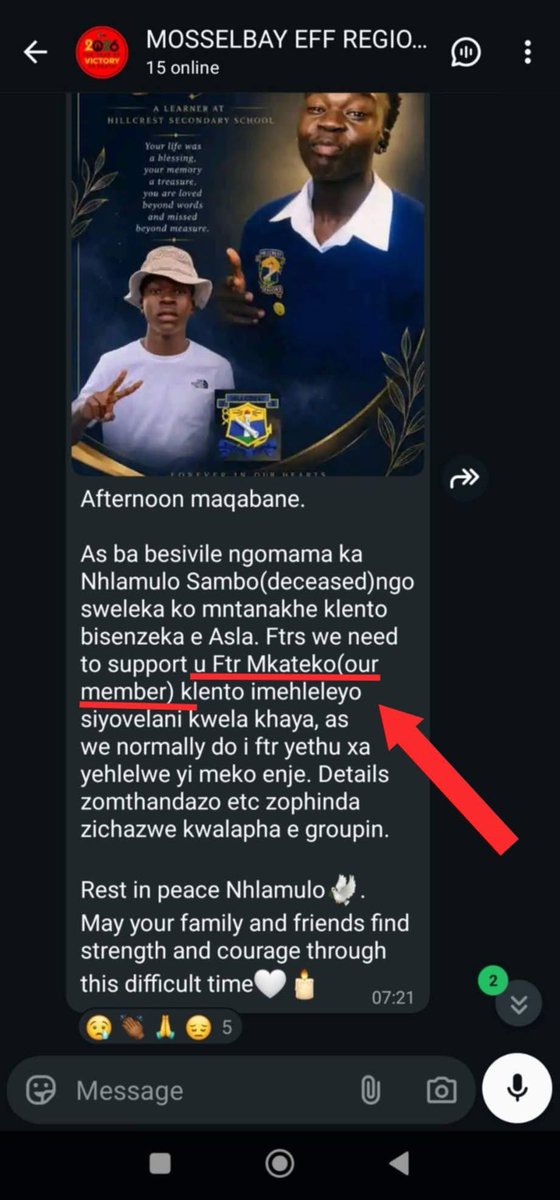
Julius Malema minions are shameless, they’ve now kicked Nhlamulo’s mom from their group because she failed to execute the mandate as expected. Fighters don’t keep what doesn’t benefit them. Mkateko must apologise to the nation meanwhile the EFF must be held accountable on the polls. The community of Mosel Bay isn’t happy with the mother and wants her out of their lives
SABC journalist, Mbalenhle Mthethwa, asked one of the 800 Ghanaians returning home how he managed to acquire asylum in South Africa after arriving in the country 21 years ago on a visitors visa, despite there being no war in Ghana 🇬🇭
Mr Nana Acheampong responded that he initially came to South Africa on a visitors visa, but later decided to apply for asylum because he was experiencing serious family problems back in Ghana and felt that his life was in danger.
@SfundoN85616@ZizinjaAbelungu they were usually called imidlwembe, Thabo Mbeki once spoke of them. they went on to have kids, strong DNA is something else😅😅
@KwabenaAgyema@S_OkudzetoAblak however not proud enough to stay in the country you love so much and build? where's your "spirit" when greener pastures are outside of the realms of your "pride" ?
BEFORE YOU CALL THEM YOUR BROTHERS AND/OR SISTERS YOU MUST KNOW HOW WE WERE TREATED IN THEIR RESPECTIVE COUNTRIES!
Africa has 54 sovereign states, but only 3 countries hosted South Africans for an agreed period of time and it was all based on preconditions and restrictions:
- Angola 🇦🇴
- Tanzania 🇹🇿
- Zambia 🇿🇲
Above were the countries that hosted South Africans with a clear understanding that, after sometime, they will go back to South Africa.
Mozambique 🇲🇿, Lesotho 🇱🇸, Botswana 🇧🇼, Zimbabwe 🇿🇼 and Swaziland 🇸🇿 were transit countries.
Ethiopia 🇪🇹, Egypt 🇪🇬 and Algeria 🇩🇿offered training camps for a selective period and soon after, South Africans had to return to the 3 host countries.
Very few countries were in solidarity support, but never in financial support.
BARE FACTS:
1. Countries like Kenya 🇰🇪 and Democratic Republic of the Congo 🇨🇩 used to deport any South African found in their country back to apartheid South Africa for possible death 💀
2. It is quite interesting to acknowledge that the liberation movement was once expelled by host nations, and it was then that Cde Kebby Maphatsoe lost his arm in Angola 🇦🇴
3. The liberation movement was also expelled from Mozambique 🇲🇿, Swaziland 🇸🇿, Lesotho 🇱🇸 and Zimbabwe 🇿🇼
4. Botswana 🇧🇼 didn’t even bother to host South Africans
5. While living in those host countries, South Africans were living in camps and they were not allowed to mix with the local people from those countries
6. They had to lease land to grow their own food
7. They had to build a school and a hospital which were fully funded by countries in Europe that were against Apartheid
8. Freedom of movement was at a minimum
9. Every South African had to leave the camp which was once every fortnight
10. They had to have a permit which only allowed them to leave the camp for only one hour
11. If they came back past the given time, they would be arrested by the soldiers who were stationed at the entrance of the camp
12. More importantly, there has never been a South African that worked in any country in Africa during that time
13. Living conditions were not good; Malaria, AIDS and other diseases killed South Africans as those diseases were very foreign and were non-existent in South Africa
MORE FACTS:
1. In March 1980, PAC members protested in Tanzania about the living conditions and soon after, 17 PAC members were gunned down for protesting in a foreign country by the FFU Unit. This was a clear reminder that you don’t protest in a foreign country.
2. South Africans were very much aware that they were in those countries temporarily and they couldn't wait to return home
3. In 1977, the group of Tsietsi Mashinini that was made up of only 20 students was deployed from Somafco, Tanzania, to go study in Nigeria, and while they were there, they were welcomed with so much resistance. Nigerian 🇳🇬 students protested claiming South Africans are there to take their jobs and women
4. Not too long after that protest, in just 2 months, one comrade by the name of Joel, was poured with acid on his face. Not too long he died, and it was then that the group had to be recalled back to Somafco
5. Tsietsi Mashinini and Mvuyo, Mbuyiseni Makhubu leaders of 1976 Soweto Uprising dissapeared without a trace at University of Ibadan, Nigeria 🇳🇬
Angeke sikhohlwe!
Re ka se lebale!
Sehle silibale!
Lest we forget!
🤞🏽
Article by Gloria Ogle.
Dr Ndlozi, I will respectully argue that your opening assertion overlooks a crucial principle: correctly naming the problem and mobilising around it. Accurate diagnosis is what enables societies to craft meaningful solutions, and your diagnosis cannot automatically stand in for theirs.
While your long experience in organising marches and shutdowns is valuable, it cannot serve as a universal script for mobilisation. Each generation, each community, and each activist movement carries its own lived experiences and contexts. Respecting those diverse realities is essential. To assume that every activist is guided by “handlers” undermines their agency and silences their voices. People mobilise because of their own grievances and aspirations, not because they are puppets of unseen forces.
Moreover, raising concerns is most effective when done in a spirit of genuine listening, rather than adopting the posture of a preacher addressing sinners who must repent. As you have presented yourself as an experienced mobiliser, I trust you will agree that mobilisation is not a morality play; it is a negotiation of power, dignity, and justice. To dismiss their efforts as “self-sabotage” without engaging with the concerns that drive them risks closing the door to constructive dialogue.
The challenge, then, is not to lecture people into silence but to propose solutions that address the root causes of their grievances. At this stage, respecting their agency and listening without preconceived judgement is crucial for fostering constructive engagement.
Constructive engagement requires recognising that the strategies and tactics of today’s activists are not of lesser intellect than those informed by past experiences of mobilisation. They reflect the realities and aspirations of the current contexts. By approaching these movements with humility and openness, we can foster dialogue.
With utmost humility and respect, I am yielding to the chair.