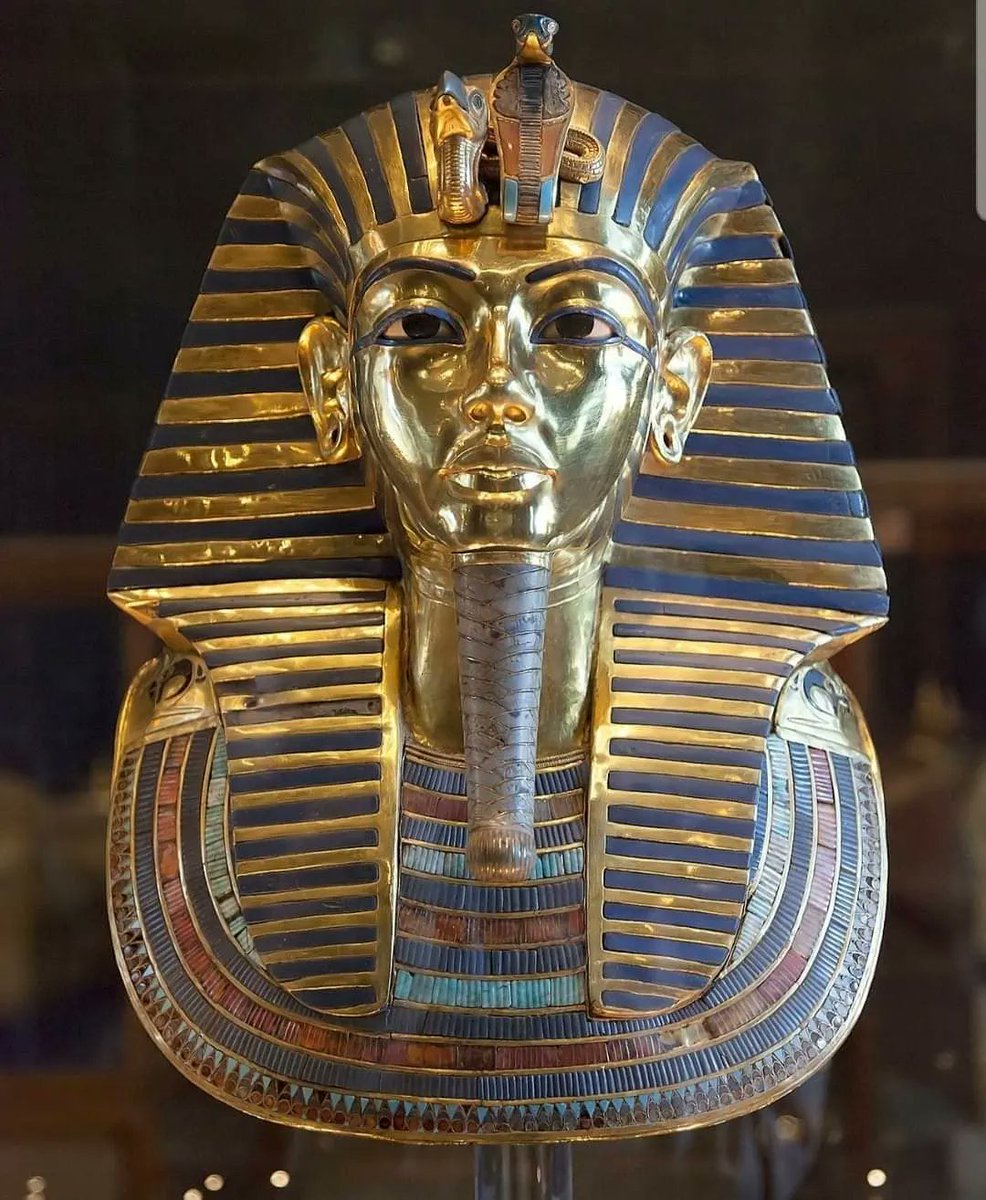
"King Tut as I know him"
A drawing by British archaeologist and Egyptologist Howard Carter (who discovered the tomb of #Tutankhamun) for Manuel Rosenberg, 1926.
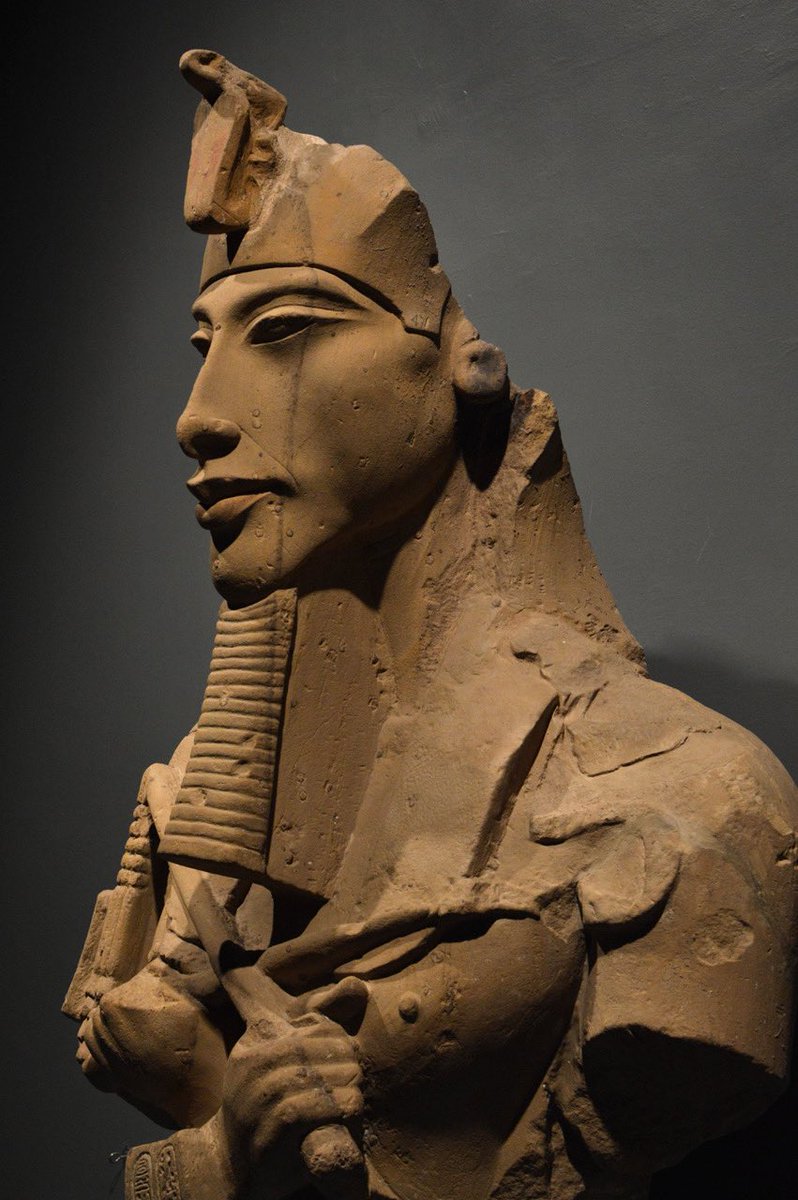
Colossus of Akhenaten from Karnak Temple, c. 1353–1336 B.C.
▫️Carved in the earliest days of his reign, this colossal statue of Akhenaten remains one of the most mysterious royal images in all of #AncientEgypt. The king stands with arms crossed, clutching the crook and flail, yet his body is anything but traditional: long face, soft lips, rounded belly, narrow torso and wide hips, a form that once led scholars to call him “androgynous,” even “primordial.”
Today, Egyptologists urge caution. These unusual proportions (including the absence of kilt detail, giving the king an almost nude appearance, and the lack of any carved genitalia) belong to what is thought to be a radical artistic style, not a confirmed attempt to portray the king as both male and female as early Egyptologists speculated. No inscription leads to this thought; and in reality many colossi omit anatomical detail; and elsewhere in his reign he appears entirely masculine.
What we can say is this: #Akhenaten used art to break the old rules. His statues were statements: bold, strange, and utterly unlike anything seen before in Egypt.
A ruler who renamed himself “Effective for the Aten,” husband of #Nefertiti and perhaps father of #Tutankhamun, Akhenaten reshaped religion, art, and royal identity in a short-lived revolution; one that, much to the dismay of Egypt’s priesthood, remains utterly unforgettable even today.
Now at the Egyptian Museum, Cairo. JE 49528
https://t.co/96oHNgJhsX
#Tutankhamun's Sandals for Eternity✨
▫ Not all of Tutankhamun’s footwear was meant for mortal steps. Among the most hauntingly beautiful pieces found upon his mummy were the sheet gold sandals, accompanied by delicate finger and toe stalls, each hammered from thin sheets of gleaming metal. These were not practical wear, but funerary adornments, fashioned solely for the journey into the afterlife. To wear them in life would have been agony; rigid, unyielding, and wholly unsuited for movement, yet in death they symbolised eternal perfection.
The golden sandals were placed upon the king’s feet before the body was wrapped, their form imitating the woven plant-fibre shoes of daily use, as if to grant the dead the comforts of life transfigured into divine splendour. Each finger and toe was sheathed in its own shimmering cover, sealing the body in precious metal as an image of completeness and immortality.
When the mummy was unwrapped in 1925, these exquisite pieces were removed; a standard practice at the time, though one modern Egyptology would no longer undertake. In contrast, the mummy of Thuya, Tutankhamun’s great-grandmother, still wears her golden sandals and stalls in situ, revealed only through the silent precision of modern CT scanning.
Today, Tutankhamun’s funerary sandals will be on display at the #GrandEgyptianMuseum, no longer bound to a body but to memory, eternal shoes for eternal steps, crafted not for walking the earth, but for treading the fields of eternity.
Photograph by Harry Burton (1879–1940), The Griffith Institute, Howard Carter Archives. Restored by Egypt-Museum.
Red jasper head of Akhenaten, c. 1353-1336 B.C.
Penn Museum. E14364
▫ “It is interesting to note that while mounting the head for exhibition, the museum craftsman could not succeed in piercing the tiniest hole in the base of the neck, even with a steel drill, so hard is the stone, yet the Egyptian craftsman of three thousand years ago, working only with tools of stone and bronze, could model it so delicately and so craftily as to produce a portrait worthy to rank with the best of any nation then or now.” – A Portrait Head of Akhenaten. ”Museum Bulletin I, no. 1 (January, 1930): 26-27″. Accessed October 13, 2023.
This head of Akhenaten is similar to portraits of the king that we believe come from early in his reign. The less exaggerated features of the soon-to-be “Amarna Period”, this serene, slight smile of the young king looks ahead, as he wears the blue “khepresh” crown of war. The uraeus would have been present but is sadly lost and damaged, as is the tip of his nose. With a beautiful red pigment, this head of Akhenaten would have been a part of a statuette (small statue).
This head is under 20cm, at 18.2cm tall, and just under 10cm wide, at 9.5cm. It was purchased by the Penn Museum from H. Kevorkian in 1927, and is currently in the “Collections Storage” section of the museum (Object no: E14364).
Read more: https://t.co/xWqiNKuKDr
Nefertiti Statue, c. 1349-1336 B.C.
This limestone striding figure of Nefertiti was unearthed in the archaeological remnants of the sculptor Thutmose’s workshop, within the remains of the same room (Amarna House P 47.02. Room 19) where the famous bust of the queen was discovered in 1912 by Ludwig Borchardt, at Tel el-Amarna.
The figure was discovered in several fragments and according to Borchardt‘s notes, the base with the feet was retrieved first, followed by the remaining sections. All fragments were found near a bust of Akhenaten (Ägyptisches Museum. ÄM 21360).
In an Ancient Egyptian expression of Damnatio Memoriae by the Amun priesthood and later kings, the attempted erasure of the Amarna Period took place; statues of the royal family of Akhenaten were broken, Aten temples brought down and the entire city of Akhetaten (Tel el-Amarna) destroyed with remnants of the material usurped. However, the carefully modelled face of the striding Nefertiti is undamaged, therefore it cannot be verified that the figure was purposefully dismantled.
On the other hand, damage to the queen’s nipples could indicate deliberate interference, but it is also possible the damage to the finer tips of the bust came from the figure falling forward at some point. The royal insignia of the queen has also been purposely removed.
This seems like an obviously deliberate removal rather than damage, this could be one of two things; the Damnatio Memoriae by the later Egyptians removing Nefertiti’s divine status, or possible plundering of the perhaps precious material (gold) of the uraeus by robbers.
Luckily for us in this modern age, except for the missing right forearm and the damaged parts in the left shoulder area, the statuette was able to be totally reassembled.
The figure, measuring at 40.5cm tall, is made from limestone and traces of paint still linger, most noticeably upon the eyelines, brows and lips.
Egyptologists tend to believe this is depicting the queen during middle age.
The idea of this figure depicting an aged queen, is simply based upon Nefertiti’s appearance depicted within the figure. Scholars take note of the fine line work of her facial details, such as the “tear troughs”, nasolabial folds, both things more present than previous statuary of the queen, along with the deeper set frown lines at the corners of her mouth.
These rather but not extremely noticeable features of age, along with the bust drooping slightly in profile, is what makes Egyptologists associate this with an older queen Nefertiti.
Although as of yet, it has never been established when or how Nefertiti died, it is generally believed Nefertiti, after vanishing from record, died sometime during her early to mid-forties.
New Kingdom, 18th Dynasty, c. 1349-1336 B.C.
From Tel el-Amarna, Remnants of Thutmoses’ Workshop, (Amarna House P 47.02. Room 19) .
Ägyptisches Museum. ÄM 21263
Read more: https://t.co/KVyJ7jW9UG
Canopic Chest of Tutankhamun
The interior of the chest is divided into four compartments, each with a cylindrical hollow covered by a lid elegantly carved in the form of the king’s head.
It is considered to be one of the finest masterpieces of #Tutankhamun’s collection.
New Kingdom, 18th Dynasty, c. 1333-1323 B.C.
Tomb of Tutankhamun, KV62.
Now in the Egyptian Museum, Cairo. JE 60687
Read more: https://t.co/wgbMXGWMmG
Today in 1923, the sealed tomb of King Tutankhamen was opened after lying undisturbed for over three millennia.
It’s potentially the greatest archaeological discovery in history!
Here’s the remarkable story 🧵
Happy Birthday to Howard Carter, who was born on this day in 1874! At the Griffith Institute, in addition to Tutankhamun materials we also hold excavation records for the Carter-Carnarvon excavations at Tell el-Balamun, Meir, explorations in the Valley of the Kings, & much more!
Quick visit to unfinished tomb KV 25 in the western branch of the Valley of Kings / the ‘Valley of the Monkeys’. First tomb of Akhenaten? https://t.co/vVpfs9nkki