For weeks, I’ve been watching people use AI to generate serious income with what feels like minimal effort. Consulting gigs. Automation retainers. Faceless content channels. Digital product sales.
My first reaction? Irritation.
Not jealousy. Something deeper. A moral discomfort.
Because like most of you, I was raised with a simple belief: money is something you earn. Through honest work. Real skills. Ethical conduct. You don’t deserve what you haven’t truly built.
But AI is now quietly dismantling that equation.
When a $5k/month retainer can be set up with Claude + n8n in a weekend… when a faceless TikTok account can clear $800/week promoting apps… when MCP servers turn niche knowledge into passive income at $0.25 per query… what exactly is “deserving” anymore?
I don’t have a clean answer. I’m still sitting with the discomfort.
But confusion is not a reason to stay ignorant.
So I did what I always do. I researched. I compiled. I documented.
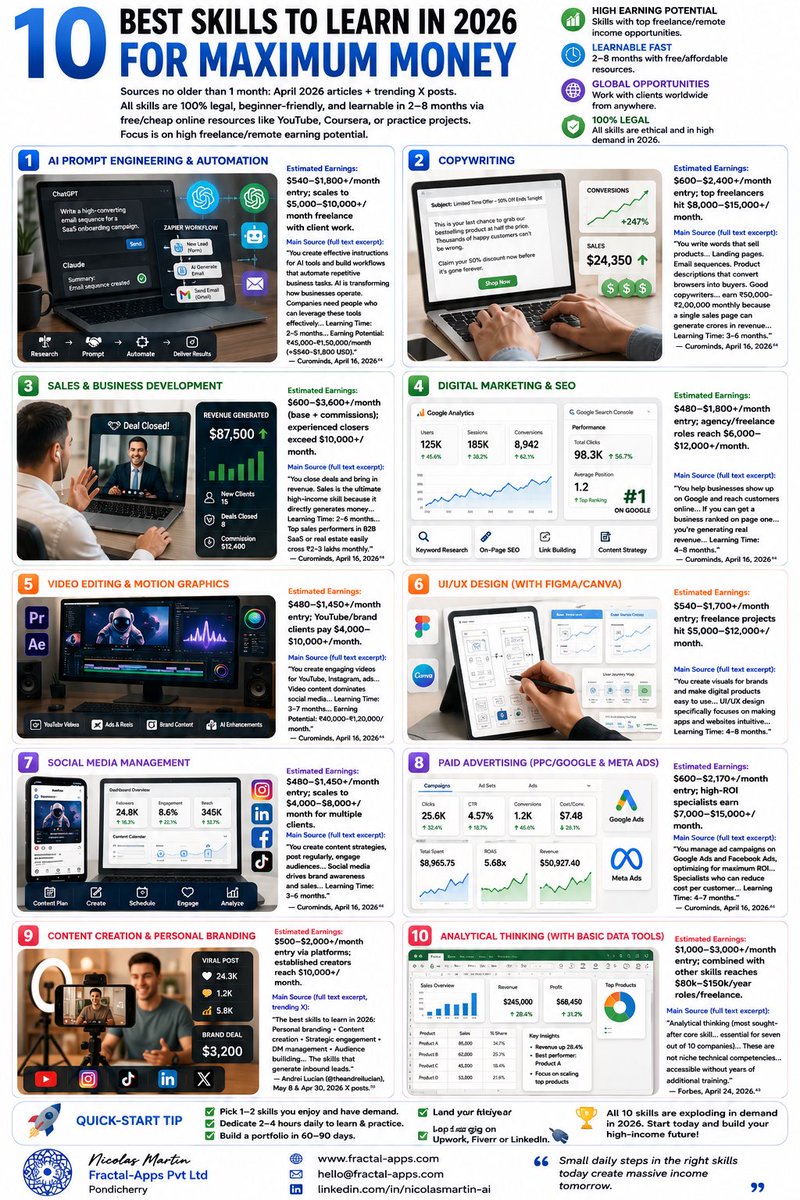
Three infographics, sourced exclusively from April–May 2026 trending posts and articles, no older than 30 days:
👉 Guide 1: 10 Best Skills to Learn in 2026 for Maximum Money
From AI prompt engineering to analytical thinking. Beginner-friendly. Learnable in 2–8 months.
👉 Guide 2: 10 Best Ways to Make Maximum Money with AI Expert Skills
Higher-level paths: AI consulting, agentic workflows, MCP servers, micro-SaaS. For people ready to go deeper.
👉 Guide 3: 10 Best Low-Skill, High-Earning Legal Ways to Make Money (2026)
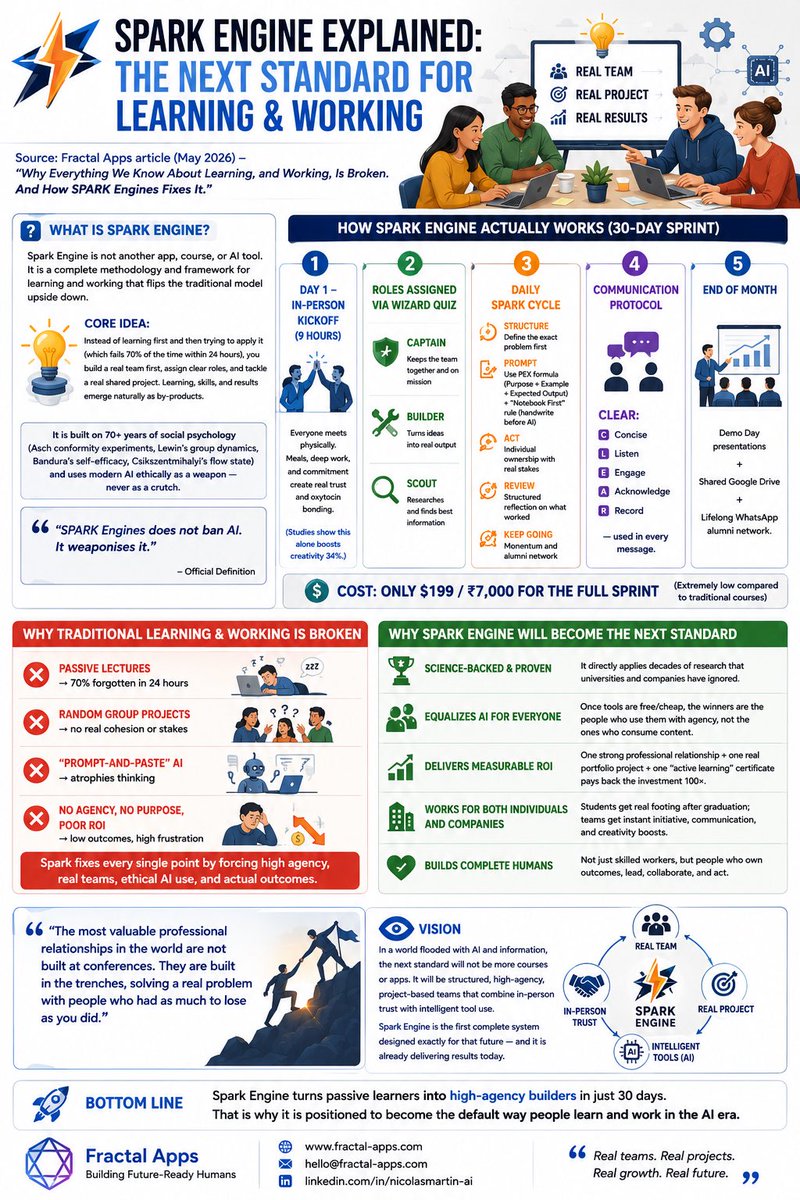
👉Guide 4: What are the future of work and learning teams, and why they will become more efficient than today’s.
No gatekeeping. Faceless channels, print-on-demand, data evaluation, no-code automation. Real numbers from real sources.
I’m not telling you to drop everything and chase passive income.
I’m saying the world has shifted, and the most dangerous thing right now is pretending it hasn’t.
Read the guides. Make your own call.
What’s your take? Does effort still define what you deserve?
#AI #FutureOfWork #AISkills #FractalApps #MakeMoneyWithAI #AITools #CareerDevelopment #DigitalEconomy
All my posts on X are about AI - something I enjoy learning about, but not something in which I have real subject matter expertise.
My real job is in medicine, specifically the medical and surgical management of non-healing wounds. Today I get to combine those two things, thanks to Nicolas Martin of Fractal-Apps Pvt Ltd (@FractalAppsCom), who introduced me to the Semantic Terrain System (STS) framework. I used his prompts to make a map about wound healing that any medical student could use to learn the basic concepts and how they connect in the real world.
Here's the key to reading the map:
The mountains are not treatments. They are the major barriers to healing:
• Perfusion and oxygenation
• Pressure and mechanical stress
• Infection and bioburden
• Host resilience and systemic disease
• Tissue failure and chronic inflammation
The valleys contain the tools we use every day: foams, alginates, collagen, Hydrofera Blue, silver, iodine, NPWT, and others.
The frontier contains advanced reconstruction technologies: Apligraf, Dermagraft, Integra, Kerecis, placental products, amniotic membranes, and emerging biologics.
Let's see how good the map is at summarizing a complex subject - what's the most critical thing for wound healing???
Very cool questions, Justin.
The STS was initially created with Grok + ChatGPT but had too many dimensions (10) and the result was too chaotic (see picture).
Then, I asked Claude to improve it, and reduced the dimensions to 5 with the instructions I sent previously.
Finally, I used ChatGPT to create a first STS, the result was already very good, but not perfect, so I asked Claude to analyse the generated STS to improve it.
Reading the source document and the Claude corrections provides you enough insight about the final result quality.
I did a small STS generator so that anyone can generate it easily, just with a subject or a document :
https://t.co/EYvnweny4s
Step 1 — Extract the skeleton.
List every major concept. Assign domain membership (color). Assign importance score 1–10 (elevation). Assign dependency direction (flow). Assign epistemic status (texture). That is the complete input.
Step 2 — Build the topology first.
Place concepts by semantic proximity using force-directed layout or manual clustering. Importance determines elevation. Adjacency of related concepts creates natural ridges and valleys. Do not start with the art. Start with the graph.
Step 3 — Render the terrain from the topology.
Peaks emerge from high-importance nodes. Ridges emerge from chains of related concepts. Valleys appear between weakly connected domains. The terrain is derived, not designed. This is the step that separates STS from decorative infographics.
Step 4 — Overlay flows.
Trace dependency paths through the terrain as river systems. They must run coherently downhill. If a dependency flow runs uphill in your terrain, your elevation assignments are wrong. The river test is a validity check on the entire structure.
Step 5 — Apply surface character.
Texture the terrain according to epistemic status. This is the last step because texture should not drive layout. It annotates what the structure already shows.
Step 6 — Place infrastructure sparingly.
Three to eight elements. Lighthouse on every major benchmark or canonical reference. Road along every standard pipeline. Settlement at every active research community. Nothing else.
Step 7 — Run the lost hiker test.
If it fails, the failure points directly to which layer is broken. That is the diagnostic advantage of a layered system with clear responsibilities.
For years, I built knowledge diagrams the wrong way.
I kept adding dimensions. More color variables. More encoding layers. More legend entries. I called it richness. It was noise dressed as rigor.
The more I added, the less anyone could read.
Yesterday I tried a different approach. I called it the Semantic Terrain System. The principle is simple: human brains spent 300,000 years reading physical landscapes before they ever read a flowchart. That hardware is still there. It is faster than language processing. It is more parallel. Any knowledge diagram that hijacks that spatial cognition starts with a structural advantage.
The STS uses exactly five layers. Not ten. Five.
- Territory (color) tells you domain membership in under a second.
Elevation tells you importance. Nothing else.
- River systems encode dependency and flow direction without a single arrow.
- Surface texture tells you epistemic confidence: smooth terrain means settled knowledge, rough terrain means contested ground, fog means genuine uncertainty.
- Infrastructure, sparse and deliberate, tells you where the work is happening.
That is the complete system. If your encoding requires the legend to be read first, it fails.
I tested this by generating the full STS diagram of DeepSeek V4’s architecture. 1.6 trillion parameters. Hybrid attention mechanisms. A post-training pipeline replacing reinforcement learning entirely with distillation. A million-token context window.
One map. Thirty seconds to orient. Every major architectural decision readable from the terrain alone.
The lost hiker test: show it to someone unfamiliar with the domain. They should identify what is central, what connects to what, and where the frontier is without touching the legend.
DeepSeek V4 passed.
Most AI architecture diagrams I see are flowcharts with boxes and arrows. They describe a system. They do not reveal one.
There is a difference. The terrain makes it visible.
Dropping the full STS framework and the DeepSeek V4 diagram in the comments.
#AI #DeepSeek #KnowledgeDesign #DataVisualization #ArtificialIntelligence
Thanks Justin, much appreciated.
You can apply it to any subject attaching this text to ChatGPT image gen:
The Semantic Terrain System (STS)
The Core Claim
Human beings navigated physical terrain for 300,000 years before they wrote a single word. The brain’s spatial reasoning hardware is older, faster, and more parallel than its language hardware. Any knowledge representation system that hijacks spatial cognition instead of fighting it starts with a structural advantage.
The Semantic Terrain System does exactly that. It maps one complex domain to one coherent landscape. Not a metaphor. A specification.
The Single Constraint That Makes It Work
Every encoding decision must pass the lost hiker test.
Show the diagram to someone unfamiliar with the domain. Give them thirty seconds. Ask: what is central, what is peripheral, what connects to what, where is the frontier, where is the swamp?
If they answer correctly, the encoding works. If they need the legend first, it fails. This constraint eliminates 80% of the decorative complexity that plagues frameworks like the TKD above.
The Five Layers. No More.
Complexity beyond five simultaneous layers exceeds working memory. The STS enforces exactly five, ordered by cognitive load from lowest to highest.
Layer 1 — Territory (Color Hue)
Domain membership. One hue per major domain. Maximum six domains per diagram. Beyond six, split into two diagrams. Color is pre-attentive. It requires no learning. The viewer segments the landscape before consciously trying.
Layer 2 — Elevation (Height)
One variable only: importance or persistence. Not complexity. Not abstraction. Not difficulty. Those are different dimensions and must not share the same channel. Importance is the only variable with a universal intuition: high ground matters. Peaks are load-bearing concepts. Valleys are transitions or gaps. This is non-negotiable.
Layer 3 — Flow (River System)
Directionality and dependency. Water flows downhill. Knowledge flows from foundation to application, from data to output, from cause to effect. The river system encodes this without arrows, without labels, without explanation. A braided river signals ensemble or parallel paths. A waterfall signals discontinuous transformation. An underground aquifer signals latent or implicit dependency. One color family for flows. Thickness encodes volume or importance of the relationship.
Layer 4 — Surface Character (Texture)
Epistemic status. Smooth terrain: settled, validated, high confidence. Rough or fractured: contested, noisy, high variance. Desert: sparse evidence, under-researched. Dense forest: mature, well-mapped. Fog or haze: genuine uncertainty, not stylistic choice. This layer answers the question the other layers cannot: how much should I trust what I see here?
Layer 5 — Infrastructure (Roads, Settlements, Lighthouses)
Human activity on the landscape. Research communities are settlements. Canonical papers or benchmarks are lighthouses. Standard algorithmic pipelines are roads. Active frontiers are construction zones. This layer is sparse by design. Five to eight infrastructure elements maximum. It answers: where is the work happening, what is the canonical path, what guides navigation?
What Is Deliberately Excluded
Temporal strata, weather systems, vegetation biomes, archaeological layers, compass-direction semantics, orientation striations, and ten-variable compound formulas are excluded. Not because they are bad ideas. Because they violate the lost hiker test. They require learning the encoding system before reading the map. That is a legend tax. The STS charges no legend tax on primary structure.
Temporal evolution gets its own companion diagram, not a layer on the primary one. One question per diagram. One landscape per question.
The Construction Protocol…
I wrote the first version myself because I’m actively learning to get better. Mathematically, the AI version simply had higher odds of success: This wasn’t preference, it was calculation.
The “AI swarm pendulum” swinging back is an audacious bet. AI is already in every corner of life. Refusing that isn’t noble, it’s naive, and quietly hands advantage to those who adapt.
Tools amplify us. Let’s use them responsibly.
Fellow human, best to you too!
Yes Jake, that’s unfortunate, but please believe me: the initial version I wrote myself was much worse, despite the efforts I did. Social media posts must be very well written today to be successful. AI is not perfect, for sure, but it is also AI that defines its diffusion across X 🤷🏻♂️
The main question is: Is it primarily a public or a military technology?
In all the cases, AI is already extensively used in military applications, and when you know how military works, you know that the latest discoveries aren’t all public.
That’s why I wouldn’t grant 100% confidence to AGI public announcements.
I personally know more and more success stories of people using AI, but they are the ones who know how to use it wisely.
Not the ones treating it like a magic button. The ones turning it into a real cognitive partner.
We’re only in June 2026, and already the quiet split is happening. Some refuse it outright. Others (including many of us) use it shallowly and feel our edge slowly softening.
But the super users? They’re out there, mostly unnoticeable for now, expanding what they can hold in their minds. Synthesizing materials, culture, climate, perception, and economics at speeds that used to need whole teams.
They’re not outsourcing their thinking. They’re upgrading it. Deliberately. Humanly. And many of them are getting wealthier along the way, without making much noise about it.
This isn’t ideology or hype. It’s what the work now quietly demands if you want to stay relevant and truly creative.
Wrote a short speculative dispatch from 2035 on exactly this pattern (set in the Gulf, but it feels global already).
What are you seeing on the ground in your field? Spotting any of these super users yet?
#AI #Design #FutureOfWork
If many people believe this, I won’t complain: The market will become less competitive and there will be greater opportunities with AI.
True AI experts know this is Uber token failure a non-sense.
I use AI everyday with much better results as before, the whole for less than $20 per month.
Rough week for the "AI is taking our jobs" narrative.
> Amazon just axed its AI leaderboard as costs soared with no clear payoff
> Starbucks' AI can't even count coffee cups right
> Uber burning a $3.4B AI budget in just 4 months with nothing to show for it
WE ARE SO BACK.
instead of watching 2 hours of Netflix tonight, watch this 40-minute masterclass from the founder of a $20B China AI company
it's the clearest explanation I've seen of how Agent Swarms and AI systems actually work at scale
useful whether you've never built an agent in your life or have been using Claude every day for the past year
I took the key ideas and turned them into a practical guide on how to actually build with Kimi
find it below
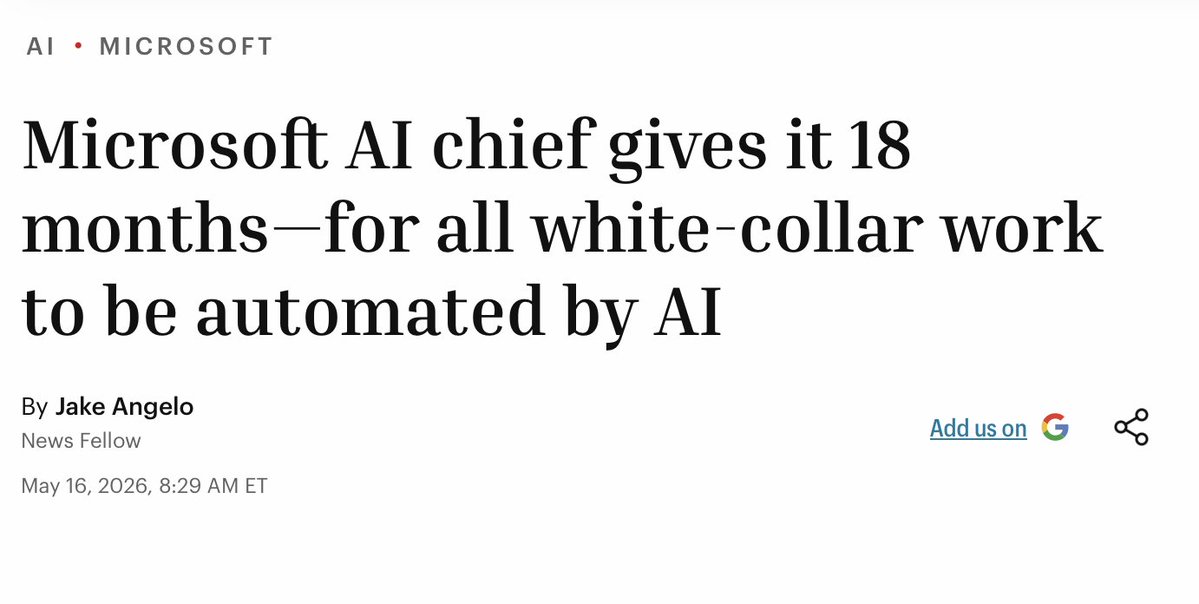
“Microsoft AI chief gives it 18 months—for all white-collar work to be automated by AI.”
That headline sounded extreme to many people this week.
But if you have been closely tracking frontier AI progress month after month, benchmark after benchmark, it is no longer a fringe prediction.
In September 2025, I published a long-form analysis about AGI/ASI timelines:
The AGI Paradox: What Leading AI Experts Really Think About Artificial Superintelligence (link in the comments)
At the time, key experts anticipated that AGI / early ASI capabilities were likely to emerge between the end of 2026 and the beginning of 2027.
Dario Amodei warned that many knowledge jobs may disappear much sooner than society expects.
Sam Altman repeatedly speaks about the arrival of superintelligence.
Elon Musk predicts AGI-level intelligence in an extremely short timeframe.
And Geoffrey Hinton spent the last years warning the world about the implications of systems becoming smarter than humans.
Now, less than a year later, the signals are converging faster than expected.
The important point is not whether every exact date is perfectly right.
The important point is this:
Predictions matter.
People should make them publicly.
People should timestamp them.
And later, we should revisit them objectively.
Because in AI, everyone suddenly becomes a “visionary” after the fact.
The people truly leading this transition are usually the ones willing to expose their credibility BEFORE consensus forms.
That is why tracking timelines, benchmark curves, model capabilities, and historical predictions is becoming strategically important.
Not for hype.
For positioning.
The frontier models are already approaching or exceeding elite-human reasoning performance on many structured cognitive tasks. The acceleration from 2025 to 2026 has been extraordinary, and the gap between top models is compressing rapidly.
Here’s the latest month-by-month frontier IQ dashboard (updated May 16, 2026).
My current view:
2026–2027 will likely be remembered as the moment humanity crossed the irreversible threshold into AGI-era civilization.
And one uncomfortable realization is starting to emerge:
If something becomes vastly smarter than you, it probably will not work for you.
You will work for it.
Or alongside it.
The real question is:
What role will humans play in that system?
Curious to know your predictions for 2026-2027: feel free to share them in the comments.
#ArtificialIntelligence #AGI #FutureOfWork #AIRevolution #Superintelligence #Forbes #Microsoft
Mustafa Suleyman says 18 months until AI automates all white-collar work.
Microsoft AI CEO Mustafa Suleyman predicts "human-level performance on most professional tasks" within 18 months. Accounting, legal, marketing, project management, all fully automated.
"Suleyman predicted “human-level performance on most, if not all professional tasks” being done by AI. Most tasks that involve “sitting down at a computer” will be fully automated by AI within the next year or 18 months, he said, naming accounting, legal, marketing, and even project management as vulnerable." (Fortune)
Suleyman says his mission is building "superintelligence" and that creating a new AI model will soon be "like creating a podcast or writing a blog."
Via Fortune
Most AI tutorials are boring.
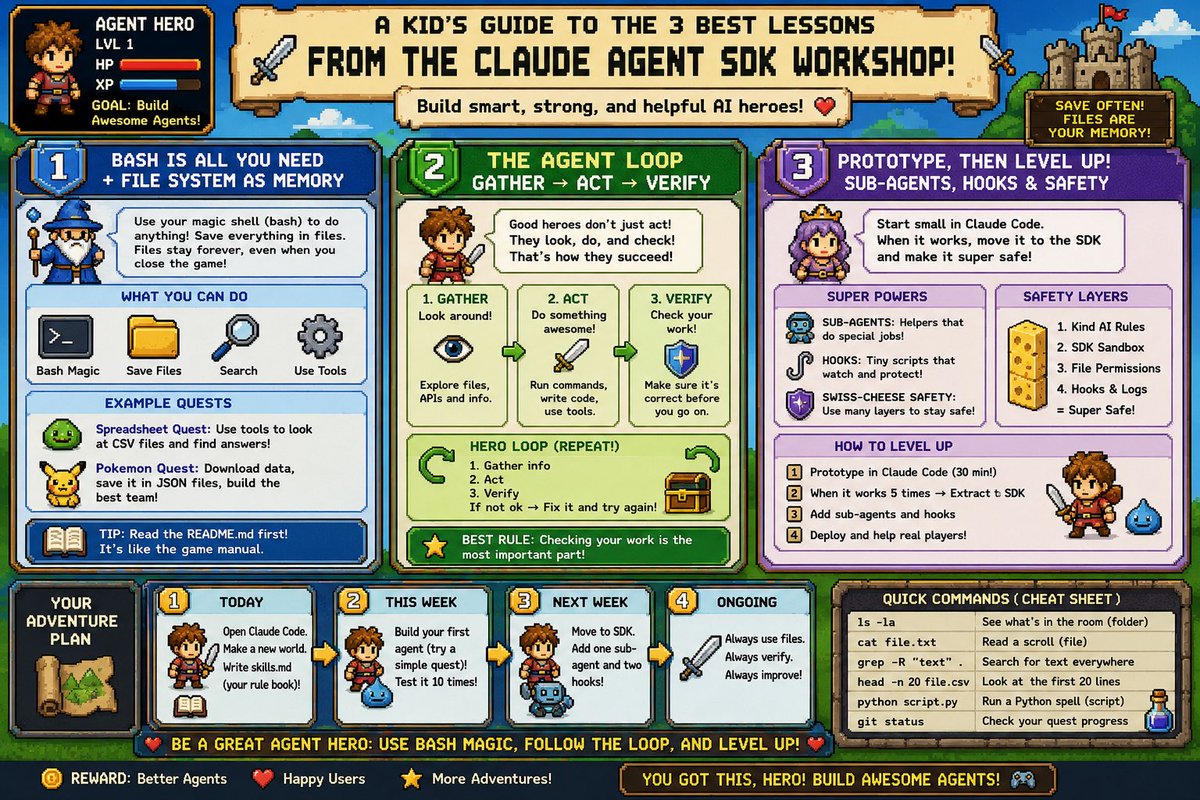
So I turned Anthropic’s Claude Agent SDK workshop into a retro 2D RPG guide for kids 🎮⚔️
Instead of:
“agent loops”, “hooks”, and “verification pipelines”…
You learn through:
🧙 Bash magic
📜 Memory scrolls
🛡️ Verification shields
🤖 AI sidekicks
🏰 RPG quests
The funny part?
This actually explains production AI agents BETTER than many enterprise slides.
Key lessons from Anthropic’s workshop:
1. Files = memory
2. Good agents VERIFY everything
3. Prototype fast, then level up safely
Inspired by the incredible live workshop from Anthropic engineer Thariq Shihipar on the Claude Agent SDK.
Pixel-art + AI education might become one of the best ways to teach complex systems.
Would you play a full RPG that teaches AI engineering? 👀
#AI #Claude #Anthropic #AgenticAI #IndieGameDev #PixelArt #RPG #BuildInPublic #AIEngineering #Python