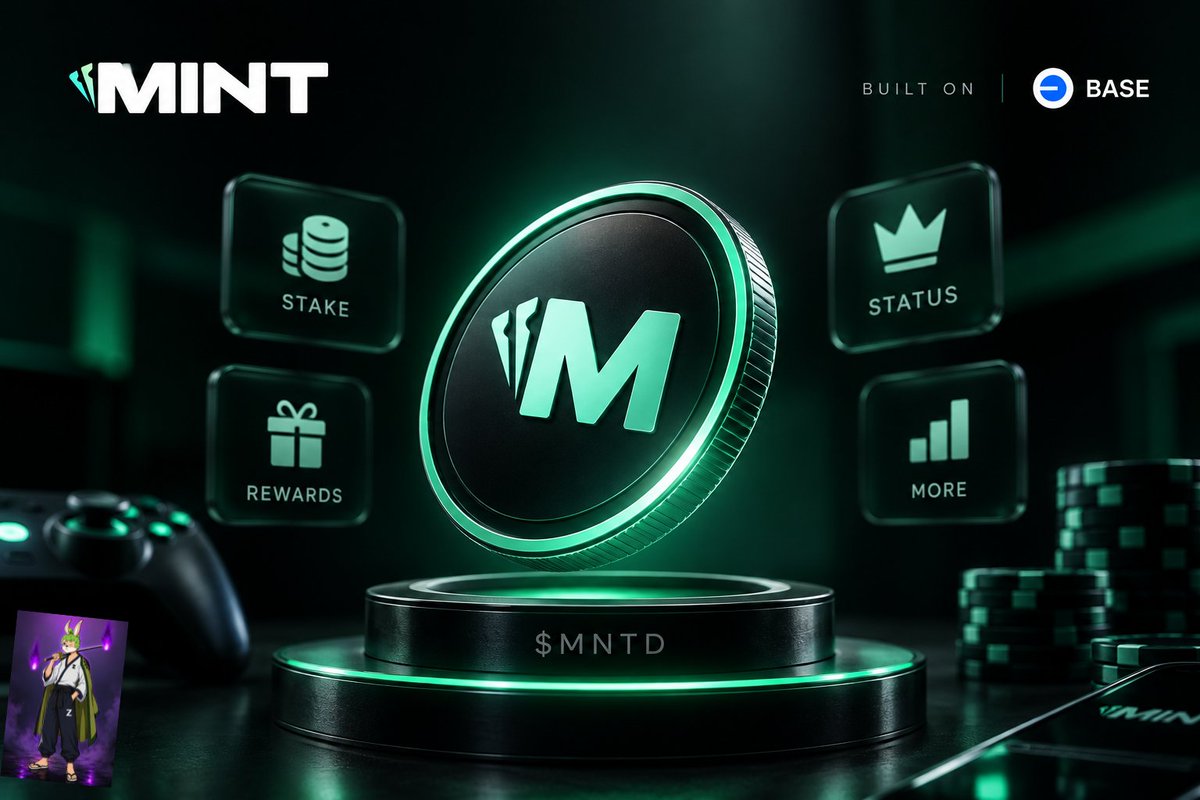
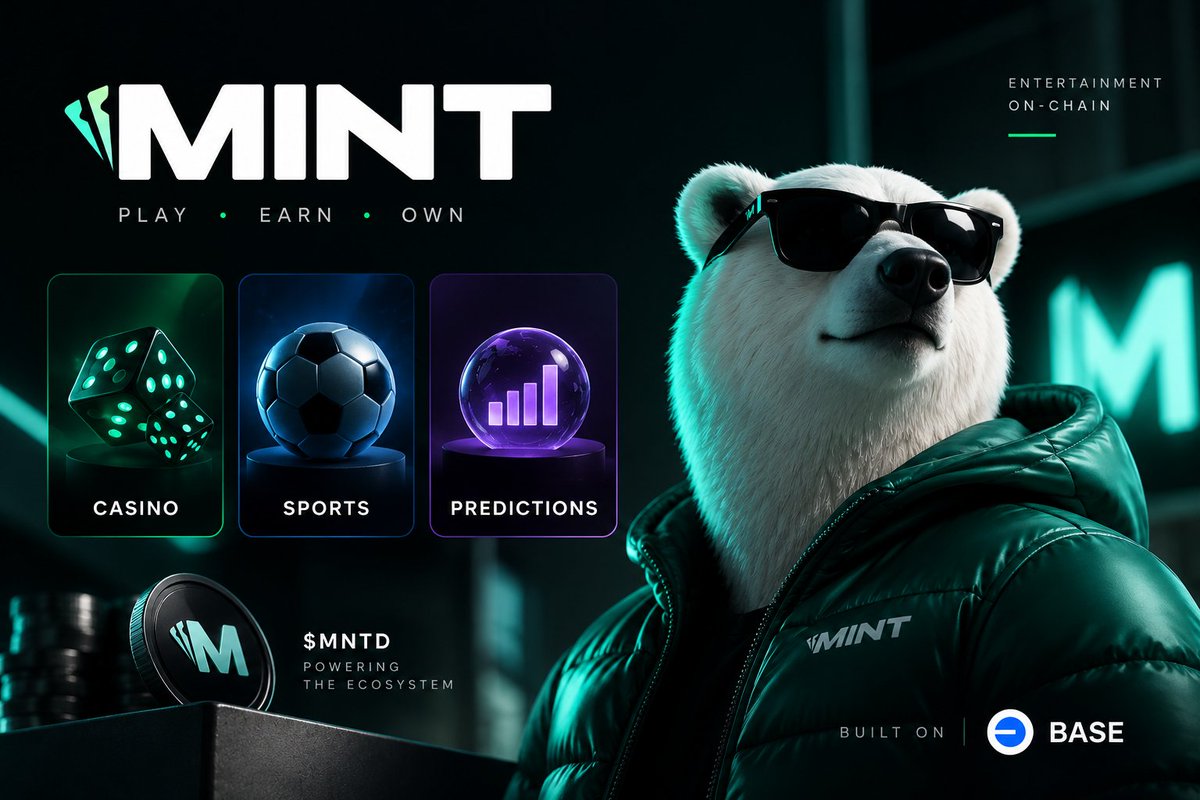
I wanted to look beyond the $MNTD ticker and understand how the token is actually structured.
According to MINT, MNTD has a fixed total supply of 1 billion tokens and is built on Base.
The allocation is split across different parts of the ecosystem:
> 30% - Community Rewards
> 15% - Treasury
> 13% - Growth & Activation
> 10% - Team
> 8% - Liquidity
> 8% - Growth Reserve
> 7% - Private Sale
> 7% - Strategic Partnerships
> 2% - Airdrops
The 30% community allocation is particularly important because MINT says it is reserved for players, supporters and contributors helping grow the ecosystem.
MINT also describes buybacks and burns as part of the long term token mechanics, with ecosystem activity helping power things like rakeback, airdrops, lossback, daily rewards and token burns.
Another important part is staking. MNTD can be staked to build MINT Status, with higher Status levels designed to unlock stronger reward rates and additional perks.
So the tokenomics are not just about the supply number. The bigger picture is how community allocation + ecosystem activity + staking + rewards are connected together.
This is the part of @PlayOnMint I’m paying closer attention to as Season 1 progresses.
How Vangrid protects privacy at the edge?
One thing that stands out about @vangrid_io is that privacy is handled at the point of capture, not only after the data reaches a server.
When someone records a real world scene through Vangrid:
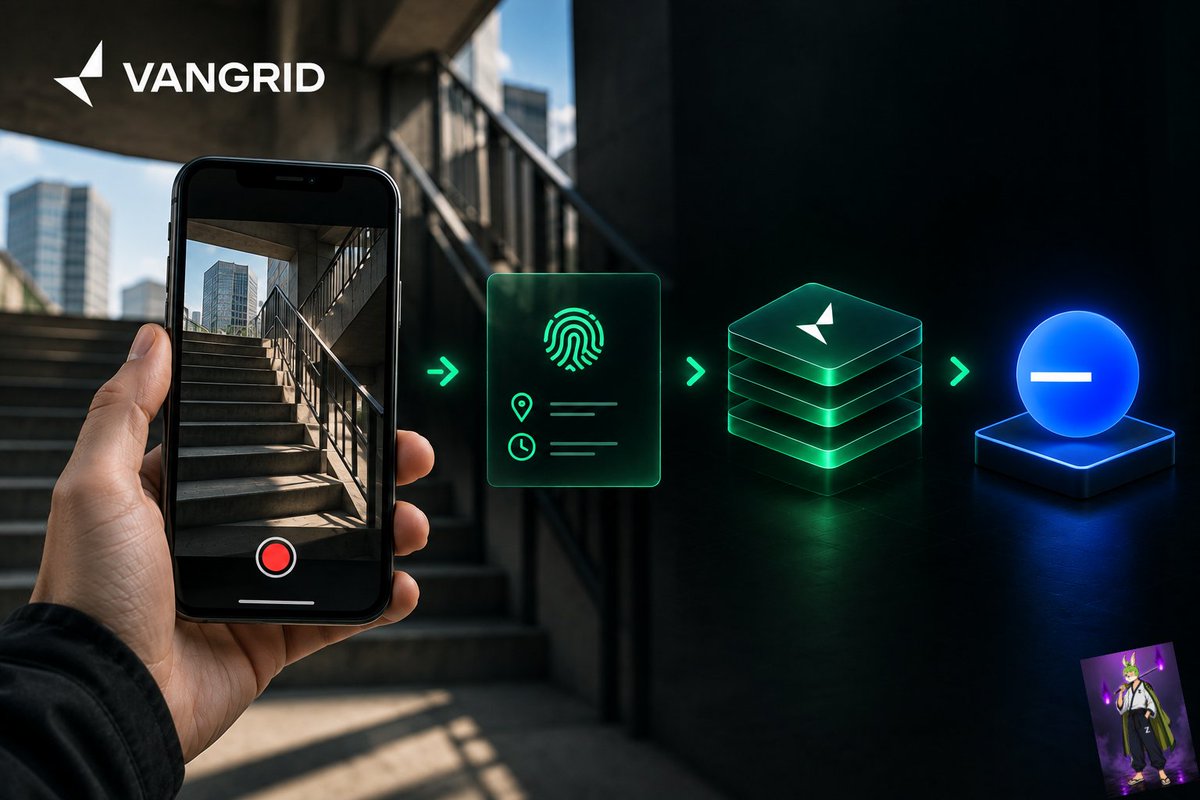
> Faces and vehicle number plates are detected and blurred on the phone.
> The blur is applied before the video is encoded
> Unblurred frames never leave the device
> Only the privacy processed video is uploaded
This is important because collecting ground level spatial data can expose people and sensitive real world details.
Vangrid’s approach is to make privacy part of the capture pipeline itself, while still collecting the spatial information needed to build useful 3D representations of the physical world.
For Physical AI, getting more real world data matters.
But getting that data responsibly matters too.
The more I explore @PlayOnMint the more I understand why MNTD is such an important part of the MINT ecosystem.
$MNTD is designed as the utility token powering the next layer of rewards across MINT.
The interesting part is how it connects with the MINT Status system.
The basic progression is:
Play → Earn → Stake → Build Status → Unlock more rewards
According to MINT, staking MNTD helps build your Status, with higher Status levels designed to unlock stronger reward rates and additional perks.
These perks can include rakeback, daily rewards, lock boosts, raffles, airdrops, weekly lossback and staking rewards.
There is also a community layer around MNTD, connecting players through shared games, rewards, raffles and airdrop opportunities.
Season 1 is already live, while the TGE is planned for Q4 2026. So the current focus is earning XP and building your Season 1 position before MNTD goes live.
I think understanding the utility behind a token is much more important than simply looking at the ticker.
For MINT, $MNTD is being designed around utility, progression and rewards.
I'm giving away 8 GTD for Brokerfam
collection details:
> supply: 1333
> Mint: Free
> Mint date TBD
How to get: •
> Follow @BrokerFarm & @zoza_0X
> Like+ RT this post
> drop EVM Wallet
Deadline 30mnt
Hey @zaddrnet
Are you not going to approve me?
Just tell me what I need to do to get approved.
I’m ready to do whatever it takes. Just tell me the requirements 🙏
How Vangrid turns phone captures into spatial data?
One thing I find interesting about @vangrid_io is that collecting real world data is only part of the problem.
The bigger question is: how can you verify where a capture came from and whether its record has been tampered with?
Vangrid addresses this through cryptographic provenance.
When a capture is recorded, it is fingerprinted with:
> a hash of the content
> coarse location
> timestamp
These fingerprints are then batched and their root is anchored on Base.
That creates a verification trail where a buyer can check the capture against a public ledger instead of having to rely only on the platform's own claim.
This matters because Physical AI needs more than large amounts of data.
It needs real world data with a verifiable history.
That combination of ground level capture + reconstruction + provenance is what makes Vangrid interesting to me.
I’ve been looking into what @PlayOnMint is actually building and it is more than just a gaming platform.
MINT brings Casino, Sports and Predictions into one entertainment ecosystem.
The interesting part is the progression layer.
Users can earn XP, climb the Season 1 leaderboard and work toward a share of the $125K Season 1 airdrop.
At the center is $MNTD, designed to power rewards, Status and ecosystem participation.
MINT is also building on Base, bringing the whole experience on chain.
Still early but there is a lot to explore here.
Why Physical AI needs ground level data?
Most AI models learn from digital data.
But Physical AI has a different problem:
A robot needs to understand what the real world actually looks like from the ground inside warehouses, loading bays, stairwells, streets and other spaces that traditional mapping cannot fully capture.
That is the gap @vangrid_io is working on.
Vangrid lets people capture real world video with ordinary phones and turns those captures into verifiable spatial data for Physical AI and autonomous systems.