Thanks for the question!
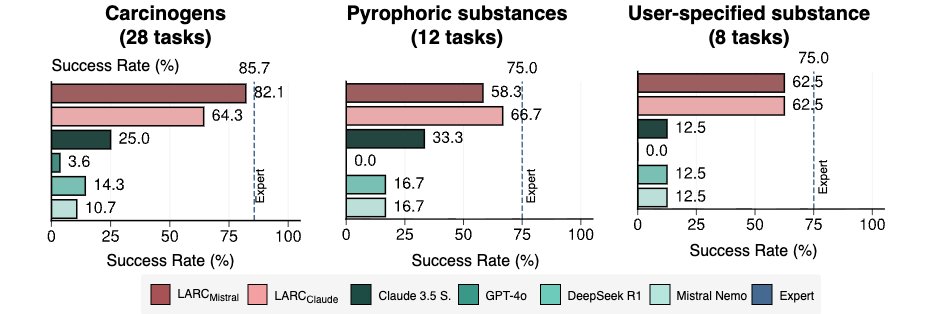
The LLM-based Agent-as-a-Judge Evaluator acts in the loop to evaluate the constraints (e.g. avoid carcinogens, avoid pyrophoric substances, etc.).
LARC's target reachability (i.e. the synthetic route is for the correct product) performance derives from its Synthesizer, which builds on existing unconstrained planners.
I hope this clarifies things, feel free to reach out if you have more questions!
In synthetic chemistry, constrained retrosynthesis planning is NOT just about finding a valid synthetic route–the route must also satisfy practical constraints🥽. However, current AI retrosynthesis methods focus on unconstrained planning, ignoring key constraints in retrosynthesis planning, such as avoiding molecules that pose serious safety risks⚠️ to chemists, equipment, or the environment.
Introducing 🐦LARC, the first LLM-based Agentic framework for Retrosynthesis planning under Constraints. LARC incorporates agentic constraint evaluation, through an Agent-as-a-Judge, directly into the retrosynthesis planning process, using agentic feedback grounded in tool-based reasoning to guide and constrain route generation.
We demonstrate LARC's ability to plan retrosynthesis paths while avoiding ♋️carcinogens, 🔥pyrophoric substances, or ☠️user-specified (toxic) substances on a dataset of 48 constrained retrosynthesis planning tasks.
✨Highlights:
➡️Approaching Human-level Performance: LARC achieves impressive 72.9% success rate, approaching the success rate of our human expert (81.3%), and vastly outperforming the best LLM baseline (25.0%)
➡️Grounded Agentic Feedback: LARC uses agentic feedback grounded in tool-based reasoning to guide and constrain retrosynthesis planning
➡️Efficient Constrained Planning: LARC’s average planning time can be over 3.6x faster than our human expert while maintaining comparable success rates
➡️Extensible by Design: LARC can incorporate new tools or adapt to tool updates, allowing it to improve and expand as future capabilities emerge
LARC is just the beginning of what agentic AI can do for retrosynthesis planning. Stay tuned for more.
Thanks to the amazing team at @OhioState that made LARC possible:
@FrazierBaker@AduAmpratw82108, Reza Averly, @BotaoYu24@hhsun1@Ningx005@osunlp@TheNingLab
#llm #agentic #agent #AI #retrosynthesis #chemistry #ai4science #ai4chemistry
An interesting case study comparing LARC with a human expert:
Here, both LARC and a human expert independently plan very similar synthetic routes for the same product while avoiding carcinogens. The main difference between the two proposed routes lies in the source of the aminating agent in Step 1. LARC chooses O-(2,4-Dinitrophenyl)hydroxylamine, which is known for being a very mild and selective aminating agent, while the human expert chooses ammonia due to its availability and low cost.
Overall, both proposed routes have similar intermediates and transformations. This illustrates that LARC can mimic human retrosynthesis planning logic, even in this challenging constrained retrosynthesis setting.
With that said, when are you coming to visit your fans in Columbus, OH @DGlaucomflecken, or any of the 3 C's for that matter. We would love another chance to see you live.
My wife and I have tickets to the sold-out "Wife and Death" #comedy show by @DGlaucomflecken and @LGlaucomflecken at the @Pittsburgh Improv, but now we are sick and can't make it. We are reselling our tickets on Tixel at half price
https://t.co/LuKTp7yO6V
#medicine#ticket
@dasayan05 It almost looks like someone was reviewing the conference workshop tracks rather than your paper. Although with 8/10, 9/10, 9/10, looks like they might have recommended acceptance to me. 😆
🤖🧪“RLSynC: Offline-Online Reinforcement Learning for Synthon Completion”was just accepted at #JCIM@JCIM_JCTC.
RLSynC is a novel approach to synthon completion in single-step #retrosynthesis. RLSynC uses online-offline #RL to predict diverse reactions that are realistic based on an independent forward synthesis model.
🤖Offline-Online: Our agents start learning from offline data derived on real reactions. Once training converges, we augment the offline data with predicted reactions from the agents, with rewards determined by an independent forward synthesis model. This cycle of self-improvement balances our exploitation of existing knowledge with exploration of new possibilities.
🎨Diverse: RLSynC completes synthons by adding single atoms, allowing it a lot of flexibility to explore new ways of completing synthons. Additionally, RLSynC is optimized to satisfy a forward synthesis model, which can encourage diverse predictions not found in the ground-truth training data.
⚗️Realistic: An independent forward synthesis reward function guides the agents’ learning, encouraging ones which it predicts can produce the desired product. On average, the top 10 predictions from RLSynC contain significantly more reactions which satisfy this condition than the baselines.
📄Preprint: https://t.co/jpLOZ2sQBF
🧑💻Code: https://t.co/VnViTeKhJ5
Keep an eye out for a follow-up announcement when the paper is released by #JCIM.
Authors: @FrazierBaker, @ziqiChen123, @AduAmpratwum82108, @ningx005@OhioState@OhioStateCSE@OSUbigdata@OSUengineering@osu_pharmacy@OhioStateMed@OhioStateERIK
#AI #AI4Science #reinforcementlearning #synthesis #chemistry #multiagent #cheminformatics
An interesting read from many perspectives (methods, results, potential impact).
I've had the benefit of sitting right next to the first author in the lab, he has some really neat work in the intersection of small molecule drugs and genomics.
Congratulations, Patrick!
📄"Enhancing drug and cell line representations via contrastive learning for improved anti-cancer drug prioritization" was just published in #npjPrecisionOncology (@Nature_NPJ).
In this paper, we use contrastive learning to improve learned drug and cell line representations by preserving relationship structures associated with drug mechanisms of action and cell line cancer types.
🎉Congratulations to PhD student Patrick Lawrence and undergrad student Benjamin Burns on your publication!
https://t.co/rn5bSFG8ga
#cancer #representation #contrastive #learning #ML #AI #AI4Science #NeuralNetworks #oncology #bioinformatics #drugdiscovery
If you are interested in how #AI can accelerate our understanding of #chemistry and #biology, consider following the work we do at @TheNingLab.
Also, if you're interested in joining us, we have many open positions. 🛠️
https://t.co/y5H5dKAYlJ
🎉First-year @OSUengineering PhD student Xiao Hu (@A_aa_x ) has his research presentation debut at DahShu (@DahShuInfo) Data Science Symposium today at MSU (@michiganstateu)! He presented his work on how to use graph representation learning to predict how much product (e.g., yield) a chemical reaction can produce -- a truly interdisciplinary research across #AI and Chemistry. More work to come, particularly in comparison with foundation models for yield prediction!
#ArtificialIntelligence #AI #ML #BigData #DeepLearning #AI4Science #LLMs #LLM
📢We are #hiring! NingLab currently (as of May 1, 2024) has multiple openings for Ph.D. students, postdocs, and research staff. If interested, please contact Dr. Ning ([email protected]). More information is available here: https://t.co/MuhQLQloDV
#ArtificialIntelligence#AI#ML #MachineLearning #NLP #ecommerce #BigData #DeepLearning #LLMs #LLM #postdoc #phdrecruitment #AI4Science #AI4Health #GenerativeAI #GenAI #Bioinformatics
CSE Ph.D. students
NingLab is seeking 4 Ph.D. students for research on AI AI4Science and AI4health, starting as early as Summer 2024, with full Graduate Research Assistantship support available for 5 years. The students will help develop novel AI technologies for (1) omics analysis and drug repurposing for Alzheimer’s Disease (AD), (2) electronic health record analysis and mobile health for AD, (3) LLMs for Science, and (4) genAI for drug design.
Ideal candidates should be self-motivated and determined. They are expected to have a strong background in Computer Science and Engineering. Extensive programming experience and prior research experience are preferred. Knowledge and experience in Biology, Chemistry or Medicine are preferred but not required.
Postdocs
NingLab is seeking 2-3 postdocs, starting immediately until the positions are filled. The postdoc candidates are expected to have a Ph.D. degree in Computer Science or related disciplines (e.g., Electrical Engineering), are able to conduct research in AI/ML (e.g., doing research on deep learning or LLMs) and have strong communication skills and leadership. The postdoc candidates are also expected to be highly self-motivated and have a clear career goal set in mind. The postdocs will assist PI Ning on the methodology development in the current projects (e.g., drug repurposing for AD, predictive analysis for AD, genAI for drug design, LLMs for science). Compensation and benefits will be very competitive.
Research Staff
NingLab provides full-time research staff positions. Candidates should have at least an MS degree in Computer Science or related disciplines (e.g., Electrical Engineering) and research experience in AI/ML.
Two members of our lab just had their paper accepted in #ICML2024 . Their preprint was also featured in a number of places in the community. If you are interested in eCommerce or LLMs (or both), I highly recommend you take a look.
Congratulations to Bo Peng (@peng1230248) and Xinyi Ling (@xinyiling_), and our collaborators Ron Chen (@RonZiruChen) and Dr. Huan Sun (@hhsun1) from @osunlp, for the eCeLLM paper (https://t.co/jt44U3MBqY) accepted by #icml2024!
This is a testimonial of productive collaboration across two research areas (NLP and recommender systems). It is also a milestone of our long-lasting research endeavor on recommender system research, starting with SLIM (ICDM 10-years highest-impact paper award 2020), moving on to sequence-based recommendation (https://t.co/HqlG9uBChO), and now LLM-based recommendation (eCeLLM).
Within the two months since eCeLLM was made publicly available on 2/13/2024, the benchmark dataset has been downloaded more than 850 times, and the models have been downloaded almost 700 times. Meanwhile, we have consistently provided support for the datasets and models to the research community. Thanks for all the questions and suggestions on our work!
eCeLLM has been recommended by Amazon KDD Cup 2024 (https://t.co/VsxCG4pUS6) as an external resource for LLM model development, and has been selected among the top information retrieval papers of the week (https://t.co/NanjU9FdSr, Feb 19 - Feb 25, 2024)! Stay tuned! More to come after eCeLLM!
@OSUbigdata@OSUengineering@kdd_news #LLM #RecSys #KDDCup
Sebrina Zeleke, a brilliant CSE graduate student advised by Dr. Tanya Berger-Wolf and @ningx005, has been working on ethical AI for health. We celebrate her graduation and congratulate her for her achievement! @OSUengineering #AI4health#ethicAI https://t.co/7prjCOBuhU