Dear Christopher Nolan,
My name is Herod Priovolos and I want to tell you what #TheOdyssey truly means to me and to generations of Greeks who grew up with Homer’s story.
Homer did not sing of Odysseus simply to entertain us with ships, storms, gods and monsters. He told the story because he understood what war, time, distance and loss can do to the human soul.
Odysseus leaves Ithaca as a king, a husband and a father. He returns twenty years later alone, exhausted and disguised as a beggar, carrying the memory of every companion who never made it home.
The monsters are not merely creatures created for spectacle.
The Cyclops is power without justice. The Sirens are the beautiful voices that tempt a person to abandon their purpose. Circe represents the danger of losing our humanity. Calypso offers Odysseus immortality, but even eternal life becomes a prison when the price is forgetting his wife, his son, his homeland and his own identity.
And Ithaca is not merely an island.
Ithaca is the place that remembers you when the world no longer recognizes your face. It is the home that remains alive inside you after everything else has been taken away. It is Penelope growing older while she waits. It is Telemachus becoming a man without his father. It is Argos surviving long enough to recognize his master one final time.
Odysseus is not great simply because he defeats monsters. He is great because he is proud, frightened, wounded, clever, imperfect and deeply human. He loses his companions, his youth, his name and twenty years of his life, yet he refuses to forget who he is.
When he finally returns, Penelope does not recognize him through strength, glory or appearance. She tests him. Odysseus proves his identity by remembering the bed they built together around the roots of a living olive tree.
That is the heart of The Odyssey.
Not the battles. Not the ships. Not the monsters.
Two people standing before each other after twenty years, asking whether love, memory and identity can survive everything time has done to them.
That is why this poem has survived for almost 3,000 years. Every human being is trying to return to something: a home, a person, a lost part of themselves, or the life they had before the world changed them.
So use Homer’s seas, gods, heroes and monsters. But please understand what you are touching.
The Odyssey was never truly about how far a man could travel.
It was about how much the world could take from him before he stopped being himself, and whether, after losing almost everything, he could still find his way home.
For the record.
Kevin Warsh’s Quiet Regime Change at the Fed
Kevin Warsh is not a hawk. He is a pro-growth monetary reformer who wants to restore price stability, reject mission creep, and rebuild a constitutional central bank that uses modern data instead of stale models, Phillips curves, and Keynesian reflexes. Yes, Wall St consensus is wrong again.
Like Scott Bessent, Warsh understands that the Fed’s deepest problem is institutional sprawl. A central bank meant to preserve monetary stability has drifted into credit allocation, financial repression, and de facto debt management. His answer is to narrow the remit, shrink the balance sheet, and scrape away the layers of forward-guidance theater that turned FOMC language into a third policy instrument. The implicit logic of a smaller, quieter Fed balance sheet is more private credit creation, capital formation moves back into markets rather than remaining warehoused on a taxpayer-backed public portfolio.
Warsh also rejects the old Phillips curve intuition that strong growth and tight labor markets are inherently inflationary threats. He is not anti-growth, he is anti-fiscal dominance. In his framework, inflation comes from policy error, too much monetary accommodation for too much fiscal excess, not from prosperity itself. That is why he can be pro-AI, pro-crypto, and broadly supply-side at the same time. He sees productivity growth, technological innovation, and new forms of private capital formation as disinflationary forces when the nominal anchor is credible.
Just as important, Warsh appears to grasp the constitutional arrangement. The Fed is not supposed to moonlight as an all-purpose technocratic state. It is supposed to preserve the currency, provide monetary order, and leave the rest to elected officials and private markets. That requires price stability first, but it also requires better inputs, more modern data, more market signals, less faith in lagging aggregates and broken academic priors.
This is not hawkishness. It is a bid to replace an antiquated Keynesian institution that has come to act as if it were above the constitution with a narrower, pro-growth, market-facing Fed that stabilizes money, scraps pseudo-scientific forward guidance, and gets out of the way.
@MrNeverSell Keeping the rates for Open customers only is certainly key. Everything is relative so whatever the rate scenario they will have a very competitive answer. Marketing Dream…I remain bullish since Kaz came in due to his actions. Thanks for your thoughts.
Stop Looking for Financial Advice — Find Your Own Conviction or Quit the Market Now!
Everyone needs to find their own conviction stocks. I have shared mine more than 100 times on X, but let me be very clear: I never have and never will give financial advice to anyone. This is a multi-million-dollar question with no easy answers. I am one of the very rare people here who actually tells the truth, while many are just marketing geniuses and scammers.
The right approach is simple: pick a few high-quality stocks, buy them aggressively during discounts, and tune out the noise from permabears and misleading voices. If you’re not prepared to hold strong companies for years, my honest advice is this — exit the market now, enjoy your life, and buy a good house for your family.
Don’t fall for the illusion that anyone online can retire you or recover your losses. Most of what you see is just marketing and scams. Save your capital and focus on what truly matters: your family and your peace of mind!
Elon Musk was once asked in a private dinner what he would do if SpaceX and Tesla both failed completely and he lost everything.
The people at the table expected him to say he'd start over. Or that failure wasn't an option. Or some variation of billionaire confidence.
Instead he went quiet for a long time. Then he said something that nobody at that dinner has forgotten. He said he'd probably become a physics teacher. Not to be humble. Because he said the only thing that has ever consistently made him feel calm is explaining how the universe works to someone who wants to understand.
Rockets, cars, tunnels, neural interfaces. All of it is just applied physics to him. The companies aren't the thing. The physics is the thing. The companies are just the most efficient way he's found to do physics at a scale that actually matters.
Most people chase the outcome. The money, the company, the title. Elon chases the mechanism. How it works. Why it works. How to make it work better. The billions are a byproduct of that obsession, not the object of it.
That's why he can't stop. It was never about the money. You can get enough money. You can never get enough understanding.
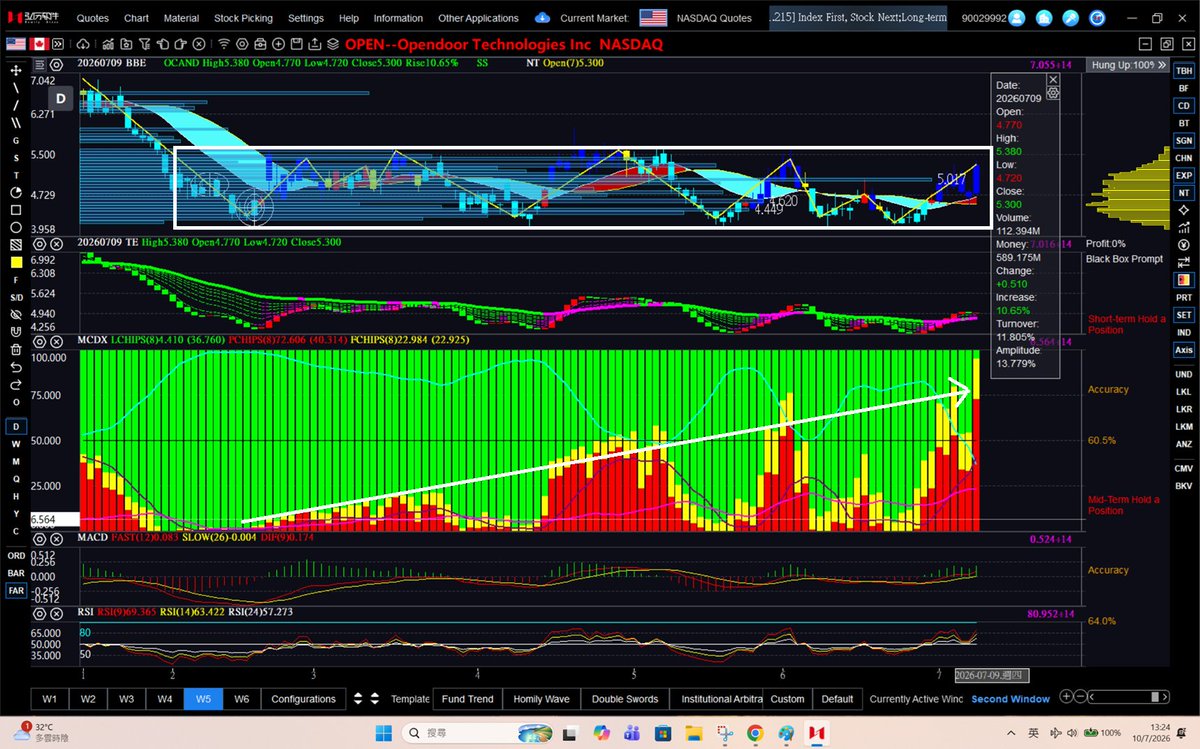
$OPEN Whale accumulation increasing and a new red ribbon unfolding…thank you @dannycheng2022
OPEN under new management with the third quarter of results coming up…
$OPEN (July 10, 2026-daily chart)
OPEN has been trading inside the white consolidation box for months. Could the latest bullish red ribbon finally give us a ray of hope?
$SRXH NAV approximately $3.07 with merger completed…
SRX Global Management Team to Host Virtual Fireside Chat on July 14, 2026, and Issues Letter to Shareholders :: SRX Global Inc. (SRXH) https://t.co/lOUG7INGnT
$envx
A good point buried in the PR announcing the new COO. This is the first PO for glasses batteries!
Enovix said today:
“Production of Enovix’s silicon-anode battery for smart eyewear is underway following receipt of its first commercial production order of approximately 50,000 units”
Less than 2 months ago Enovix reported:
“ In smart eyewear, Enovix has begun initial shipments and expects to ramp manufacturing in the third quarter to support a leading smart eyewear reference platform. We expect to produce approximately 50,000 units in 2026 and increase into 2027 as downstream deployments expand.”
Raj later clarified that these downstream deployments should be in the millions.
“It should be in the millions next year. We have sampled to many different customers”.
So “should” can now presumably be replaced with “will”.
$ENVX Very interesting…
Enovix Appoints Former Apple Operations Leader Michael Vyvoda as Chief Operating Officer to Lead Global Manufacturing Ramp | Enovix https://t.co/f7RlMAmlBX
Wow! This is a much watch of Alex Karp.
His comments on LLMs and frontier models resonates
As does “there are three tech centers I the world: The USA, china and Israel.
Watch till the end
Palantir's CEO just exposed Sam Altman and Dario Amodei for robbing every Fortune 500 company.
Within two minutes, Alex Karp took the entire frontier AI industry apart on national television.
His exact words:
"Every single enterprise in this country, these people are LIVID. They are paying for tokens that create no value. These people are stealing the weights and alpha of my business."
He literally said the entire frontier AI business model is intellectual property extraction dressed up as a subscription.
Then he also destroyed the pricing model with a single question that Silicon Valley still refuses to answer:
"If it was so valuable, let's say I can make you $1 billion tomorrow. Wouldn't I say I'll make you $1 billion and I want 30 percent? Why are they charging for tokens if it's so valuable?"
That question breaks the industry.
If OpenAI and Anthropic's models truly delivered the productivity gains the labs claim, they would take equity or a share of the profit they generate. They would not sell access by the million tokens.
Token pricing is itself the CONFESSION that the product cannot produce reliable value at scale. If it did, they would price for the value. But they price for the compute because that is what they are actually selling.
Karp went even further...
He called the entire arrangement "a wealth tax that does not help the poor. It just punishes."
American businesses are transferring the alpha of their operations, meaning the workflows, the customer data, the strategy memos, the internal models that make them competitive, directly into the training pipelines of a handful of Silicon Valley labs. Once those labs retrain, the customer's own edge becomes the next enterprise product sold back to their competitors.
And the part the AI industry does not want anyone thinking about:
Every enterprise running its confidential documents, its customer conversations, and its financial models through a frontier model is potentially teaching that model HOW to replace them.
The vendor collects the token fee AND the compounding intelligence about that customer's business. That is the mechanism. And that is why Karp used the word "stealing."
He claims this is why every executive he meets is furious in private and silent in public. Nobody wants to be the CEO who called out the labs and then discovered their next competitor was built on their own leaked workflows.
The entire AI industry has been priced for perfection on one assumption:
That frontier labs produce durable, defensible value that justifies infinite compute spend.
But Karp just told us that the customers do not believe that assumption anymore. They believe they are being taxed without benefit, watched without consent, and copied without recourse.
The moment enterprises stop believing, the whole valuation stack shakes.
"If all else fails, I will retreat up the valley of Virginia, plant my flag on the Blue Ridge, rally around the Scotch-Irish of that region and make my last stand for liberty amongst a people who will never submit to tyranny whilst there is a man left to draw a trigger." -GW
$OPEN What I find interesting about Opendoor isn’t that they’re cutting costs.
It’s where they’re choosing to spend.
Over the last year, they’ve reduced spending on sales, marketing, and operations while increasing investment in engineering, data science, and pricing models.
To me, that signals a shift in mindset.
Instead of trying to grow through more advertising or more employees, they’re trying to build a smarter system.
Think about it like this:
If Opendoor can price homes more accurately than competitors, even by a small amount, that advantage compounds across thousands of transactions. Better pricing means buying homes at the right price, managing risk better, and ultimately improving margins.
What’s also notable is the talent they’re bringing in. People from quantitative finance and advanced modeling backgrounds don’t join a company to maintain the status quo. They’re there to solve complex pricing and risk problems.
The market still tends to view Opendoor as a company that buys and sells houses.
Management seems to be building a company that uses technology and data to make better housing decisions than everyone else.
Whether that strategy works remains to be seen.
But the shift from an operations-heavy business to a technology-driven business is one of the more interesting parts of the Opendoor story today.