We need to acknowledge that most people prescribed SSRIs for depression and anxiety are so prescribed due to expedience and not because it’s the correct treatment. The correct mental health treatment (therapy) will reduce depression and anxiety before SSRI’s have time to begin ‘working’. No side effects, no billions to big pharma, no never-ending cycle of ‘treatment’ which leaves two thirds of patients with no improvement yet the treatment continues.
Theo Von reveals he was put on antidepressants after “a tough day at school” and has NEVER been able to get off them since.
THEO: “That shit makes you feel dead, man.”
ROGAN: “So why did you take them in the first place?”
THEO: “Cause I was in a bad relationship 20 years ago, and I was having a tough day at school, and they f*cking gave them to me, and then I never got off.”
Theo’s experience is not uncommon.
A 2019 meta-analysis revealed that 56% of people experience withdrawal symptoms when trying to quit antidepressants.
Of those who experienced withdrawal symptoms, nearly half (46%) described them as “severe.”
Psychiatry promised to solve the mental health crisis. Instead it created one.
More ADHD diagnoses, more prescriptions, more "awareness" — and more suffering than ever recorded.
When the solution consistently makes the problem worse, it's not a solution. It's the business model.
What would it take for you to question the system treating you?
AWAKEN.
@DrRyanSultan
Drs see drugs as the solution because of their training. This is especially true for spiritual issues such as loss, depression, anxiety, trauma, etc. Drugs should be a last resort not a first. If you’re struggling, get in touch. Short therapy interventions are often all that’s needed.
Doctor: "Your LDL is still high. I'm adding a second statin."
Patient: "I'm already on one. My legs ache."
Doctor: "That's a known side effect. I'll add CoQ10."
Patient: "And I'm tired all the time."
Doctor: "Fatigue is common. I'll add modafinil."
Patient: "My memory is foggy."
Doctor: "Cognitive effects can occur. Donepezil should help."
Patient: "I have a cough now."
Doctor: "That'll be the ACE inhibitor I prescribed last visit. We'll swap it for an ARB."
Patient: "I'm not sleeping."
Doctor: "Zopiclone."
Patient: "Heard that's addictive."
Doctor: "We'll taper you with mirtazapine when the time comes."
Patient: "My blood sugar has gone up."
Doctor: "Statins can do that. Metformin."
Patient: "I get diarrhoea on metformin."
Doctor: "Loperamide."
Patient: "I've gained weight."
Doctor: "Ozempic."
Patient: "I feel nauseous."
Doctor: "Ondansetron."
Patient: "I don't want to be on twelve medications."
Doctor: "Anxiety is common at this stage. I'll add sertraline."
Patient: "What if I just stopped the statin?"
Doctor: "Absolutely not."
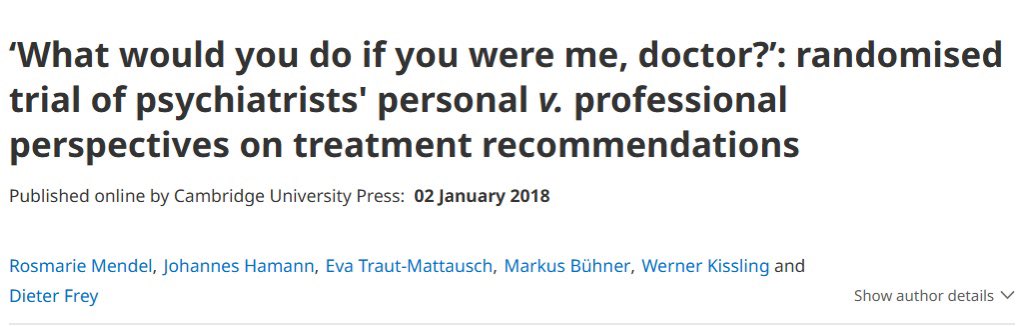
Did you know that 79% of psychiatrists would recommend immediate antidepressant treatment for an outpatient with depression, but only 39% they would take one themselves immediately in the same scenario?
No this is not a joke.
I've often seen has-been psychiatrists casually- almost boastfully- saying "Finding the right antidepressant is a trial and error process."
Do they even hear themselves?
Do they not realise what the ERROR part means for patients?
It means this:
The patient enters the mental health system at a hopeless point.
They're then subjected to a whole host of horrible start-up effects and drug switches (involving messy cross-tapers and withdrawals).
And as this happens the patient has to juggle more appointments, more scripts, more admin.
And if this 'trial and error' process— as psychiatry refers to it— doesn’t work (which is hardly surprising), there’s always more diagnoses and drug classes to try.
Has-been psychiatry also has the arrogance to say this an art and a science.
I say this trial and error process is neither. It's just error.
This is really important. Dr’s really believe the drugs they prescribe help their patients and are safe. They still believe in the chemical imbalance theory of depression and anxiety. This is the biggest medical malpractice story in our history. Just wait and see. All this when just a handful of good therapy sessions can restore mental health for most clients without drugs.
U.S. nursing homes are fabricating schizophrenia diagnoses to hide their use of dangerous antipsychotic drugs to subdue dementia patients, a government watchdog report found.
The drugs increase the risk of falls, strokes and death. https://t.co/6SkzWxZfSz
A new startup in Utah is using AI to prescribe SSRIs.
No psychiatrist. No exam. A chatbot, a questionnaire, a prescription.
Our current system already dishes these drugs out like candy. 15% of Americans on antidepressants. Suicide up 40%.
The answer is to automate it?
This is an abomination.
Exactly. There is almost no difference between antidepressants and placebo in randomised trials and the small difference that exists is easily explained by amplified placebo effects and possibly emotional blunting
Strawman argument. The psychiatric guild isn't being criticised for what it does in managing psychosis and mania, it's being criticised for the mass over-prescription of SSRIs and anti-anxiety meds for minor emotional issues best treated with a handful of sessions by a proven therapist.
“Criticizing psychiatry is the easy part. The harder question is who would actually take responsibility for managing psychosis, mania, suicidality, severe withdrawal, or agitation at scale.”
If antidepressants appear to 'work' it's mostly due to the placebo effect, exaggerated by confirmation bias, nudged by emotional blunting (which may or may not be experienced as desirable) & the natural course of one's distress simply improving over time. That's it.