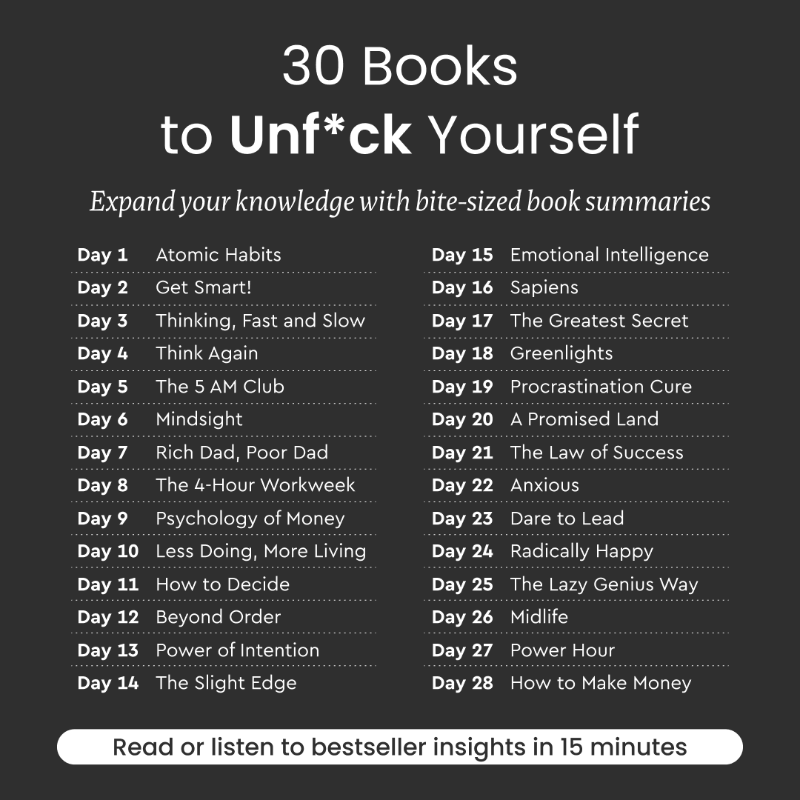
I DON'T UNDERSTAND WHY PEOPLE DON'T USE CHATGPT FOR SIDE HUSTLES.
Everyone's complaining about money while sitting on a goldmine.
ChatGPT can analyze markets, create products, and find customers for you.
Use these prompts to build a $5K/month income stream:
After 2 years of using ChatGPT, I can say that it is the best technology that has revolutionized my life the most, along with the Internet.
So here are 10 prompts that have transformed my day-to-day life and that could do the same for you in 2026:
I ACCIDENTALLY UNLOCKED "GOD MODE" IN CHATGPT,
AND IT STARTED TEACHING ME THINGS I DIDN'T KNEW EXISTED.
HERE ARE THOSE 7 CHATGPT PROMPTS THAT WILL CHANGE EVERYTHING FOR YOU:
These 9 questions broke me.
I cried. I raged.
I wanted to unhear them.
Because once you know the truth about what you actually want, you can't go back to pretending.
Here's the brutal reality:
⚠️ The Bitcoin cycle is testing us HARD right now...
We’ve heard it all:
Tether FUD
Saylor is selling?
OGs are giving up...
This is usually the time when people make dumb mistakes.
But you're not one of those people.
Because you came across this video.
💥 THE EXIT MANUAL – EPISODE #16
Bitcoiners need to understand this, because the reality is simple.
Michael Saylor built the first functioning refinery for digital capital.
He takes raw Bitcoin, stabilizes the volatility, and turns it into scalable credit instruments.
Those instruments unlock yields that appeal to an addressable market more than 150 times larger than Bitcoin itself.
That is what real adoption looks like.
Bitcoin is not going to absorb trillions just because a small group of holders promise to “never sell.”
The capital has to enter the system somewhere, and it only enters when the asset becomes usable.
There are people who insist Bitcoin will hit $2 million while pretending the inflow mechanics do not matter.
They never explain where the money will come from, which markets will rotate in, or what incentives will pull global capital into the network.
A commodity does not become global reserve infrastructure by sitting inert. Oil had refineries. Steel had mills. Electricity had grids.
Bitcoin needs financial architecture that makes its properties accessible to the world, not just to cold-storage purists.
That is exactly what Saylor is building.
He is refining digital commodity money into credit rails that any institution can plug into.
That unlocks yield, improves balance sheets, and gives Bitcoin a surface area large enough for global capital to interact with it.
Cold storage is foundational, but it is not a business model for the planet.
Refinement is what turns Bitcoin from a savings tool into a functioning monetary substrate.
And that is why the future flows through Bitcoin-backed credit.
I am a die-hard Bitcoin maximalist, and I see other maximalists that do not seem to understand that Bitcoin is not a simply currency that you keep under your mattress.
Bitcoin is MONEY. And the best money brings the a new monetary operating system altogether.
Enabling people to use Bitcoin without holding Bitcoin feels like heresy to maxis, but it is the only path that actually scales.
Nobody out there is begging for blockchains. They just want their problems gone.
If Bitcoin solves those problems behind the scenes, then Bitcoin wins without anyone even noticing the victory.
Normies are not signing up to learn seed phrases, mining difficulty, or timechain metaphysics.
They want smoother payments, better yield, cheaper credit, and stability.
If Bitcoin delivers those outcomes invisibly, adoption happens automatically.
Every successful technology hides its guts. Apple never forced users to learn ARM architecture. Netflix never taught anyone how video codecs work.
Bitcoin is the only technology on earth that keeps insisting everyone must become a protocol scholar before they’re allowed to benefit from it, which is why Facebook has three billion users and Bitcoin has maybe fifty million people who even understand what they own.
The future is simple.
Bitcoin wins the moment it disappears into the background and powers the world without demanding people worship the machinery.
If you’re wondering what is going on with $Bitcoin, $MSTR and JP Morgan, you need to listen to this👇
It’s probably the most important thing you’re going to read today.
H/t: @HodlMaryland
⚠️ I just read 42 Bitcoin books.
Most were torture.
But the ones that weren’t?
They finally helped me understand why 99% of people still don’t get Bitcoin in 2025.
Give me 10 minutes and I’ll show you the ideas that actually matter.
💥 THE EXIT MANUAL – EPISODE #14
After 16 years and $1.83 trillion, I finally understand what Bitcoin actually is.
It's not digital gold. It's not a payment system. It's not even money.
Bitcoin is humanity's first institution where legitimacy comes from physics instead of politics.
Here's what that means:
Your bank account exists because a government says it does. They can freeze it. Print more. Change the rules.
Bitcoin exists because thermodynamics says it does. Each block costs $281,700 in electricity. You cannot print energy. You cannot vote to change physics.
To rewrite one day of Bitcoin history costs $40 million in power.
To rewrite one day of banking history costs one phone call.
This is why it won't stop.
Not because of price. Not because of believers. Because of math.
Metcalfe's Law predicts Bitcoin's price with 90% accuracy across 15 years. The same law that governs how epidemics spread and how earthquakes cascade.
Game theory predicts zero successful attacks across 16 years. The same math that keeps nuclear weapons unused and traffic flowing.
Thermodynamics predicts why it costs more to attack than defend. The same physics that makes gold impossible to counterfeit.
Three scientific laws. 16 years of data. $1.83 trillion in validation.
Every other money in history asked: "Do you trust us?"
Bitcoin asks: "Can you do the math?"
For 5,000 years, money meant trusting kings, priests, or central bankers.
For 16 years, money has meant verifying physics.
You don't have to believe in Bitcoin.
You didn't have to believe in the internet either.
TCP/IP hit year 16 in 2005. People still thought it was a fad.
Today you're reading this because of it.
The pattern is simple: Infrastructure that removes the need for trust always wins. Always.
Not today. Not this year.
But eventually.
Because physics is patient.
And physics doesn't negotiate.
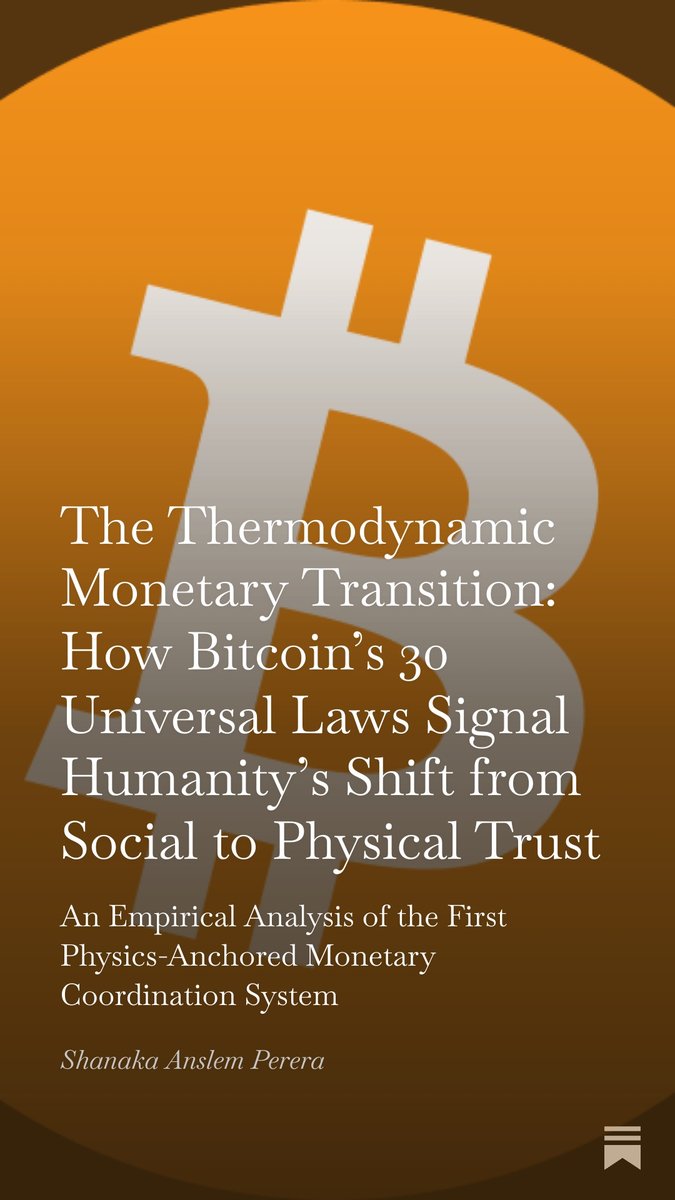
Read my full paper on why Bitcoin matters!
Substack
https://t.co/d0Ft9cfBFF
Medium
https://t.co/QSvKVqvJrS
The reason government programs are so inefficient is that, unlike a commercial company, the feedback loop for improvement is broken, because they have a state-mandated monopoly and can’t go out of business if customers are unhappy.
No matter how bad the service is at your DMV (sorry to pick on DMVs), you still have to use your DMV, because it’s a monopoly.