Everybody's building an AI that can make a phone call.
At @FreightScoutai we built one that runs the whole brokerage floor.
It prices the RFP. Builds the loads. Works every carrier that fits. Makes every check call. Sends the invoice. And picks up when a driver calls at 2 AM.
This is your brokerage floor. With superpowers.
Meet Scout.
Backed by the Chang Robotics Fund @CR_Fund, and we are building this right here in Jacksonville.
Every tracking product in freight is racing to detect problems earlier. Detection was never the constraint. Your team knew at 6am. An exception that reaches a rep who does not know what to do with it is not an exception. It is a notification.
@FreightScoutai started publishing free freight market research this week. Sign up and enter your company name & logo to get it white labeled and sent to your inbox weekly.
https://t.co/WrdtUHZiSi
Count the carrier emails your team touched today that never became a load.
MCs that didn't clear. Carriers never close on rate. Replies answered two hours late, after the truck was gone.
That pile costs you twice. Rep hours on dead threads, and loads that died behind them.
Every buy rate starts with the same question. What will it take to cover this today?
Most brokerages answer with last month's settlements and gut feel. But your team collected quotes on that lane this week. Nobody wrote them down.
You already know what carriers want.
A carrier quotes a lane on a Tuesday call. The rep scribbles it down, covers the load with someone else, and that number is gone.
Multiply by every rep, every call, every day. Years of market intelligence evaporating in real time.
Your best market data died on a sticky note.
What separates a top carrier rep from the median isn't calls per day. It's loads per carrier.
Sourcing every load fresh: post it, take 20 calls, book, watch it bounce, start over. Tendering repeat lanes to carriers you know flips that math.
The repetitive work was the ceiling.
Every brokerage has a carrier list in the thousands and a group of carriers that actually answer.
The list is a database. The relationships are the business. Most systems can't tell you which is which.
Which of your carriers would take a load from you at 4pm on a Friday?
The worst part of outbound isn't rejection. It's the blank page.
Pick an account, research it, figure out what to say, write it, send it, remember to follow up. Multiply by forty. That's why prospecting slips first in a busy week.
Three of those five steps never need a person.
By the time it's out to bid, the decision has been forming for two or three quarters.
The volume moved first. The calls got shorter. Somebody else started covering the hard lane.
The RFP is the receipt.
Most of brokering is following up on freight that is already going fine. Check calls. Pre-detention notices. The POD chase. That work should run on its own, so the floor spends its day on the loads that actually need a broker.
Customers don't leave in the month they leave.
Volume dips. Cadence slips. A lane quietly moves. Margin erodes. Eight months later the RFP arrives and the only variable left is price.
Every one of those months left a trace in your TMS. Nobody was reading them.
Broker liability has real money attached to it now. Vetting is not a box you tick after the truck is booked. Our coworkers vet the carrier before the quote goes out, so the floor knows who it is tendering to before it commits.
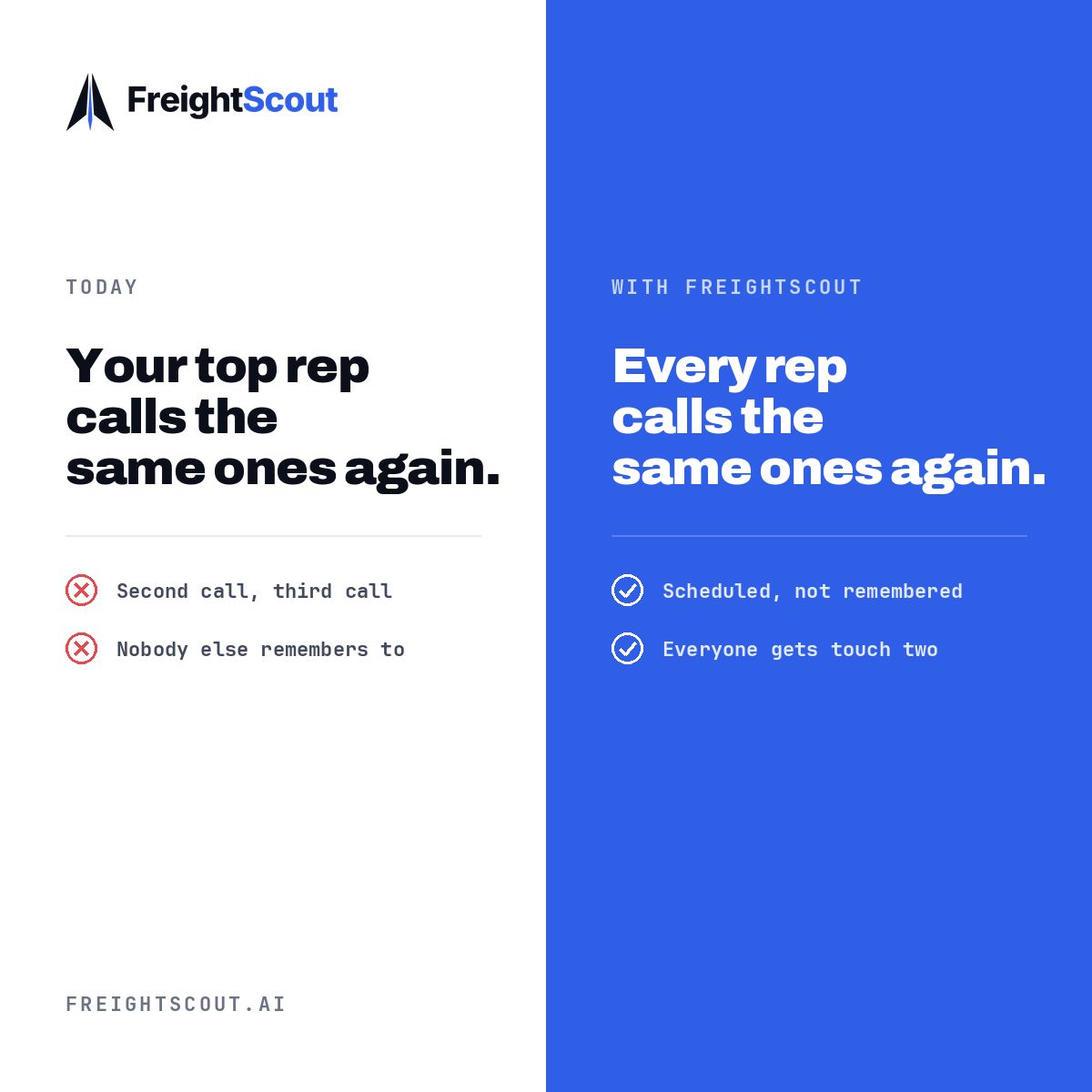
Every floor has that one carrier rep who talks Cowboys football for five minutes before he ever says the word load.
And every manager has stood behind him watching 40 loads sit uncovered thinking, dude, come on.
Then you pull his numbers. Same carriers every week.
Better rates. Trucks actually show up. Dispatchers call him first when a truck opens up in Dallas. None of that shows up on a rate sheet, but it's literally why he wins.
Most reps don't have time for that with 40 loads to cover.
So when we built how @FreightScoutai Cover Agent calls carriers who already run for you, that was the first thing I wanted in it.
It knows who hauled the lane, how it went, the driver's name, and yeah, that the dispatcher is a Cowboys fan. It catches up first. Then it pitches the load, negotiates inside your max pay, books it and sends the rate con.
Sound on. Mike's still not over the fourth quarter.
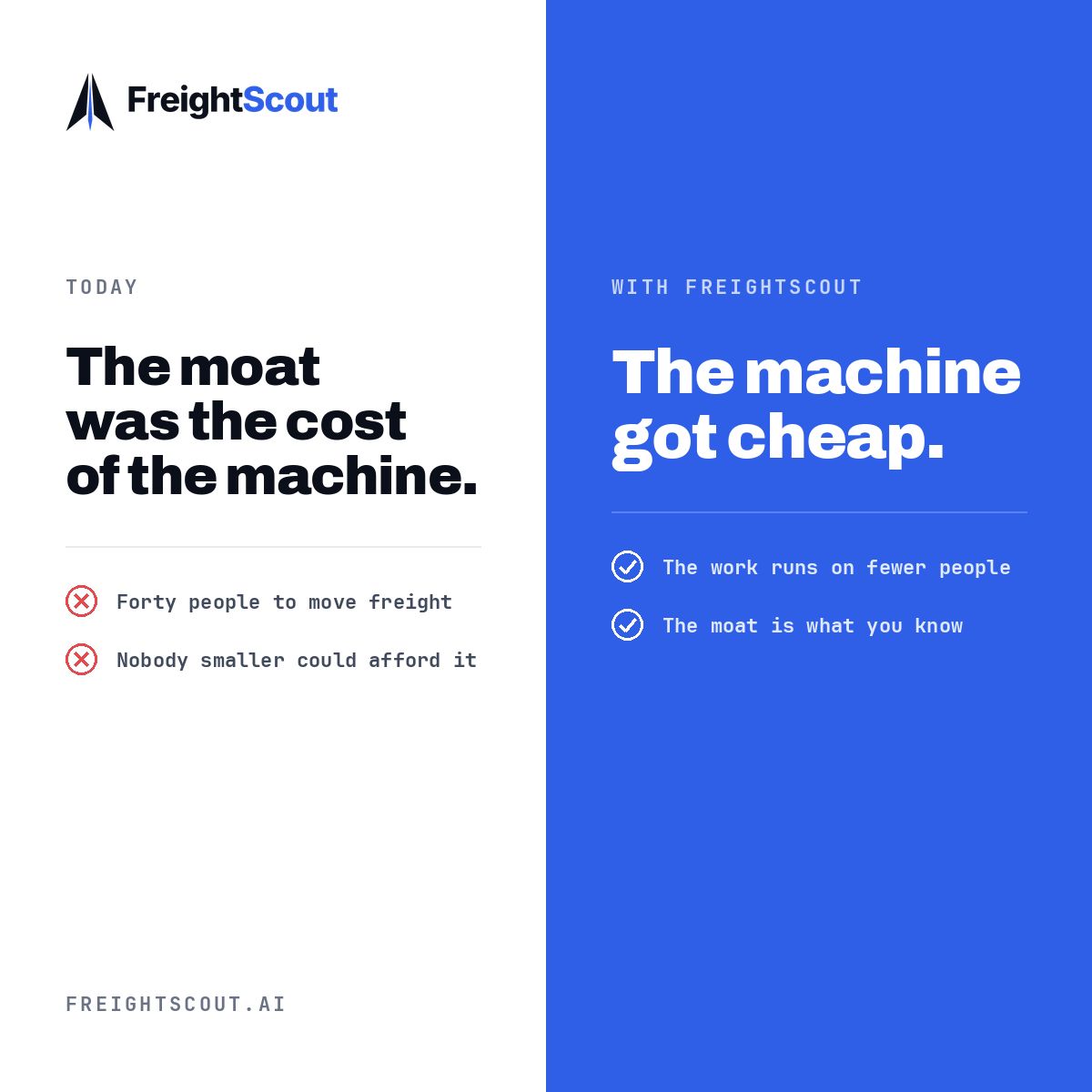
For a decade, a digitally automated brokerage was a scale game. Eight figure tech budgets, dedicated engineering.
That era is over. A 1,000 load a month shop can run the playbook that used to need a top 10 brokerage.
The moat was never the freight. It was the machine.
Most target lists are sorted by nothing. Alphabetical, or by territory.
The rep works top to bottom while three companies that just opened a DC in a lane you already run sit at position 340.
The list isn't the problem. The order is.
Contract TL rates are at a 52-week high, $2.72/mi plus fuel, up 18% YoY. Any lane you bid off last year's rates is a lane you can win and lose money on all year. This is what that looks like.
Sister carriers. Chameleon MCs. Fake fleet data. The common thread is the broker that books first and checks later. Our Cover agent vets the carrier before the quote goes out so the floor doesn’t learn the hard way.