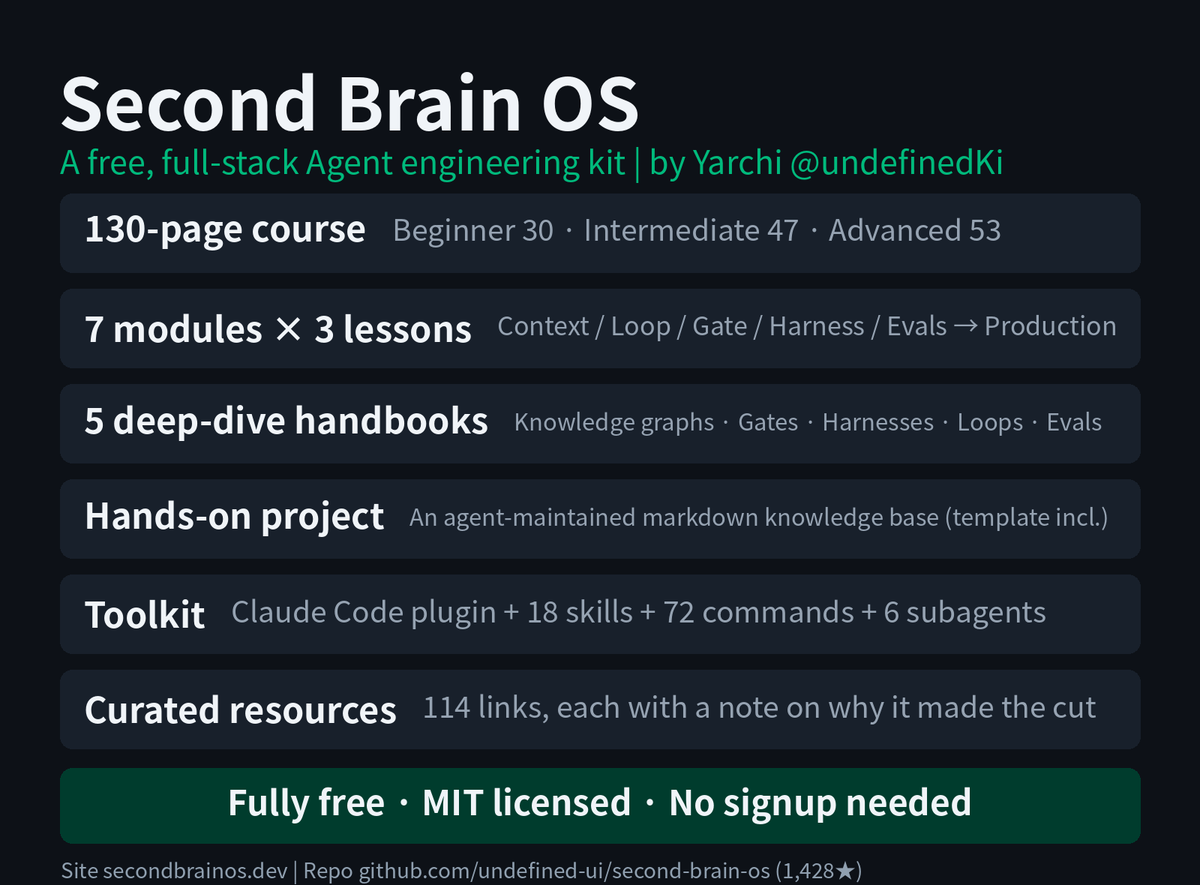
Someone open-sourced an entire agent engineering course for free: 130 pages, 7 modules, 5 deep-dive handbooks, and a hands-on project you can copy outright. MIT licensed. No paywall, no signup, not even an email field.
It's called Second Brain OS, by Yarchi (@undefinedKi). The repo was last pushed on Nov 3 (UTC), and I re-checked the numbers tonight (Nov 5): 1,428 stars and climbing. The problem it solves is specific: everything worth knowing about agent engineering is scattered across papers, engineering blogs, and random repos, and nobody had strung it into one path. This is that path — theory with sources, and a build at the end of every module.
What's actually inside (I counted against the repo itself):
1. A full agent course
7 modules, 3 lessons each, from "write your first prompt" to shipping an agent to production. The core five layers: Context, Loops, Gates, Harnesses, Evals — basically the skeleton of agent engineering as it stands right now.
2. Five handbooks, one layer each
Knowledge graphs, Gates, Harnesses, Loops, Evals. Read the one that hurts. Every handbook ends in a build, too.
3. A hands-on project you can copy
A second brain: a knowledge base in plain markdown files, maintained by an agent. Not "read and forget" — the repo ships the starter template.
4. A ready-made toolkit
A Claude Code plugin for the course, plus 18 skills, 72 slash commands, and 6 subagents to practice on your own projects.
5. 114 curated resources
Each one annotated with why it made the cut, and checked back against the source. This list alone is worth the save.
How to start, in 3 steps:
Step 1: Open the site first (link in the first reply) — don't download anything yet. The whole site is one graph: every concept is a bubble, the lines are real links, click one to see what it builds on. Pick your entry point by level: Beginner 30 pages, Intermediate 47, Advanced 53. Don't grind it front to back.
Step 2: Clone the repo (link in the first reply). All 130 pages are markdown — fully readable offline.
Step 3: Want to build? Follow the quickstart: copy the vault-template as your knowledge-base base, drop in the skills, commands, agents and scripts folders, launch Claude Code inside it, and work through the 9 Setup pages in order. By design, the agent maintains the vault from there.
Who it's for: anyone trying to learn agent engineering systematically who's tired of fragmented tutorials — especially if you already use Claude Code.
Who it's not for: anyone looking for a handful of copy-paste prompts. This is built around "finish it and you can design, build, and evaluate agents yourself," and it reads like it.
Three honest caveats: it's a serious amount of reading, and no one can promise what you'll get out of it — that part is on you. I verified the contents item by item against the repo, but I can't verify learning outcomes. And the author's line about "understanding agents better than 95% of people in 15 minutes"? That's marketing. Ignore it.
The one thing to do tonight: open the site graph, find which of the five layers you're weakest on, open that handbook, and read page one. Knowing which layer you're missing beats hoarding another hundred tutorials.
Dan Koe ran the numbers yesterday (Nov 3, 2026), and the math stopped me mid-scroll:
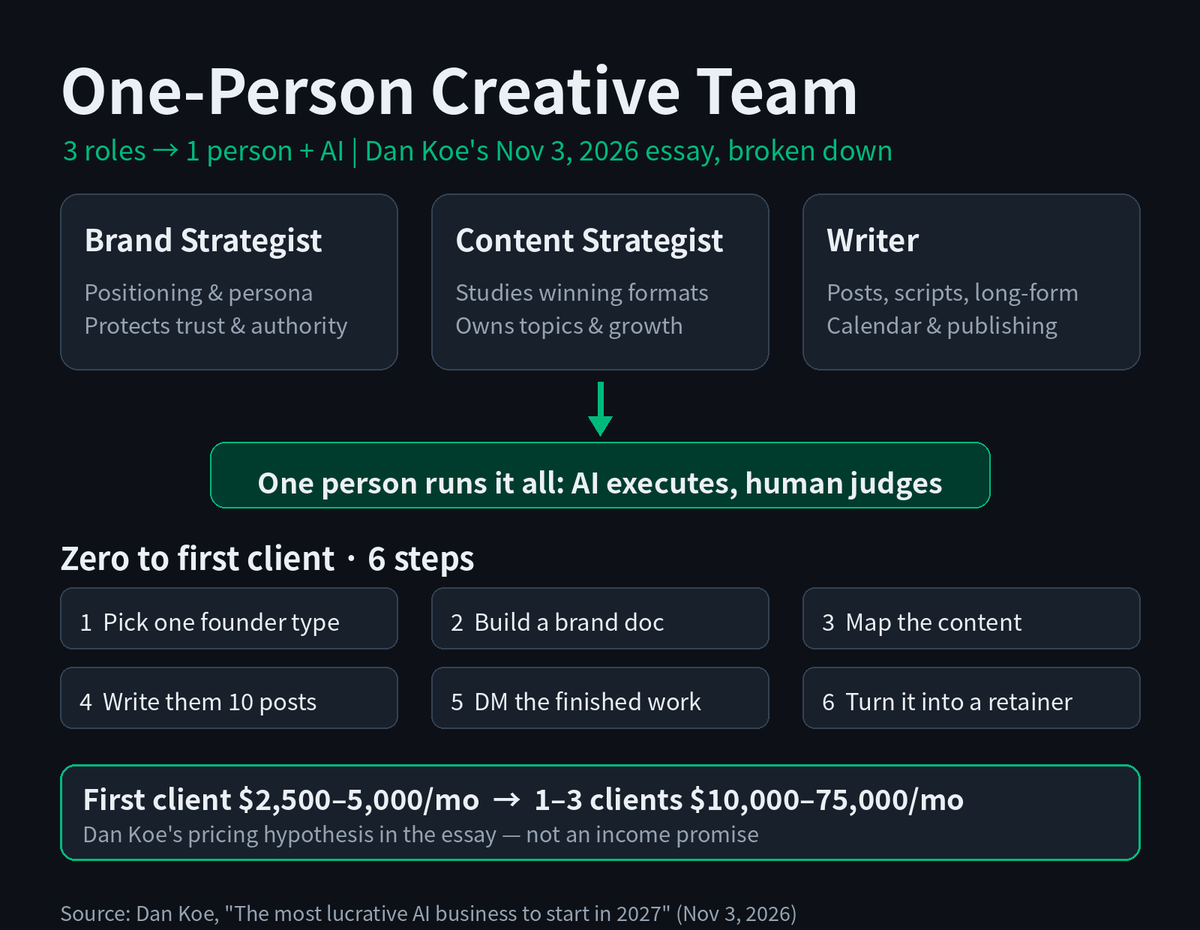
The most lucrative AI business of 2027 isn't a one-person company selling courses. It's one person working as an entire creative team — 1 to 3 clients, at $10k–$75k a month, by his math. His starting price for a first client: $2,500–$5,000 a month.
Don't take that pricing at face value — I'll take it apart at the end. But the model underneath it is the most copyable play I've seen all year.
What is a "one-person creative team"?
Founders and top creators don't lack ideas. They lack hours. They have a business to run and a personal brand they can't feed.
That used to take three people:
→ A brand strategist — positioning, persona, protecting trust and authority instead of chasing junk trends
→ A content strategist — studying formats that travel, owning the topic pipeline and the numbers
→ A writer — drafting every post, script and long-form piece
Now one person with AI can fold all three desks into one. Not by letting AI run wild. A content-agency operator quoted in the essay puts it well: his job became reviewing and editing — about 4 hours a day, down from roughly 12. AI absorbs the research and the first drafts. The human keeps two jobs: strategy calls and taste.
AI does the execution. The human does the judgment:
· Brand — AI turns interviews, history and opinions into a brand document; you decide which beliefs are worth repeating for a year
· Content — AI scrapes what's working, breaks down hooks, builds the topic bank; you decide which trends fit and which would cheapen the positioning
· Production — AI drafts, re-hooks and schedules; the final take, the story, the emotion — that's you
So how does a beginner actually start? Here's his process, condensed into 6 steps. Quick disclosure: the skeleton and the specific numbers (10–20 posts per platform, 3–4 pillars broken down further) are his, from the essay. Only the 10-post mix in Step 4 is my own breakdown to make it easier to follow. In a hurry? Jump to Steps 4 and 5 — that's the door-knocking play you can run tonight. Steps 1–3 are the delivery system once a client says yes.
Step 1: Pick one specific type of founder
"I do AI content" is too wide to sell. Pick one person you could study for a year: SaaS founders, consultants with deep expertise and no posting habit, small business owners whose content can't keep up with their product. Your output from this step is one sentence: who you serve, and what it costs them to stay invisible.
Step 2: Build them a brand document
AI's real problem isn't writing. It's not knowing who it's writing for. Pull their 10–20 best-performing posts from each platform and extract four things: the core beliefs they repeat, their verbal habits, the stories that hit hardest, and what they stand against. No back catalogue? Interview them: Who do you most want to help? What did you learn the hard way? What does everyone in your niche say that you think is wrong? Output: one document every future post grows from — no more asking AI to invent topics from thin air.
Step 3: Build a content map
Set 3–4 content pillars (say: industry insight / personal story / product & proof / contrarian takes). Break each pillar into 5–7 topics, each topic into 5–10 ideas, each idea into 4–5 angles. AI generates the branches from the structures that have already worked for them; you prune whatever doesn't fit the positioning. His claim: this gets you roughly six months of content inventory. Output: the end of "what do I post today?"
Step 4: Write them 10 posts (this is your key)
These 10 posts are your portfolio. My mix: 2 personal stories, 2 industry insights, 2 reasoned contrarian takes, 2 practical how-tos, 2 positioning long-posts. Polish each one until they could publish it almost as-is. Ten lazy AI drafts don't open the door — they close it.
Step 5: DM the finished work. Don't send a resume
This has a track record. JK Molina — the guy Dan Koe credits with starting the Twitter ghostwriting wave — got in by DMing Koe himself, in substance: "I know you don't want anyone writing for you, but I wrote 10 posts for you anyway. Post them, and if you like them, let me write more — or just give me a testimonial." Koe calls this the best strategy he knows for landing a first content client. Someone else applied in public: posted a video arguing Grant Cardone needs a new creative director because his content is stuck in 2016. Cardone replied that he was stuck, and to get in touch.
Structure your DM like this:
"Been following you for a while — your thinking deserves a bigger audience. Guessing you're busy and posting keeps slipping, so I studied your past content and your voice, and wrote you 10 posts. They're attached. Use them free if you like them; if they perform, let's talk about doing this properly."
Value first, pitch second. That's his "permissionless apprentice" idea: don't wait for permission, walk in carrying proof. His claim, not mine: run this properly and he'd find it hard to believe you couldn't land one client in a month.
Step 6: Turn 10 posts into a monthly retainer
Once they've used the posts and seen results, the conversation changes from "ghostwriting" to "running the whole thing": weekly content planning, publishing rhythm, performance reviews, turning winners into long-form and a newsletter. His pricing ladder: $2,500–$5,000/month for the first client to get the machine running, then toward the 1–3 client model at $10k–$75k a month.
Why now? Goldman Sachs research from April 2023 projects the creator economy growing from $250B in 2023 to $480B by 2027. A good product doesn't market itself, and knowing a business isn't the same as expressing it. That gap is the one-person creative team's job description.
Now the teardown — three things before you get carried away:
One: the $10k–$75k pricing has no market data behind it. No close rates, no retention numbers, no income distribution. It's his pricing hypothesis, not a salary you unlock with the right prompts. Premium fees follow the client's business size and your measurable results — nothing else.
Two: Dan Koe founded Eden, the tool this entire workflow showcases. Learn the workflow; build the brand document, the content analysis and the planning in ChatGPT, Claude and docs if you want. Don't confuse a great system with a mandatory tool.
Three — the one that matters: AI writers are not scarce. Anyone can generate 10 posts. What's scarce is judgment — what persona to build, which trend to refuse, how to turn an ordinary experience into a story that travels. That's what clients actually pay monthly for.
So separate the opportunity from the pitch. The opportunity: help people with real businesses turn expertise into a compounding content asset. The pitch: "learn a few prompts, make five figures." Only one of those is a business.
Your first move tonight: pick one founder whose content is clearly worse than their product. Spend 30 minutes on their account, find the 3 ideas that deserve a bigger audience, and write the first post for them. Then finish the 10 and send the DM.
In the AI era, prompts are copyable. A finished piece of work that's genuinely valuable to a specific person — that's the key that opens doors.