Price action for gold remains baffling, today for eg: oil, US yields and DXY lower. Perhaps longs are beginning to liquidate, ETF flows key here. The Fed’s fav inflation metric is out later and will show if the CB can extend its pause or if sticky inflation will force a Dec hike.
Post the FED, rather than providing relief, the pause reinforced the reality that borrowing costs will remain high. Markets are pricing in a 82% probability of a rate hike in Dec. This raises the opportunity cost of holding non-yield bullion, pulling capital toward guilts instead
The ECB and BOJ meetings up next, perhaps they can provide more action than the FED, something more akin to the RNBZ decision, though I am not holding my breath.
Market seems vaguely skewed toward fading a dip in the BBDXY, any signs of basing will exacerbate this. However, the Dollar is still struggling for any meaningful direction at the moment.
The Bank of Canada delivered a widely expected 25bp rate hike to 2.50% at its October meeting, the first hike since July 2023. Communications kept the door open to further tightening, but highlighted optionality.
A FED hold may be almost entirely priced in, but the tone matters:
Hawkish Fed will support the dollar and pressure eur/usd and cable lower.
Dovish tone will allow high beta ccys and risk assets to extend gains.
Themes of the week:
France fiscal stress (EU bond spread ~170bp), Energy price surge, AI stock repricing.
Oddly, G10 FX is static despite the grandiose nature of these themes; lack of follow through is the key feature of this market cycle, perhaps we're all becoming numb.....
Rising energy prices are exacerbating the negative fiscal outlook in the EU.
OAT-BUND spread widening sharply as French 10yr hit 5% for the first time since 2002, while other EU bonds continue to move inversely.
Many headlines over the weekend that counterbalance each:
Russia and Ukraine don’t attack each other’s energy infrastructure.
Houthi’s tearing it up in Saudi Arabia; a considerable risk for energy and trade.
Trump pushing for Russian diesel to lower prices pre-mid terms.
The attempted move higher in Euro on Friday was static as people are willing to sell into rallys . Euro can’t break the 1.1165 level either way. Eyes on French spreads and US CPI.
Following a strong-ish Q3 for G10 GDP and the mixed economic narratives as of recent. The signals on inflation dictate a harsh rebound, gripping purchasing power and focusing central banks on near term hikes.
French unions call for further strikes while the gov considers issuing short term debt; another instance of a developed market behaving like an emerging market - Rabobank & MNI.
Eur crosses holding in, just abt.
EURO STOXX down and Nikkei in the red o/n. Should this be the beginning of bond volatility spilling into equities, its abt to get choppy. The unwind of offshore Japanese equity hedges could provide the catalyst for more prolonged JPY strength.
although risk is skewed downside for eur, todays move up reflects reduction in shorts as a result of last weeks fears somewhat disappointing, oat/bun spread tightening, equities up, EMFX up
The broader theme remains unchanged: as the back end rates sell off continues, weak spots appear, with France first for a hanging. Tighter financial conditions are also bringing the near term central bank outlook into focus; a dovish ECB pivot being one possible release valve.
Page 1 of 2…
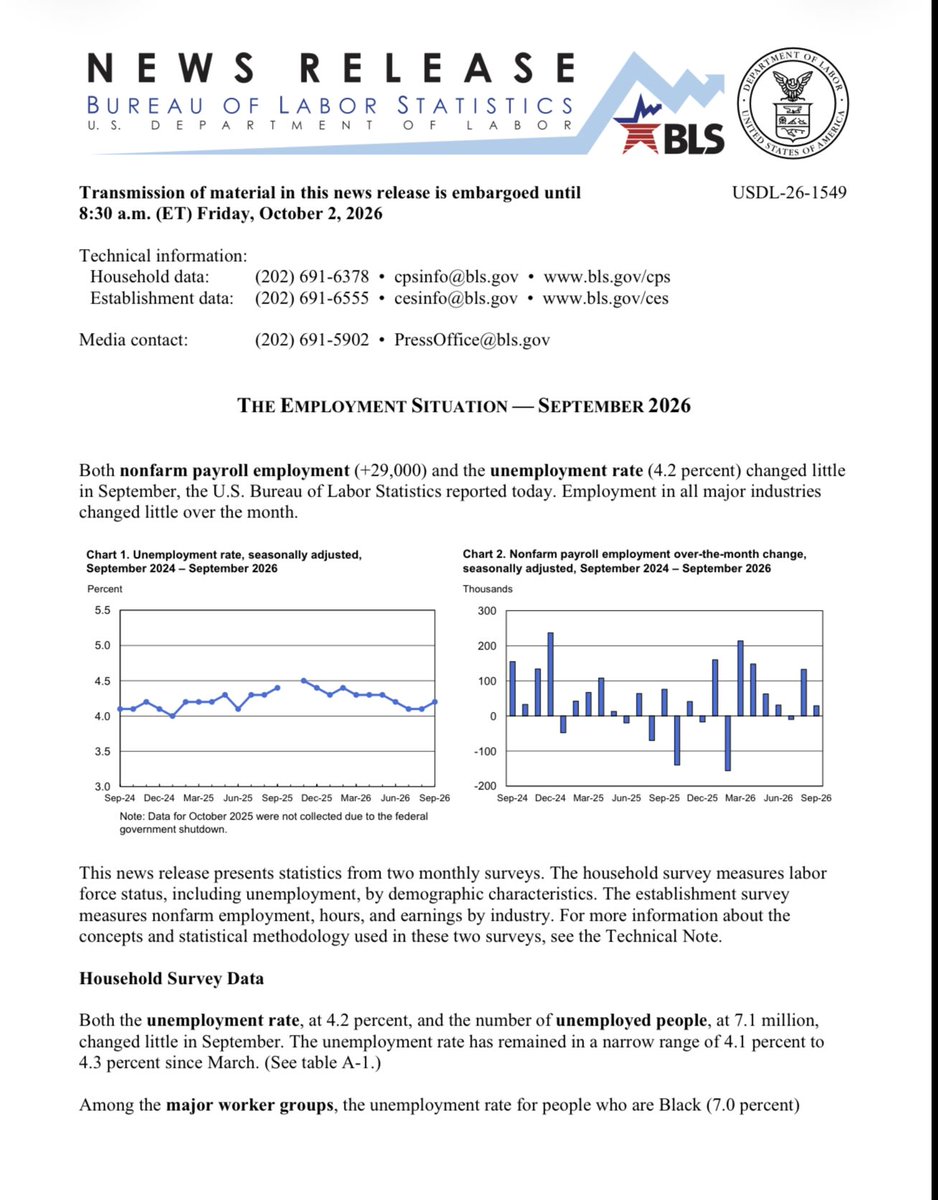
September 2026 Jobs Report Shows The Seasonal Noise Is Clearing And The Underlying Weakness Is Getting Harder To Ignore
September payrolls increased just 29,000 after seasonal adjustment. That is weak by itself, but the composition tells us considerably more.
Private payrolls fell 523,000 raw yet became a 46,000 adjusted gain, an effective seasonal lift of roughly 569,000 jobs.
Government moved the opposite way. Employment rose 856,000 raw, largely as schools reopened, but became a 17,000 adjusted decline. That is why the national raw increase of 333,000 ultimately became only 29,000 after adjustment.
The important point is not that seasonal adjustment created the national gain. It did not.
It is that seasonal adjustment again transformed a very large private sector decline into positive reported growth.
Some of the biggest transformations were
• Leisure and hospitality fell 454,000 raw but became plus 10,000 adjusted
• Restaurants fell 148,400 raw but became plus 10,800
• Retail fell 79,500 raw but became plus 5,800
• Construction fell 49,000 raw but became plus 11,000
• Manufacturing fell 44,000 raw but became plus 9,000
• Temporary help gained 53,300 raw but became minus 10,900 adjusted
The mechanics clearly cut both ways. The correct argument is therefore not that adjustment automatically makes everything stronger.
Something Important Is Normalizing
The 523,000 raw private decline initially looks disastrous.
But the average raw September decline from 2015 through 2019 was roughly 528,000.
That means September 2026 behaved remarkably similarly to a normal pre pandemic September.
This matters.
From 2020 through 2025, shutdowns, reopening surges, labor shortages and unusual school and seasonal staffing patterns badly disrupted normal seasonal behavior.
Now the raw September pattern appears to be moving back toward its old structure.
The seasonal pattern may be returning to normal. The underlying economy is not.
That actually makes the weakness harder to dismiss.
If September seasonality increasingly resembles 2015 through 2019, then after removing that normal seasonal rundown we are still left with only 46,000 private jobs and 29,000 total payrolls.
The problem is increasingly not the normal September decline.
It is the lack of underlying hiring once that normal decline is stripped away.
The Revisions Are Becoming Hard To Ignore
July was revised from plus 21,000 to minus 10,000.
August was revised from plus 162,000 to plus 133,000.
Another 60,000 jobs disappeared from the previous two months.
The 3 month average is now only about 51,000 per month.
And the September gain of 29,000 is nowhere near the roughly 122,000 monthly change BLS says is required for statistical significance.
The reported increase is therefore not statistically distinguishable from zero at the confidence level BLS normally uses.
The Breadth Is Deteriorating
Private employment diffusion fell from 57.6 to 49.0.
Manufacturing diffusion collapsed from 63.9 to 46.5.
Below 50 means employment losses are becoming more widespread across industries.
Manufacturing added 9,000 total jobs, but production employment fell 1,000.
Temporary help lost 10,900.
Professional and business services lost 9,000.
Information lost 10,000.
Financial activities lost 7,000.
Those are exactly the areas I would watch before a broader layoff cycle becomes obvious.
@WatcherGuru unlikely to cut yes, hike 65% priced in on bbg for sept meeting, any further overspill from US-IRAN onto prices, ie cpi, or consumer disposables is going to move the needle more in favour of a sept hike.