[ Lighter Latency Report (week Dec 15) ]
The overall execution latency this week is significantly better than last week, so I felt obligated to post an update. I think it’s helpful (and fair) to keep sharing these stats on a weekly basis.
High-level comparison vs last week (Dec 08):
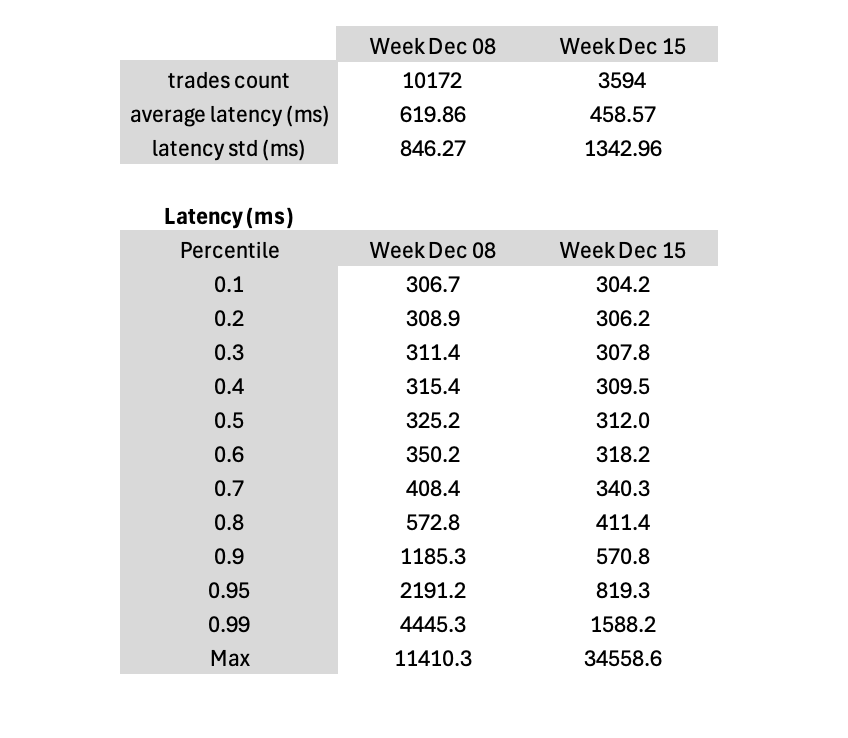
• Avg latency: ↓ 161ms; ~459ms this week from ~620ms last week
• Median (P50): ↓ 13 ms; ~312ms this week from ~325ms last week
• P70: ↓ 68ms; ~340ms this week from ~408ms last week
• P95: ↓ 1372; ~819ms this week from ~2191ms last week
• P99: ↓ 2857; ~1588ms this week from ~4445ms last week
The ECDF comparison shows a clear left-shift this week — both typical latency and tail latency improved materially. This lines up with the infra improvements mentioned earlier.
That said, tail risk still exists. The last screenshot shows the top 10 highest-latency executions this week, and 7 of them occurred during a short window when ETH moved ~1% within ~3 minutes.
In other words:
• Normal conditions → execution is much more stable
• Extreme volatility → latency tails can still spike into multi-second territory
Overall, this is a meaningful improvement week-over-week, especially in P90/P95. Still watching how the system behaves during high-stress market conditions, but credit where it’s due — progress is clearly visible.
I’ll keep posting these weekly for transparency and tracking.
a piece in critique of “it’s priced into the spread”
the assertion “it’s priced into the spread” does not allow one to claim anything about relative total execution cost unless you actually define z.
set x = taker fee, y = spread, z = total execution cost
zero-fee venue: 0 + y₁ = z₁
fee venue: x₂ + y₂ = z₂
assume 0 < x₂ and y₁ > y₂ (ie: lower taker fee, higher spread)
then:
z₁ < z₂?
z₁ = z₂?
z₁ > z₂?
you can’t tell. z is ambiguous in all cases.
saying “it's priced into the spread” skips over the fact that the exact difference between y₁ and y₂ is ambiguous even though y₁ > y₂ and turns the claim into a logical sleight-of-hand.
now consider numerical examples from actual venues
exchangeA: 0 bp taker fee, 0.2 bp maker fee
exchangeB: 2.5 bp taker fee
exchangeC: 4.5 bp taker fee
assume exchangeB and exchangeC have 0 spread. (takers pay half spread):
mms on exchangeA would need to quote a 5 bps spread to match exchangeB’s execution cost and a 9 bps spread to match exchangeC’s execution cost. that is 25x and 45x more than what is charged to them in fees!
it is absurd to assume "it's priced into the spread" constitutes rational shorthand when no disambiguation of z occurred. therefore, it can only be assumed this substitutes ambiguity for rigor to support a predetermined narrative.