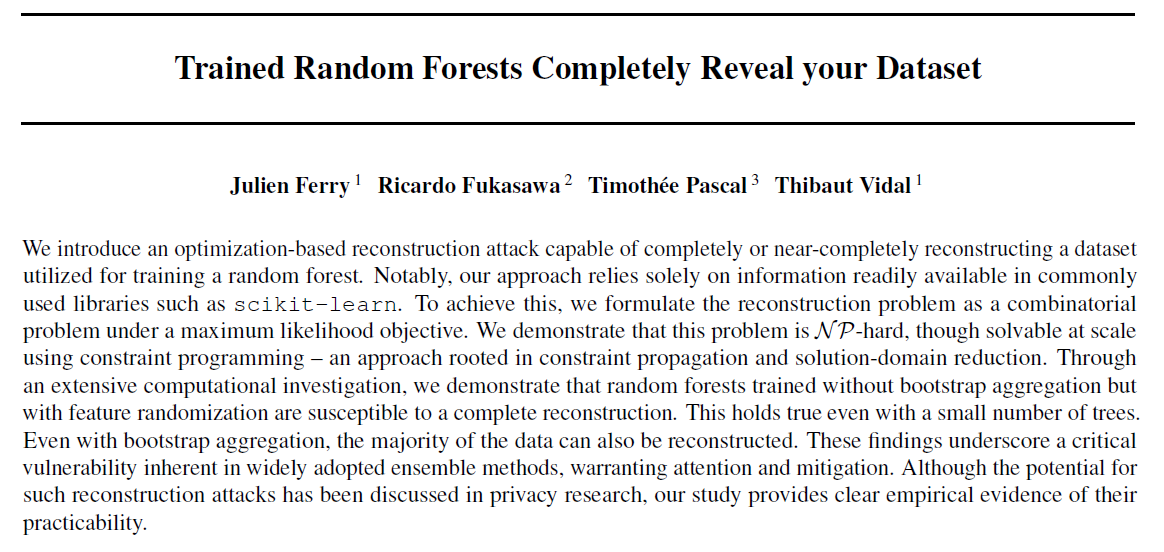
*Trained Random Forests Completely Reveal your Dataset!* https://t.co/hMmDkiNFSe
#MachineLearning models encode extensive information that can be exploited to reconstruct most --if not all-- of their private training data. Wanna know how? Buckle up! (1/8)
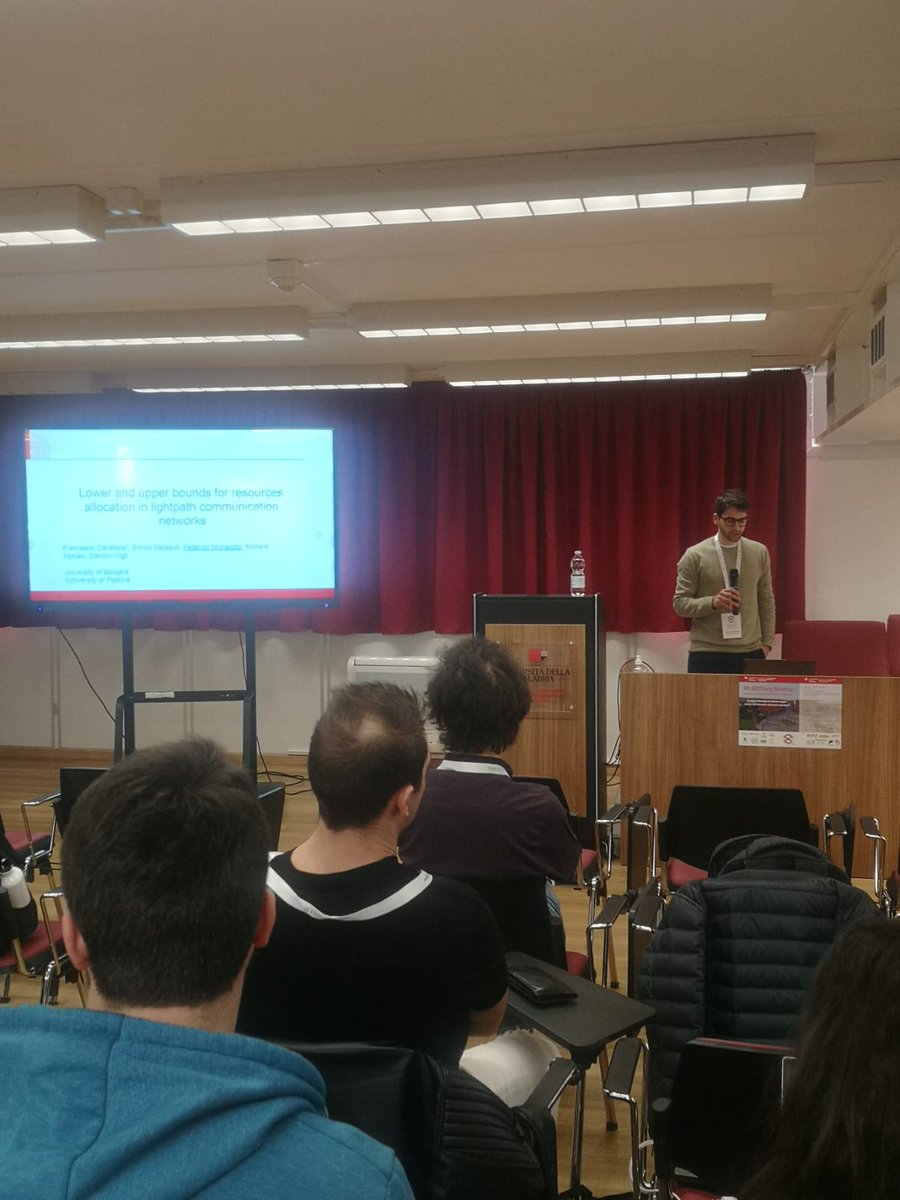
#8AYW#Day3#OptimizationOnGraphs
Federico Michelotto presents a lower-bound procedure and a heuristic algorithm for the problem of designing survivable telecommunication networks with shared-protection routing robust against single link failures #orms
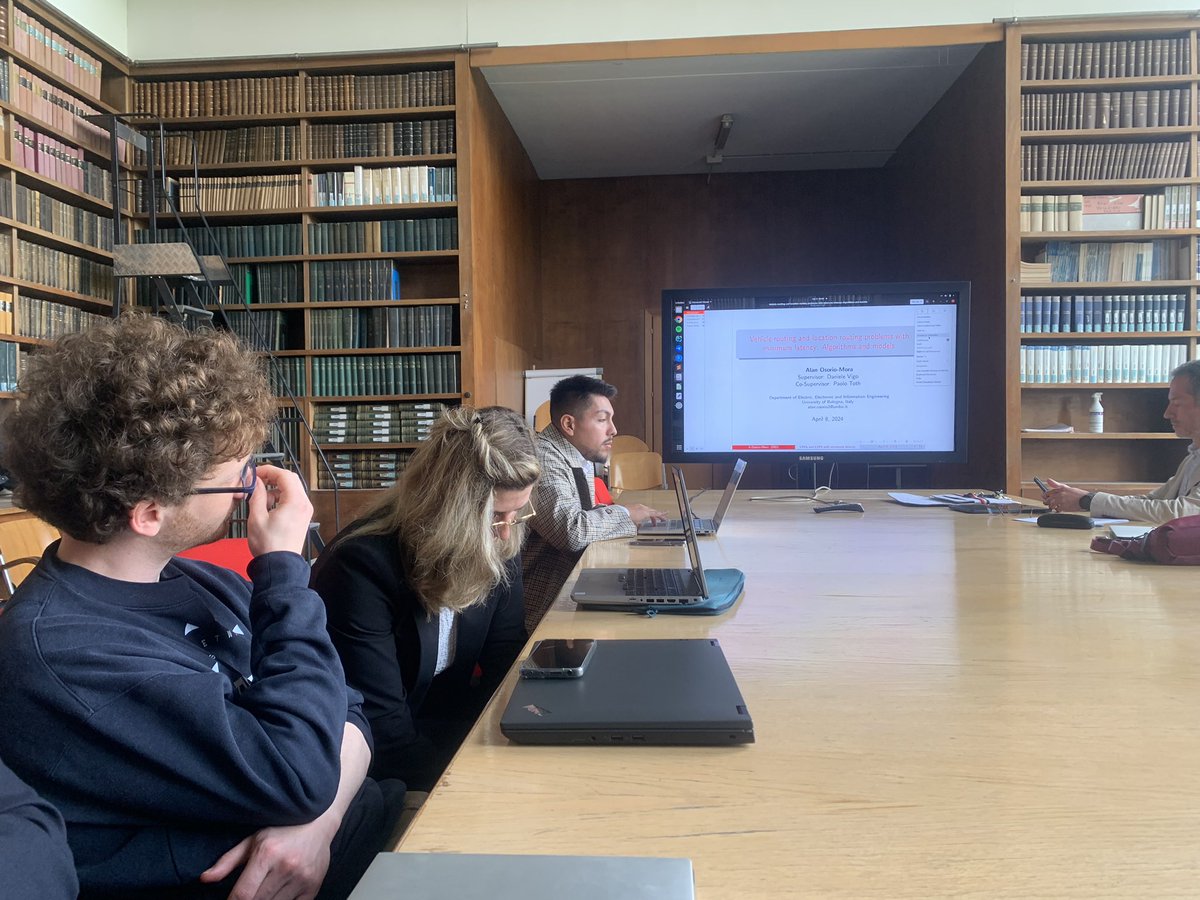
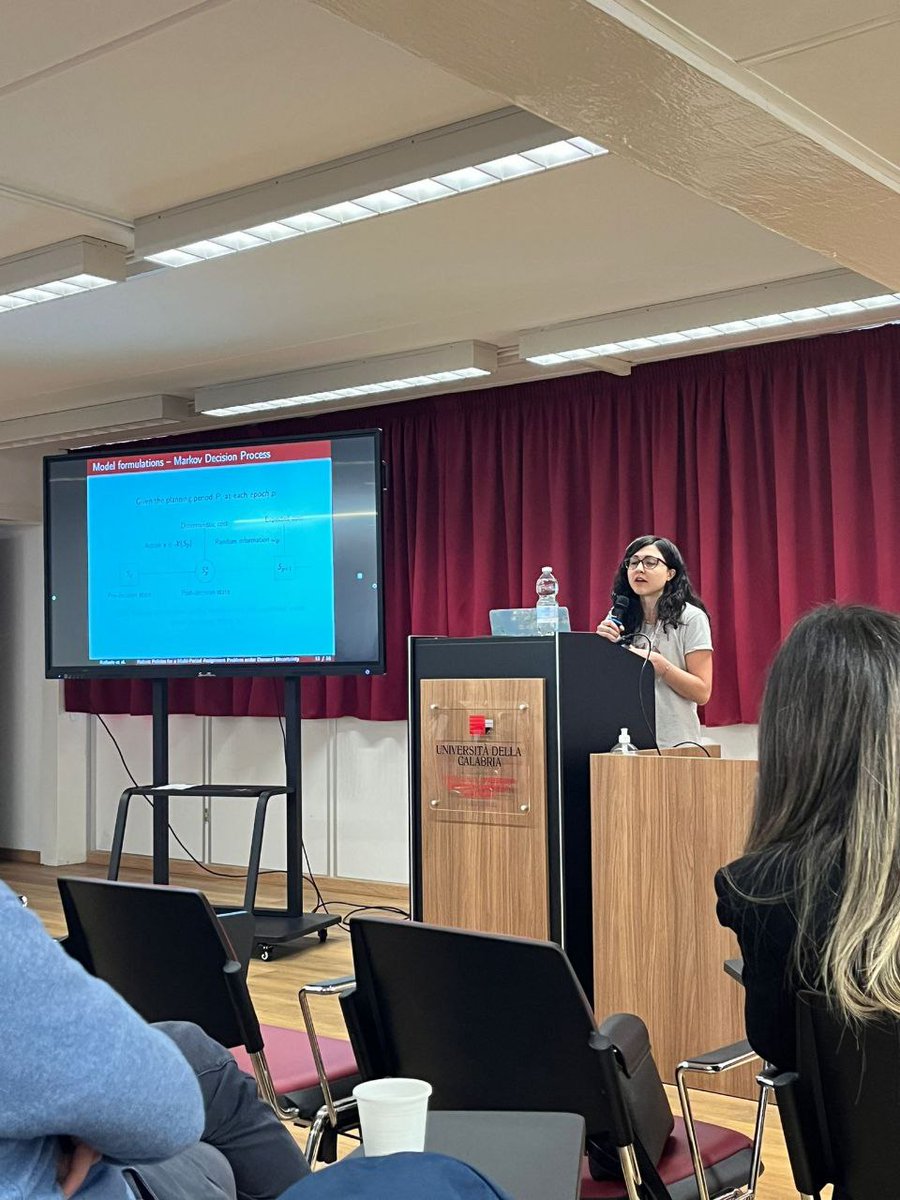
#8AYW#Day3#DynamicUncertainOptimization@AliceRaffaele1 combines stochastic dynamic programming with robust optimization to tackle a multi-stage assignment problem with uncertain demand to minimize fleet sizing and customer inconvenience costs #orms
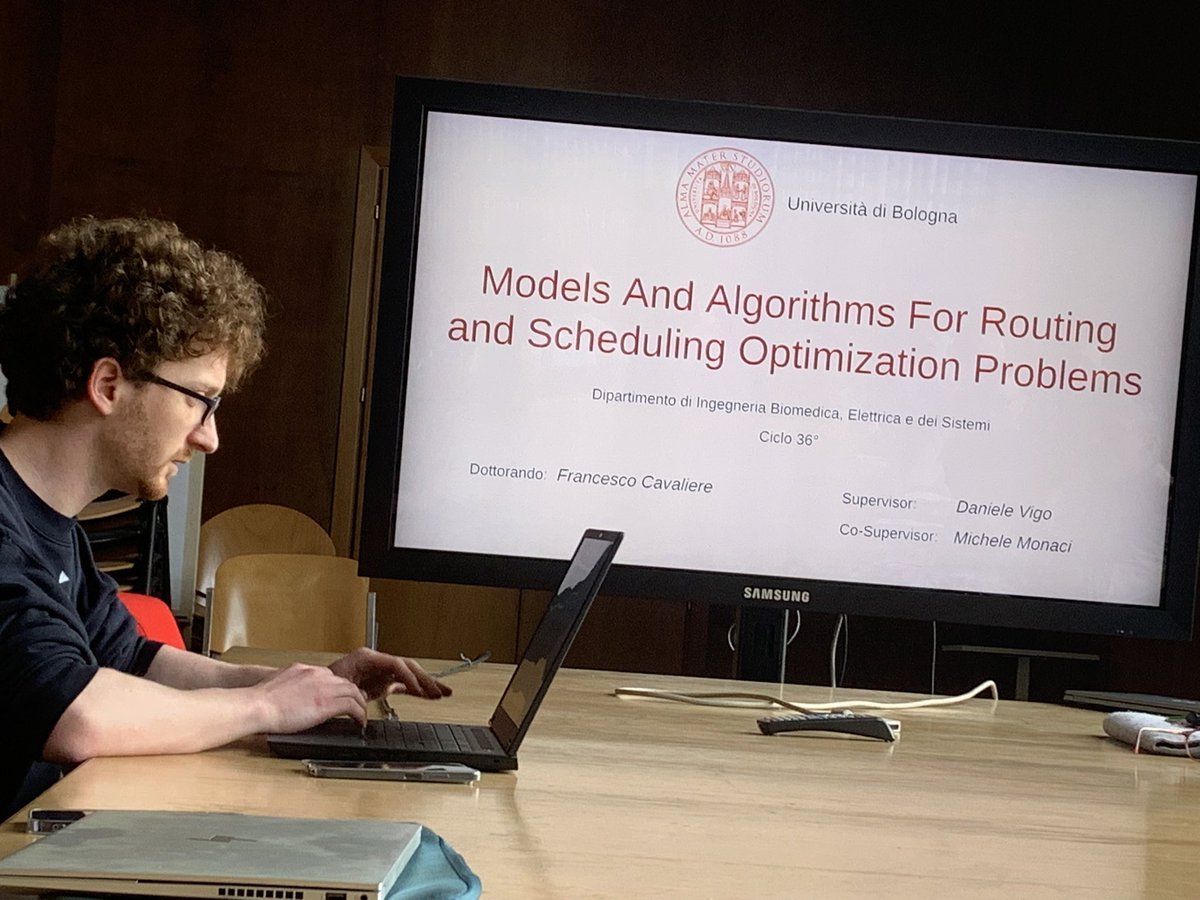
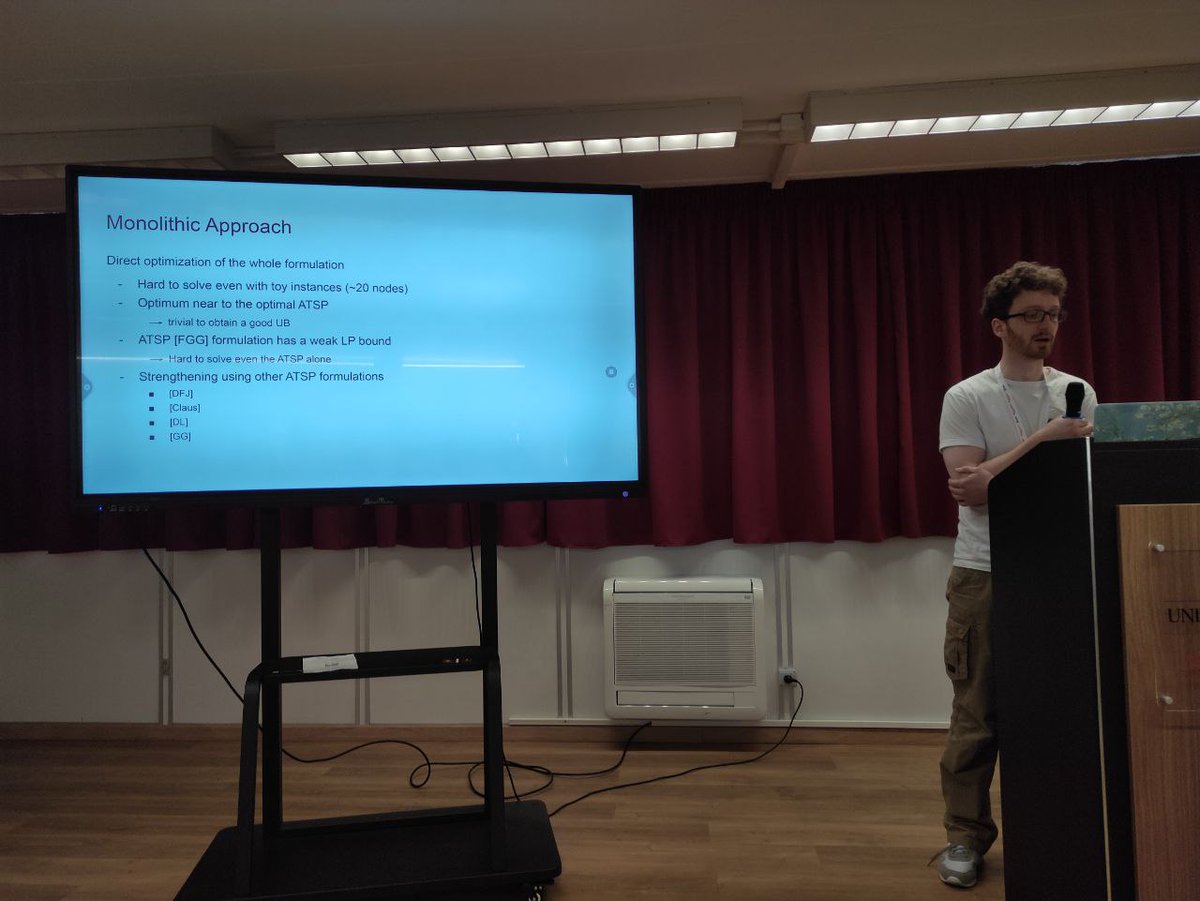
#8AYW#Day3#DynamicUncertainOptimization@FrnCava introduces a novel formulation for the Time Window Assignment Traveling Salesperson Problem with Stochastic Travel Times and exploits Benders' decomposition #orms
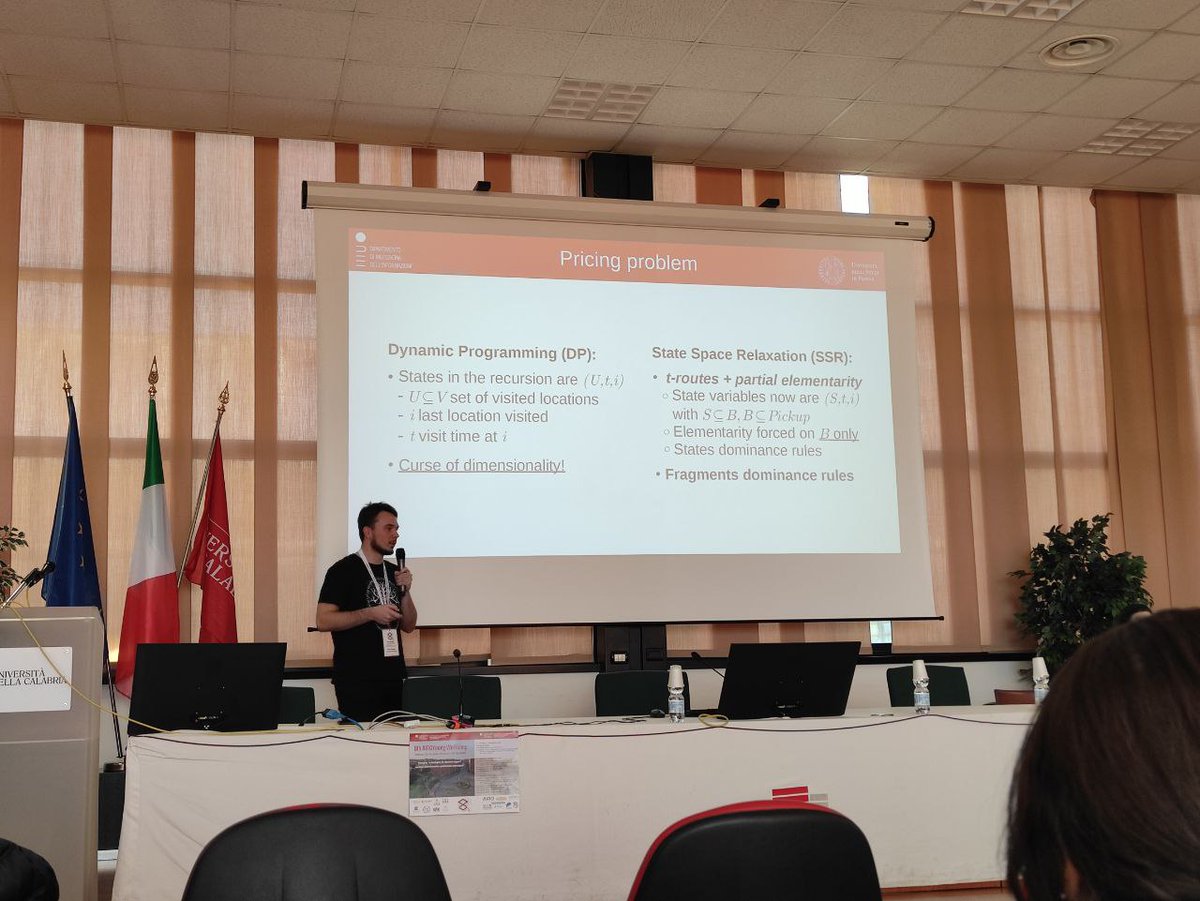
#8AYW#Day2#Logistics@DPalasgo talks about #ColumnGeneration algorithms using fragments to compute tight dual bounds to the Pickup and Delivery Problem with Time Windows and Last-in-First-out Loading #orms
#8AYW#Day2#PlenaryLecture
The second keynote speaker is Prof. @DanieleVigo (@Unibo), who presents different heuristic approaches developed with several former Ph.D. students (among which Luca Accorsi and @FrnCava) to solve Vehicle Routing Problems #orms 1/n
Want to watch @seanbax's talk entitled “#Circle evolves C++ to fix defects + make the language safer & more productive,” which he gave to Bloomberg's C++ engineers earlier this year?
https://t.co/SkaUVV1KTj
#cpp#cplusplus#cpp20
I have my first working C++ NLL borrow checker tests.
Use the ^ (shared) and ^^ (mut) borrow types. The "no mutable aliasing" rule is enforced at compile time.
The birth of Memory Safe C++!
@timoberthold pla85900 itself is likely easier to solve than 85,900 points randomly distributed in a unit square, due to the co-linear points in the VLSI application. We have been unable to solve a 100,000-point random instance created by David Johnson in 2000 for the DIMACS TSP Challenge.