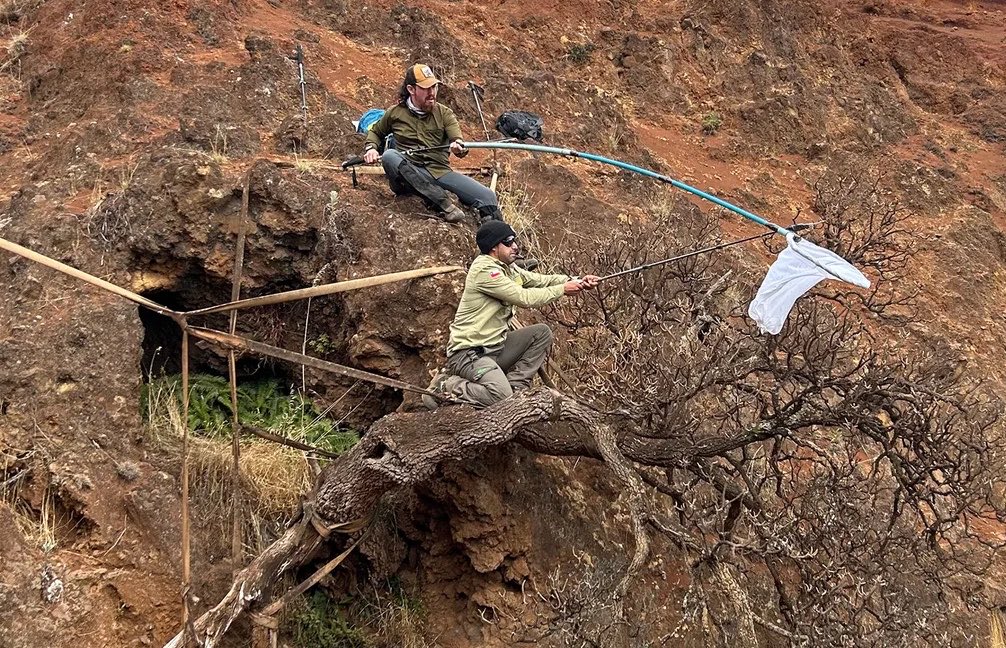
Such a sad photo. Two scientists on a remote island collect seeds from the last known example in the world of a type of tree, hoping to preserve it.
Imagine being beside the last known of anything in the world. A humbling experience
Photo and story: https://t.co/PwLMhe21w7
On Valentine’s Day in 2011, marine conservationist Michael Fishbach discovered Valentina — a humpback whale floating motionless on the surface of the Sea of Cortez, tightly entangled in a heavy fishing net. Michael jumped into the water with only a small knife and spent nearly an hour cutting through the net to free her. Valentina remained completely still and unmoving throughout the entire rescue. 💓✨
The moment she was released, Valentina did something that the entire crew on Michael’s boat has never been able to fully put into words — a special, deeply emotional act of gratitude.
One of the most heroic things I've seen recently is one little town in northern Michigan that kept a bird from going extinct.
The town is Mio, population of about 1800. The bird is the Kirtland's warbler, a small gray-and-yellow songbird that breeds in exactly one kind of habitat, mostly in a single corner of Michigan.
In 1974, the entire global population dropped to 167 singing males. The bird was one of the first species listed under the original 1966 Endangered Species Preservation Act, and it looked like the species was going to be extinct within a generation.
The problem was the habitat. Kirtland's warblers need fire-disturbed jack pine. Their entire breeding range is one specific successional stage of a fire-adapted forest. Decades of fire suppression had let the jack pine grow up past the age the birds could use. The birds had nowhere left to nest.
Mio became the staging point for the recovery. They built a forest management program: clear-cut, replant, burn, repeat. About 76,000 hectares are now managed on roughly six-year rotations to keep a continuous supply of young pine in the bird's preferred age range.
The work has paid off with the total population estimated at over 4,500 birds. The Kirtland's warbler was removed from the endangered species list in 2019, a rare full delisting.
The bird still requires active management. If the work stopped, the jack pine would age out within 20 years and the species would collapse again.
While everyone argues about data centers and water, California almonds quietly use up to 80x more, AND the whole industry only survives because of trucked-in "livestock"...
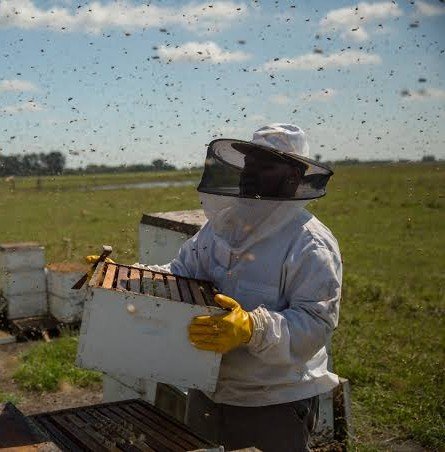
Every February, beekeepers transport nearly every commercial honeybee colony in the United States (around 2.8 million hives) to California to pollinate almonds.
It's the largest "managed-pollination" event on the planet. Almonds cover 1.4 million acres and need bees to pollinate so they set nuts.
So why do we need to truck them in? Well, almonds are grown in huge monoculture orchards, meaning the native bee species are all but eradicated...there's nothing for them to eat most of the year.
To fix the problem WE created, we ship in bees from across the country. I interviewed the creator of the 2019 documentary The Pollinators, which followed this migration and brought a lot of this story into public view.
First off, honeybees aren't native to North America. They were brought from Europe in the 1600s. The "bee crisis" you read about, with national colony losses around 55% last year and some commercial keepers losing 60 to 70% in a single season, is happening to a managed, introduced species.
It's a livestock collapse driven by long-haul transport, pesticide exposure at bloom, hives packed together spreading mites and viruses, and a monoculture diet.
Meanwhile, North America has roughly 4,000 native bee species. Most are solitary, don't make honey, don't sting, and quietly pollinate everything from squash to blueberries.
Research out of UC Davis and UC Berkeley has been direct about this: when blue orchard bees, bumble bees, and other natives forage alongside honeybees in almond orchards, fruit set goes UP, not down.
The presence of wild bees changes how honeybees move through the trees and makes the honeybees themselves more effective pollinators.
So the fix isn't more honeybee hives. It's hedgerows, wildflower strips, bare ground for ground-nesting bees, and uncut field edges, aka habitat for the natives who were doing this work long before we started trucking in livestock.
Honeybees are livestock. Native bees are the wildlife, and we should be planting to include them in our agriculture.






![bts_bighit's tweet photo. [#2026BTSFESTA]
SUGA's NORMAL LOG
(https://t.co/HJG4IX6i8T)
#BTS #방탄소년단 #BTS13thAnniversary https://t.co/mUdFr2K2Qd](https://pbs.twimg.com/media/HKL5X1uagAA2qKW.jpg)