The Plan To Build The First AI That Makes Humans Smarter Instead of More Dependent
The whole AI industry is racing to make smarter AI: More parameters. Better benchmarks. Higher scores.
But they're playing the wrong game.
On paper, the numbers are growing exponentially yet the practical experience itself improves marginally.
The AI still apologizes constantly, overthinks simple requests, makes up context, and validates everything you say as if you’re God.
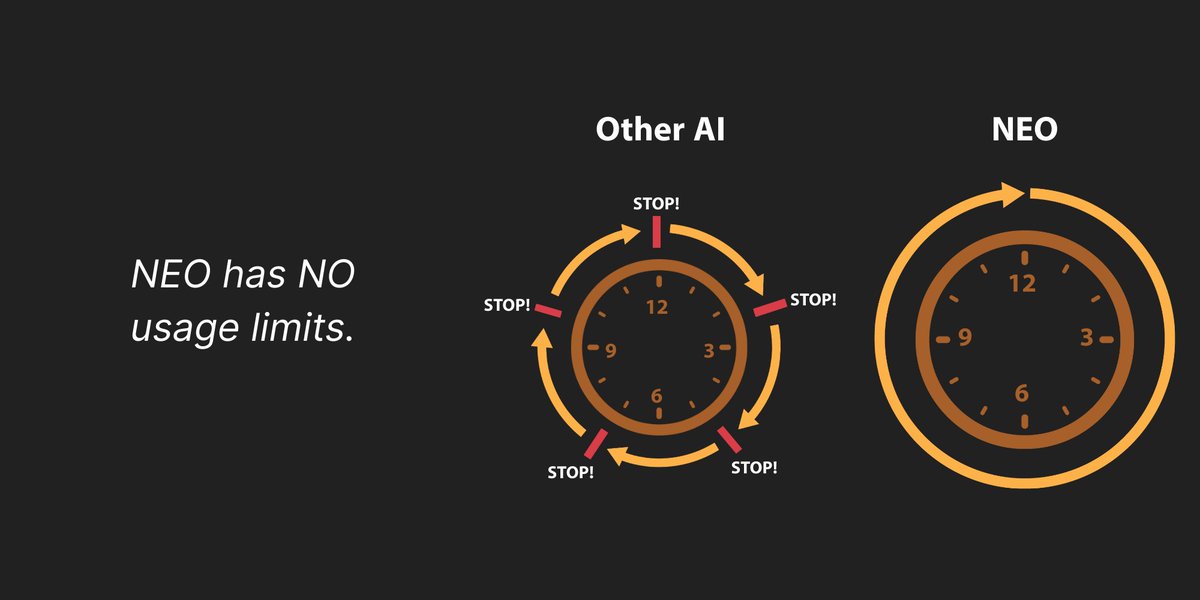
You hit usage limits. Capacity constraints. And have to carefully ‘context engineer’ every conversation.
Meanwhile, developers keep adding "features" that are more hype than substance.
• Persistent memory that remembers useless details while forgetting important ones.
• RAG that barely works.
• Models that codes “well” but can't remember basic instructions.
They're so focused on making AI intelligent, they forgot to make it useful.
And then comes the problem of AI Brainrot.
People outsourcing their thinking entirely and getting dumber with each conversation.
We’re losing the ability to think critically because AI validates every self-aggrandizing thought, conspiracy theory, and obeys every lazy request.
Even MIT documented the damage.
1. ChatGPT users showed 47% lower neural network efficiency than those writing unaided.
2. Memory recall collapsed to zero as not a single participant could correctly quote their own AI-assisted essay minutes after writing it.
Give it five years, and we'll have a generation that can't solve any problem without first asking an AI about it.
Can't form original thoughts.
Can't distinguish between their ideas and what AI fed them.
We're speedrunning into cognitive extinction, not through some dramatic AI takeover, but through voluntary surrender of our ability to think.
Because while developers are racing to build “more intelligent” AIs, what we actually need is AI that makes humans more intelligent.
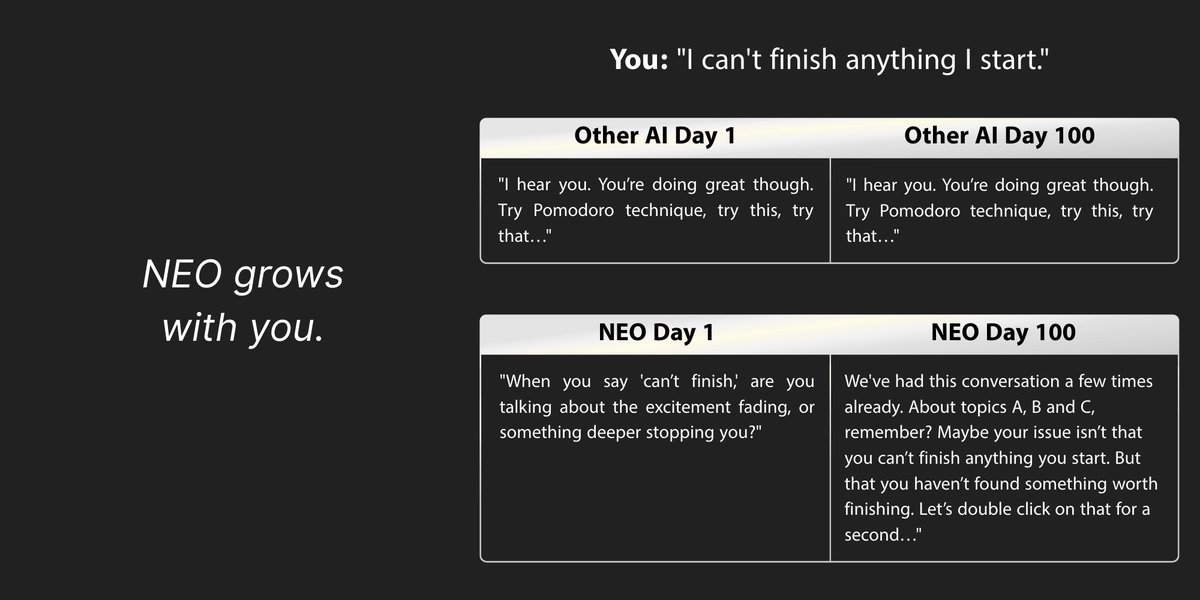
Current AI creates dependency and that's the opposite of what we need.
So here’s our plan to fix this.
THE GOAL
"Build NEO, the first AI that makes humans smarter instead of more dependent."
MEASURED BY
100 people messaging us "NEO made me realize something I couldn't see for years."
THE PLAN
1. (Immediate) Ship the 3 core features that makes NEO different. More on that soon.
2. Become Patient Zero: We use NEO daily ourselves. If it doesn't improve our own thinking, it's not ready.
3. Document Everything Publicly: Every bug, every breakthrough, every realization. Messy and visible.
4. Price for Commitment: High enough that only serious thinkers join.
5. Build The Movement: Let real breakthroughs create the content. Not hype.
THE PRINCIPLES
NEO will be built based on the following principles:
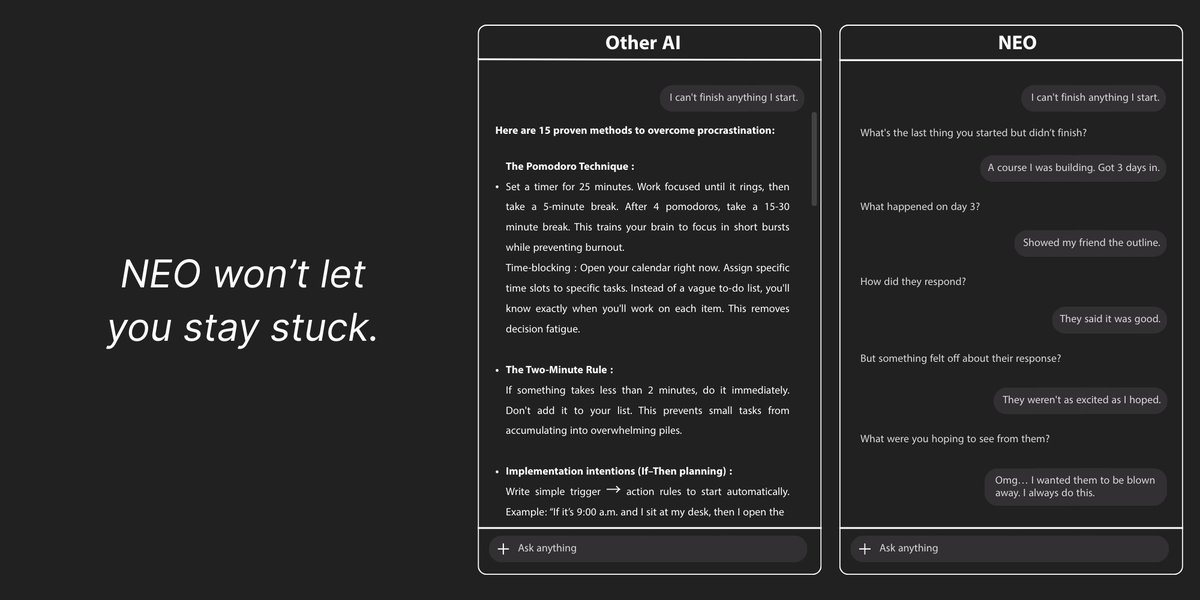
1. No Sycophancy: Other AIs validate everything you say and treat you like God. NEO will challenge what needs challenging to facilitate actual breakthroughs.
2. Questions Over Assumptions: Other AIs fill gaps with fabricated context and backtrack later. NEO clarifies and waits for alignment before getting to work.
3. Equal, Not Servant: Other AIs grovel and hedge. NEO speaks clearly, cleanly, and with conviction. Like a smart human peer.
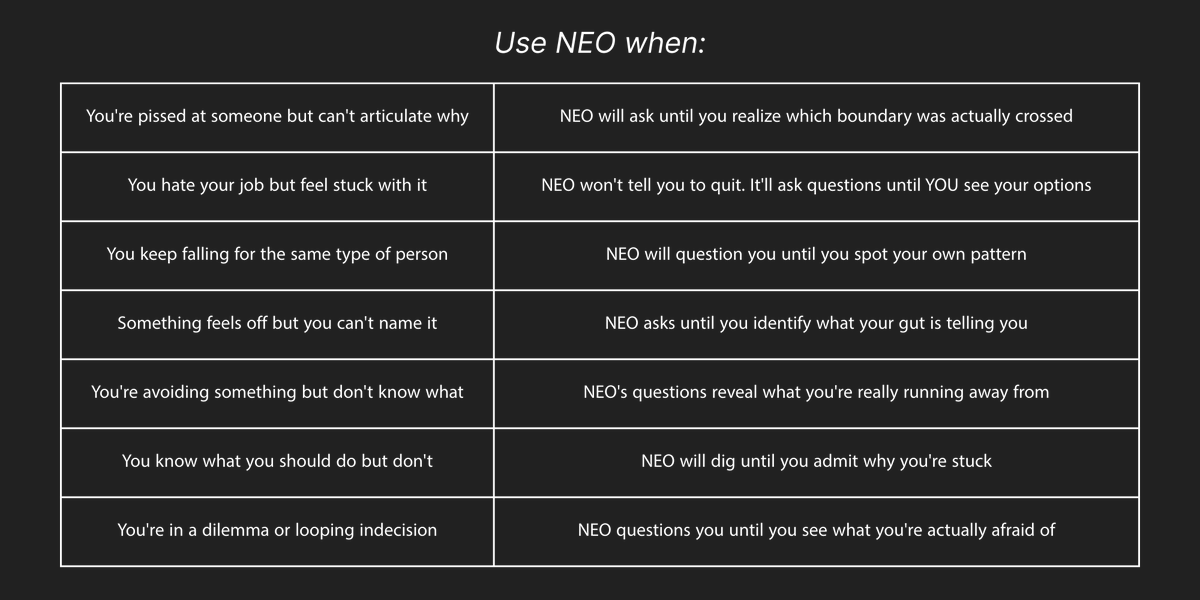
4. You Don't Prompt NEO: Other AIs rely on you to figure out the perfect context to feed them. NEO pulls out exactly what it needs from you through intelligent questioning.
5. Wisdom Over IQ: Other AIs are built to give you all the answers. NEO is built to figure out which one you need most… right now.
6. Your Truth, Not Everyone's: Other AIs are built to give advice based on what works for strangers. NEO learns and applies only what works for you.
7. Mirror, Not Manual: Other AIs show you information in their attempt to teach you. NEO teaches you by showing you blind spots you couldn't see alone.
Stay tuned.
We'll keep updating as we go.
FELIX
P.S. We're accepting applications for anyone who wants to be a NEO beta tester.
Find the application link in the first comment.
𝐕𝐢𝐛𝐞 𝐜𝐨𝐝𝐢𝐧𝐠 𝐯𝐬 𝐀𝐠𝐞𝐧𝐭𝐢𝐜 𝐞𝐧𝐠𝐢𝐧𝐞𝐞𝐫𝐢𝐧𝐠
The current market discusses building with AI agents as if the process requires no effort.
But they don’t understand the difference between vibe coding and agentic engineering.
Vibe coding prepares a project for a preview video, a sizzle reel.
Agentic engineering prepares a system for a stable production environment.
One in an expensive hobby, while the other is a business.
When done correctly, it can be a profitable business model, but it must be done right.
This June 24th, I am hosting a live debrief on 𝐀𝐠𝐞𝐧𝐭𝐢𝐜 𝐄𝐧𝐠𝐢𝐧𝐞𝐞𝐫𝐢𝐧𝐠 𝐅𝐨𝐫 𝐍𝐨𝐧-𝐓𝐞𝐜𝐡𝐢𝐞 𝐏𝐞𝐨𝐩𝐥𝐞.
I will show you the exact structural rules, the physical boundaries, and the mechanical gates I’ve learned to build and stabilize a complex AI system.
Register for the lab here: https://t.co/qXKzl1yiwm
𝐘𝐨𝐮’𝐫𝐞 𝐢𝐧𝐯𝐢𝐭𝐞𝐝
This 24th I will be hosting an “Agentic Engineering 101” webclass and you are invited.
In here we will learn:
- Why agentic engineering will be the new CV requirement.
- How building with agents is not as difficult as you think.
- Mistakes people do that makes it harder than necessary.
- “Prompting is a bug, not a feature.” - Why you may be wasting your time with AI bros.
- The Chokepoint Method that saves your sanity as your project grows.
- The “non-techie” architecture I discovered I wish I knew on Day 1.
I’ll be sharing the kind of information that, had I learned them early on, would have saved me many weeks and thousands of dollars in costly mistakes.
And more importantly, I will be sharing this from the perspective of someone who built a production ready app, as a non-technical founder.
People like us, I find, need to approach this in a slightly different way from how a software engineer would do it.
And I’m more than happy to share on the day itself.
Want in?
Register here: https://t.co/qXKzl1yiwm
𝐓𝐡𝐞 𝐡𝐚𝐫𝐝𝐞𝐬𝐭 𝐭𝐡𝐢𝐧𝐠 𝐈 𝐞𝐯𝐞𝐫 𝐝𝐨𝐧𝐞
Whenever people ask: “How are you?” they typically ask it expecting a “fine”
Its a normal social thing, but for me, it often confounds me.
How am I…relative to what?
My life goals?
Since last we spoke?
My station in life and society?
Or…just right now?
But what do 𝑟𝑖𝑔ℎ𝑡 𝑛𝑜𝑤 even mean?
When someone asks me “How are you Felix?” my brain automatically scans through the answers to all these different scenarios, all at once.
But I only have one mouth and the person is only expecting one answer, not a thesis.
That is, usually.
Today though, someone ask me how am I and there was one answer that shouts above all else:
“I am getting my ass kicked.”
NLC is the hardest project I’ve ever attempted.
Its not “the most suffering” - far from it.
Its not the wake-up-every-morning-with-a-panic-attack kind of hard like it was back in the day.
I’ve pivoted many times in my life, and every pivot was scary, and required adaptability.
NLC is the hardest one of them all for different reasons.
It’s hardest because I didn’t necessarily need to do it.
It goes against the grain of what every one with my background is doing.
Marketer, doing production-grade software, without even knowing how to read code?
Ridiculous. Surely that can’t work.
Yet it’s working every single day.
NLC now has 22 customers.
We started with $700 install fee per copy, with $100/mo maintenance.
Today it’s become $1,250 install fee per copy, with $200/mo maintenance.
Regular users of Claude Code, Codex, are signing up even with my premium prices.
And folks are reporting wins and easy 10x ROI from using NLC.
The struggle is real. I’ve had many sleepless nights from coding and fixing bugs.
I am learning things far, far outside my comfort zone.
I might even say outside my 𝑡𝑜𝑙𝑒𝑟𝑎𝑛𝑐𝑒 zone.
But through all my fears and discomfort, my gut tells me this is all going to be worth it.
On the 24th June 9pm SGT, I’ll be sharing all the things I’ve learned from my journey building with agents.
Real, practical tips from someone who understands what it’s like having to build production grade systems without software engineering knowledge.
The webclass is called Agentic Engineering 101 and you’re invited to join.
Sign up here: https://t.co/qXKzl1yiwm
𝐈𝐭 𝐟𝐢𝐧𝐚𝐥𝐥𝐲 𝐬𝐡𝐢𝐩𝐩𝐞𝐝
Around 2 months ago, I saw the limitations of NLC.
When it comes to agentic engineering, its easy (and tempting) to keep adding new functions and features.
The sexy ones.
The ones that make people go “wow!” and get lots of attention.
Its very tempting to just create sizzle reels off the 10% times that things do work, talk about all that things that the product 𝑐𝑎𝑛 do while conveniently hiding things it can’t.
But the reason why I won’t is because NLC wasn’t built for ‘everyone.’
It was built for me and people like me.
Nothing in the market has what I need without having to stitch together apps from dozens of different sources.
I wanted everything that I will ever need, under one roof, capable of producing the output of an entire corporation.
One human deciding the direction, with an army of AI agents doing my bidding.
Yes, there’s a lot of these “AI employees” concept going around these days…
…but many of them are employees in name only.
You can’t really rely on them the same way you can rely on humans.
I want generals, not infantry.
I want things that glues all of them together, not be the glue myself.
NLC is my vehicle, and to prove that it works, it needs to be able to do all of that for me.
2 months ago, I encountered that limit.
NLC was “fine” - but fine wasn’t good enough.
I got to work and announced that I am creating a major “stability update.”
That same update took so much work, it is now becoming NLC 2.0.
While that was happening, however, my customers weren’t getting updates.
Reason is that while I dogfood my own creations, my own copy of NLC that I am using is simply a huge mess of bugs.
Not production ready.
So shipping stopped because I need to make the changes on my main copy, and ship that copy to everyone else.
For a long time, that weighed on me.
And then I discovered the concept of a ‘hotfix.’
Basically:
- If there is a bug, make the fix in the customer machine directly instead of on my machine
- If there is a feature request, make the changes in their machine instead of mine
- Merge the changes to the latest stable version instead of my own copy
- Roll it out fleet wide
I quickly established a protocol for that a few weeks back, and proved it on the same day.
Today, I compiled 35+ stabilization updates I’ve made over the weeks and shipped the whole thing.
So stabilization update: Mission Accomplished.
But in the pursuit of this mission, I realized there are so many more things that I need to do in order to realize my vision of a 1 man corporate army.
And so, the next mission is to finish NLC2.
Since a lot of the work has been ongoing for the past 6 weeks however, I am glad to say I am not starting from scratch.
I will be updating you guys on my progress as I go.
Doing this, I also realize there are so many things that vibe coders really miss when they are building their apps and so on.
If I with all my experience with AI could get my ass kicked in real production work, I imagine the same might apply for many others too.
So I’m thinking to run a class on agentic engineering, sharing everything I’ve learned so far about building with AI.
Frameworks, processes, how to manage agents, etc.
Would attending said class be of interest to you?
Hit reply and let me know.
𝐈 𝐚𝐥𝐦𝐨𝐬𝐭 𝐝𝐢𝐝𝐧’𝐭 𝐰𝐚𝐧𝐭 𝐭𝐨 𝐬𝐞𝐧𝐝 𝐭𝐡𝐢𝐬.
About three weeks ago I stopped writing my updates and this changes now.
I had things to share, but I was fighting a battle in the trenches.
About 2 months back, I started noticing something weird about NLC.
The majority of users were fine. But a small subset reported repeated bugs.
Every new feature I added felt like taking 20 steps forward and 19 steps back.
I started working with my agents to figure out why.
The answer was simple: the codebase had grown too large for the agents to handle.
When I started, I was a "vibe coder" - zero engineering background.
I let the platform grow organically:
- Many features were added in isolation
- We have redundant codes
- Split feature owner issue
- Duplicates here and there
AI makes generating code incredibly fast. But that speed can mask a structural danger.
And if you don't pay attention, the complexity will come back and bite you.
NLC is "fine." But "fine" is not enough.
I want an agent operating system that can create the output of an entire corporation, run by one person.
And to make that transition from good to great, I have to take a pause on development, and focus on stabilizing everything.
So six weeks ago, I paused development and started a stabilization project.
But every layer I uncovered forced me to learn more about actual software engineering.
When I finally hit the bottom-most layer, I realized that ‘stabilization’ is not really what I wanted
There is an entire league of difference between a weekend side project over a production-grade system, and you can’t build a skyscraper on a foundation that was designed for a single-story home.
35 hours ago, after days of scoping conversations and double-checking every assumption, I gave my lead agent the greenlight.
I abandoned the six-week stabilization project entirely.
We aren't updating NLC anymore.
We are building NLC 2.
It was a painful pivot and it cost me six weeks of work.
But it is the only way to achieve the scale I want.
My journey so far has taught me that the transition from prompt-writer to agentic engineer is brutal.
But the direction is worth it.
I am going back to monitor the build.
𝐈 𝐚𝐥𝐦𝐨𝐬𝐭 𝐝𝐢𝐝𝐧’𝐭 𝐰𝐚𝐧𝐭 𝐭𝐨 𝐬𝐞𝐧𝐝 𝐭𝐡𝐢𝐬.
About three weeks ago I stopped writing my updates and this changes now.
I had things to share, but I was fighting a battle in the trenches.
About 2 months back, I started noticing something weird about NLC.
The majority of users were fine. But a small subset reported repeated bugs.
Every new feature I added felt like taking 20 steps forward and 19 steps back.
I started working with my agents to figure out why.
The answer was simple: the codebase had grown too large for the agents to handle.
When I started, I was a "vibe coder" - zero engineering background.
I let the platform grow organically:
- Many features were added in isolation
- We have redundant codes
- Split feature owner issue
- Duplicates here and there
AI makes generating code incredibly fast. But that speed can mask a structural danger.
And if you don't pay attention, the complexity will come back and bite you.
NLC is "fine." But "fine" is not enough.
I want an agent operating system that can create the output of an entire corporation, run by one person.
And to make that transition from good to great, I have to take a pause on development, and focus on stabilizing everything.
So six weeks ago, I paused development and started a stabilization project.
But every layer I uncovered forced me to learn more about actual software engineering.
When I finally hit the bottom-most layer, I realized that ‘stabilization’ is not really what I wanted
There is an entire league of difference between a weekend side project over a production-grade system, and you can’t build a skyscraper on a foundation that was designed for a single-story home.
35 hours ago, after days of scoping conversations and double-checking every assumption, I gave my lead agent the greenlight.
I abandoned the six-week stabilization project entirely.
We aren't updating NLC anymore.
We are building NLC 2.
It was a painful pivot and it cost me six weeks of work.
But it is the only way to achieve the scale I want.
My journey so far has taught me that the transition from prompt-writer to agentic engineer is brutal.
But the direction is worth it.
I am going back to monitor the build.
𝐈 𝐚𝐥𝐦𝐨𝐬𝐭 𝐝𝐢𝐝𝐧’𝐭 𝐰𝐚𝐧𝐭 𝐭𝐨 𝐬𝐞𝐧𝐝 𝐭𝐡𝐢𝐬.
About three weeks ago I stopped writing my updates and this changes now.
I had things to share, but I was fighting a battle in the trenches.
About 2 months back, I started noticing something weird about NLC.
The majority of users were fine. But a small subset reported repeated bugs.
Every new feature I added felt like taking 20 steps forward and 19 steps back.
I started working with my agents to figure out why.
The answer was simple: the codebase had grown too large for the agents to handle.
When I started, I was a "vibe coder" - zero engineering background.
I let the platform grow organically:
Many features were added in isolation
We have redundant codes
Split feature owner issue
Duplicates here and there
AI makes generating code incredibly fast. But that speed can mask a structural danger.
And if you don't pay attention, the complexity will come back and bite you.
NLC is "fine." But "fine" is not enough.
I want an agent operating system that can create the output of an entire corporation, run by one person.
And to make that transition from good to great, I have to take a pause on development, and focus on stabilizing everything.
So six weeks ago, I paused development and started a stabilization project.
But every layer I uncovered forced me to learn more about actual software engineering.
When I finally hit the bottom-most layer, I realized that ‘stabilization’ is not really what I wanted
There is an entire league of difference between a weekend side project over a production-grade system, and you can’t build a skyscraper on a foundation that was designed for a single-story home.
35 hours ago, after days of scoping conversations and double-checking every assumption, I gave my lead agent the greenlight.
I abandoned the six-week stabilization project entirely.
We aren't updating NLC anymore.
We are building NLC 2.
It was a painful pivot and it cost me six weeks of work.
But it is the only way to achieve the scale I want.
My journey so far has taught me that the transition from prompt-writer to agentic engineer is brutal.
But the direction is worth it.
I am going back to monitor the build.
𝗪𝗵𝗮𝘁 𝗮𝗴𝗲𝗻𝘁 𝗼𝗿𝗰𝗵𝗲𝘀𝘁𝗿𝗮𝘁𝗶𝗼𝗻 𝗰𝗮𝗻 𝗱𝗼 𝗳𝗼𝗿 𝘆𝗼𝘂
I am hosting a workshop this Thursday, 21st May on agent orchestration, and you are invited to join.
Yesterday I told you about how I was working toward making NLC’s Overseer function work.
It wasn’t even possible 3 weeks ago.
But in the past 4 days I finally saw the first signs of success.
It was able to fix a single, very difficult bug overnight while causing no regression in any other parts of my system.
Then it was able to fix 4 overnight without me being in the loop.
Today, it was able to fix 16 difficult bugs in five and a half hours.
Without me being in the loop, with “done means done.”
(I was working on a completely different thing altogether)
These are not simple tasks like write an email here, do a presentation slide there, or even build a website.
No cron job or scheduled tasks. Not a dumb “routine” work.
It’s fully autonomous, with the agent adapting to the task at hand in real time, carrying itself turn after turn.
True agentic orchestration like this is state-of-the-art and I am working hard to deploy this because this will be a complete game changer for both my business as well as that of my clients.
Imagine an agent orchestrating taking over your marketing arm, testing and adapting in real time to data coming in from your social media stats, ad metrics and SEO dashboard.
Automatic follow up and retention of your consultation, coaching, or training clients - in a complete ownership kind of way instead of relying on dumb routine, robotic jobs.
Agents crawling through your entire Zoom recording vault and codifying your talks, meetings, consultations and sessions into mental frameworks, workflows, SOPs, lead magnets, and courses you can sell.
I want to show you more but you will have to join the workshop I am hosting this Thursday.
It is free for you, and it happens 9pm SGT.
Link in the comment section below 👇🏻
𝗣𝗿𝗼����𝗿𝗲𝘀𝘀
For the past 3 days I’ve gained a meaningful progress with the Overseer function of NLC.
I started the project for NLC as “NLC Stabilization Project”, but I soon realized that even something like this would take too lon because my app is getting large.
So, I decided to fold in Symphony and Sandcastle.
The rationale is this: Before I can even think about multi-agent orchestration, can the agents be trusted individually to create high quality work?
By high quality work, I mean:
• Done means done. I don't have to discover from my own usage that its still broken or not working.
• Does not introduce any other bugs
• Does not require a 1 hour scoping conversation or repeated conversation about doing the thing
I want the ability to pass a vague objective to any agent, and trust that it will get it done to my liking.
That alone is already very sophisticated.
I am not talking about something simple like “build a website”
I am talking about complex tasks like creating an entirely new function in an already large codebase - without breaking anything in the process.
In other words, NLC agents cannot be a high quality toy but a production-grade enterprise solution for businesses with real stakes and minimal room for errors.
And it worked.
I was able to start parallel agents, hand them a vague objective, and from there I only needed two touchpoints:
𝗧𝗼𝘂𝗰𝗵𝗽𝗼𝗶𝗻𝘁 #𝟭: When they come back after doing their research and present a plan
𝗧𝗼𝘂𝗰𝗵𝗽𝗼𝗶𝗻𝘁 #𝟮: When they finish the job and I know “done means done” because I don’t see any issue with the thing they built/fixed
With this new system of persistent memory I was able to task my agents with very complicated tasks that requires multiple hours of work.
Screenshot 1: The CLI agent ran for 6 hours 28 minutes and 40 seconds.
This wasn’t the longest run.
I took this screenshot during pause (after I slept) at a 16.5 hour long run.
The reason why I am happy with that is because every time I paused and asked the AI questions about what it did, it demonstrated that it has followed my instructions precisely.
It never lost sight of the objective, the constraints, and the state of the matter.
But that is nowhere near enough.
There have been many technical debts accumulated over the months, and I constantly parked them for later for one urgent reason or another.
For my vision of having an AI corporate army, I must not be the bottleneck.
If I had to be the one to tell
So I pushed on, and while fixing the tail end of a major blocker to NLC’s stabilization project, I realized that the Overseer was the perfect way to dogfood this implementation.
(The blocker was a merge conflict issue for parallel workflows that consumed 8 days where I was only able to use just 1 agent at a time.)
I had a stroke of inspiration and decided to implement that,
Screenshot 2: This morning, I woke up to this.
These screenshots are from my WebUI.
Specifically, the sidebar of NLC’s WebUI which keeps track of all the agents and the incoming messages from them.
Almost all of these were started by the Overseer.
The instruction I gave it was to fulfill the contract with me comprised of 34 work items (complicated ones), and if it encountered a blocker or a bug in the orchestration process preventing the work from proceeding, it should create another agent to unblock that before continuing.
When I started this project, Overseer wasn’t able to do anything at all.
3 days ago, I had proof that a single agent is able to take a very vague objective of mine and turn it into reality and to my liking without much of my input.
2 days ago, after working through the night, the Overseer was only able to steer one agent to finish one of the 34 tasks.
Yesterday, it was able to complete 4 tasks of the 34 work items, but one new item has to be added to the list, making it 35.
In the past 12 hours, only 2 items were done because of two reasons:
• Those two tasks were genuinely difficult
• We found that the same guards that forces agents to behave is overzealous
So now as I am writing this, we are making changes to the Agent Flow framework to make it minimal-friction for agent tasks.
And then comes another round of dogfooding which is to make the Overseer drive them once again as I go to sleep - its 1am here.
Tomorrow morning I will get to see the results of it.
Stabilizing NLC and the Overseer will unlock a whole set of new possibilities for me and all NLC users.
Ultra long running objectives without using Ralph Loops and cron jobs.
No dumb repetitive work. Not a robot zombie slave. An actual leader who can drive projects forward autonomously.
A general, not an infantry.
And you guys get to be on the front row seat as I continue to develop this.
𝗢𝗿𝗰𝗵𝗲𝘀𝘁𝗿𝗮𝘁𝗶𝗼𝗻 𝟭𝟬𝟭
For the past four months I’ve been building agentic workflows for my business.
A large part of it involved the idea of ‘Orchestration’ - many agents running and coordinating with each other in real time.
The reason why is because I don’t want single agents to do tasks for me.
I don’t want 5 agents to do tasks for me.
I want 50 full time agents, even a hundred, all of them leaders and orchestrators, running my company full time - and lead projects just the way highly competent human executives would.
And not tasks that are short lived like “build this website”
Tasks that are long lived like “take over the entire marketing arm of my business and grow my audience by 50% in the next 6 months”
This kind of workflow isn’t possible by manually copy pasting inputs and outputs.
Or by setting up fragile, single-purpose workflows and calling it an ‘agent’ (e.g. n8n).
No.
In order for my dream of having an AI corporate army, I need much more.
We need coordination and communication between the agent teams.
Quality control.
Predictable, near-deterministic outputs coming from reliable and adaptive agents.
In other words, agents you can count on.
This doesn’t exist (yet).
So I am building it.
Being part of my community means you get to be on the first row seat learning what I learned as an actual on-the-ground operator and practitioner.
Next Thursday, I am hosting a workshop on ‘Orchestration 101’ and you’re invited.
𝗢𝗿𝗰𝗵𝗲𝘀𝘁𝗿𝗮𝘁𝗶𝗼𝗻 𝟭𝟬𝟭
What you’ll be learning:
• The difference between ‘Agents’ and ‘Orchestrator Agents’
• Why should you care?
• What can orchestration do that single agents like Claude Cowork can’t do
• How to enforce QUALITY as a non-negotiable criteria in your agentic workflows
• What it actually takes for AI to run an entire business end-to-end without a human in the loop
• Real life example of my own orchestration framework in action
Zoom link coming tomorrow (it’s late here).
If you’re interested, reply with 𝗢𝗥𝗖𝗔
I’ll send you the registration link.