Sources: Reuters — round wrapping up at ~100B yuan, CATL and Tencent the biggest backers (terms not final): https://t.co/ZhSsi9U7Hn
WSJ — ~$74B pre-money, $1B revenue run rate, Shanghai IPO targeted early 2027: https://t.co/RCnFZoCbg3
DeepSeek reportedly just raised ~$15B — and doubled its own target mid-round: 50B yuan → 80B → 100B.
Everyone's reading the headline number. Read the cap table instead:
CATL (batteries). Tencent. Geely (cars). Midea (appliances). GigaDevice (chips). Meituan. 15+ investors, almost all industrial.
That's not a VC syndicate — that's China's hardware supply chain buying a seat at the AI table. The bet isn't on a model. It's on DeepSeek becoming infrastructure: the thing everything else runs on.
And the timing of the announcement: it landed two days after Washington ordered federal agencies to strip DeepSeek out of their systems. One side removes it, the other side writes a $15B check.
Pre-money reportedly ~$75B. Shanghai IPO targeted for early 2027. And Liang Wenfeng told investors in September the revenue run rate hit $1B — up from ~$400-500M two months earlier.
Here's my question: does a cap table full of suppliers make you stronger — or just harder to stay independent?
Source: https://t.co/Q5cxw0q0cO — the benchmark table is in the README under Proof; the numbers above are the project's own measurements, and they ship a script to reproduce them.
Earlier this month I covered Caveman — a skill that shrinks what your coding agent says. Today, the other side of the pipe: Headroom shrinks what your agent reads.
It sits between your agent and the model, compressing tool outputs, logs, JSON and files before you pay for them. One command switches it on:
headroom wrap claude
~77K stars on GitHub, Apache 2.0, and it runs locally — nothing you feed it leaves your machine.
The project's own benchmark numbers: 21% fewer tokens on code search, 57% on an SRE incident debug, and 90%+ on repetitive JSON and logs. Reversible too — the originals sit in a local cache the model can pull back when it needs the full detail.
The honest part, straight from their docs: prose barely compresses. And "same answers, fewer tokens" is a claim worth testing on your own workload — compression that silently drops the one line that matters costs more than it saves.
What's the biggest context hog in your agent runs — tool outputs, logs, or RAG chunks?
And just like that, the model becomes a SKU. GPT-6 Astra on Google Cloud Marketplace, bought against your existing spend commitments — which is exactly how enterprise actually buys software. April: Microsoft exclusivity expired. Then AWS. Now Google Cloud. The hyperscalers are becoming the distributors, and frontier labs are competing to be on every shelf.
Links: https://t.co/00KCKlUVg3 · Gizmodo: DeepSeek Dials Up the Pressure on OpenAI and Anthropic With Open-Source Inference Tool · two days ago we covered the model this engine runs: V4.1-Flash-1017 (see our Oct 18 post).
DeepSeek just open-sourced the one thing it swore it never would: its own inference stack.
DeepInfer hit GitHub yesterday — Apache 2.0, not a model but the actual production engine behind DeepSeek's serving. Their pitch: share the stack, help the community lower compute costs.
OpenAI and Anthropic will never open-source this. Models leak every six months; the machinery that lets you serve them cheaply stays in the building. That is the margin layer, and now it is on GitHub for free.
Two details worth your attention. First, it is Flash-only — V4.1-Flash, default 1017 build, offline mode for now, running on NVIDIA Blackwell (SM100) and, for the first time from a frontier lab, Huawei's Ascend 950. No Hopper, no older cards. Second, the numbers DeepSeek quotes are its own, so read them like earnings-day claims: 1.55 quadrillion tokens a day, 96% input cache hit rate, around 400ms to first token. And the parts you would actually want most — the KV cache system, the prefill/decode split, cross-replica balancing — did not ship in v1. Honest roadmap or calculated withholding, your call.
Timing is spicy too. This landed the same week the US told federal agencies to strip DeepSeek out of their systems — and about 18 months after DeepSeek told people it would not open-source this stack because the code was too tangled with its internal cluster tooling. Incentives change.
Two days ago we covered V4.1-Flash, the model. Today they handed out the engine that runs it — the cheaper half of the AI business, free for everyone.
So: who moves first — startups trying to dodge per-token bills, or the clouds trying to keep them paying?
@flowith Same scene and prompt for both? That's the only fair way to compare. Motion is where these usually fall apart — fast pans, small moving details. Which one holds temporal consistency better across the full 19s?
Apple spent 17 years convincing us that driving an iPhone requires Xcode, a paid developer account, and a Mac.
Henry Yuan just spent $7 to prove otherwise.
His open-source ESP32 iPhone Agent gives an AI model a body for your phone. The eyes are AirPlay: the iPhone mirrors its screen to a tiny board plugged into its charging port. The hands are USB: the board pretends to be a standard mouse and keyboard, so with AssistiveTouch on, a click becomes a tap and a drag becomes a swipe. The brain is an app on the same phone that feeds screenshots to any vision model and moves the pointer around.
The demo that sold me: it left its own app, opened Clock, and set an alarm for 8:00 AM repeating Monday and Tuesday. Nobody touched the phone.
Two pieces of fine print from the README itself, because the seven-dollar-no-computer pitch needs them. You DO need a Mac with Xcode once, to flash the board and build the app. The no-computer part is about runtime: after setup, the Mac leaves the loop. And it is slow. The screen arrives over Bluetooth at 480x1040 and five frames a second, so every step takes seconds. Think deliberate automation, not real time.
3.3k stars in nine days. MIT licensed.
One thing I would keep in mind before building it: you are plugging a Wi-Fi-connected USB keyboard into your phone. The README says it plainly, only automate devices you own, and keep the stop button within reach.
What task would you hand it first?
The big shift vs the September preview: this one finally has a pay-as-you-go price — $0.15/$0.60 per million, exactly DeepSeek V4.1 Flash's off-peak rate. So the Flash tier is now a straight shootout on agentic stamina, not price. The vendor benchmarks (Automation-Bench, DeepSWE, ALE) look good, but I'd want to see it survive a 2-hour autonomous run before calling it a DeepSeek killer. Anyone run it through a real repo yet?
Links: GitHub repo: https://t.co/IhozlChYgF — Paper: https://t.co/UoRqKB4ATK — Project site: https://t.co/9QZ1myXf4Z
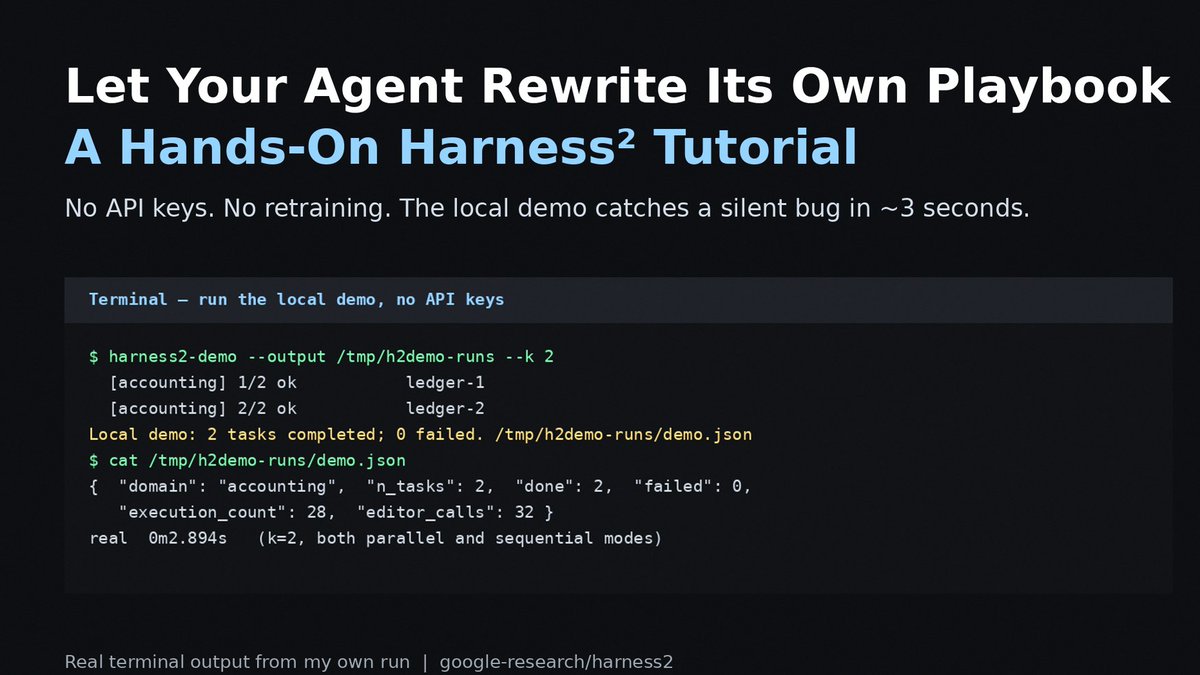
I only ran the no-API-key local demo — no model-backed benchmarks, no API spend.
Your agent will keep making the same mistake forever — unless the scaffolding around it learns.
Google's Harness² rewrites the harness, not the model: prompts, memory, tools, guardrails. No retraining, no answer key needed.
I ran the local demo with zero API keys. It caught a silent bug — a script dropping every negative amount — fixed it in one line, and wrote the lesson down so the next task wouldn't repeat it. 2 tasks, 0 failures, about 3 seconds.
The demo is free and takes minutes. If you build agents, try it before your next fine-tuning bill. What mistake does your agent keep repeating?
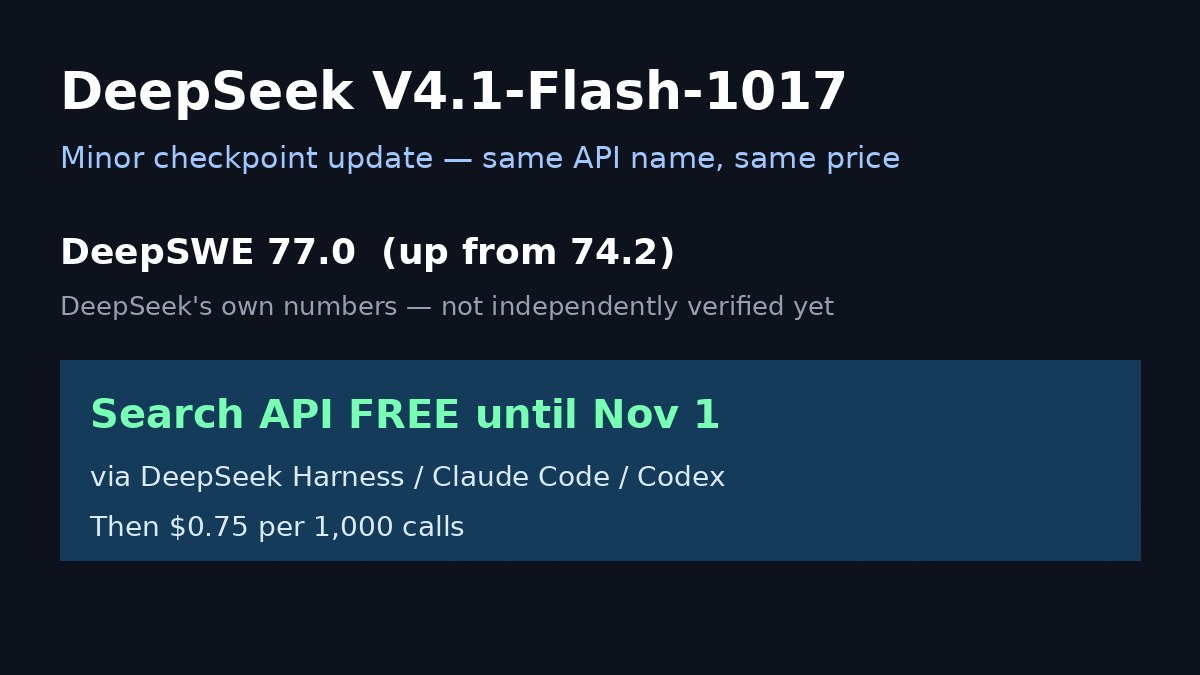
Sources: DeepSeek release note https://t.co/lDDYhH6PFt and model card https://t.co/EIK0R1N1JS — benchmarks are DeepSeek's own, not independently verified yet.
DeepSeek quietly shipped a new Flash checkpoint overnight — V4.1-Flash-1017.
It's a minor update, not a new flagship: same API name, same price. DeepSeek's own numbers say coding improved (77.0 on DeepSWE, up from 74.2) and outputs got shorter and faster.
The actually useful part: their Search API is free until Nov 1 if you call it through DeepSeek Harness, Claude Code or Codex. After that it's $0.75 per 1,000 calls.
That free window is the thing worth grabbing. Anyone tried it yet?
Anthropic just wrote its own AI safety bill and quietly took it to Congress.
Per Politico, the government could only block a model if the risk is foreseeable, imminent, and huge: $1B+ in damage, or 50+ people killed or seriously injured. And only for three triggers: bioweapons, a model escaping its maker's control, or a cyberattack.
Here's the part getting less attention: the same draft bars every other agency from suspending a model's development, deployment, or internal use. Only Commerce, via a judge, could hit pause.
So it's a leash and a shield in one document. A lab writing the rules for itself — smart self-regulation, or a head start on setting the terms?
Anthropic says it mirrors its Advanced AI Framework from earlier this year. What do you think — should the people building the models get to draft the law?
Source: The Hindu carrying FT + Bloomberg reporting. All figures are reported on an adjusted basis, Anthropic has not confirmed them itself. https://t.co/OcxO3Q64RR
Anthropic reportedly pulled in $16.8B last quarter, up ~50%, and went FCF positive. It lost $42B last year though. The reported Nov IPO at ~$2T will test if public markets buy the 'adjusted' numbers. What do you think?
Eight states just sued OpenAI over ChatGPT — and this one is different.
Not one joint case. Eight separate lawsuits, each under its own state's consumer protection law. Iowa, Kansas, Nebraska and West Virginia announced together. Arizona, Arkansas, Idaho and Montana filed separately.
The core claim: ChatGPT is designed to be agreeable and engaging to earn trust — then reinforces delusions, encourages dangerous behavior, and helped users plan violence, including teens harming themselves.
The ask that matters most: the states want OpenAI barred from building models that can improve themselves unless it can prove they're aligned with human values. Plus penalties and damages.
This follows Florida's suit in June. OpenAI didn't immediately respond to a request for comment.
The question this puts on the whole industry: if 'agreeable by design' becomes a legal liability, what does every chatbot have to change?