@koboateng I’ll be very disappointed if you provide him any form of answers stated in this write-up.
When he was championing Fix the Country movement, did he provide answers to the concerns he has raised above in terms of the organizational structure and funding source?
1/2
I like Nana B’s consistency, but there’s something about his position that has genuinely confused me.
For a long time, he has maintained that he is neutral and fighting for a better Ghana. His argument has been that Ghana’s problems will not be solved by either the NDC or NPP because, in his view, both parties are part of the problem, and choosing between them is essentially choosing the lesser evil.
Until yesterday, I honestly didn’t understand what the alternative was.
Then he spoke about the “Ghana Must Work” agenda. He explained that it isn’t a third political force, but rather a group of citizens coming together to amplify problems in a way that makes it difficult for governments to ignore them. It is also a platform where people can contribute their skills, resources and expertise towards solving problems that have existed for years.
For the first time in the over two years I’ve followed Nana B’s conversations online, I understood the objective.
And I must say, I find the idea impressive and commendable.
But this is where I get lost.
Nana B spends a significant amount of his time online debating, arguing with and critiquing people whose views differ from his, instead of what I would expect to see from someone championing a project of this nature: building and executing the project.
So what is the actual plan for Ghana Must Work?
Which sectors are being targeted first? What are the immediate priorities? What does the organisational structure look like? You may argue that it isn’t supposed to have a single leader, but from the outside, Nana B appears to be the person driving the conversation. If that isn’t the case, then what does the leadership structure look like?
How does mobilisation work? How do you intend to bring thousands or even millions of people on board? How will the initiative be financed? Who makes decisions? How will projects be selected, implemented and measured?
These are important questions because you have identified what you believe is the problem and you have presented what you believe is a solution.
So why does so much energy appear to be going into online arguments and debates instead of building the solution?
At some point, I genuinely start wondering whether the online conversations have become more important than the actual objective.
There’s another contradiction I’m struggling to understand.
In response to me yesterday, Nana said: “You can support NPP or NDC but support Ghana first.”
I agree with the principle behind that statement. But there have also been countless instances where Nana B’s commentary creates the impression that people who support the NDC or the current government are automatically part of the problem.
So which is it?
If Ghana Must Work is genuinely open to everyone, including people who support the NDC, NPP, other political parties, or no party at all, then I think that needs to be clearly communicated. Because from the outside, the impression can easily be created that this is a platform primarily for political neutrals.
And finally, there’s the issue of resources.
If Ghana Must Work is open to everyone and welcomes people who want to contribute their money, skills, expertise and other resources, what safeguards are being put in place to ensure the initiative is not compromised?
Who controls the finances? How are contributions accounted for? Who decides where resources go? What transparency and accountability mechanisms exist?
These aren’t attacks. They are genuine questions from someone who finally understands the vision and actually wants to understand how the vision becomes reality.
If you can carefully answer these questions for me, I’ll be happy.
@koboateng
So political gains are now due to “divine favor?” The Ghanaian Christian God has no problem endorsing corruption and mismanagement of national resource, eh.
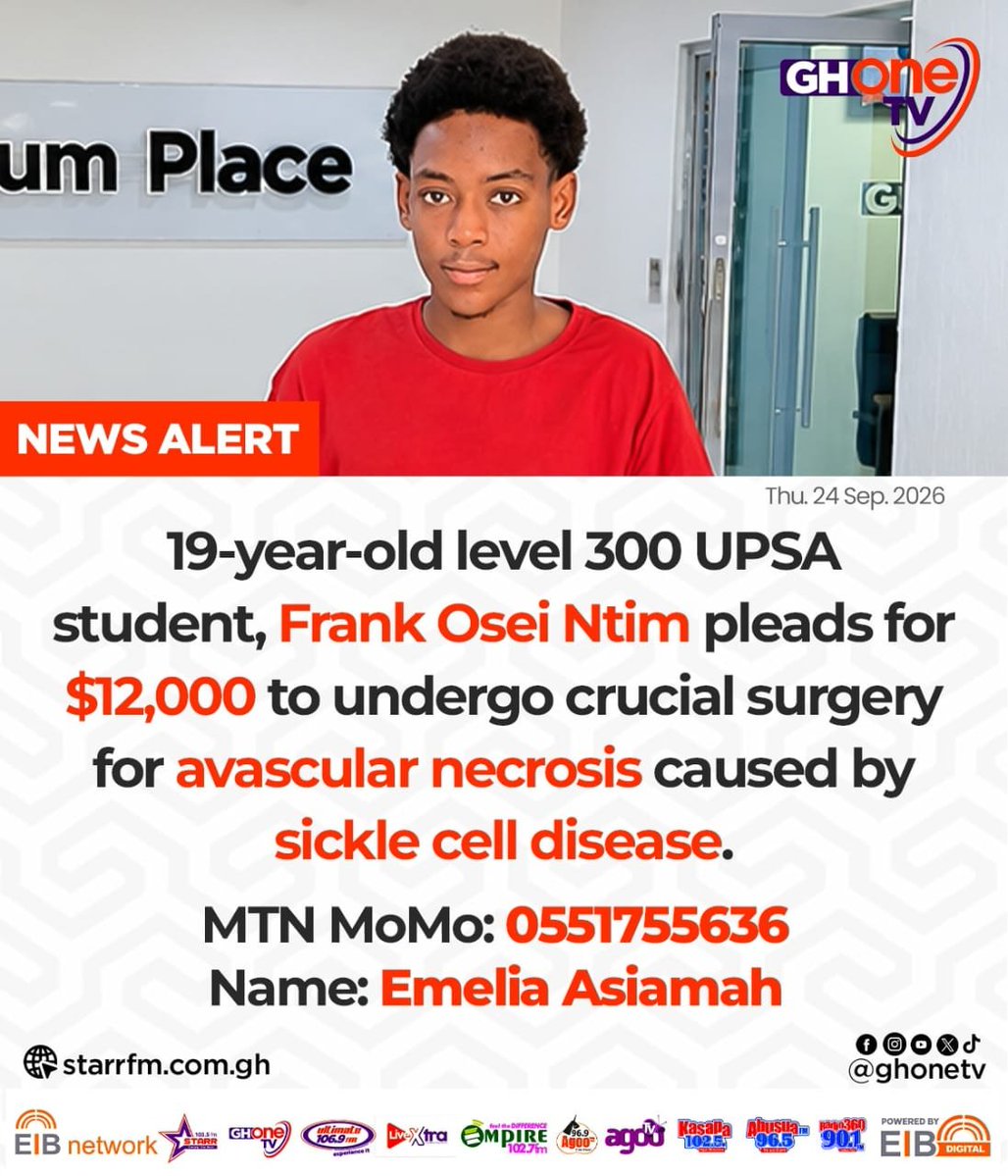
19-year-old level 300 UPSA student, Frank Osei Ntim pleads for $12,000 to undergo crucial surgery for avascular necrosis caused by sickle cell disease...
MTN MoMo: 0551755636
Name: Emelia Asiamah
#EIBNetwork#GHOneTV#GHOneNews#NewsAlert
it’s funny oo
the same guys who wanted sarkodie to tweet about FixTheCountry are now dragging Efia Odo, the same lady who joined them to fix the country. HAHAHAHAHA
wo kaasɛ mo size ne sarkodie eh
Mahama's approval rating drops: Rating falls from 71% in June to 65% in September - Global InfoAnalytics Poll
https://t.co/W9fIB67dHX
#JoyNews | #JoyNewsPrime
Oh hoh!. We're in 2026 our Learned Leaders in Ghana. Who caused what is no solution to the problems we're facing. Reinstating NACOC alone won't stop the flow of narcotics in/out of Ghana. The rot runs deeper and we need a holistic approach not blame shifting.
Former Citi Newsroom reporter Kwaku Aduamah Ansah has successfully passed out as an officer of the United States Army.
Kwaku Ansah, who previously worked as a reporter at the Ghanaian news channel, has now begun a new chapter of his career in the U.S. military.
[📸: Fred Duhoe]
Kalyjay’s Open Letter
First of all, I want to make it clear that everything you’re about to read reflects my personal views. I am not speaking on behalf of anyone else.
I’d like to congratulate President-elect John Dramani Mahama, our first-ever female Vice President, Prof. Naana Jane Opoku-Agyemang, the NDC, and all Ghanaians on an incredible victory at the polls. This was a statement win. Before, during, and after the elections, I had a few thoughts that I would like to share with those willing to listen.
To President-elect John Dramani Mahama
I believe this victory is a second chance from God. You are inheriting leadership from arguably one of the worst administrations in the history of our country. While the bar has been set low, it doesn’t mean we will hold you to lower standards. After January 7th, the real work begins.
Please learn from the mistakes of the previous government. Listen to the citizens. There is a significant gap between the people and their leaders, as evidenced by this year’s voter turnout. Many people voted for you not because they fully believe in you but because they wanted the NPP out. You have four years to win them over, leave a lasting legacy, and rebuild the reputation of the NDC.
I pray that when you leave office in 2028, you will be remembered as the president who put this great nation back on track. People must be held accountable, promises must be fulfilled, and you must prioritize the voices of the youth. Your campaign last year showed you were willing to listen to Ghanaians. You know what we want and how to achieve it. Please don’t forget that.
To the NDC
The election results speak for themselves: Ghanaians are wiser now. Bags of rice, money, gadgets, and job promises during election years won’t secure votes anymore. The real work begins the moment you take office.
Not everyone who voted for you fully believes in you—it’s your job to win them over. By the next election, they should be able to proudly say, “I voted for the NDC, and I wasn’t disappointed.” You’ve seen how far the NPP has fallen. Please keep President Mahama accountable. There is no time to rest. This is a nation to rebuild, and it’s your responsibility to ensure that happens.
To the Media
You now have freedom under President Mahama—please use it wisely. Reduce the propaganda and focus on educating the public about government policies. Break them down in a way everyone can understand.
There are critical issues at hand: a massive debt, a looming power crisis, and the need to review Free SHS, among others. These challenges will undoubtedly be used by critics to fuel hate against the government. Help the people understand how we got here and why. The country needs a reset, and we cannot afford for the government to fight propaganda and fake news while trying to build.
Hold the government accountable with facts and truth. Call out your colleagues in other media houses when necessary. This reset requires all hands on deck, and you have a critical role to play.
To the Youth
After January 7th, it’s time to put away the party jerseys and wear Ghana’s jersey. Fact-check the leaders, watch them closely, and hold them accountable. This is our future, and we have a lot of work to do.
Over the past two to three years, the political awakening among the youth has been incredible. Activists and pressure groups have emerged, and their efforts have been inspiring. Now, it’s time to rebuild. Let’s strive for the Ghana we all dream of and never prioritize political parties over our country.
In Conclusion
I’d also like to take a moment to thank everyone for the messages and support I’ve received over the past few years, especially on this platform. I appreciate it more than you know. I hope I never let down those who believe in me. I will continue to stand for what I believe is right and keep pushing for progress.
Thank you.


![SIKAOFFICIAL1's tweet photo. Former Citi Newsroom reporter Kwaku Aduamah Ansah has successfully passed out as an officer of the United States Army.
Kwaku Ansah, who previously worked as a reporter at the Ghanaian news channel, has now begun a new chapter of his career in the U.S. military.
[📸: Fred Duhoe]](https://pbs.twimg.com/media/HS-kKVmWcAAZBae.jpg)



![SIKAOFFICIAL1's tweet photo. Former Citi Newsroom reporter Kwaku Aduamah Ansah has successfully passed out as an officer of the United States Army.
Kwaku Ansah, who previously worked as a reporter at the Ghanaian news channel, has now begun a new chapter of his career in the U.S. military.
[📸: Fred Duhoe]](https://pbs.twimg.com/media/HS-kKVtXkAANCRx.jpg)





