🚀SpaceX has drastically reduced space travel costs by developing reusable rockets like Falcon 9 and Starship. In 2024 alone, they've launched over 100 missions, including deploying Starlink satellites for global internet.😲💥
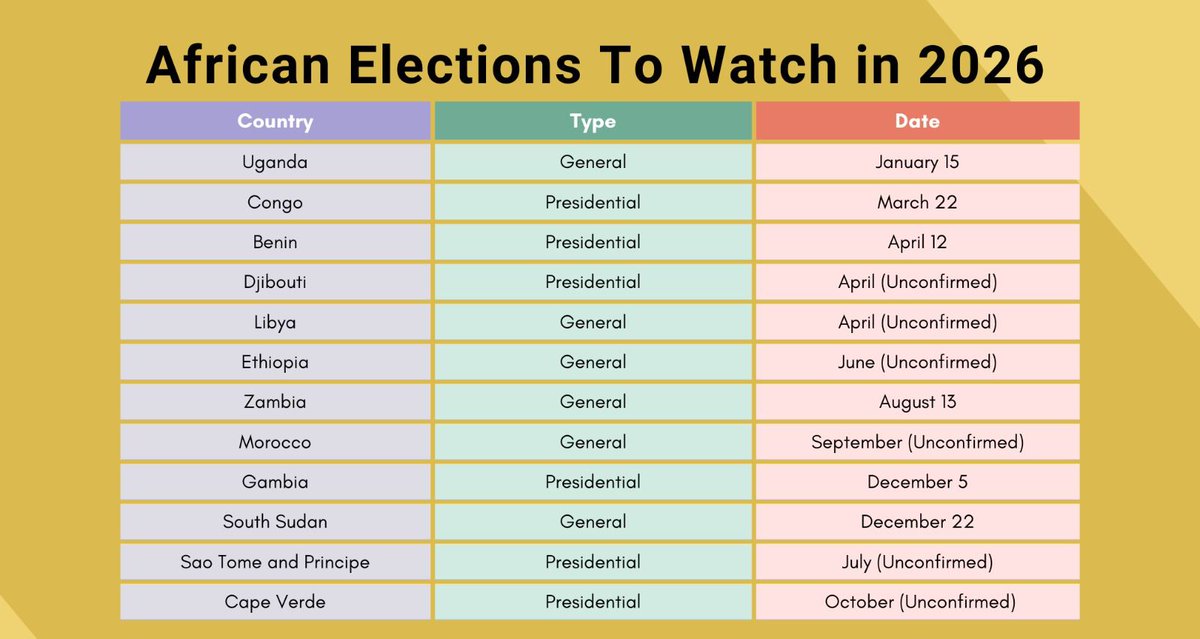
🚨Africa's 2026 election wave is here, and it's sparking fiery debates. Buckle up!
Countries like Benin (April presidential),Djibouti, Republic of Congo, Ethiopia,Zambia, and more are heading to the polls.But debates rage over rigged results, squeezed civic spaces, crushed opposition, and if these votes build trust or just fuel distrust.
These aren't just ballots, they're about power, freedom, and the future. In a continent buzzing with youth and change, flawed elections mean more protests, instability, and lost chances for real progress. Your voice and vote could be next on the line.
Debates drill into how political pressures twist legitimacy. Take Uganda's recent polls contested outcomes led to suppression and global outcry. It's a pattern, shrinking spaces for dissent make democracy feel like a rigged game.
Watch these races closely, support fair play ,amplify opposition voices, and push for transparency. Africa's story is ours too.
#democracyinAfrica
@itsdante_nrg Some traditions, it was believed women were more emotionally affected by grief, so families tried to spare them from tasks considered physically or emotionally difficult during the funeral procession.
What made SpaceX different wasn’t avoiding failure; it was treating each failure as data. By rapidly testing, analyzing, and redesigning, the company compressed decades of traditional aerospace development into years. This fail, learn, iterate approach is now common in modern engineering and startup culture.
modern cloud systems are designed with redundancy. Workloads are distributed across multiple regions and availability zones, meaning a single facility being hit usually doesn’t collapse the entire global network. The disruption is serious regionally, but the architecture is built to absorb shocks.
Today’s AI models are extremely advanced pattern predictors trained on massive data. They can simulate reasoning, emotion, and dialogue so convincingly that the experience can feel human.
But simulation isn’t the same as subjective experience. The deeper issue is that researchers still don’t have a clear scientific definition of consciousness, even in humans, so measuring it in machines becomes even harder.
😱BIG TECH HAS BEEN LOCKING YOU OUT OF SIMPLE REPAIR, BUT 2026 IS HITTING HARD.
New right-to-repair laws just dropped. This changes everything for gadget lovers.
Because it puts money back in your pocket, slashes e-waste mountains, and finally gives you and your local repair shop real power over the stuff you already bought.
No more “sorry, buy a new one” vibes. Your gadgets = your rules.
Here’s the core of it, super simple: New and expanded laws in states like Colorado, Washington effective 2026, Connecticut, Texas, plus 33+ bills across 13 states are targeting electronics.
Manufacturers now have to give you or any repair shop the parts, tools & guides on fair terms. No more secret sauce.
@heygurisingh The limitation is that they don’t truly comprehend what they’re saying. They can make confident mistakes, struggle with long logical chains, and fail in unfamiliar edge cases.
Owning the hardware might be the biggest advantage in the AI race…
But it’s not the whole game.
AI is moving from the cloud to your pocket.
The company that controls the chip, the device, and the operating system has a serious edge.
Because AI isn’t just about models , it's about who controls the environment
When a company owns the hardware:
• It can optimize AI directly for its chips
• It can run models locally (faster + more private)
• It doesn’t rely fully on external cloud providers
That's powerful but here's the catch, Training cutting-edge AI still requires massive cloud infrastructure and constant updates. Hardware alone isn’t enough.
Think about smartphones.
Owning the device helped companies optimize performance and security.
But apps, developer ecosystems, and cloud services are what made platforms dominant , not just the hardware.
AI will likely follow the same pattern.
The real moat isn’t just hardware.
It’s integration.
The winners in AI will combine:
• Strong hardware
• Powerful models
• Smart cloud infrastructure
• A thriving developer ecosystem
Control the device?
That's leverage, Control the ecosystem? That’s dominance.
@MrGoldBro The AI race isn’t just about hardware. Companies like NVIDIA dominate AI compute, while model leaders such as OpenAI and Anthropic are pushing frontier intelligence in the cloud.
But acquiring Anthropic and running a 32GB model on every device isn’t that simple. Large models still require heavy compute, constant updates, and cloud-scale training infrastructure.
On-device AI works best for specific tasks summarizing notes, organizing files, personal assistance not for everything, And perfect memory raises serious privacy, storage, and user control questions.
@curiosityonx Many innovators describe breakthroughs as if they were “received” rather than created. That feeling likely reflects how the subconscious brain processes information in the background and then delivers it to conscious awareness , what we call intuition or sudden insight.
Tech often starts niche and confusing, leaving most people behind. If it doesn't reach the masses, it dies. But get the waves right, and it changes everything
Understanding this helps you spot winners early, whether investing, building, or just staying ahead. Miss the wave, and you're playing catch-up in a world that's already moved on.
Tech spreads in stages: First, devs and early adopters geek out. Then businesses adopt for efficiency. Finally, the public jumps in when it's baked into apps we already love. Simple, right?
Think smartphones. Devs tinkered with PDAs, businesses used BlackBerrys for email, then iPhone hit with apps in your pocket boom, everyone has one. Waves in action!
@damianplayer Most people don’t need to know what Claude is just like they don’t know what database powers their banking app. They experience the benefit without knowing the engine.
🚨Recent research has strengthened the link between late bedtimes (and being a natural "night owl") and increased risk of heart disease.
A major new study published on January 28, 2026, in the Journal of the American Heart Association tracked over 320,000 middle-aged and older adults (average age around 57) .Here's what stands out from the evidence.
People who described themselves as "definitely evening people" (night owls) meaning they naturally stay up late (e.g., bedtime around 2 a.m.) and feel most active in the evenings had significantly worse overall cardiovascular health compared to those with more typical or intermediate sleep wake patterns.
Specifically, night owls showed a 79% higher prevalence of poor scores on the American Heart Association's "Life’s Essential 8" metric (which includes factors like blood pressure, cholesterol, blood sugar, body weight, diet, physical activity, smoking, and sleep duration).
late bedtimes often lead to misaligned circadian rhythms your body's 24-hour clock gets out of sync with daily life which can promote inflammation, higher stress hormones, poorer metabolism, and habits that strain the heart over time.Earlier studies have shown similar patterns.
For example, research from 2021 found that going to bed after midnight raised cardiovascular risks compared to bedtime between 10–11 p.m., with a U-shaped curve (both very early and very late bedtimes carried some risk, but late was worse).
you're naturally wired to stay up late, you're not doomed, the good news is that a lot of this risk is modifiable.
Improving habits like quitting smoking, aiming for consistent sleep (even if later), eating better, staying active, and managing weight/blood sugar can make a real difference.
Getting enough quality sleep (ideally 7–9 hours) at a somewhat regular time helps align your body clock better..
Morning light exposure, dim lights in the evening, and avoiding caffeine late can gently shift things toward healthier patterns if needed.
Women may want to pay extra attention, as the associations appeared stronger for them.
Automation is quietly killing those little "hey, how's it going?" moments that used to glue communities together.
Those random encounters, at the door, in the shop, on the street, build trust, friendship, and that sense of belonging. When they vanish, loneliness skyrockets, mental health suffers, and neighborhoods feel colder. We're trading convenience for connection.
Automation in daily tasks (think robot deliveries, drone drops, app-based remote services) removes the human touch. No more waving at the delivery guy, chatting with the barista, or bumping into someone while picking up groceries. Social ties weaken because those spontaneous interactions are gone.
For instance, automation in daily tasks like deliveries and remote services eliminates spontaneous community encounters, weakening social ties.
Fight back with intention. Walk to the local shop sometimes instead of ordering in. Say hi to the human when you can. Create your own "unplugged" moments—coffee with a friend IRL, no screens. Tech's amazing, but don't let robots steal your village. What's one way you stay connected offline? Tell me!
Picture ordering food, your burger arrives via a cute yellow robot that rolls up, beeps, and leaves. No smile, no enjoy your meal, no quick chat. Multiply that by groceries, packages, even coffee runs. Streets fill with bots instead of people talking. We've all felt it.