I'm building Futari, a Japanese learning app for the people who quit Duolingo.
No streak shame. No leagues.
Just a fox, a tanuki, and a real curriculum that gets you to JLPT N5.
Free at the core. iOS + Android.
🦊🦝🌸 https://t.co/p5rdfhO4sW
@vanicakeivi i think there are a lot of good online resources depending on what you want to learn, but if you'd like to try an app feel free to try mine! :)
@Bhushan4work_ i recommend using Tofugu to learn hiragana and katakana! And then I'd recommend learning basic vocab and grammar throguh Genki or Tae Kims Grammar Guide, while also using Anki decks!
If you could build the perfect Japanese learning app from scratch, what's the ONE feature it absolutely has to have?
Not five features. One.
The non-negotiable.
The most important word on this list is 半額 (hangaku — half price). Japanese supermarkets discount bento boxes and fresh items in the evening, usually after 7–8pm. You'll see yellow 半額 stickers on everything. That's your cue to eat like royalty for 300 yen.
Most learners only know さようなら. 😅
Here are goodbye phrases Japanese people actually use. 👇
・じゃあね (jaa ne)
→ see you
(casual, with friends)
・またね (mata ne)
→ see you later
(casual, you'll meet again soon)
・バイバイ (baibai)
→ bye
(common with friends and family)
・また明日 (mata ashita)
�� see you tomorrow
(when you'll meet again tomorrow)
・じゃ、また (ja, mata)
→ see you
(very common casual farewell)
・またあとで (mata ato de)
→ see you later
(when you'll meet again later the same day)
・また今度 (mata kondo)
→ see you sometime
(when no specific date is set)
・気をつけて (ki o tsukete)
→ take care
(when someone is leaving)
・お疲れ様です (otsukaresama desu)
→ goodbye
(common at work)
・お先に失礼します (osaki ni shitsurei shimasu)
→ I'm heading out
(when leaving work before others)
#Japanese #日本語 #LearnJapanese #JapaneseLanguage #JLPT
@James_II_1688 My suggestion is first starting with learning the kana: hiragana and katakana. From their start building a solid foundation by learning basic grammar structures and basic vocab. As you progress start including more and more active and passive listening!
@ugliestdeath Learn the basics like hiragana and katakana, then start building a solid base including basic vocabulary and then basic grammar, and then from there including more and more active and passive listening!
Three forms of "delicious" in Japanese:
おいしい (oishii): standard, polite, safe うまい (umai): casual, masculine, stronger やばい (yabai): slang, means "this is insanely good"
やばい means "dangerous." Its used for anything extreme: good, bad, delicious.
Context is everything.
The Japanese word for "breakfast" is 朝ご飯 (asagohan).
朝 = morning ご飯 = rice/meal
"Lunch" is 昼ご飯 (hirugohan). Afternoon rice.
"Dinner" is 晩ご飯 (bangohan). Evening rice.
Every meal in Japanese is defined by rice.
Japanese has no spaces between words.
この文章にはスペースがありません。
Your brain learns where one word ends and another begins by recognising kanji, hiragana, and katakana boundaries.
That's why learning all three writing systems isn't optional. They're the spaces.
【Essential Japanese Particles ② ✍️】
Here's another set of commonly used particles!
When you learn new verbs, it'd be more effective to learn it with particles and example sentences to understand what particle it usually takes!
Hope this helps! 🔁 ❤
#Japanese#JLPT
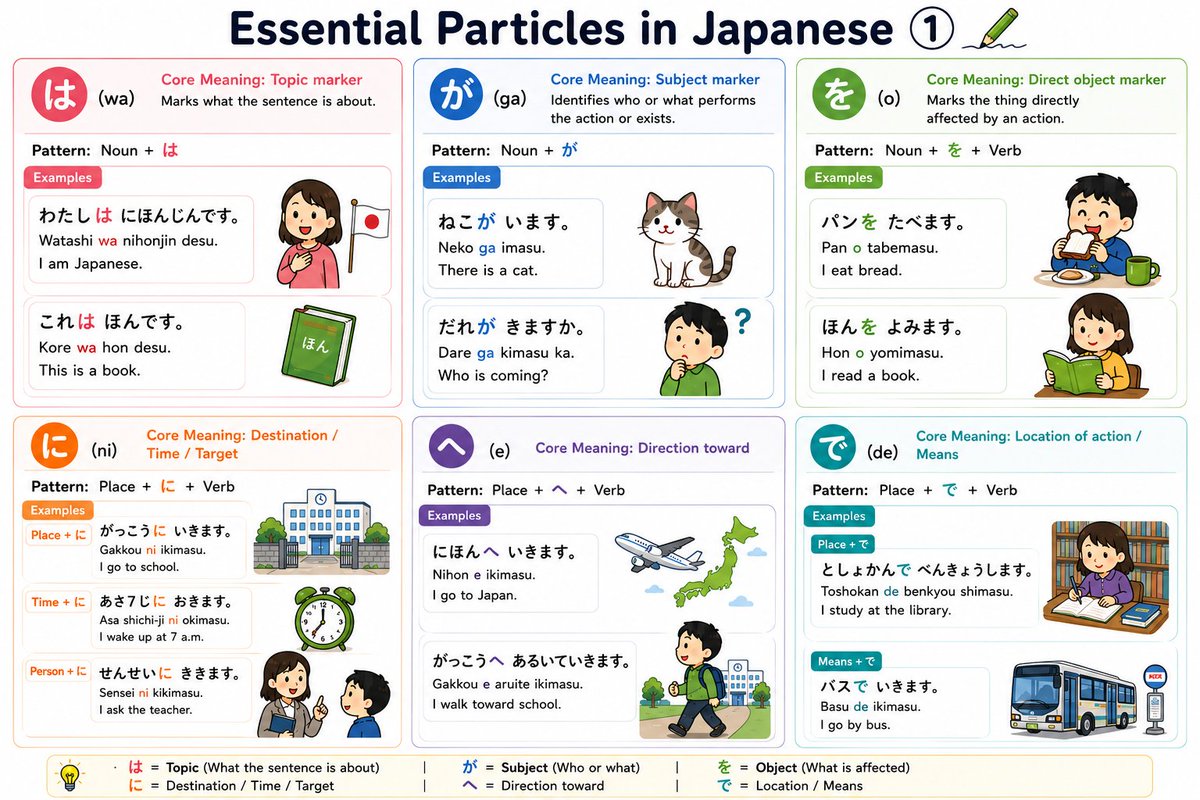
【Essential Japanese Particles ① ✍️】
If you wanna master Japanese, understanding particles is critical because misplacing a particle completely changes the meaning of your sentence ⚠️
Here are the core images of particles は, が, を, に, へ, and で!
#JLPT#Japanese
The fastest way to double your adjective vocabulary: learn them in opposite pairs. Your brain remembers contrasts better than isolated words.
These are all N5 adjectives you'll see on the JLPT. Save this as a study reference!