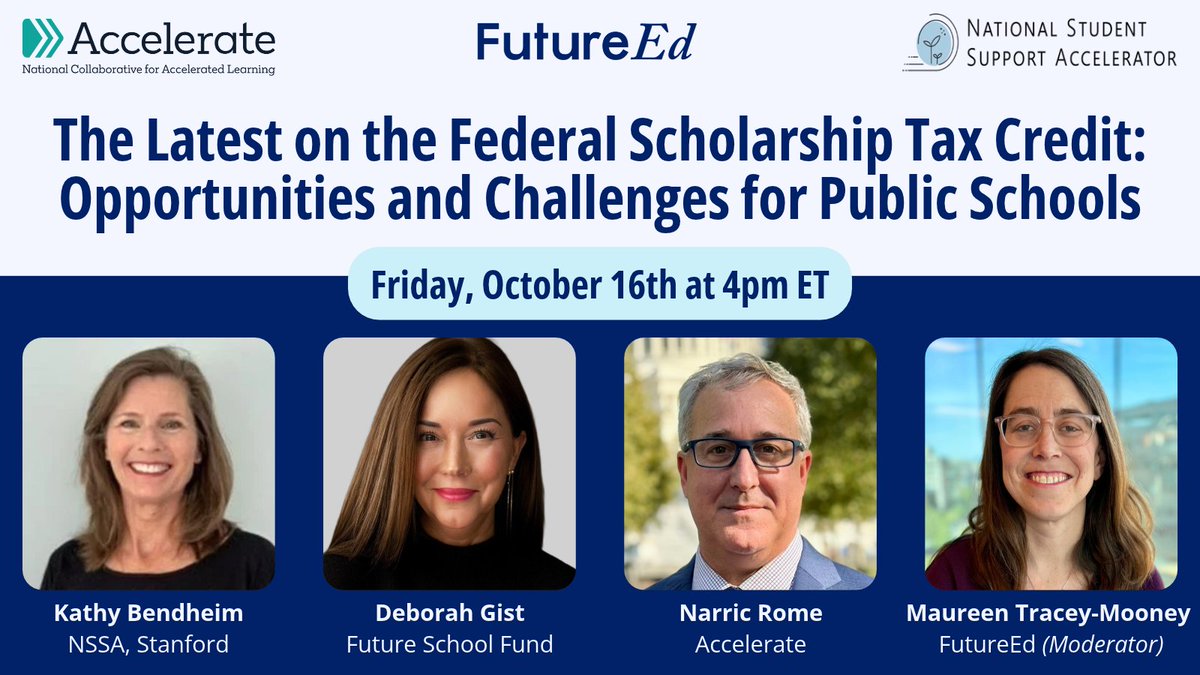
🎥In case you missed it: On Friday, FutureEd Associate Director Maureen Tracey-Mooney spoke with experts about using the federal scholarship tax credit to support public school programs, including high-quality tutoring.
Watch the webinar recording: https://t.co/aal65aIvxM
📚 WEBINAR: The Latest on the Federal Scholarship Tax Credit: Opportunities and Challenges for Public Schools
🗓️ October 16th at 4pm ET
🔗 Register here: https://t.co/tj36PJMBtH
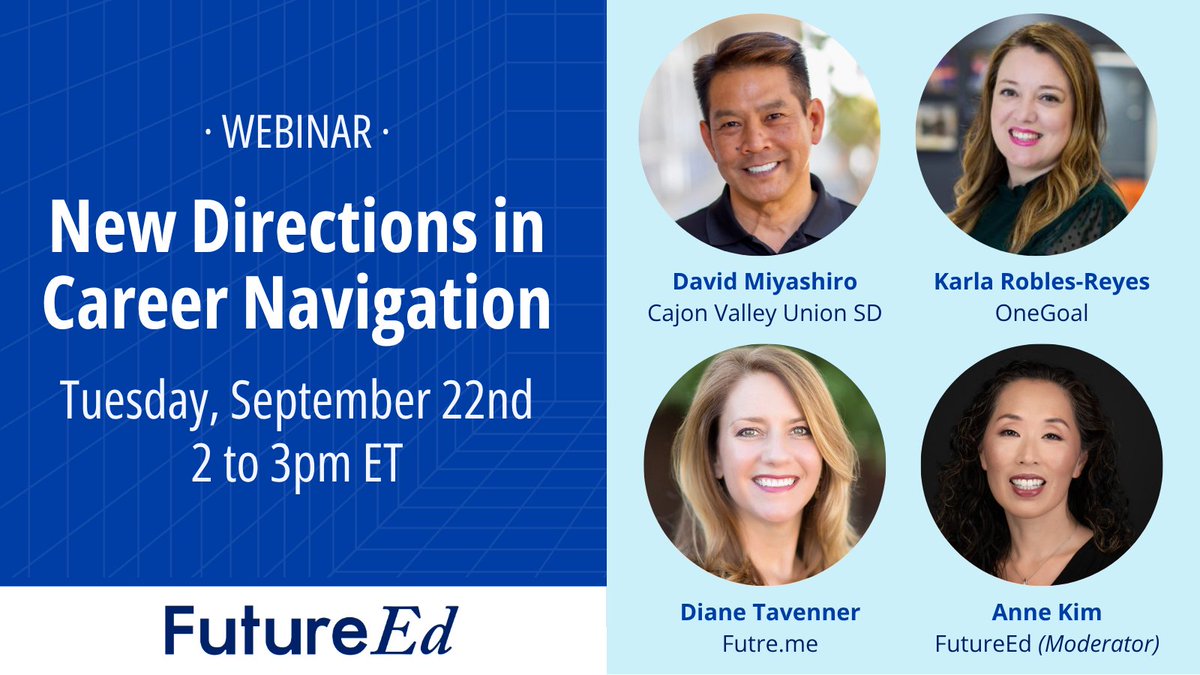
More students than ever have access to career pathways and credentials, but too many still lack the guidance to navigate them.
In a commentary originally published by @The74 , FutureEd Senior Fellow Anne Kim explores why career navigation needs to become a more central part of K-12 education, and highlights promising approaches—from creative curriculum design to personalized advising to cutting-edge technology—to broaden access to high-quality career guidance “without massive hiring sprees few districts can afford.”
Read the commentary https://t.co/5FO7d49GBx
In our latest research notes, Laura Lopez details findings from Youngsun Lee, Jing Liu, and Emily Penner. In their study of a southern school district, the researchers found that expanding alternatives to suspensions has not eliminated racial disparities in discipline.
To address these inequities, the authors recommend clearer guidelines for administrator discretion, rather than simply expanding the list of available disciplinary options.
Read the research notes: https://t.co/I9L8U1Airx
In Education Next, Policy Analyst Tara Moon takes readers inside Washington Leadership Academy, a D.C. charter school that has been experimenting with AI since ChatGPT’s launch in 2022.
Drawing on classroom observations and interviews with WLA's educators, administrators, and students, Moon shows what it looks like when a school moves beyond debating AI and starts figuring out how to use it well. She highlights both the promise and the pitfalls of AI in teaching and learning—and what policymakers can do to support schools as they navigate its adoption.
Read the full piece in Education Next: https://t.co/f2SYTR8Ffv
FutureEd at Georgetown Director @thomas_toch recently sat down with @deborahgist to talk about the new federal Education Freedom Tax Credit. While much of the money generated through the program is expected to flow to private schools, Gist's new scholarship-grant organization aims to help public schools across the country use the program to fund supports like tutoring, summer and afterschool for public school students.
Read the interview at the link in the first comment for a candid discussion of the real challenges and opportunities the program provides for public schools.
Gist is the former top public education official in Rhode Island and the District of Columbia and the former superintendent of the Tulsa schools in Oklahoma.
How much did the landmark Plyler v. Doe ruling impact K-12 public school enrollment?
In our latest research notes, Laura Lopez highlights a study by FutureEd Research Advisor Stella Flores, Mehdi Akhbari, Julio J. Mena Bernal, and Lesley Rivas. They found that within two years of the Supreme Court ruling, Texas saw a sharp 15 percentage-point spike in overall Latino student enrollment compared to other states, with gains driven largely by young, foreign-born Hispanic children. With several states now challenging Plyler, these findings underscore the historic weight of public school access.
https://t.co/rE7RvWvdrT
Should school districts eliminate middle school academic tracking to close achievement gaps, or expand it?
In our latest research notes, FutureEd Research Associate Laura Lopez breaks down a new study by Carrie Miller and Meredith Phillips at UCLA, finding that early access to advanced math in seventh grade significantly propels students into higher-level high school courses and four-year colleges. The researchers suggest that instead of cutting advanced tracking, expanding access is key to supporting underrepresented students.
https://t.co/7QT5HL6TDO
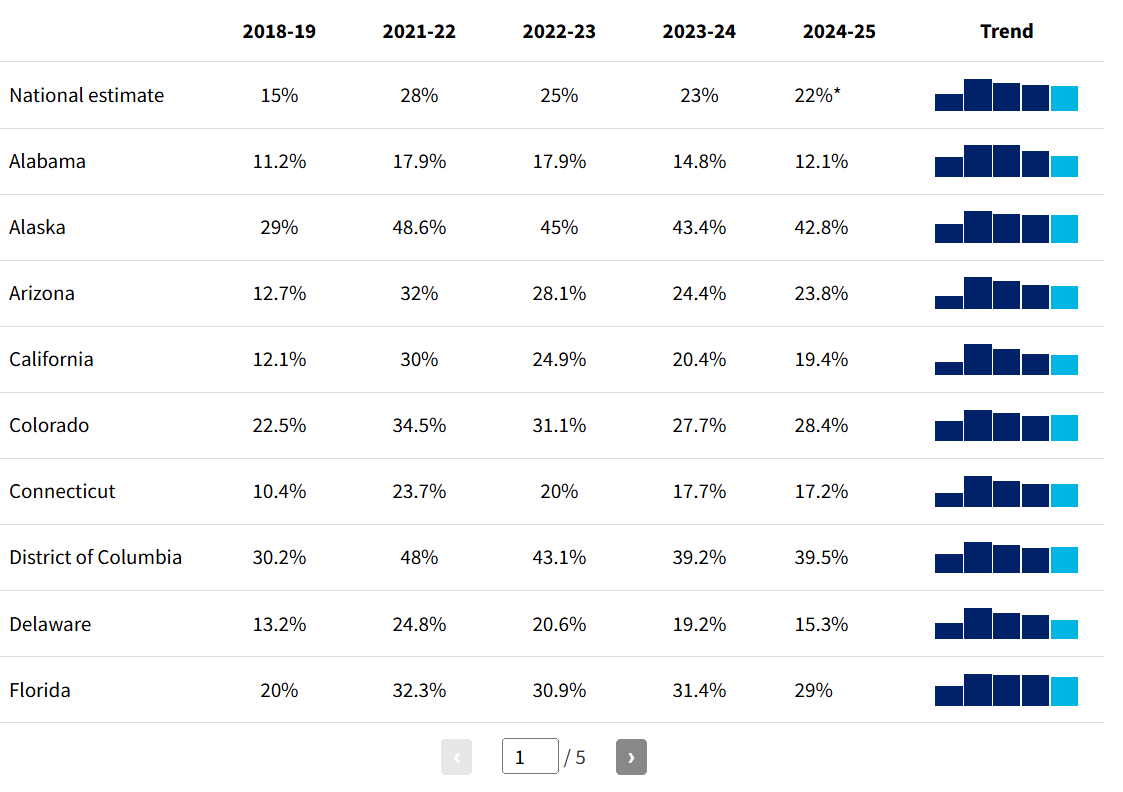
🚩44 states and D.C. have released chronic absenteeism data for the 2024-25 school year, and most continue to show progress. Based on available data, the national estimate sits at 22% of students who were chronically absent in 2024–25, down from 23% the previous year but still well above the pre-pandemic rate of 15%.
Explore the updated tracker at the link in the first comment below.
💡 “First decide what we want for students, then ask whether AI can help us get there,” said Chris Agnew managing director of Stanford’s AI Hub for Education AI Hub for Education at Stanford University at the SCALE Initiative at Stanford University.
FutureEd spoke with Agnew about a learning-centered approach to integrating AI in classrooms, what the research says about its potential to support teaching and learning, and where educators and policymakers should focus as the technology continues to evolve. Read his Q&A with FutureEd at Georgetown's Tara Moon at the link in the first comment.
📊Updated: Our explainer on K–12 public school enrollment declines has been updated with the latest data from the National Center for Education Statistics and the U.S. Census Bureau.
Between fall 2019 and fall 2024, public school enrollment fell from 50.8 million to 49.4 million—a loss of more than 1.4 million students, or 2.8%, in just six years. The updated data confirm that the long-term patterns—including which student groups and states are experiencing the largest declines—remain largely the same.
https://t.co/sb9XXr6vUq
🎙️ Future U has officially wrapped up its 9th season.
Hosted by Jeff Selingo and Michael Horn, the podcast continues to offer thoughtful conversations about the future of higher education and the challenges and opportunities facing colleges and universities.
You can find Season 9 and past episodes on the FutureEd website.
https://t.co/yrQ08Y0UYN
🚨 New Report 🚨
Policymakers have invested heavily in expanding career pathways for high school students, but many young people still lack the guidance they need to navigate these options and make informed decisions about their futures.
In our latest report, "Future Shock: The Crisis in Career Navigation", Senior Fellow @Anne_S_Kim examines why so many students feel unprepared to make choices about college and careers despite growing investments in career-connected learning, the consequences of inadequate career guidance, and innovative programs and technologies that are helping students chart stronger paths from school to careers.
Read the report here: https://t.co/nu1MsVfhUW
📊 Education, by the numbers:
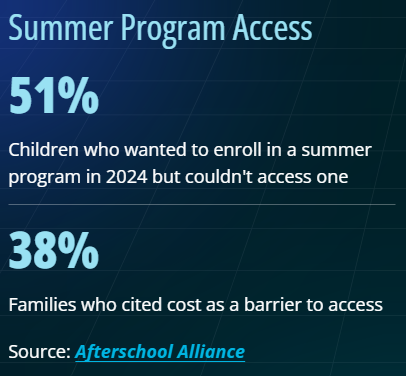
According to research from @afterschool4all , more than half of children who wanted to participate in a summer program in 2024 were unable to access one. Among families whose children could not enroll, 38% cited cost as a barrier, making affordability the most significant obstacle to participation.
For more education statistics, check out the Index on our homepage: https://t.co/zZ2rn0WaUO
How much can a simple change in “default” enrollment policy expand access to advanced coursework?
A new study by Daniel Alejandro Vargas Castaño, Dareem Antoine, and Trey Miller finds that shifting from opt-in to opt-out enrollment for advanced courses significantly increases participation in advanced coursework, though not evenly across student groups.
Read the research notes: https://t.co/iECKsheZkL
🚨 New Report 🚨
AI is reshaping America’s schools faster than most educators and policymakers were prepared for. While students are already using AI, many schools remain uncertain about how to respond.
In "Digital Trailblazers: Lessons from a School on the Frontier of Artificial Intelligence", FutureEd Policy Analyst Tara Moon examines how Washington Leadership Academy, a D.C. public charter high school, has integrated AI into teaching and learning while confronting challenges around academic integrity, creativity, privacy, and the evolving role of teachers.
The report highlights both the opportunities and challenges AI presents for schools, and warns that without stronger policy guidance and support, many students risk being left behind.
Read the report here: https://t.co/8kgFizqDCD