Learning to debate isn't only for critical thinking. It also teaches us to advocate respectfully for our ideas.
People randomly assigned to debate training are more likely to rise into leadership roles—even 18 months later.
A key to influence is being direct without disrespect.
Silence is not always a sign of disengagement. It's sometimes a symbol of deep reflection.
The quieter people in the room aren't refusing to contribute. They're choosing to process before reacting.
It's usually better to think without speaking than to speak without thinking.
#PedsICU#NeuroPICU Combined ketamine and midazolam vs. midazolam alone for initial treatment of pediatric generalized convulsive status epilepticus (Ket-Mid study): A randomized controlled trial - Pediatric Neurology https://t.co/pQnlcuDHx8
https://t.co/PFBp263Glg
Congrats to @shragrawal and her team in Cambridge and across the UK, including @smithclaudiaann and @Dr_Hari_Krishna! This is the first prospective multicenter study evaluating the clinical utility of PRx monitoring after pediatric traumatic brain injury.
Having effective facilitation can make a massive difference to outcomes. By enabling clear communication, structured problem-solving, and inclusive decision-making, facilitation drives performance & innovation. Bringing in highly skilled external facilitators who help us to see the big picture can be a powerful intervention but it isn't enough. Every leader should be a facilitator. Leaders who prioritize & cultivate facilitation skills often see immediate improvements in team dynamics & productivity. Facilitative leadership can create a strong foundation for sustained success.
https://t.co/OO3W4fwcqs. By Voltage Control.
Graphic by Adrian Robke.
Mental health is not about being happy all the time. It's about learning to handle the full range of emotions.
It's normal to feel grief after loss, anger at injustice, and fear in danger.
Resilience lies in putting our feelings in perspective instead of letting them define us.
Generosity is not about saying yes to everyone. It’s about supporting people who live up to your standards of character.
Helping people who are consistently selfish rewards the wrong behavior.
A key to healthy boundaries is reserving your time for those who respect your time.
Dear students: Service doesn't just look good on your resume. It builds your character.
62 studies, 11k students: service learning enhances leadership skills, civic engagement, self-confidence, motivation, and grades.
Community service should be part of every child's education.
Generosity rarely starts with an offer of help. It often begins with a question about what others need.
Even those close to us face invisible hardships. The best way to give is to ask about their challenges.
We don't always have a solution, but we can always make them feel seen.
#GivingTuesday
As leaders we are role models: our words, deeds & the environment we create are massively amplified to those around us. New research evidence shows that people will take on more challenging tasks if they see others around them do so. It's like a form of social contagion. If, as leaders, we visibly engage in & embrace challenging tasks, we can influence our team members to do the same, encouraging a culture of growth, innovation & collective support.
https://t.co/08O4UkRhsm. Via @CansuOgulmus. Graphic by @marissashandell.
In a distracted world, the most underrated leadership skill is listening.
144 studies, 155k people: Good listeners have deeper bonds and better results. We feel valued, and they get smarter.
Great leaders are devoted learners. A key to learning is to listen more than you talk.
Intense emotions rarely last as long as we expect. In the heat of the moment, we overindex on our anguish today and underestimate our capacity to adapt tomorrow.
Pain and sorrow are never permanent—they evolve over time. They can help us make sense, find meaning, and fuel change.
https://t.co/XqtWuWmG8U
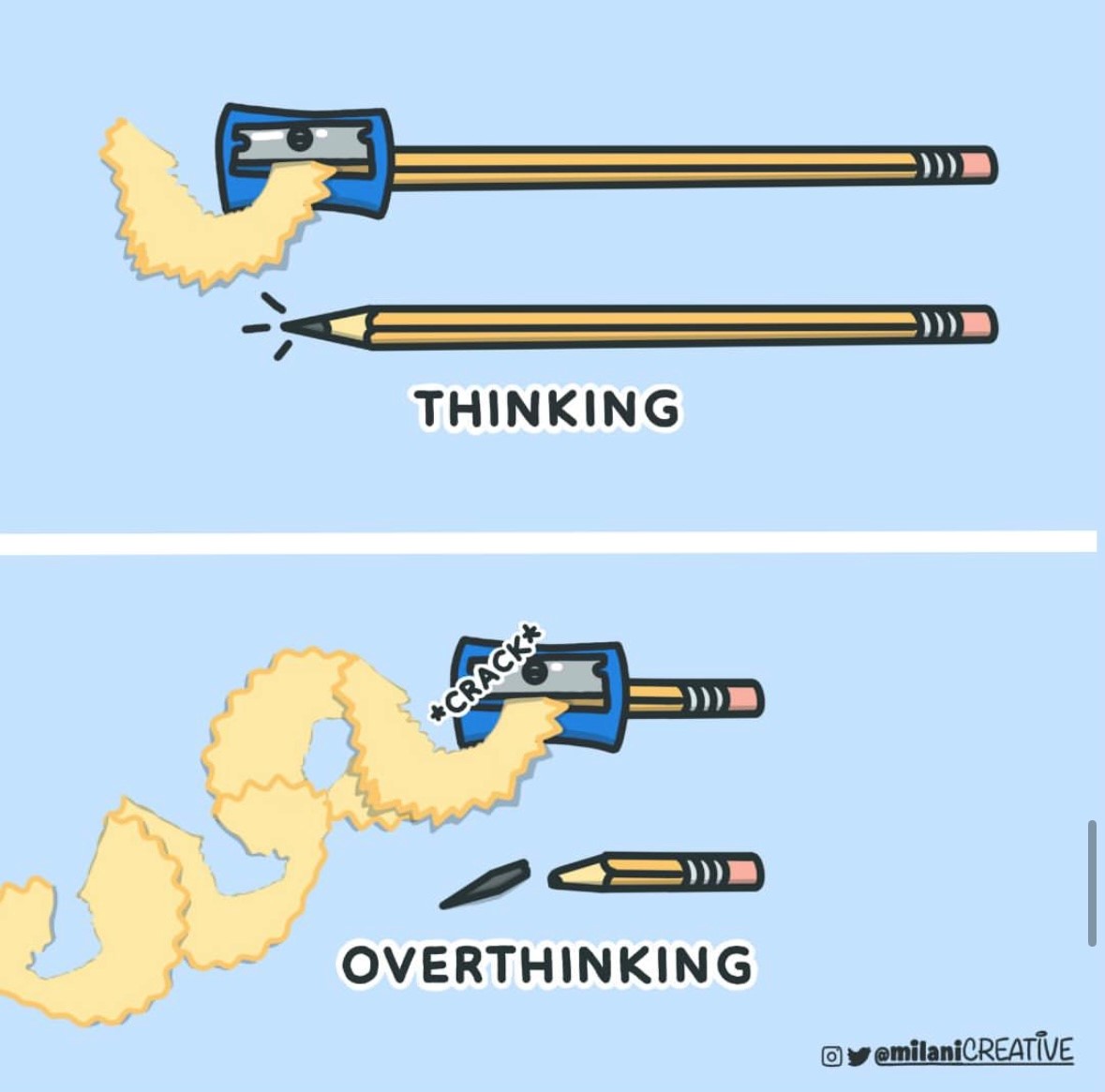
The antidote to overthinking isn't thinking less. It's rethinking more.
Overthinking is ruminating on old ideas without a new lens. It narrows your focus and wears you out.
Rethinking is revisiting the same issue from a different perspective. It broadens and sharpens your view.
“That’s the way we’ve always done it” is not a justification. It’s a lazy excuse for failing to evolve.
Blind faith in traditions makes us prisoners of the past. Routines should be based on present value and future potential.
A key to new growth is questioning old habits.
Learning & change are deeply connected. Successful change requires continuous learning, yet we often don't think enough about the fundamental nature of learning as it enables change. Here are "ten mental models (general ideas that explain things) for learning anything": from the author of best selling book "Ultralearning":
1) Problem solving is search: learning is the process of acquiring patterns and methods to cut down on brute-force searching.
2) Memory strengthens by retrieval: once we’ve seen the answer, we’ll learn more by retrieving it than by repeatedly viewing it.
3) Knowledge grows exponentially: how much we’re able to learn depends on what we already know.
4) Creativity is mostly copying: new invention is essentially the random mutation of old ideas.
5) Skills are specific: practice at one task helps little with unrelated tasks, even if they seem to require the same broad abilities like “memory,” or “critical thinking”.
6) Mental bandwidth is extremely limited: we can only keep a few things in mind at any one time.
7) Success is the best teacher: we learn more from success than failure.
8) We reason through examples: learning is often faster through examples than abstract descriptions
9) Knowledge becomes invisible with experience: when knowledge becomes tacit, it becomes harder to make explicit how we make a decision.
10) Relearning is relatively fast: we retrieve forgotten knowledge much faster than starting from scratch.
https://t.co/9KchFDWCbl. By @scotthyoung
Viewpoint:
Venkatakrishna Rajajee: Noninvasive Intracranial Pressure Monitoring: Are We There Yet?
Link: https://t.co/EE8nVVd7NQ
@neurocritical#NeuroCritCare
Delayed Cerebral Infarction After Aneurysmal Subarachnoid Hemorrhage: Location, Distribution Patterns, Infarct Load, and Effect on Outcome https://t.co/Vqq5qDIZNo
#NeuroTwitter
The purpose of debriefing bad decisions is not to blame and shame. It's to grow and change.
Failure is an invitation to reflection. The most important question is not who's at fault—it's how to improve.
Yesterday's mistakes are lessons to learn today and apply tomorrow.