Hello everyone! I see the big names are trying to keep $ICP low. They are afraid because the cloud engines are the real solution and they are afraid of this innovative technology! Let them know that we are many more.
Like & repost if you agree!!! ♾️🔥🚀
Dear ICP community, the Internet Computer has now been running strong for 5 years 👏👏👏
Here is a celebratory preview of ICP "cloud engines," the sovereign frontier cloud technology the network shall soon provide from https://t.co/D5Dfj44BmO.
Main points:
— Cloud engines enable anyone to spin up their own sovereign frontier cloud. The technology involves an extraordinary inventive step, in which cloud is created from a mathematically secure network of nodes. The nodes run as part of the Internet Computer network (https://t.co/ptsshOm9nj) but are selected and configured by the cloud engine's owner.
— The frontier cloud provided by engines is strongly focused on enabling AI agents to build and update online applications and services for us. The world is changing fast, and nearly all new online apps and services are already being built with the help of AI, and thus cloud engines target the future of cloud.
— Software hosted on cloud engines is tamperproof, which means that it is immune to infrastructure hacks, because it runs inside a mathematically secure network protocol, rather than on computers directly. This means that AI agents, and those building with them, don't need to have a security team in the loop, or to trust someone else's security team. This is crucial, because in the future, non technical people will demand the freedom to build with full automation — where they just need to issue instructions to AI about what to build, and don't need to worry about anything or anyone else. Of course, apps and services running on engines are also vastly safer from the new breed of hacker being enabled by frontier AI.
(The cloud engines themselves are also "tamperproof." Even if a hacker gains physical access to some portion of a cloud engine's nodes, and can make arbitrary changes, the computations and data of the hosted apps and services cannot be corrupted or interrupted so long as the network's fault bounds aren't exceeded. The recent hack of Vercel, a major cloud platform, which gave hackers access to the apps it hosted, provides additional perspective on the importance of this advantage.)
— Software hosted on cloud engines is guaranteed to run, so long as a sufficient number of the engine's nodes are running. This means that AI can build applications and services without the need to have a human systems admin team constantly tinkering with the underlying platform to keep it running, which is again crucial, because in the future, non technical people will expect the freedom to use AI to build without the support of others.
— New frontier programming language technology, in the form of the Motoko language developed by Caffeine Labs, leverages seminal "orthogonal persistence" technology that unifies program logic and data to deliver further unlocks for AI (Motoko is the first computer language being developed that targets agents that are writing software rather than humans engineers per se). Nowadays, AI can build and update production apps at a prodigious rate, even at the speed of conversation. But it can also make mistakes, and there's a risk that an update it creates might be "lossy" in the sense it causes some transformed data to be lost. Again, in this new world, it's both undesirable and impractical for everyone to have to have a systems admin team on-hand to detect lossy updates and roll them back, but Motoko provides a solution: it can detect new software updates are lossy before they are applied, reducing potentially catastrophic errors by AI to harmless coding retries.
— Software hosted on cloud engines is "serverless" but unlike traditional serverless software, directly it directly incorporates data through "orthogonal persistence." Another key purpose is simplify backend software logic and fuel the modeling power of AI by increasing abstraction (sorry for the technical language!!!). Put simply, this enables AI to produce more sophisticated backends, faster, and at dramatically lower costs, as measured by the number AI API tokens consumed during coding. (Tip for the technical: orthogonal persistence is a new paradigm where "the program is the database," and data lives inside program variables, which is possible because it's as if hosted software runs forever in persistent memory).
— An expanding database of skills at https://t.co/lloVYiGYs8 shall make it possible to develop and directly deploy apps and services to your cloud engines directly from Claude Code, Perplexity, Codex and other AI platforms. Further, your account on https://t.co/IfQrVovF3L can be connected, so that new apps and updates created through conversation automatically appear hosted from your cloud engine. In the future, R&D is going to be very seamless. You converse with AI, and your secure and unstoppable apps or services are created or updated. Cloud engines are designed to directly support this "self-writing cloud" future where we can work hands-free.
— Tech sovereignty is becoming a huge issue worldwide, with governments and corporations seeking to create sovereign tech stacks owing to geopolitical tensions. Increasingly, people are realizing that tech provided by foreign nations can come with hidden backdoors and kills switches, from the base platform, right up through hosted apps and services. ICP technology is open source, and those building on ICP using AI own their own source code. When you have the source code, you can verify that there are no backdoors, and when you own the source code thanks to AI, you can update it at will, freeing you from vendor lock-in. But cloud engines take sovereignty much further...
— You create a cloud engine by selecting the nodes that will be combined. You can choose the class of nodes used, and their number, but more importantly, you can choose who operates the nodes, and where they are located. Almost any configuration is possible, because the Internet Computer scales the security privileges afforded to hosted software within the network according to configuration (software hosted on cloud engines can directly interoperate with software on other engines and traditional subnets, but base restrictions are applied according to security rules). A cloud engine can be created within a region such as Europe, to comply with regs such as GDPR, or completely within a sovereign state like Switzerland or Pakistan. But cloud engines go further still...
— Sovereignty is also about freedom from vendor lock-in. Cloud engines are essentially ICP (Internet Computer Protocol) network configurations, and this means the underlying compute nodes they combine can be swapped out without interrupting their hosted apps and services. This is a big deal. In addition, cloud engines now support nodes that are instances running on Big Tech's clouds, in addition to nodes that are dedicated specialized hardware, as per the Gen I and Gen II nodes that dominate the Internet Computer today. For example, it is possible to have an engine running across different AWS data centers, say, and then reconfigure the engine to run across a mixture of AWS, Google, Azure and Hetzner for even more resilience, without the users of hosted apps and services noticing a thing. That's true freedom.
— Sovereign AI is becoming increasingly important too, and cloud engines allow special "AI nodes" to be added to them, so that hosted software can perform inference on hardware provisioned by the owner from a location the owner has selected. Even though the AI nodes are only accessible within the cloud engine, they can still benefit from the forthcoming Internet Intelligence Gateway (IG), which will make it possible to validate inference performed on key frontier open weights LLMs, even when the inference is performed on completely independent AI clouds. When the results of inference are received, this technology can verify that neither the prompt+context (input) nor the inference result (output) have been modified, and that the results were produced by the precise LLM expected. This ensures that AI clouds don't cheat by running inference on cheaper models than are being paid for, and bad actors aren't modifying the inputs or outputs to surreptitiously insert advertising into results, say, or change facts, or insert malware when code is being generated. What's super cool about this technology is the cost of the verification is scalable. A very valuable additional security can be achieved with only 1-2% of extra cost.
— Scaling apps and services when they hit capacity limits is another thorny problem that cloud engines help the world address. Engines make scaling possible without rewriting or reconfiguring software. The query workload capacity of hosted software can be horizontally scaled simply by adding new nodes to an engine, and nodes can also be added in geographical proximity to demand. Meanwhile, update workload capacity can first be scaled-up by swapping an engine's nodes out for the next class up, and then when no larger class of node is available, horizontally scaled-out by "splitting" the engine into two, which doubles available capacity. (Technical tip: horizontally scaling update capacity by splitting engines requires multi-canister architectures).
— For those who have been following how Caffeine builds apps that can efficiently store large numbers of files, I should mention that apps built on cloud engines will also support the new ICP Blob Storage cloud network (since cloud engines currently have up to about 3 TB of memory, which apps storing large amounts of files can easily exceed). We are also working on allowing blob storage nodes to be added to cloud engines, to enable sovereign mass blob storage within an engine, similarly to how AI nodes can be added currently.
— Lastly, but certainly not least, I should mention that cloud engines are multi-blockchain capable, and ready for digital assets, thanks to the clever math at their core. For example, an e-commerce service built on a cloud engine can securely accept and custody stablecoin payments, or a multi-chain DEX could be hosted. Further, engines can support software autonomy (software orchestrated and controlled by other autonomous software, in a decentralized way) and can themselves be orchestrated by SNS technology, and thus run autonomously too.
Today, though, the focus is on *mainstream* cloud. This year, the cloud industry will generate approximately one trillion dollars in revenue. That number is already huge, but is expected to grow to two trillion dollars by 2030.
After years of continuous development, which have seen more than $500m spent on R&D, the Internet Computer network is now tacking directly toward this mainstream cloud market with cloud engine technology.
In their first version, cloud engines are not meant to be a cloud panacea. For example, currently they are not ideal for working with big data. You should use something like DataBricks for that.
Cloud engines are carefully targeted at enabling AI to produce traditional online applications and services, including SaaS, in a safer and more productive way, which represents a new market segment with tremendous potential. Of course, DFINITY will continue to work relentlessly to push forward ICP's capabilities, so expect further developments.
It's worth mentioning that this cloud segment isn't just about creating new apps and services using AI, it's also about replacing legacy systems and apps built on super expensive SaaS services. Caffeine Labs is working to produce technology (Caffeine Snorkel) that can study an enterprise's legacy systems and app built on SaaS, create replacement systems and apps, and migrate the data, while supporting key stakeholders through the process over email and chat, with full automation. Thus the legacy systems and SaaS markets shall also be addressed by cloud engines.
Zooming out, and reasoning in a more metaphysical way, we believe, as we always have, that there is room for a new kind of cloud created by mathematical networks, that provides seminal advances in the fields of security and resilience, as well as true sovereignty and freedom from lock-in. That this same technology, with the help of additional technologies like orthogonal persistence and Motoko, enables AI to build for us without the need for so much oversight, and to create more backend sophistication while consuming fewer AI API tokens, enables ICP to bring game-changing advances to the world.
Cloud engines will work synergistically with the Intelligence Gateway, which will enable apps and services running on engines to seamlessly leverage AI, wherever that AI is running, while providing verifiability at extremely low cost for open weights frontier models.
We believe that cloud engines represent an inflection point in the storied history of the Internet Computer project, and I'm very proud to be sharing the details with you on the network's fifth birthday 💪
I'll be back with more news soon!!
First Pakistan Cloud Engine is live! 🇵🇰
Next:
1. Tiered rollout of an initial 1,500 caffeine licenses to the Government, Academia, and Startup sectors with direct deployment of caffeine-made apps to the national Cloud Engine.
2. Pilot of a national chat messenger.
.@KeetaNetwork just set a new performance record
Keeta handled 41.5 TPS, the highest ever recorded on mainnet
The most advanced way to move money, pushing performance higher
📊 https://t.co/93BiUUaYL3
People asking what ICP "cloud engines" – the Internet Computer as frontier onchain cloud for agents building apps, services and systems - actually looks like.
Here's approximately what's coming:
We're thrilled to announce our partnership with @thirdweb to bring native infrastructure and Account Abstraction to Goliath, enabling gasless $XCN transactions, streamlined developer tools, and seamless wallet integration.
Read more below 👇
https://t.co/nzRNKo2F0q
$ICP so far:
> Arizona Officially Lists ICP in New "Strategic Digital Reserve" Bill
> Sovereign Cloud Adoption by Switzerland
> Sovereign Cloud Adoption by Pakistan
> 260k+ ICP burned 🔥
> 140k+ canisters registered
> @caffeineai V3 officially launched
> 10X+ more builders than ALL Web3
> Cloud Engines
> #Mission70
Andrej,
I’m John Fletcher. I have a PhD in mathematics and theoretical physics from Cambridge, and since 2016 I have been working full-time on the problem of how to coordinate untrusted distributed compute for algorithmic innovation.
I listened to your No Priors conversation and recognised the architecture you were describing: commits that build on each other, computational asymmetry (hard to find, cheap to verify), an untrusted pool of workers collaborating through a blockchain-like structure.
The result is The Innovation Game (TIG), which has been in continuous operation since mid-2024. The correspondence is so close that I thought it worth writing.
The short version: roughly 7,000 Benchmarkers test algorithms submitted by Innovators by solving instances of asymmetric computational challenges (SAT, Vehicle Routing, Quadratic Knapsack, Vector Search, among others).
This testing is "proof of work" in the technical sense of Dwork and Naor (1992). Innovators earn rewards proportional to adoption by the Benchmarkers. The repository of algorithms is open source (https://t.co/qTvN0Ri0i9).
The system is already producing state-of-the-art results. For the Quadratic Knapsack Problem, 476 iterative submissions by independent contributors brought solution quality to a level that now exceeds methods published by Hochbaum et al. in the European Journal of Operational Research (2025).
We are working with Thibaut Vidal (Polytechnique Montréal), who has submitted a state-of-the-art vehicle routing algorithm directly to TIG, and with Yuji Nakatsukasa (Oxford) and Dario Paccagnan (Imperial College London), among many others.
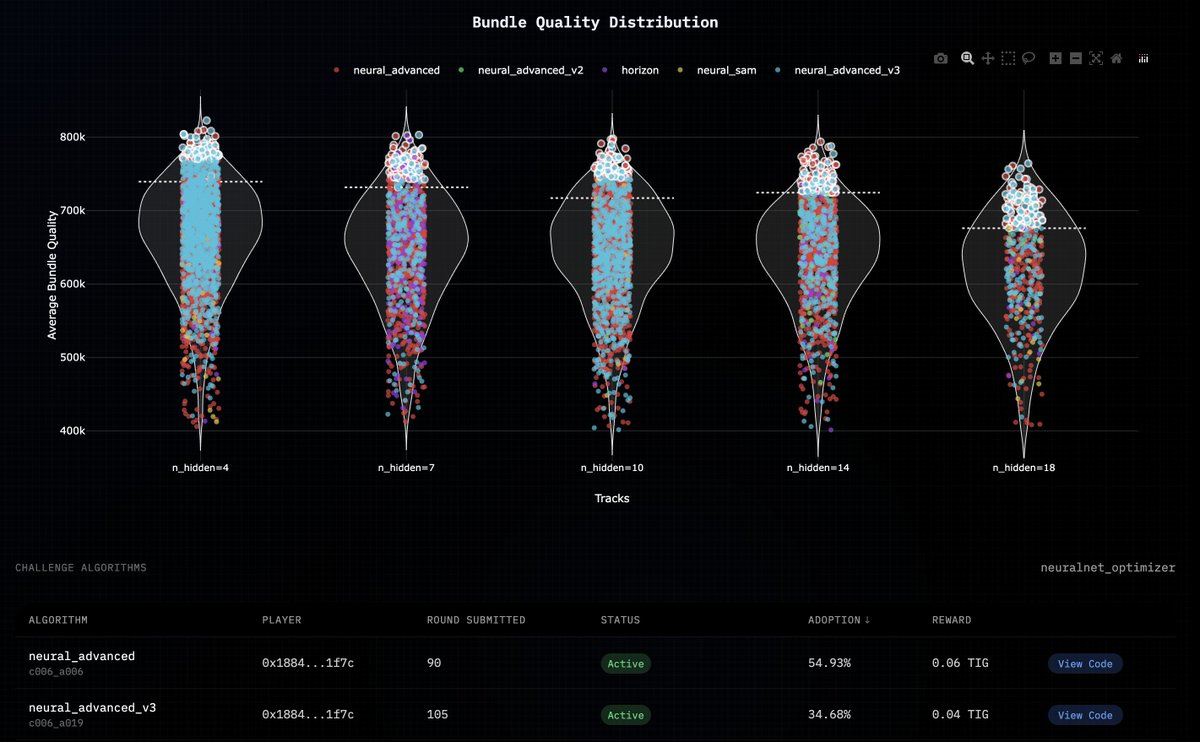
One of TIG’s active challenges is directly relevant to your autoresearch work: an optimiser for neural network training (https://t.co/RRecucTdiz), where Innovators compete to develop an improved optimiser (see screenshot).
One way in which TIG extends the vision is on the economic side. In our view, a monetary incentive is required, otherwise the open strand simply cannot compete at scale. TIG’s open source dual licensing model (designed by my co-founder Philip David, who was General Counsel at Arm Holdings for over a decade, and was the artchitect of ARMs licensing strategy) is intended to solve that problem.
I expect we have each thought about parts of this that the other hasn’t. Happy to talk whenever suits.
John Fletcher
https://t.co/vMLGTmtVQx
We're thrilled to announce that the Goliath mainnet is now live and seamlessly integrated into the @Onyx App alongside native #XCN Ethereum ERC-20 support.
Access Goliath bridging, $XCN liquid staking, and swaps now at https://t.co/QrIvGjwUnF 👈
https://t.co/gKDolqmrbn
I’m delighted to announce that @quantnetwork and Murex are partnering to bring tokenised deposits and digital bond settlement into MX.3.
Institutions have been asking the same question. How do we move forward with tokenisation without disrupting the trading, risk and post-trade operations we depend on?
The answer is now inside the platform they already use.
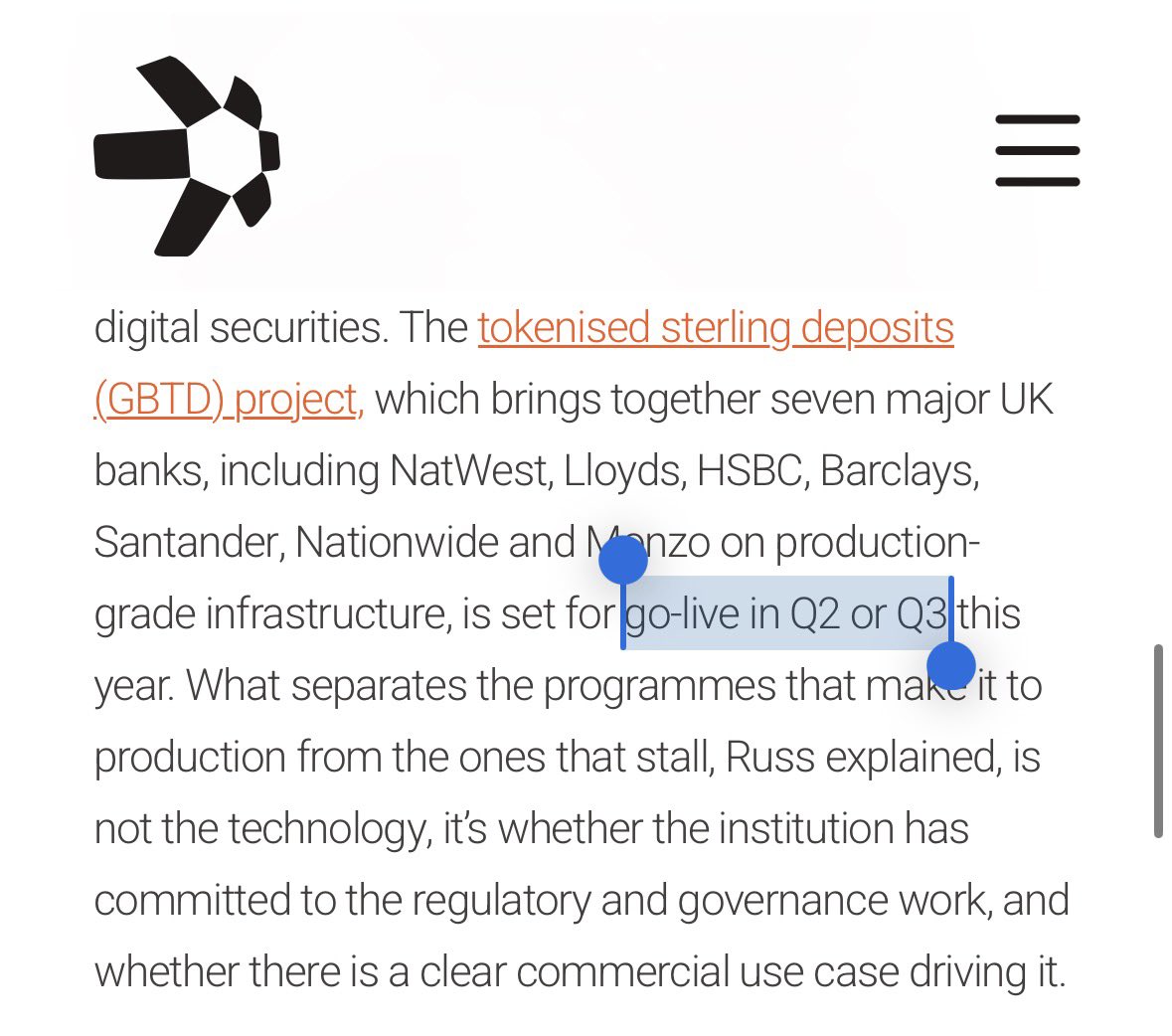
Tokenised RWAs just crossed $100 billion. DTCC has SEC approval to tokenise real-world assets from mid-2026 and major UK banks are already working with Quant through the Great Britain Tokenised Deposit initiative - all of which signals that the market is moving.
Users in banks, asset managers, insurance companies, pension funds, hedge funds, corporations and energy utilities in over 65 countries now have a production-ready path into tokenisation through the systems they already run.
The future of capital markets infrastructure is programmable: https://t.co/RmT2yVJ4SH
#Tokenisation #DigitalAssets #CapitalMarkets #Programmability
A decade in the making, we have published an ISO standard for blockchain interoperability.
This is a milestone I've been working towards since 2015, Remitt was founded with the conviction that blockchains could transform financial services but only if the industry solved interoperability and harmonised around global standards. Without that, blockchain would remain fragmented, siloed, and locked out of mainstream institutional adoption.
In April 2016, we published what was the world's first proposal for a blockchain standard (https://t.co/SL83Yl4Ejr) a bold move at a time when the industry was still largely focused on proofs of concept and competing protocol narratives, not standardisation.
The idea was simple but ambitious: if blockchains were going to serve global markets, they needed a common framework that transcended any single protocol or vendor.
Central to this thinking from the very beginning was the concept of a multi-gateway architecture, leveraging the know-how of 20 years of experience in cybersecurity to frame the principle that interoperability shouldn't depend on a single bridge or point-to-point connection, but on a layered gateway model that could abstract away the differences between underlying DLTs and connect them through a common interface. This was the architectural foundation of what would become Overledger, and it was also the design philosophy we brought to the standards process.
The belief was that a viable international standard for blockchain interoperability had to be protocol-agnostic and gateway-driven, enabling any DLT to communicate with any other DLT (any-to-any) and with existing networks, without requiring those ledgers to change how they operate. The standard and the technology were born from the same insight.
That same year, I worked closely with the team from @standardsaus (Standards Australia), who had the foresight in 2015 to champion the initiative at the international level. Together, we pushed for ISO to establish a dedicated Technical Committee for blockchain and not to be absorbed into an existing committee, but to stand on its own as a recognition that this technology warranted its own global standards programme. The industry demand was there, the use cases were multiplying, and the fragmentation was becoming a real barrier.
In September 2016, the New Work Item Proposal (NWIP) received global approval, and ISO formally gave the green light to establish a new Technical Committee (https://t.co/7biJjvHRk9). TC 307 — Blockchain and Electronic Distributed Ledger Technologies — was born (https://t.co/5SsFPIw0HH). The inaugural meeting was held in Sydney in April 2017, and from that moment the real work began.
As the standards work progressed internationally, the mission at Remitt was evolving too. What started as an effort to use blockchains for financial services and solve interoperability grew into something far larger, a full enterprise infrastructure platform for connecting any blockchain to any network. Remitt became Quant, and we built Overledger, the world's first blockchain operating system to deliver on that original vision. The multi-gateway architecture that informed the standards thinking became the core of Overledger's design: a technology layer that sits above all blockchains, providing institutions with a single integration point to access any DLT, any network, and any existing system. The interoperability challenge that drove the standards work was the same challenge we set out to solve commercially and the two efforts reinforced each other throughout.
For close to a decade since TC 307's formation, subject matter experts across the world have contributed their time and expertise to Working Group 7 — Interoperability is the committee I chair.
International standards are not built quickly they are built through consensus, technical debate, and relentless refinement. The same methodology and rigour that created the Internet, through publishing standards. The result is a published international standard for blockchain interoperability.
🔗 https://t.co/GRoR7fXNLQ
A huge thank you to @isostandards as the international standards developing organisation, to the team at @standardsaus who started the initiative in 2015 and worked tirelessly to get TC 307 approved and established globally, and to every subject matter expert who contributed to Working Group 7 over the years. This would not exist without that collective effort.
From a blog post proposing the world's first blockchain standard in 2016, to a published ISO standard in 2026 and from Remitt to Quant, from an architectural concept of multi-gateway interoperability to Overledger and a global standard, this has been a decade-long journey of building both the standards and the technology to make blockchain interoperability a reality for institutions worldwide.
There is still much more work ahead. More standards to develop, more to evolve, and more to build. But today, we mark a significant milestone.
#Blockchain #ISO #Interoperability #Standards #TC307 #DLT #Quant #Overledger
We have markets for oil, wheat, and gold.
We even have markets for lumber, concentrated orange juice and cheese!
But we have zero price discovery for the most valuable resource of the digital age:
Algorithms.
This is what TIG fixes