"…where the body of the people, or any single man, is deprived of their right, or is under the exercise of a power without right, and have no appeal on earth, then they have a liberty to appeal to heaven, whenever they judge the cause of sufficient moment."
J. Locke
Carney is at it again — recycling the same inflated immigration numbers in today’s Alberta referendum presser that he used on Red FM and elsewhere
He claims:
* Asylum seekers down 70%
* Temporary foreign worker flows down 60%
* Foreign students down 80%
“over the course of the last 18 months.”
Here’s the actual data from IRCC and government sources:
* Asylum: Full-year 2025 was only a 34% drop (114,515 claims vs ~173,000 in 2024). The ~68–70% figure only appears when you compare early-to-mid 2026 against the 2024 peak. That’s not “the last 18 months.”
* Temporary workers: Full-year 2025 new arrivals were closer to 47% lower than 2024. Jan–Aug 2026 vs the same period in 2024 is ~57%. The 60% is a selective partial-year snapshot, not the sustained 18-month reality.
* Students: Full-year 2025 new arrivals fell ~61% from 2024. The 80% figure is for January–July 2026 versus the same months in 2024. Again, cherry-picking the steepest recent window.
The temporary-arrival cuts from the 2023–24 peak are real. Presenting the most flattering partial-period percentages as if they describe the entire last 18 months is not. Permanent resident targets remain near 380,000 — still far above pre-Trudeau historical norms — and one-time programs plus existing temporary residents keep the overall numbers elevated
This is the same pattern: take the most dramatic recent comparison, drop the full-year context, and sell it as “we’ve taken back control.” Albertans voting on the other nine questions (including greater provincial say on immigration) heard a carefully edited version of the record
Strange how the paid press gallery keeps hearing Carney utter the same false numbers and go silent @MarkJCarney
In 2021, the head of the UN World Food Programme said $6 billion from Elon Musk could solve world hunger.
Elon replied: publish the plan, right here, publicly, and I'll sell Tesla stock on the spot.
The plan came out. And when you read it, it wasn't a plan to solve hunger. It was one year of food for 42 million people. A twelve-month subscription. And the year after? Start over.
A few months later, Elon summed up his view: if you care about the reality of goodness rather than the perception of it, philanthropy is extremely difficult.
"Reality of goodness over perception of goodness."
That line stuck with me for weeks. Does philanthropy actually work?
Gates-style philanthropy is first and foremost institutional capture. Foundations funding NGOs, funding governments, funding programs, producing reports, producing photos. Everyone's happy, and the aid machine keeps itself alive. Sixty years and hundreds of billions later, much of Africa is still dependent on aid. Zambian economist Dambisa Moyo laid it out in Dead Aid: aid breeds dependency, feeds corruption, and short-circuits the only mechanism that has ever lifted a country out of poverty.
So what actually works?
It's been tested. In Kenya, Berkeley researchers working with GiveDirectly randomly selected villages and gave every poor household about $1,000 in cash. No program. No training. No conditions. Just cash.
The result: people bought metal roofs, livestock, started small businesses. Barely any inflation. And every dollar injected generated around $2.50 of economic activity locally, including for neighbors who received nothing.
Why? Because you didn't give them charity. You gave them capital. You primed the pump.
And that's where everything hinges: ownership. Hernando de Soto showed that the world's poor hold trillions of dollars in assets, but without recognized property titles, it's dead capital. You can't borrow against it, pass it on, or grow it. Where property rights are respected, the system starts running. Where they aren't, no amount of aid will ever be enough.
Now reread Elon's post.
"Next year, I will give one of my SpaceX shares to every kid in America. This will be the first of many."
That's not a meal. That's not a handout. That's a property title. A piece of the company building the infrastructure of a multiplanetary civilization, owned directly by millions of kids.
A kid who gets a handout depends on the state. A kid who owns a share of SpaceX owns a piece of the future. He learns what an asset is, he has a stake in the economy working, and one day he'll vote as an owner, not as a client of the state.
Gates buys perception. Musk distributes ownership.
The reality of goodness versus its perception. And it's absolutely brilliant.
🚨🧵 𝗖𝗮𝗻𝗮𝗱𝗮’𝘀 𝗡𝗘𝗪 “𝗟𝗮𝗯𝗼𝘂𝗿 𝗠𝗮𝗿𝗸𝗲𝘁 𝗜𝗻𝘁𝗲𝗴𝗿𝗮𝘁𝗶𝗼𝗻” is NOT Just 𝗔𝗻𝗼𝘁𝗵𝗲𝗿 𝗜𝗺𝗺𝗶𝗴𝗿𝗮𝘁𝗶𝗼𝗻 𝗦𝗰𝗮𝗺 𝗶𝗻 𝘁𝗵𝗲 𝗠𝗮𝗸𝗶𝗻𝗴? 🇨🇦💰
How could the proposed 150 CRS “Labour Market Integration” system become 𝗮𝗻 𝗲𝘃𝗲𝗻 𝗯𝗶𝗴𝗴𝗲𝗿 𝗳𝗿𝗮𝘂𝗱 𝗿𝗶𝘀𝗸 than the infamous 50-point LMIA scandal?
This could prove to be 𝗼𝗻𝗲 𝗼𝗳 𝘁𝗵𝗲 𝗺𝗼𝘀𝘁 𝗱𝗮𝗺𝗮𝗴𝗶𝗻𝗴 𝗽𝗼𝗹𝗶𝗰𝘆 𝗱𝗲𝗰𝗶𝘀𝗶𝗼𝗻𝘀 𝗶𝗻 𝗖𝗮𝗻𝗮𝗱𝗶𝗮𝗻 𝗶𝗺𝗺𝗶𝗴𝗿𝗮𝘁𝗶𝗼𝗻 𝗵𝗶𝘀𝘁𝗼𝗿𝘆.
🇨🇦 Immigration Minister @LenaMetlegeDiab risks undoing years of efforts to restore integrity and public confidence in Canada’s immigration system.
𝗛𝗲𝗿𝗲’𝘀 𝘄𝗵𝘆. 1/5👇
Carney's Black Hawk Deal Down
Canada’s special forces are still flying 30-year-old Griffons while Carney quietly pauses 16 Black Hawks already cleared by the U.S. State Department
The military wanted them—more robust, air-refuelable, better for the Arctic. A former special forces commander said the obvious: these helicopters last 20–30 years, not the rest of any one president’s term. Buy what the force needs, not what polls well this week
Instead Carney freezes the deal for domestic optics—look tough on the US, keep the whipped up Boomer base satisfied—while capability sits idle. Delays like this are political theater. The equipment is needed. The pause is for the CBC's ani-American easily triggered audience
Over the last 20 plus months we have witnessed a Covid style propaganda campaign convincing Canadians to hate and be fearful of the U.S.
Then when people were at the height of their anxiety & anger over tariffs and Trump our Government launched phase 2 of their plan, convince Canadians that an “associate membership” with the EU is somehow going to help save us from further economic collapse.
The media has played the biggest roll in this manipulation.
Ask yourself, how many times a day or week do you see an article or story about our Governments lack of interest or ability in getting a deal with our largest trading partner? Is there even one? But how many articles do you see pushing anti-US rhetoric? It’s daily.
So when you see over the next several weeks endless pro EU alliance stories, understand that you are being manipulated to believe you want this union. Trust me, Carney’s plan to get us closer to the EU will not end well for Canada.
According to Nanos Research this morning, 79% of Canadians support Canada negotiating associate membership with the EU, even though not a single person can explain what that entails.
Fascinating world we live in…
Here’s something that not many Canadians both know and understand in Canada. There are currently zero laws in place regarding our Government’s ability to use propaganda against it’s citizens.
Not only can they do it, but they have teams of behavioral scientists & psychologists figuring out how to do it effectively.
In 2016 there were only 6 federal employees in the role. Since 2021 there are now over 70
In the Public Health Agency of Canada (PHAC) there are over 16
Immigration, Refugees and Citizenship Canada there are over 5
Treasury Board Secretariat over 3
Environment and Climate Change Canada over 2
And there are more working in the Privy Council Office
During Covid they admitted to using these individuals to push COVID-19 compliance up amongst the population, They ran research surveys & experiments to test messaging and interventions, and designed choice architecture or communications to drive desired behaviours.
These ghouls manufactured consent amongst the population & nudged people to make decisions they didn’t want to.
Fast forward to today and what we are witnessing in regard to the U.S. and Europe. They are using the same tactics to convince people that the U.S. is our enemy & the EU is our savior. Stop falling for their propaganda, step back and think for a moment, why are they bombarding you daily with anti-U.S. rhetoric, climate fear, pro EU messaging. Are you being manipulated to accept their plan’s & decisions.
In case anyone thinks the Bradford campaign edited the video unfairly or that this is AI, I found the original unedited video.
Street festivals everywhere!
Canadians are being sold a deceptive picture of the federal government’s finances. That’s what my @financialpost article is about this week.
Prime Minister @markjcarney recently boasted that his government is “on track to balance the operating budget next year, one year ahead of schedule.”
Sounds impressive. Except there’s a rather large problem: the operating budget is a construct of the government’s own making, based on an old accounting trick - that I’ve written about for the last 18 months since the government adopted this horrible practice - that allows it to decide which spending counts and which spending gets moved into another column.
Imagine a couple whose paycheques don’t cover their spending, so they top up the difference every month using their home equity line of credit. One of them has an idea: split the household budget in two. Put the mortgage payments and new roof into an “investment” column. And why not the groceries? After all, well-fed kids grow into productive adults.
Move enough expenses into the investment column and - voilà!!The everyday household budget balances!! Problem solved!!
Except the line of credit keeps growing and the bank still wants its interest.
That’s essentially what the Carney government is asking Canadians to accept with its operating/capital budget framework. And the Parliamentary Budget Officer has, once again, demonstrated how easy it is to pull off this trick.
It starts with defining “capital” and making it so broad that it is easy to shift spending out of the operating budget without changing actual government spending or borrowing. The PBO previously estimated that the federal government’s measure of capital investment in the 2025 budget was overstated by roughly $94 billion compared with international practice.
That’s not fiscal discipline. It’s deceptive accounting presentation.
And here’s why it matters: public debt charges are expected to be $58.7 billion this fiscal year - more than Ottawa expects to collect from the GST. That’s roughly $1,400 for every Canadian, or $5,600 for a family of four. By 2030-31, those interest costs are projected to reach $80.9 billion.
Carney can call expenditures “capital.” He can celebrate balancing the “operating budget.” But none of that changes the amount Ottawa actually borrows or the interest Canadians have to pay.
Debt is debt is debt.
When the fall budget arrives, ignore the deceptive accounting labels and ask the question that actually matters: Is the government genuinely restraining spending and borrowing, or is it simply moving enough expenditures into another column to claim success?
A financially literate household wouldn’t pretend its debt disappeared because it changed the labels in its spreadsheet. Canadians shouldn’t accept that practice from their government either.
https://t.co/EOKoNYpilq
George Orwell, Thomas Sowell, Friedrich Hayek and Frédéric Bastiat give you four excellent tools for cutting through Canadian political language.
Orwell: Watch the words.
Sowell: Ignore intentions. Examine results and trade-offs.
Hayek: Be suspicious when politicians think they possess enough knowledge to manage millions of people’s decisions from the centre.
Bastiat: Look beyond what you can immediately see. Ask what the policy costs, what it prevents, and what would have happened otherwise.
Apply those four tests to Canadian politics.
“Affordability” can mean spending more government money, cutting a tax, sending you a cheque, controlling a price or subsidizing something.
Orwell asks: What does “affordability” actually mean here?
Sowell asks: Does the policy really make Canadians better off after all the costs are counted?
Hayek asks: How does Ottawa know the right price, subsidy, industry or investment for millions of different Canadians?
Bastiat asks: What don’t we see? What would taxpayers, businesses and families have done with that money instead?
“Investment” sounds better than “government spending.”
Fine. Investment in what? How much? Who decided? Who takes the loss if it fails?
“Compassion” describes an intention.
It doesn’t tell you whether a program works.
“Fairness” sounds unquestionably good.
But fairness to whom? Who pays more? Who receives more? What behaviour does the policy encourage?
“Common sense” is another slogan until somebody explains the actual policy.
“Corporate greed” can describe genuine misconduct, but it can also become a convenient explanation that ignores taxes, regulation, wages, competition, monetary policy, supply constraints and government decisions.
“Crisis” may describe a real emergency.
It can also create the political urgency needed to push through measures that would receive much more scrutiny under ordinary circumstances.
“Misinformation” should mean a factual claim that can be demonstrated to be false. It should never become shorthand for “an argument we don’t want to answer.”
“Dangerous” tells you somebody wants you to fear an idea.
Ask for the evidence.
And when somebody calls an argument “simplistic,�� ask them to identify exactly what is wrong with it. Sometimes a simple argument is wrong. Sometimes the complicated language is there because the simple question is uncomfortable.
This applies to Liberals, Conservatives, New Democrats, premiers, bureaucracies, CBC, private media, corporations, unions and people on social media.
It also applies to the politicians you like.
Especially the politicians you like.
Strip away the language and ask:
What is actually being proposed?
What will it cost?
Who pays?
Who benefits?
What incentives does it create?
What knowledge would government need to make this work?
What consequences aren’t immediately visible?
What would people have done with their own money and resources instead?
What evidence says the policy works?
What happens when it fails?
Orwell teaches you to examine the language.
Sowell teaches you to examine incentives, trade-offs and consequences.
Hayek teaches you the limits of centralized knowledge.
Bastiat teaches you to look for the unseen cost.
Put all four together and you have a pretty good bullshit detector for Canadian politics.
Feds are quietly concealing more records than ever, according to @OIC_CI_Canada Commissioner Caroline Maynard. Single clause in omnibus budget bill #C31 allows cabinet to conceal records.
https://t.co/Zuslrdc1Yj
@PrivyCouncilCA@TBS_Canada#cdnfoi#ATI
CBC found an AI CEO who walked away from a Silicon Valley pitch day and turned it into another episode of CBC's Trump Derangement Hour
Andrew Nichols and Alistair Vigier sit there whipping each other up: tariffs, “51st state,” Lake America, Article 5, annexation by economic coercion. The conference is real. The Canadian Technology Accelerator slot was real. Walking away from investor rooms and B2B meetings is a real cost. None of that requires treating a president’s verbal taunts as if NORAD just dissolved and the border is now a suggestion
It takes years to build an AI company. Caseway still has U.S. legal-tech customers. Defence work is political everywhere, not only when Donald Trump is on television. NORAD is still a binational command. Policing and intel cooperation along the world’s longest undefended border did not clock out because a clip went viral. Those institutions are slower and duller than a CBC segment, which is why they rarely make the rundown
Trump’s bluster is often treated as binding doctrine in Canadian studios and ignored as opening bid everywhere else. His own party does not treat every insult as policy. Mexico has been talking, conceding on some files, and moving toward a deal while Ottawa and the public broadcaster treat every Oval Office line as proof the continent is ending. That is how you get a trade outcome in one capital and a sad morality play in the other
A founder can choose Europe and Taiwan. That is a business decision. Packaging it as a national stand while a state-funded newsroom cheers along is something else: content. The U.S. remains the market, the defence partner, and the neighbour. The 24-hour “Trump” loop is not strategy. It is the CBC packaged boomer product
CP: Carney says immigration is “under control,” so a “controlled increase” is next
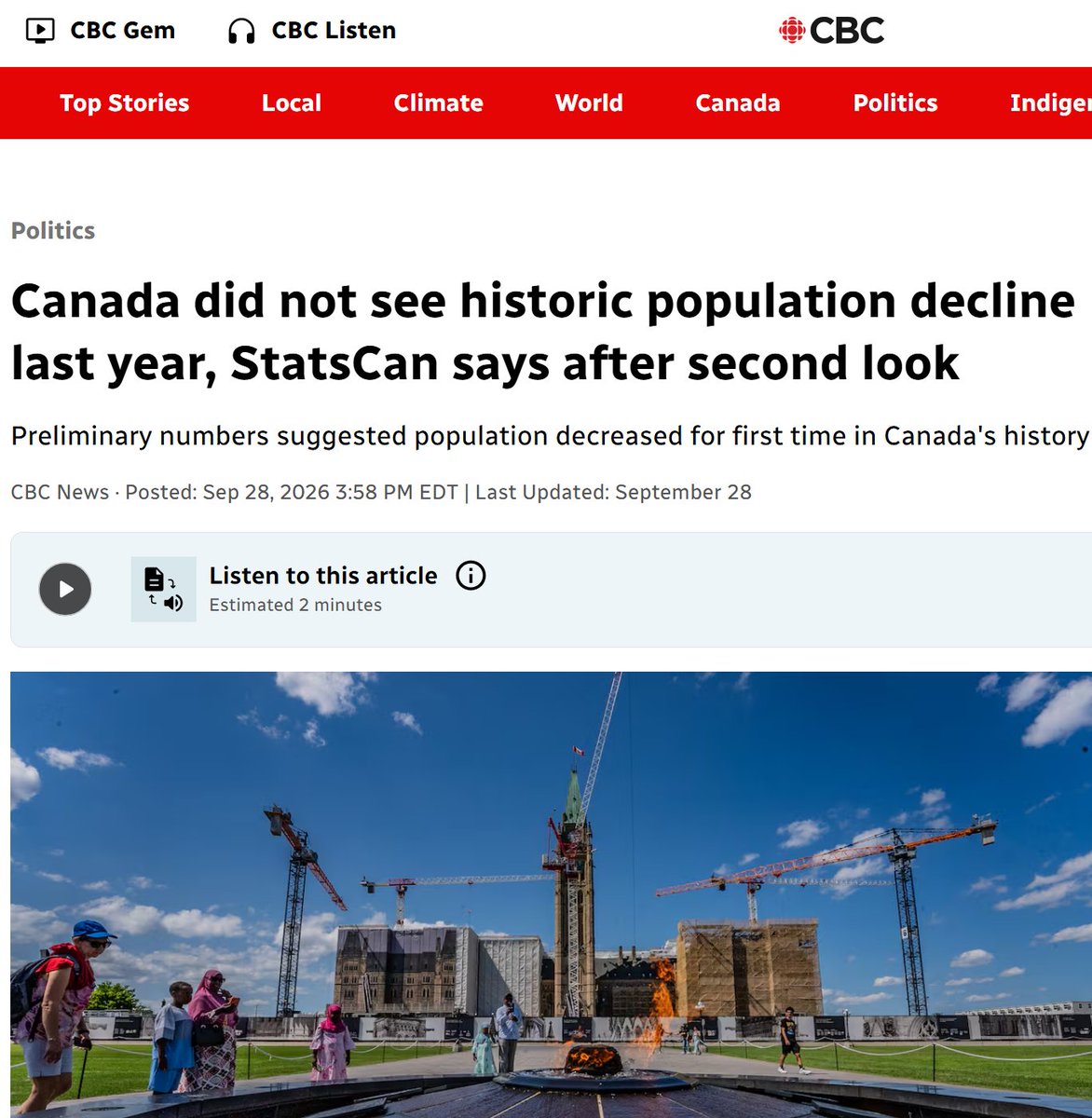
That Carney line was built on the old StatCan data. The Sept. 23 revision put ~240k temps back; NPRs are still 2.78 million, 6.7% — farther from the 5% target, not a green light
CP/CTV omitted that pertinent detail...
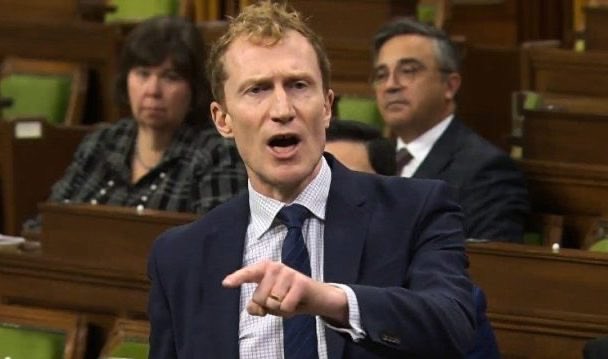
Heritage Minister Marc Miller says Ottawa must draw a “fine line” between “legitimate and illegitimate discussion” online.
That should alarm every Canadian. The government does not get to decide which opinions are legitimate.
Bill C-34 threatens free expression and privacy under the banner of online safety.
https://t.co/yhCJKAG8ke
Take action today: send a letter to Prime Minister Mark Carney and the Attorney general opposing Bill C34:
https://t.co/WIPiPqcQul
"... @USAmbCanada Pete Hoekstra [recently noted] that the preliminary #trade agreement between the U.S. and Canada can no longer be the starting point for future talks. He said too much had changed in just three and a half weeks, including the EU proposal."🤔
Third @CdnHeritage attempt at regulating legal internet content will decide "what constitutes legitimate & illegitimate duscussion,” @MarcMillerVM tells reporters. Last 2 bills lapsed amid public outcry over censorship.
https://t.co/5tCeNdYyfr #cdnpoli
Mark Carney just sat down with the New York Times—the paper many Democrats treat as their house journal—weeks before the U.S. midterm elections
His message: Donald Trump is unpredictable and dangerous. Canada has even studied the far-out risk that the U.S. might use military force. So Ottawa is buying fewer American fighter jets, relying less on Elon Musk’s Starlink satellites, talking more to China on trade, and trying to depend less on the U.S. dollar. At the same time he says he still talks to Trump and a trade deal is possible.That is useful for Democrats. Their midterm pitch is: Trump’s tariffs and fights with allies raise your prices and make America look chaotic. A respected former banker saying it from Canada makes the argument easier to sell
Who wins: U.S. Democrats trying to take Congress, future Democratic presidential hopefuls who have been meeting Carney, Carney’s image at home as the guy who stands up to Trump, and the New York Times. Ordinary Americans paying more at the store, and Canadians still selling the U.S. most of its imported oil, are not the ones getting the flattering write-up
The Times never mentions Maia Johnson. She is an American who worked on Hillary Clinton’s campaign and later around Joe Biden and Kamala Harris. Carney hired her to advise on U.S. strategy, then made her chief operating officer of his own office—the most powerful staff job in Ottawa
Simple version: the article paints Carney as the calm adult managing Trump risk, and skips the fact that a U.S. Democratic campaign veteran is now helping run his government and the Trump file
Tell the New York Times: if you’re going to lecture America about reliability, say who is actually sitting in the Canadian prime minister’s office
That is a pretty serious omission @MatinaStevis@SangerNYT@tylerpager@colbyLsmith
Carney is using a tactic called the illusory truth effect on Canadians.
He repeats the same statements over and over again in order to make them feel believable and familiar.
Facts eventually mean nothing to the people who keep seeing, hearing or reading them because of this repeated familiarity.
Here I highlight the endless usage of “deepening”
Carney uses it almost weekly.