Happy that my new book is finally out: https://t.co/GCQtOppKmu
Based on ethnographic research in Madagascar, it documents the social world of young children in unprecedented detail and offers a critique of the persistent parent-centric bias in major developmental theories.
There is a class of “global health” people who warmed to (even sought to lead) discussions on “decolonisation” when it began to catch fire in the field, but who has over time come to see that they are the people, their interests are the interests, and their practices are the practices, from which the field would need to be, is being called to be decolonised. It’s been fascinating to watch their retreat, even antagonism.
In this short @GlobalHealthBMJ essay, we draw attention to how standardised “global”measurement approaches obscure diversity, marginalise locally relevant insights needed for effective interventions, and create fragile measurement monocultures. https://t.co/T2rU8PZ0qw
We are hiring! Fixed term & very part time /mostly wfh ending May 31. If you’re in medical humanities or medical anthropology/sociology see https://t.co/HDLRf2h74h
Pls share widely
The most dangerous people in psychiatry aren't the small minority of pharma-funded 'Key Opinion Leaders', but the huge majority who uncritically defer to them.
I know nuance breaks our brains these days but we need to be serious about this "forecast." Africa will not simply roll over and die without USAID. All this shock-inducing statistical narrative does is reinforce the very American-centrism that led to this mess in the first place
An Inuit woman named Keira, living in Denmark, has been forced to hand over her newborn baby, to state authorities just two hours after giving birth. Danish officials did not allow Keira to dress, breastfeed, or even soothe her baby before taking the child away. Authorities claimed that Keira was not mentally capable of raising her child because she does not speak Danish fluently. This decision was based on an assessment by a Danish psychologist who failed to consider Keira’s reliance on body language, a key aspect of Inuit communication.
Critics argue that this is a clear act of racial discrimination by Danish authorities, as Inuit culture places great importance on non-verbal communication. The language barrier led to what many consider an unfair and biased judgment of Keira’s parenting abilities.
Official statistics reveal a troubling trend: while only 1% of Danish children are removed from their families, the number rises to 6% for Inuit children. This disproportionate rate raises serious concerns about systemic discrimination against Indigenous communities in Denmark.
🔹La investigadora #VioDemos, en @CentroCIIR y académica de @Antropologia_UC, @murreta, organizó la mesa "Ethnographic insight for the study in child caretaking beyond invisibility and pathologizing", donde participó con @G_Scheidecker, Valeria Llobet y Rachel Rosen.
“We are concerned the new Lancet Series [Early Childhood Development & the Next 1000 Days] maintains at its core, a deficit model, which can cause harm by misguiding interventions & promoting negative stereotypes about people living in poverty… [&] reflect epistemic injustice.”
@G_Scheidecker@TheLancet Great paper! Thank you for highlighting these limiting and harmful western biases. I think paediatric health professionals in high income countries also must recognise and value multicultural ways in bringing up children within their communities.
For the first time, @TheLancet has published a critical paper on the science of Early Childhood Development (#ECD). As an interdisciplinary and international group of authors, we call on the ECD field to move beyond the widespread use of deficit models.
https://t.co/O0JQG791X4
Looking forward this talk by Emely Yates-Doerr at the University of Zürich If you wish to participate online, please write me an email: [email protected]
Call for papers – Childhood journal has commissioned @murreta and me to edit a special issue on: "Children as Caregivers: Ethnographic Perspectives and Political Implications."
Please consider submitting an abstract by June 20, 2025.
Call for articles: "Children as caregivers: Ethnographic
perspectives and political implications."
For a special issue of the journal Childhood.
Abstracts are due by 20 June.
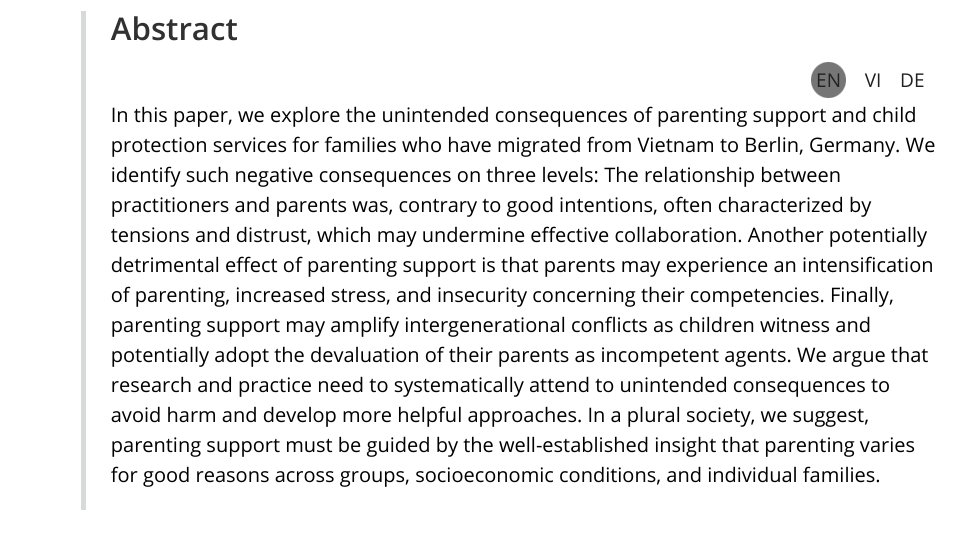
New paper from @G_Scheidecker on the harms of parenting support; a must-read depth update on how the policing of families works in current parenting culture
@AshleyAFrawley
"Help Can Harm." In this new paper in Ethos, Nga T.T. Mai and I examine the unintended consequences of parenting interventions among Vietnamese migrant families in Germany. We argue that such harmful effects deserve much closer attention.
https://t.co/RmO2c93PnF